Mar 13, 2015 | Advocacy, Non-legal submissions
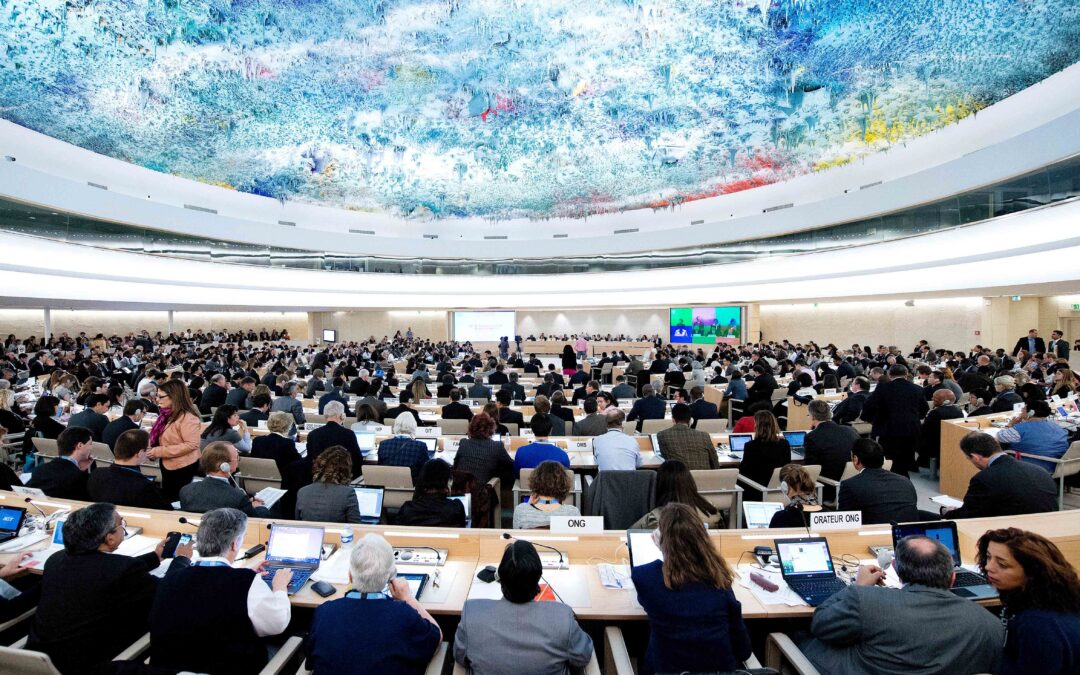
The Colombian Commission of Jurists, an affiliate of the ICJ, today called for the UN Human Rights Council to uphold the use of civilian courts, rather than military tribunals, to try civilians and to adjudicate claims for human rights violations.
An oral statement to the UN Human Rights Council highlighted that:
- military tribunals should as a matter of principle have no jurisdiction to try civilians or to adjudicate claims of serious human rights violations;
- These matters should be the domain of civilian courts; and
- The jurisdiction of military tribunals should be restricted to specifically military offenses committed by military personnel.
The oral statement emphasised to the global reach of the issue, referring by way of example to the military commissions established by the United States of America at Guantánamo Bay, as well as recent negative developments in Colombia, Egypt, Thailand and Pakistan.
The statement noted that the Principles Governing the Administration of Justice Through Military Tribunals presented to the Commission on Human Rights by Emmanuel Decaux in 2006 (UN Doc E/CN.4/2006/58), are widely referenced, but have yet to receive full recognition by the Human Rights Council. The statement added its support to the calls by the Special Rapporteur on Independence of Judges and Lawyers, the Working Group on Arbitrary Detention, and others, for the Council to endorse and seek implementation of the Principles without further delay.
The statement responds to an expert consultation on the administration of justice through military tribunals convened by the Council (UN Doc A/HRC/28/32).
The full oral statement can be downloaded in pdf format here: Advocacy-HRC28-MilitaryCourts-OralStatement-2015
Said Benarbia, Director of ICJ’s Middle East North Africa Programme participated in the expert consultation.
His statement can be found here: MENA-Military Courts HRC28-Advocacy-2015-ENG (full text in PDF).
Thailand exercised its right of reply, which can be viewed in the UN webcast archive, here.
Nov 25, 2014 | Advocacy, Analysis briefs, News
Bangladesh must immediately launch a thorough investigation into alleged attacks on a prominent human rights lawyer, the ICJ said today. The government appears to have taken no real action in the year since the events.
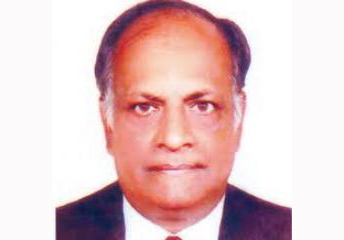
Rabindra Ghosh (photo), advocate at the Supreme Court of Bangladesh and President of the non-governmental organization Bangladesh Minority Watch, has made credible allegations that he was subjected to acts of violence, intimidation and other interference with his functioning as a lawyer.
”The authorities in Bangladesh seem not to have taken Rabindra Ghosh’s allegations seriously, in breach of international standards,” said Matt Pollard, head of ICJ’s Centre for the Independence of Judges and Lawyers. “In addition to his complaints, our own letters to the authorities simply went unanswered.”
Rabindra Ghosh, among other incidents, alleges that he was physically attacked by six of his peers on 25 November 2013, while he was at work in the Gopalgonj District Court.
He further alleges that on 14 January 2014 he was subjected to physical violence, threats, and verbal abuse at the hands of police officers.
He reports that there has been no substantive investigation of his complaints and that he has received no response from the responsible authorities.
“Lawyers play an essential role in protecting human rights and the proper administration of justice,” Pollard added. “International standards require State authorities to prevent attacks and harassment of lawyers and to take effective measures to protect their security.”
The ICJ requested the Prime Minister, the Ministry of Law, Justice and Parliamentary Affairs, the Ministry of Home Affairs and the President of the Bar Association to provide further information and a response to these allegations, but has received no response.
In addition to its call on the authorities of Bangladesh to immediately launch a thorough and independent investigation of the allegations made by Rabindra Ghosh, the ICJ calls on the authorities to take concrete measures to ensure that he and other lawyers are able to discharge their professional duties without any interference or intimidation of any kind. If the investigation confirms the allegations, those responsible must be held accountable.
“The ICJ has observed a general erosion of the rule of law and respect for the ability of lawyers to carry out their duties in Bangladesh,” said Pollard. “Lawyers play a crucial role in ensuring that people whose rights have been violated can demand their right to a remedy. When lawyers themselves become victims simply for carrying out their work, it signals a serious problem for the legal system.”
Rabindra Ghosh’s allegations come against the backdrop of a series of recent attacks on human rights defenders in Bangladesh, including among others the harassment of human rights defenders including Adilur Rahman Khan, secretary of Odhikar; the promulgation of a constitutional amendment that empowers the Parliament to impeach Supreme Court judges; and the amendment of the Information and Communication Technology Act, which is being used to assault freedom of expression and freedom from arbitrary detention.
Contact:
Matt Pollard, ICJ Senior Legal Adviser, +41 22 979 3812, matt.pollard(a)icj.org
A brief background note on the case is available here in PDF:
Bangladesh-Ghosh backgrounder-Advocacy-2014-ENG

Sep 16, 2014 | Advocacy, Non-legal submissions
ICJ affiliate the Colombian Commission of Jurists today delivered an oral statement at the UN Human Rights Council, concerning enforced disappearances in Thailand.
The statement noted that of the 81 cases transmitted by the Working Group on Enforced or Involuntary Disappearances to the Royal Thai Government between 1980 and 2014, the Government has clarified only two (A/HRC/27/49, 5 August 2014).
The statement highlighted the case of Somchai Neelapaijit, a lawyer and human rights defender, who was subjected to enforced disappearance more than 10 years ago but whose case remains unresolved. I also described the recent disappearance of Pholachi “Billy” Rakchongcharoen, a Karen minority human rights activist, who has not been seen since April 2014, when he was last seen in the custody of certain public officials with whom he and his community were engaged in an ongoing legal dispute.
The statement emphasised that Thailand must effectively investigate all cases and provide victims, including family members, withfull remedies and reparation. Enforced disappearance should be a distinct crime in domestic law, with penalties reflecting its extreme seriousness. Thailand should also accept the 30 June 2011 visit request of the Working Group and ratify the Convention for the Protection of All Persons from Enforced Disappearance, which it signed on 9 January 2012.
Thailand exercised its right of reply to respond to the oral statement.
The statement can be downloaded in PDF format here: Thailand-EnforcedDisappearance-Advocacy-non legal submission-2014-ENG
The statement and reply can be viewed in the UN video archive, here.
A written version of the reply by Thailand (unofficial, the official reply is as delivered in the video above) can be downloaded in PDF format here: Thailand_R of Reply_GD_18
Aug 26, 2014 | Advocacy, Non-legal submissions
The ICJ and other leading NGOs have called on the President and member states of the Human Rights Council, as well as the government of Sri Lanka, to take action to ensure no-one faces reprisals for cooperating with the United Nations.

Jun 13, 2014 | Advocacy, Non-legal submissions
The ICJ today delivered an oral statement on extrajudicial, summary or arbitrary executions, expressing concerns about recent and pending legislation in Pakistan on the use of firearms and other force by law enforcement officials.
The joint statement, delivered at the UN Human Rights Council during the interactive dialogue with the Special Rapporteur and on behalf also of the Human Rights Commission of Pakistan (HRCP), expressed appreciation for the Special Rapporteur’s emphasis in his study on the issue, on the need for states to bring domestic laws on the use of force by law enforcement agencies, into line with international standards.
The statement noted that it was not clear whether the Protection of Pakistan Ordinance (PPO) 2013, which is currently in force, and the proposed Protection of Pakistan Bill (PPB) 2014 currently being debated in Parliament, were provided for review.
The statement explained how the PPO and PPB contain provisions that give law enforcement agencies overbroad powers to use firearms without independent accountability, in contravention of international standards. They increase the risk of use of excessive and lethal force and arbitrary deprivation of life.
The full statement may be downloaded in PDF form: Advocacy-HRC26-SREJEs-12062014.
The Report of the Special Rapporteur is available here.
May 19, 2014 | Advocacy, News, Open letters
A joint statement from civil society groups, including ICJ, calling on Cambodia’s National Assembly to delay debate on the three draft laws related to the judiciary.