Oct 1, 2015 | News
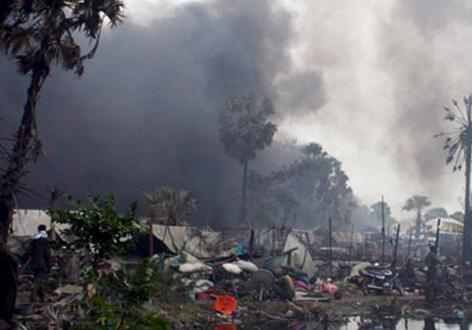
The ICJ today welcomed the adoption by the UN Human Rights Council of a further resolution on promoting reconciliation, accountability and human rights in Sri Lanka.
The resolution, co-sponsored for the first time by the Government of Sri Lanka (GOSL), is a historic step towards post-war justice, accountability and reconciliation.
The ICJ at the same time called on the GOSL to take genuine and prompt steps to deliver on the commitments and obligations reflected in the resolution, which was adopted by the UN Human Rights Council by consensus.
“Today’s resolution is a significant step towards achieving justice, accountability and reconciliation for the victims of Sri Lanka’s long and bloody civil war,” said Nikhil Narayan, ICJ’s senior legal adviser for South Asia.
“The shift in posture of the Sri Lankan Government in co-sponsoring the resolution marks a further welcome break from the Rajapakse regime. The Government must now demonstrate its political will by immediately launching concrete steps towards a genuine process of truth-seeking, justice and reconciliation,” he added.
The consensus resolution reflects certain key recommendations contained in the Report of the office of the UN High Commissioner for Human Rights (OHCHR) summarizing findings of the OHCHR Investigation on Sri Lanka (OISL), the ICJ notes.
The investigation and report was mandated by an earlier UN resolution on Sri Lanka, adopted in March 2014 over the strong objections of the Rajapakse government.
The report documents in vivid detail alleged serious violations and abuses of human rights and humanitarian law amounting to war crimes and crimes against humanity committed by both sides during the armed conflict in Sri Lanka, including extrajudicial killings, torture, enforced disappearances, forced recruitment, including of children, and sexual violence.
One of the most important recommendations of the High Commissioner for Human Rights called for an accountability process through a special judicial mechanism and prosecutor’s office that involves the full participation of international judges, prosecutors, lawyers and investigators.
Responding in part to this call, the resolution affirms the importance of participation of foreign judges, defence lawyers, prosecutors and investigators in an independent and impartial judicial mechanism to hold individuals accountable for human rights and humanitarian law violations, including those documented in the report.
The resolution also mandates further monitoring and reporting back to the Council on implementation of the accountability and other measures.
“The international community, through the UN Human Rights Council, the Office of the High Commissioner for Human Rights and Special Procedures, and other UN member states, must as the High Commissioner himself recommended, remain engaged through continued and sustained monitoring, assistance, support and fully integrated involvement of the international community to ensure full implementation of the resolution,” said Narayan.
Background:
The ICJ has worked with judiciaries, governments, civil society and victims around the world for decades to address impunity and victims’ right to remedy for violations of international human rights and humanitarian law, including in situations of transition.
In Sri Lanka, the ICJ has been documenting and reporting on a gradual erosion of judicial independence, impartiality and integrity under successive governments, and the resulting culture of impunity, for over thirty years.
The ICJ considers the International Criminal Court (ICC) to be the preferred mechanism for individual accountability where national authorities and courts lack the capacity or the willingness to genuinely investigate and prosecute all war crimes and crimes against humanity. In the absence of an ICC process, the ICJ’s extensive experience in Sri Lanka and elsewhere demonstrates that any credible and effective accountability process in Sri Lanka must involve, at a minimum, a majority of international judges, prosecutors and investigators.
The ICJ therefore advocated for and welcomed the resolution’s recognition of the need for international participation.
Since January 2015, when a new president was elected, the GOSL has undertaken a number of important steps to reverse the slide towards authoritarianism and the erosion of the rule of law and the culture of impunity experienced under the Rajapakse government, and restore democratic governance and build confidence towards reconciliation among Sri Lanka’s ethnic minorities, including by restoring the Constitutional Council through the passage of the 19th amendment to the Sri Lankan Constitution, and returning some tracts of military-occupied lands in the North and East.
However, after decades of war and distrust, and a history of promises undelivered, much work remains to be done to deliver justice to victims and their families, and to rebuild trust and confidence among Sri Lanka’s fractured ethnic minorities. Continued and sustained monitoring and engagement by the international community in ensuring the progress of the implementation of this resolution will be essential.
Equally importantly, today’s consensus resolution also reaffirmed the OHCHR’s recommendations on: the mandate and resources of the accountability mechanisms; legislating retroactive recognition of international crimes under national law; justice and security sector reform; repealing the Prevention of Terrorism Act (PTA); strengthening the Witness and Victim Protection Act; accession to the International Convention on the Protection of All Persons from Enforced Disappearances (CED), the Additional Protocols to the Geneva Convention, and the Rome Statute of the International Criminal Court; and continued monitoring of and technical support for implementation through the OHCHR and by the Council.
Contact
Nikhil Narayan, ICJ’s senior legal adviser for South Asia; t: +41 79 730 09 27; e: nikhil.narayan(a)icj.org
Oct 1, 2015 | News
At a two-day conference held in Bangkok, and first of its kind, committed to working to enhance the right to Freedom of Religion or Belief in Southeast Asia.
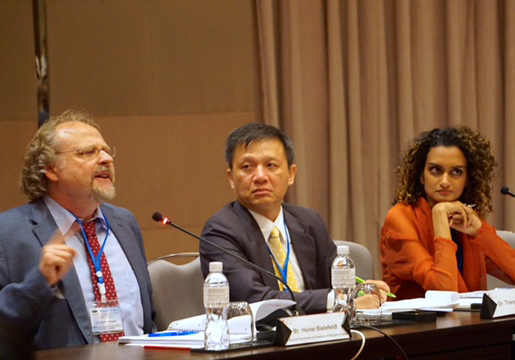
For the first time, approximately 70 human rights defenders, members of religious groups, rights groups, UN agencies and representatives from the ASEAN Intergovernmental Commission on Human Rights, ASEAN Commission on the Promotion and Protection of Rights of Women and Children, National Human Rights Institutions and other government agencies from across the region gathered together to discuss key pressing concerns regarding the right to freedom of religion or belief in Southeast Asia with the UN Special Rapporteur on Freedom on Religion or Belief, Heiner Bielefeldt.
The event was co-organized by the Asian Forum for Human Rights and Development (FORUM-ASIA), the ICJ, and Boat People SOS (BPSOS) from 30 September to 1 October 2015 in Bangkok, Thailand.
During the event, participants were able to deepen their understanding on the right to freedom of religion or belief under international law and standards, and how religious freedom and other human rights should be interpreted and applied in a complementary manner.
“Many people suffer complex violations of their human rights, for example in the intersection of religious minority status, ethnicity, gender, sexual orientation or indigenous origin,” said Heiner Bielefeldt.
The two-day conference also successfully provided a multi-stakeholder platform for the participants to share challenges and best practices, as well as brainstorm ideas on addressing violations related to state control and regulation of religion, and extreme interpretations of religion.
“The politicization of religion undermines freedom of religion or belief, not only to the detriment of minorities, but also of followers of majority religions who do not wish to see their faith be turned into a tool of political power gambling,” added the Special Rapporteur.
Notable suggestions raised by the group on addressing identified obstacles to the free practice of religion or belief included the need for reforms, such as the repeal of blasphemy laws and mandatory registrations, and the importance of dialogue between groups of the same faith, as well as those of different religions.
“We need more cooperation across boundaries, including between faith-based and secular civil society organization,” stressed the expert.
Participants at the conference also recognized the opportunity presented before them in advancing freedom of religion or belief in the region and committed to working to enhance this right by reaffirming:
- Article 18 of the Universal Declaration of Human Rights, which declares: “Everyone has the right to freedom of thought, conscience and religion; this right includes freedom to change his religion or belief, and freedom, either alone or in community with others and in public or private, to manifest his religion or belief in teaching, practice, worship and observance.”
- Freedom of religion or belief is an inalienable, non-derogable human right, encompassing the right to hold or not to hold any faith or belief, to change belief, and to be free from coercion and to manifest religion or belief.
- For freedom of religion or belief to be fully enjoyed, other human rights must also be respected, particularly the principle of nondiscrimination and freedoms of expression, assembly, association, education, and movement.
The participants also committed to:
- Defend and promote freedom of religion or belief as a universal, inalienable and non-derogable human right, as set out in the Universal Declaration, in international law and declarations, and in the work of national, regional, and global institutions.
- Defend and promote freedom of religion or belief for all persons, as individuals and in community with others, through their work and respective institutions by sharing information and mobilizing effective responses.
- Work toward the nondiscriminatory realization of freedom of religion or belief in recognition of multiple and intersectional discriminations and vulnerabilities, including, among other grounds, on grounds of ethnicity, indigenous identity, gender, sexual orientation, citizenship, and disabilities.
- Enhance global and regional cooperation by working across geographical, national, racial, ethnic, political and religious boundaries.
- Advocate for accountability and remedies for individuals and communities suffering from violence, persecution, discrimination, harassment, marginalization or other abuses of human rights because of their religion or belief.
- Express and act in solidarity with individuals and communities suffering from violence, persecution, discrimination, harassment, marginalization or other abuses of human rights because of their religion or belief.
The Conference Declaration was based on the Charter for Freedom of Religion or Belief and the New York Resolution for Freedom of Religion or Belief of the International Panel of Parliaments for Freedom of Religion or Belief (IPPFORB).
South East Asia-Decla Freedom of religion-Advocacy-2016-ENG (full Declaration, in PDF)
Sep 29, 2015 | Events, News
From 30 September to 1 October 2015, the Asian Forum for Human Rights and Development (FORUM-ASIA), International Commission of Jurists (ICJ), and Boat People SOS (BPSOS) will jointly organize a conference in Bangkok.
The regional conference will discuss pressing concerns on the promotion and protection of freedom of religion or belief.
The UN Special Rapporteur on Freedom on Religion or Belief, Mr. Heiner Bielefeldt, will be joined by approximately 60-70 human rights defenders, members of religious groups, rights groups, UN agencies and representatives from the ASEAN Intergovernmental Commission on Human Rights, ASEAN Commission on the Promotion and Protection of Rights of Women and Children, National Human Rights Institutions and other government agencies.
The event will provide a multi-stakeholder platform to discuss key emerging issues, distinct and shared challenges faced by various Southeast Asian religious groups and advocates of religious freedom, identify advocacy strategies and best practices to overcome these obstacles, and to strengthen cooperation between the different stakeholders important in promoting freedom of religion or belief in Southeast Asia.
The event will also be an opportunity for participants to have a better understanding of the mandate of the UN Special Rapporteur on freedom of religion or belief.
Some of the key topics expected to be discussed include state control and regulation of religion, extreme interpretations of religion, and how freedom of religion together with other human rights are complementary or mutually reinforcing.
Upon the completion of the conference, the Special Rapporteur will hold a press briefing at the Foreign Correspondents’ Club of Thailand (FCCT) at 7.30pm on 1 October 2015 to provide an overview of the status of freedom of religion or belief in Southeast Asia and how this right could be better protected and promoted.

Sep 24, 2015 | News
The ICJ and ten other civil society organizations are concerned about the possible refoulement by the Cambodian government of more than 100 Montagnard asylum seekers to Viet Nam and call on Cambodia not to take such action.
They issued a statement that can be downloaded here:
Cambodia-Refoulement of Montagnard asylum seekers-News-web story-2015-ENG (full text in PDF)

Sep 16, 2015 | News
Myanmar’s government must end the practice of appointing newly retired military officials as judicial officers to its courts and ensure that the judiciary carries out its functions as a separate branch and independent of the Executive, said the ICJ today.
At least 20 former military officers who have just recently resigned from the military were reportedly appointed as vice director generals to the country’s Supreme Court this month.
They will be performing administrative functions but according to section 310 of the Myanmar Constitution will be in line for senior judicial appointments at the state or regional level after 5 years or sooner if the President considers them to be ‘eminent jurists’.
“One of the fundamental aspects of an independent, impartial and accountable judiciary is the appointment of judges, through proper procedures, on the basis of their legal competencies,” said Sam Zarifi, ICJ’s Asia Director. “The process for appointing and promoting judges must be transparent and ensure judicial independence and impartiality.”
A group of leading members of the Myanmar bar launched a “yellow ribbon” campaign last Friday in Yangon to protest the practice of assigning military officers to serve as judicial officers.
“The process of selecting these officers and assessing their legal qualifications is totally opaque,” Zarifi added. “The lawyers wearing yellow ribbons are emphasizing the belief of people in Myanmar that strengthening the rule of law is essential to guaranteeing justice and the country’s political and economic development, so it’s important to improve the judiciary’s qualifications and increase public trust.”
The Supreme Court of Myanmar launched its Strategic Plan 2015-2016, citing “judicial independence and accountability” as one of its key strategy areas.
The UN Basic Principles on the Independence of the Judiciary provide that that “Persons selected for judicial office shall be individuals of integrity and ability with appropriate training or qualifications in law.”
“The Myanmar judiciary is trying to shake off decades of interference from the Executive branch in order to assert its proper role as defender of the rights of people in Myanmar, and it can’t do so without a clear and transparent appointment and promotion process,” Zarifi said.
An exposition and analysis of international law and standards are available in English and Myanmar language in the ICJ’s authoritative Practitioners’ Guide on the Independence and Accountability of Judges, Lawyers and Prosecutors.
Contact:
Sam Zarifi, ICJ Regional Director for Asia and the Pacific, t: +66 807819002; e: sam.zarifi(a)icj.org
Vani Sathisan, ICJ International Legal Adviser for Myanmar, t: +95 9250800301; e: vani.sathisan(a)icj.org
Sep 14, 2015 | News
The ICJ expressed disappointment over the decision made today by the Malaysian Federal Court to refer human rights defender Lena Hendry for trial, after dismissing the constitutional challenge on section 6(1)(b) of the Film Censorship Act 2002.
The ICJ said this provision is being applied in a manner inconsistent with the right to freedom of expression, which includes the right to seek and impart information of all kinds.
“The decision by the Federal Court is incompatible with the commitment to the rule of law and respect for human rights which was expressed by Malaysia during its last Universal Periodic Review at the UN Human Rights Council in 2013,” said Sam Zarifi, ICJ’s Regional Director for Asia and the Pacific.
“Lena Hendry is clearly a human rights defender and Malaysia has the special duty not only to respect her right to freedom of expression, but to protect her exercise of this right through the exposure of human rights violations in Sri Lanka,” he added.
The constitutional challenge was brought by the lawyers of Lena Hendry who was charged under section 6(1)(b) of the Film Censorship Act 2002 for screening the film “No Fire Zone: the Killing Fields of Sri Lanka” on 3 July 2013.
Authorities allege that she violated section 6(1)(b) of the law for showing a film that had not been approved by the Board of Censors.
The lawyers of Lena Hendry are now preparing for the trial before the Magistrate’s Court.
The ICJ calls on the Government of Malaysia to drop all charges against Lena Hendry and to undertake steps to make its laws consistent with the country’s obligations and commitments under international law.
Background:
Section 6(1)(b) of the Film Censorship Act 2002 states that “No person shall circulate, exhibit, distribute, display, manufacture, produce, sell, or hire any film or film publicity material, which has not been approved by the Board [of Censors].”
On 14 September 2015, the Federal Court of Malaysia dismissed the constitutional challenge on Section 6(1)(b) of the Film Censorship Act 2002. The question posed to the Federal Court was: “Whether section 6(1)(b) of the Film Censorship Act 2002 read together with section 6(2)(a) violates Article 10 read together with Article 8(1) of the Federal Constitution and therefore should be struck down and void for unconstitutionality.”
The Federal Court answered the question in the negative and ordered that the case be sent back to the High Court. The High Court, in turn, will transfer the matter back to the Magistrate’s court for trial. The Magistrate’s Court is where the matter initially originated.
If convicted, under section 6(2)(a) Lena Hendry could be fined up to RM30,000 (approximately US$6,900) and/or sentenced to up to three years imprisonment.
The right to freedom of expression is guaranteed in the Federal Constitution of Malaysia under Section 10(1)(a), which states that “every citizen has the right to freedom of speech and expression.”
The Universal Declaration of Human Rights and the UN Declaration on Human Rights Defenders also affirm the duty of all states to respect and facilitate freedom of expression, particularly as regards information or opinions about human rights.
Contact:
Emerlynne Gil, Senior International Legal Adviser of ICJ for Southeast Asia, t: +66 840923575 ; e: emerlynne.gil(a)icj.org