Jul 9, 2013 | News
The ICJ today called for the immediate release of Le Quoc Quan, after the People’s Court of Hanoi announced on 8 July 2013 the postponement of his trial, without setting any new dates for the case. The reason given for the hastily informed adjournment was that the judge had suddenly taken ill.
The ICJ considers that Le Quoc Quan’s continued detention is in violation of Vietnam’s penal law and the State’s international legal obligations.
Le Quoc Quan, a lawyer and human rights defender, was arrested on 27 December 2012 and charged for tax evasion under article 161 of Vietnam’s 1999 Penal Code.
The postponement of the trial appears to signal that Le Quoc Quan will continue to remain in jail. Since his arrest last year, he has already been detained for more than six months.
“The continued detention of Le Quoc Quan is akin to him being punished even before the trial has commenced. This is a clear violation of his right to being presumed innocent,” said Andrew Khoo from the Malaysian Bar Council, an expert appointed by the ICJ, who had traveled to Hanoi to observe Le Quoc Quan’s trial.
On 29 December, two days after Le Quoc Quan’s arrest, his wife filed an application for bail to the police and procurator. She had also applied for release on his own recognizance. There are no specific detailed procedures spelled out in law governing bail procedures. Under article 92 of the Criminal Procedure Code, only family members are permitted to act as guarantors. To date, neither the police nor the procurator have replied to her applications.
Under article 9 of the International Covenant on Civil and Political Rights (ICCPR), to which Vietnam is a party, it should not be the general rule that persons are detained while awaiting trial, and release pending trial may only be subject to conditions to ensure appearance at the trial.
“There is no reason to believe that if released Le Quoc Quan would not appear for trial, and in any event his family has made representations to act as guarantors”, said Emerlynne Gil, the ICJ’s International Legal Adviser on Southeast Asia, who was also in Hanoi to observe the trial. “The People’s Court of Hanoi must order Le Quoc Quan’s release either on bail or his own recognizance.”
The ICJ notes that the postponement also violates Le Quoc Quan’s right to a speedy trial. Under international law, including ICCPR article 14, an accused has the right to be tried without undue delay and within a reasonable period of time. This prevents any unnecessary continuing deprivation of liberty and ensures that the interest of justice is properly served.
“We would expect that the People’s Court of Hanoi will notify promptly the public of the next date of Le Quac Quan’s trial and ensure that his right to a fair and public trial is upheld,” said Emerlynne Gil.
The ICJ looks forward to returning to Vietnam to continue monitoring this case and ensuring that the rights of Le Quoc Quan, including his right to liberty and to a fair trial, are fully respected and protected.
CONTACT:
Ms. Emerlynne Gil, International Legal Adviser for Southeast Asia, tel. no. +662 6198477; email: emerlynne.gil(a)icj.org

Jul 5, 2013 | News
The Government of Pakistan should renew the official moratorium on the death penalty, with a view to definitively abolishing the practice in law, says the ICJ.
The Government signaled its intention to resume executions on Thursday, 4 July 2013 when it failed to renew a 2008 Presidential order imposing a moratorium on executions. It is estimated that approximately 8000 people are currently on death row in Pakistan.
“Resuming executions would be a major step backwards for Pakistan in protecting human rights,” says Sheila Varadan, ICJ Legal Advisor for South Asia. “The prospect of lifting the moratorium is all the more alarming given the extraordinarily high number of people on death row.”
The announcement apparently comes as part of the newly elected Government’s strategy to tackle high levels of crime and insecurity in Pakistan.
The ICJ condemns the death penalty as a violation of the right to life and a form of cruel and inhuman punishment. Moreover, it is widely accepted that the practice cannot serve as a deterrent to crime or be administrated without error or discrimination.
More than 150 of the 192 United Nations members States have either abolished the death penalty or imposed a moratorium on its practice.
In December 2012, the United Nations General Assembly adopted its fourth resolution calling on all States retaining the death to place a moratorium on the practice with a view towards abolition.
Of the 186 member States present, 111 member States voting in favour and only 41 member States against, an increase from the previous three resolutions.
“Pakistan is part of a dwindling minority of States who continue to retain the death penalty and carry out executions,” Varadan. “The ICJ urges the newly elected Government of Pakistan to demonstrate its commitment to upholding human rights and to desist from licensing the State deliberately to take the life any person in its custody.”
CONTACT:
Sheila Varadan, ICJ Legal Advisor, South Asia Programme (Bangkok), t: +66 857200723; email: sheila.varadan(a)icj.org

Jun 26, 2013 | News
The ICJ condemns the attempted assassination of Justice Maqbool Baqir, a judge of the Sindh High Court, who also sits on the anti-terrorism court in Karachi, Pakistan.
A bomb blast injured Justice Maqbool Baqir and thirteen others and killed at least nine people.
“This is the second bombing targeting the Pakistani judiciary in under six months. The ICJ is extremely concerned that these attacks signal a renewed challenge to the ability of the Pakistani judiciary to function as an independent institution,” said Sheila Varadan, ICJ’s South Asia Legal Advisor.
According to local media sources, the Tehreek-e-Taliban Pakistan (TTP), an armed group operating in northwestern Pakistan, has claimed responsibility for the bombing, admitting that it specifically targeted Justice Maqbool Baqir for his ‘anti-shariah’ judgments and ‘ruling against the mujahideen’.
“Any physical attack on a judge constitutes a serious threat to the rule of law and the independence of the judiciary. If the TTP or another armed group is deliberately targeting judges, it could constitute a crime under international law,” Varadan added.
Under international standards, including the United Nations Basic Principles on the Independence of Judges, Pakistan is responsible for taking measures to ensure the protection of members of the judiciary from acts of violence or other threats to their safety.
Earlier in March 2013, the ICJ condemned the suicide bombing inside a Peshawar courthouse killing four people and injuring thirty others.
CONTACT:
Sheila Varadan, ICJ Legal Advisor, South Asia Programme (Bangkok), t: +66 857200723; email: sheila.varadan(a)icj.org
Jun 24, 2013 | News
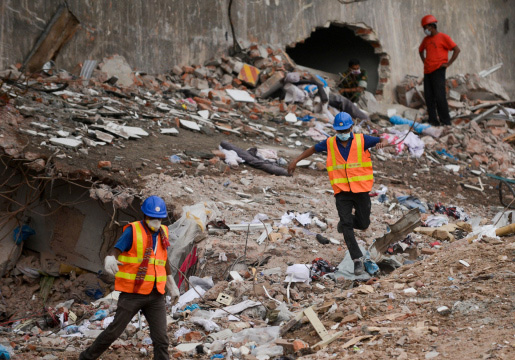
The recent Rana Plaza building disaster, in Bangladesh, could, and should, have been averted if the government had performed its obligation to adequately protect the workers, the ICJ said today.
“The Rana Plaza collapse, which killed 1,131 workers and injured close to 2,500 others, is the most recent in a long list of industrial disasters brought about by the government’s failure to regulate and monitor workplace conditions and sanction private entities violating the law,” said Sheila Varadan, ICJ Legal Advisor on South Asia. “To single out and focus solely on the role of multi-national companies does not reflect the full picture.”
“While the ICJ does not minimize the responsibility of private enterprises, unless the underlying systemic issues such as institutional weaknesses, corruption and lack of enforcement are addressed, such tragedies will continue to happen,” Varadan added.
Litigation is a vital tool to ensure accountability, remedy and reparations, where government agencies fail in their essential functions.
The Bangladesh Legal Aid and Services Trust (BLAST), a leading national human rights organization, has been petitioning the Supreme Court over the past decade, obtaining orders against government agencies and seeking compensation for victims and their families in work-related disasters.
“The government of Bangladesh must take active measures to ensure its regulatory framework is adequate and effective; its laws are rigorously enforced; and victims are adequately compensated,” Varadan also said. “Failing to do so not only violates Bangladeshi law but is also in breach of Bangladesh’s obligations to protect human rights under international law.”
CONTACT:
Sheila Varadan, ICJ Legal Advisor, South Asia Programme (Bangkok), t: +66 857200723; email: sheila.varadan(at)icj.org
Sam Zarifi, ICJ Asia-Pacific Regional Director, (Bangkok), t:+66 807819002; email: sam.zarifi(at)icj.org
Bangladesh-Rana Plaza-Public interest litigation-backgrounder-featured article-2013 (full text in pdf)
Bangladesh-WGBHR5-OralStatement-LegalSubmission-2013 (full statement to the Working Group on Business and Human Rights)

May 31, 2013 | Agendas, Events
Some 30 judges from the highest national courts from 16 countries in Asia and the Pacific will meet in Bangkok, Thailand on 2-4 June to discuss the role of the judiciary in the AIDS response.
The meeting is convened by the Joint United Nations Programme on HIV/AIDS (UNAIDS), the United Nations Development Programme (UNDP) and the ICJ as part of efforts to address concerns that legal environments, including laws and policies, law enforcement practices and access to justice across the Asia and the Pacific do not consistently protect people most at risk of HIV infection and those living with HIV from violations of their human rights including health, privacy, non-discrimination and freedom from violence.
The judges’ discussions will be supported by experts and resource people from communities living with HIV, representatives of sex workers and men who have sex with men, people who use drugs and transgender people and United Nations entities.
The ICJ has always believed that an independent judiciary is essential in delivering justice to vulnerable populations, including those living/infected with HIV.
As Mr. Sam Zarifi, Regional Director for Asia and the Pacific, said: “The judiciary has a crucial role to play in establishing a legal environment that assists the struggle against the spread of HIV. In Asia and the Pacific, those most at risk of contracting HIV are often among those with the least access to justice. An independent judiciary can help protect at-risk populations from discriminatory laws, negative stereotypes, and misguided policies.”

May 13, 2013 | News
On 13 May, the Hong Kong Court of Final Appeal granted W, a transgender woman, the right to marry her male partner. The ICJ, which made submissions in the case, applauds this decision.
W is a resident of Hong Kong who has undergone gender reassignment surgery, paid for by the Hong Kong Government, and who holds a national identity card and passport recording her sex as female.
In 2008 she applied to the Registrar of Marriages seeking confirmation that she could marry her male partner.
The Registrar denied her request on the grounds that “the biological sexual construction of an individual is fixed at birth and cannot be changed.”
Because “only an individual’s sex at birth counts,” the Registrar would not celebrate the marriage.
The trial court and court of appeal upheld the Registrar’s interpretation of the Marriage Ordinance and Matrimonial Causes Ordinance and ruled that it did not conflict with Hong Kong’s Basic Law or its obligations under the International Covenant on Civil and Political Rights.
These courts relied on the 1970 British case of Corbett v. Corbett, which held that sex was fixed immutably at birth.
W won her case at the Court of Final Appeal, which ruled in a 5-4 decision that the Marriage Ordinance and Matrimonial Causes Ordinance ignored the “psychological and social elements of a person’s sexual identity” and thus were inconsistent with the constitutional right to marry.
Furthermore, the ordinances were unconstitutional because they denied W the right to marry at all and thus impaired the very essence of the right.
While the Court granted the parties leave to make further submissions as to the exact nature of the declaratory relief, it held that “a transsexual in W’s situation” should in principle be granted a declaration that she is in law a woman within the meaning of the marriage ordinances and “therefore eligible to marry a man.”
Importantly, the Court also stated: “We would not seek to lay down a rule that only those who have had full gender reassignment surgery involving both excising and reconstructive genital surgery, qualify. We leave open the question whether transsexual persons who have undergone less extensive treatment might also qualify.”
“This is a historic decision,” said Alli Jernow, Senior Legal Advisor at the International Commission of Jurists. “Not only has W won her own case at the Court of Final Appeal, her courage and commitment have changed the lives of transgender people in Hong Kong.”
The parties have an additional 21 days to file written submissions. The Court’s proposed order gives the Hong Kong legislature time to respond but indicates that even in the absence of intervening legislation, the marriage ordinances would be given a remedial interpretation to include W.
Photo by K.Y. Cheng: Michael Vidler, solicitor of the appellant, holds the judgment in his hand outside Court of Final Appeal.