Sep 16, 2019 | Advocacy, News
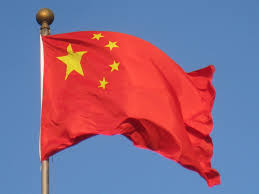
Antonio Guterres should publicly condemn China’s widespread violations of the rights of its Muslim minority citizens, especially in Xinjiang Province, the ICJ demanded in a joint letter submitted along with Amnesty International, the International Federation for Human Rights (FIDH), Human Rights Watch, and the World Uyghur Congress.
The joint letter urged the UN Secretary-General to call for an end to widespread arbitrary detention of Muslim and minority communities through the immediate closure of Xinjiang’s ‘political education’ camps. Reports by the United Nations and human rights organizations have estimated that more than one million Muslims have been interned in extra-legal ‘political education’ detention camps.
“In the past few years, China’s violations in Xinjiang, including arbitrary detention, ill-treatment, pervasive surveillance and political indoctrination of Turkic Muslims, have intensified, and continue to worsen,” said Sam Zarifi, ICJ’s Secretary General.
“Quiet diplomacy has not worked. Mr. Guterres must exercise the full extent and power of his mandate as leader of the United Nations to demand and ensure protection of the rights of everyone in China, including all individuals in Xinjiang.”
The joint letter urged the UN Secretary-General to publicly support the creation of a UN fact-finding mission to assess the scale and nature of crimes under international law and human rights violations in Xinjiang. It further called on the UN Secretary-General to refrain from unqualified praise of China’s ‘Belt and Road’ Initiative – an investment initiative in which Xinjiang is a centerpiece – and to meet with representatives from the Uyghur community to hear first-hand of their plight.
“China has exerted immense and often inappropriate political pressure on individuals, governments and organizations criticizing its human rights violations,” said Zarifi. “The United Nations must push back against China’s political pressure and provide principled and steadfast leadership to end China’s political and cultural repression, and ongoing human rights violations in Xinjiang.”
Public criticism of China’s actions in Xinjiang has been growing. In August 2018, a member of the UN Committee on the Elimination of Racial Discrimination noted that China’s treatment of its Muslim minority citizens in Xinjiang had turned the region into a “‘no rights’ zone” with individuals being treated as “enemies of the State based on nothing more than their ethno-religious identity”. In March 2019, the UN High Commissioner for Human Rights, Michelle Bachelet, highlighted the need for her office to gain full access to facilitate independent and impartial investigation into ‘wide patterns of enforced disappearances and arbitrary detentions’ in the region. On 10 July 2019, 25 countries issued a joint statement calling on China to refrain from subjecting Uyghurs and other Muslim and minority communities in Xinjiang to arbitrary detention, surveillance and restrictions on freedom of movement.
Sep 16, 2019 | Events, News
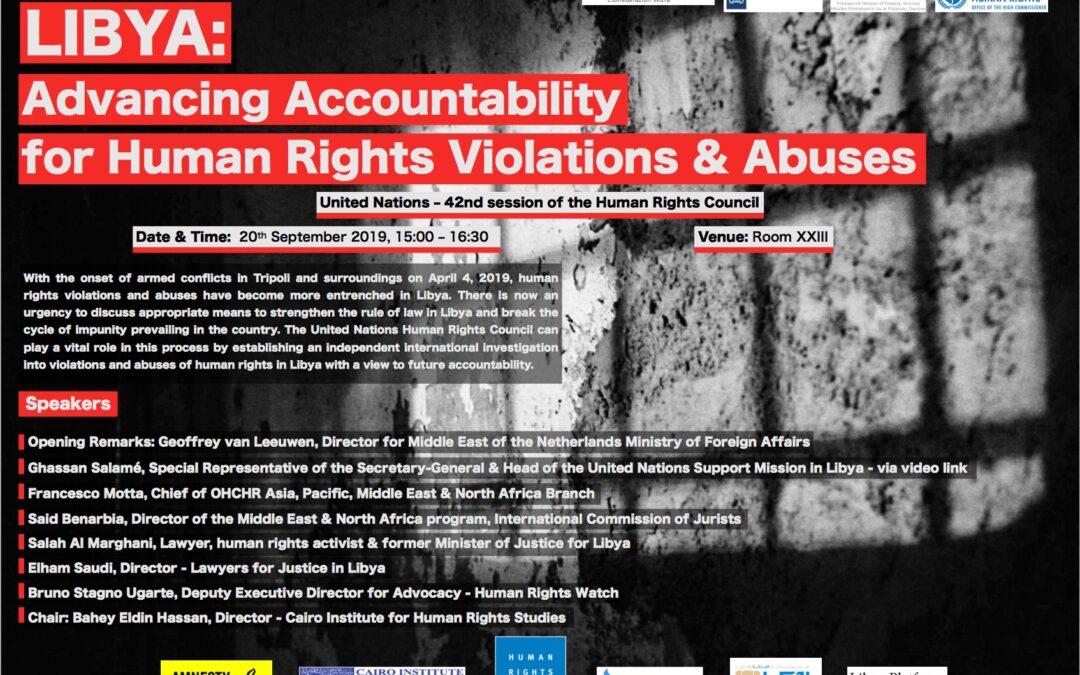
The ICJ, together with the Netherlands, Finland and Swiss missions to Geneva, OHCHR and other NGOs invite you to a panel discussion on Advancing accountability for human rights violations and abuses in Libya at the UN Human Rights Council in Geneva.
The event takes place on Friday 20 September 2019, at 15:00 – 16:30, Room XXIII, in the Palais des Nations.
With the onset of armed conflicts in Tripoli and surroundings on April 4, 2019, human rights violations and abuses have become more entrenched in Libya. There is now an urgency to discuss appropriate means to strengthen the rule of law in Libya and break the cycle of impunity prevailing in the country. The United Nations Human Rights Council can play a vital role in this process by establishing an independent international investigation into violations and abuses of human rights in Libya with a view to future accountability.
The event will be opened by Geoffrey van Leeuwen, Director for Middle East of the Netherlands Ministry of Foreign Affairs, moderated by Bahey Eldin Hassan, Director of the Cairo Institute for Human Rights Studies, and feature:
–Elham Saudi, Director – Lawyers for Justice in Libya
–Ghassan Salamé, Special Representative of the Secretary-General & Head of the United Nations Support Mission in Libya – via video link
–Francesco Motta, Chief of OHCHR Asia, Pacific, Middle East & North Africa Branch
–Said Benarbia, Director of the Middle East & North Africa program, International Commission of Jurists
–Salah Al Marghani, Lawyer, human rights activist & former Minister of Justice for Libya
–Bruno Stagno Ugarte, Deputy Executive Director for Advocacy – Human Rights Watch
A flyer for the event is available here.
Sep 13, 2019 | Events, News
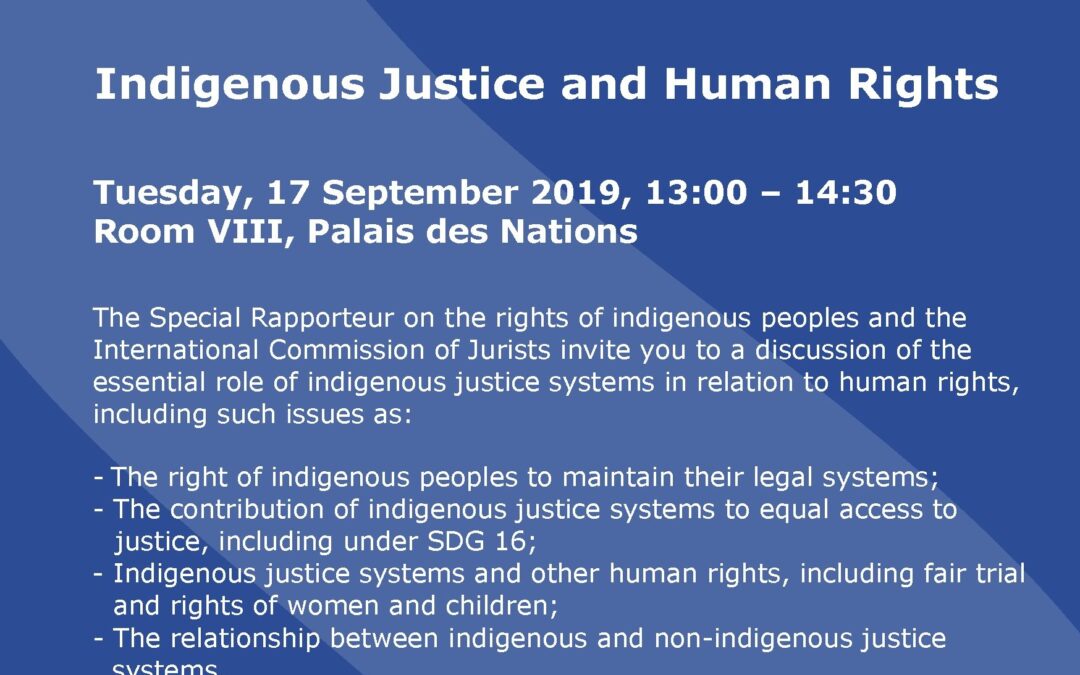
The ICJ and the UN Special Rapporteur on the rights of indigenous peoples are organizing a panel discussion on indigenous justice and human rights, at the UN Human Rights Council session in Geneva.
The event takes place Tuesday, 17 September 2019, at 13:00 – 14:30, Room VIII, in the Palais des Nations.
The event will discuss, among other aspects:
- The right of indigenous peoples to maintain their legal systems;
- The contribution of indigenous justice systems to equal access to justice, including under SDG 16;
- Indigenous justice systems and other human rights, including fair trial and rights of women and children;
- The relationship between indigenous and non-indigenous justice systems.
The panel will feature:
- Victoria Tauli Corpuz, UN Special Rapporteur on the rights of indigenous peoples.
- Ilaria Bottigliero, IDLO Director of Policy, Research and Learning.
- Jovita Tzul Tzul, indigenous lawyer from Guatemala.
- Matt Pollard, ICJ Senior Legal Adviser.
The event will allow for dynamic exchange between panelists and attendees, on current initiatives including: the Special Rapporteur’s report on indigenous justice systems; ICJ’s global initiative on indigenous and other traditional or customary justice systems; and IDLO’s series of publications titled ‘Navigating Complex Pathways to Justice: Engagement with Customary and Informal Justice Systems’, which aim to advance policy dialogue and distil lessons from programming and research to help realize SDG 16.
Spanish-English interpretation will be available.
A flyer in PDF format can be downloaded here: SideEvent-IndigenousJusticeandHumanRights
For more info contact un(a)icj.org
Sep 13, 2019 | News
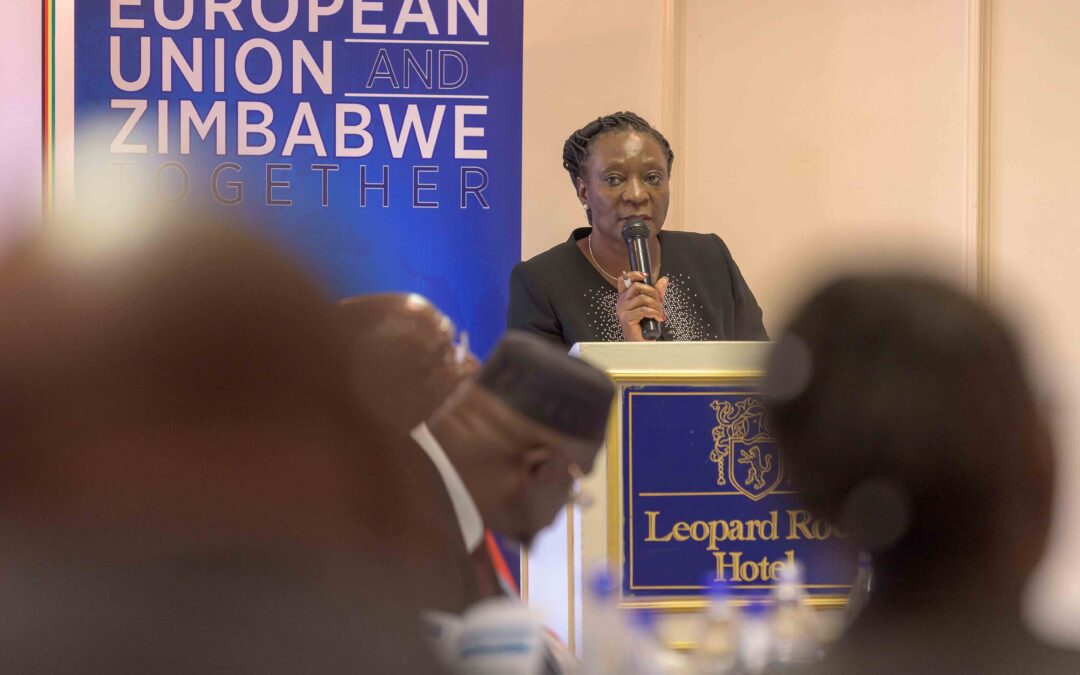
The ICJ, in collaboration with the Judicial Service Commission (JSC) of the Republic of Zimbabwe, has concluded a two-day Judicial Symposium on the theme ‘Core-Skilling: Towards a Human Rights Jurisprudence’, organized to mark the end of the second judicial term in the Zimbabwe judicial calendar.
In his remarks at the opening of the symposium, ICJ’s Africa Regional Director, Mr Arnold Tsunga, noted that the theme of the symposium had been carefully chosen to enhance discourse on national transformation in an atmosphere of respect for the rule of law and international human rights. He noted further that the symposium was to critique the concept of transformative adjudication and explore its relevance to applying the Constitution of Zimbabwe as an instrument and framework for national transformation.
Noting that the ICJ appreciated its on-going partnership with the JSC in Zimbabwe, Mr Tsunga expressed the hope that the training and symposium would enhance the effectiveness of the judiciary with a view to improving access to justice for all, especially victims of human rights violations, women, marginalized and vulnerable groups and contributing to attainment of the United Nations Sustainable Development Goals number 16 and 5.
On his part, in his opening remarks the Chief Justice of the Republic of Zimbabwe, the Hon. Chief Justice Malaba, noted that the ICJ-JSC organized symposia have provided a platform for continuous improvement of judicial work and networking amongst judges.
Chief Justice Malaba observed that these meetings have enabled judges to dialogue on how to improve the effectiveness and efficiency in the justice delivery system. He noted that this year’s theme on human rights jurisprudence lies at the heart of an independent and effective judiciary.
He further noted that the current Constitution of Zimbabwe has a better framework and potential for the protection of human rights than previous constitutions. Accordingly, he expressed the view that the judiciary has a more important role to play in protecting and safeguarding human rights.
He highlighted that the judiciary’s commitment to the protection of human rights is evidenced in local jurisprudence in respect to human rights cases, where several important judgments have been given by all the courts.
Chief Justice Malaba used the opportunity to give updates on developments which were taking place within the JSC, particularly in its research centre, in the High Court, in the Fiscal and Tax Appeals Division, amendments to the Judicial Laws which were gazetted on the 9th of September 2019.
Chief Justice Malaba stated that in performance appraisal, the JSC has constituted a Performance and Training Committee led by the Deputy Chief Justice to come up with a system that enables accurate measurement of the performance of judges.
Responding to issues of accountability raised by the Chief Justice, ICJ’s Mr Tsunga urged the JSC to develop and adopt a system to track, monitor, document and communicate results arising from these trainings, as the results would help the ICJ, and international development partners to evaluate the usefulness of the trainings and efforts at justice sector reforms.
This year’s symposium was attended by 16 female and 27 male judges from the Constitutional Court, Supreme Court, High Court, Labour Court and Administrative Court of Zimbabwe.
Sep 10, 2019 | Events, News
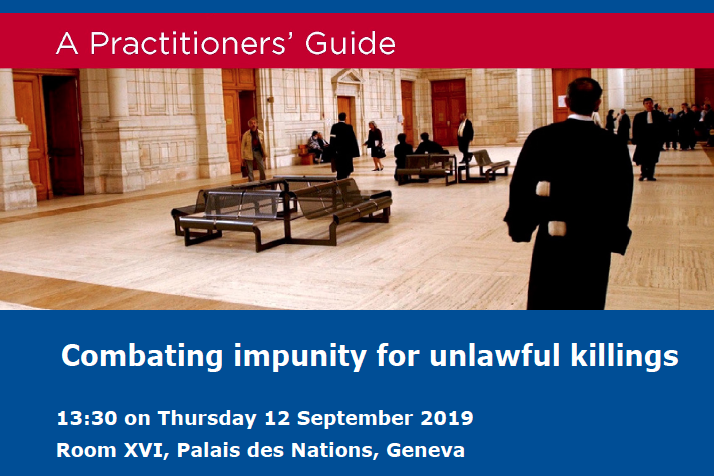
The ICJ invites you to a discussion of new tools to assist investigation and accountability for extrajudicial, summary or arbitrary executions, and other potentially unlawful deaths. The event takes place on Thursday, 12 September, 13:30, Room XVI, at the Palais des Nations in Geneva.
ICJ’s new Practitioners’ Guide No 14 on the Investigation and Prosecution of Unlawful Death helps legal practitioners ensure that investigation and accountability processes are implemented in accordance with international human rights law.
The Guide elaborates on the revised Minnesota Protocol on the Investigation of Potentially Unlawful Death (2016), a set of practical standards and guidelines that was updated by former UN Special Rapporteur on extrajudicial, summary or arbitrary executions, Christof Heyns, and published by the Office of the United Nations High Commissioner for Human Rights (OHCHR) in 2017.
The panel discussion will highlight key elements of the Protocol and Practitioners Guide, and their relevance to cases such as the 2016 killing of political commentator, Kem Ley, in Cambodia and the 2018 killing of Saudi Journalist, Jamal Khashoggi in Turkey.
Speakers
- Agnes Callamard, Special Rapporteur on extrajudicial, summary or arbitrary executions (by video conference, TBC).
- Stuart Maslen, Honorary Professor, Centre for Human Rights, University of Pretoria.
- Kingsley Abbott, Senior Legal Adviser & Coordinator of the ICJ’s Global Accountability Initiative.
Moderator
- Carolina Villadiego, ICJ Legal and Policy Adviser, Latin America
Printed copies of the ICJ’s Practitioners’ Guide No 14 on the Investigation and Prosecution of Unlawful Death will be available.
A flyer for the event is available here.
*** Room XVI is on the 5th floor of Building A, behind the Assembly Hall, accessible by the elevators at the Salle des Pas Perdus. Details here.
Sep 10, 2019 | News
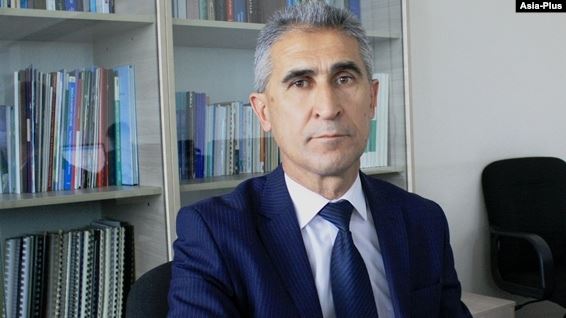
The ICJ today expressed concern that a Government anti-corruption agency has engaged in acts of intimidation against the Chairperson of the Union of the Lawyers of the Republic of Tajikistan, Saidbek Nuritdinov, and 15 other lawyers.
The intimidation apparently relates to the lawyers’ defence of Abdulaziz Abdurahmonzoda, a lawyer facing trial on charges of fraud, who was allegedly ill-treated in detention by officers of the city Department of the Agency for Financial Control and Combating Corruption of the Republic of Tajikistan (Anti-Corruption Agency).
After the lawyers representing Abdurahmonzoda alleged that he had been ill-treated, the judge of the Sino district of Dushanbe city hearing the case, Ahmadzoda Farogat, requested the Prosecutor General’s Office to investigate the allegations.
Following the initiation of the inquiry of the allegations of ill-treatment, the Head of the Anti-Corruption Agency of Dushanbe, allegedly sent requests to a number of district courts of Dushanbe to obtain information about civil and criminal cases in which Saidbek Nuritdinov had participated as a lawyer.
The requests are said to seek information such as the names and, place of residence of clients: subject matter of civil cases, and details of the charges against his previous clients. In addition, it was reported to the ICJ that Judge Akhmadzoda Farogat, transmitted a list of the fifteen lawyers and copies of their official orders, the documents authorizing the representation of the lawyer, to the Anti-Corruption Agency at its request.
The ICJ notes, that while this information is not confidential per se, previous such investigations of the Anti-corruption Agency have led to criminal prosecution and conviction of lawyers.
“In this case, representation of a lawyer subject to criminal proceedings was undertaken by a group of his colleagues, including the head of the association of lawyers, in line with professional ethics, said Temur Shakirov, Senior Legal Adviser of the ICJ. “Such representation is consistent with international standards on the role of lawyers as well as national law of Tajikistan”.
“If the investigation is related to the lawyers’ representation in the case of Abdurahmonzoda, it would constitute a means of intimidation of the lawyers. And as such it should be ceased, and the lawyers should be able to continue to act freely and diligently in accordance with the national law and international law and standards on the role of lawyers”, Shakirov added.
Background
The criminal case against lawyer Abdulaziz Abdurahmonzoda was initiated under article 247.2, of the Criminal Code (fraud) on 17 April 2019. At the court hearings observed by the ICJ, Abdurahmonzoda insisted on his innocence and alleged breaches of the criminal procedure in course of the preliminary investigation: initiation of a criminal case without legal grounds (the case was said to lack the victim’s statement about the fraudulent actions committed on the part of Abdurahmonzoda); violation of the procedure of the preliminary investigation and submission to the court of evidence knowingly obtained by illegal means. The ICJ is observing the trial.
According to the UN Basic Principles on the Role of Lawyers, governments “shall ensure that lawyers are able to perform all of their professional functions without intimidation, hindrance, harassment or improper interference” and they should not “suffer, or be threatened with, prosecution or administrative, economic or other sanctions for any action taken in accordance with recognized professional duties, standards and ethics.”(Principle 16).
Furthermore, interference or obstruction of lawyer’s activity is prohibited by the Law of the Tajikistan on Lawyers and Lawyers’ Activities. According to the law, a lawyer cannot be held liable for any opinion expressed by him/her as part of his/her lawyers’ activity, with the exception of actions that may constitute a crime. The request from lawyers or lawyer’s unions of information related to the provision of legal assistance in specific cases is not allowed.
According to the Draft Universal Declaration on the Independence of Justice (“Singhvi Declaration”), enable the Bar Association to fulfil its function of preserving the independence of lawyers, they should “be informed immediately of the reason and legal basis for the arrest or detention of any of its members or any lawyer practising within its jurisdiction”. In these cases, bar associations are “ entitled to be represented by its president or nominee to follow the proceedings and in particular to ensure that professional secrecy and independence are safeguarded”.