Nov 7, 2017 | Agendas, Events, News
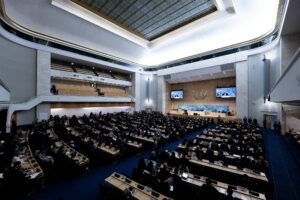
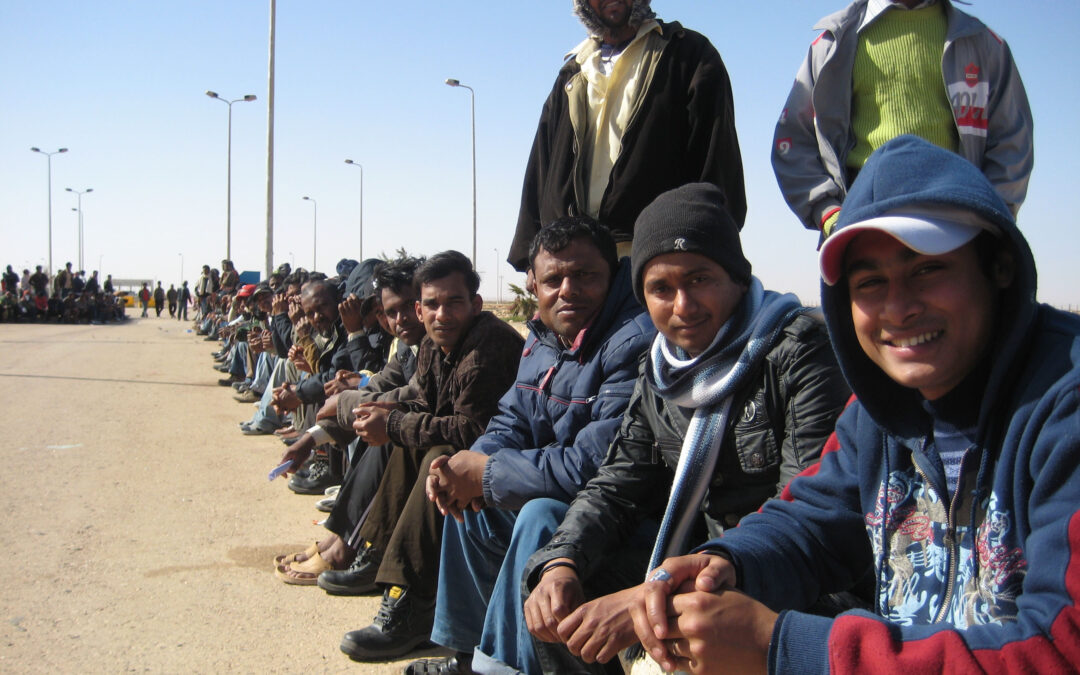
The ICJ delivers today and tomorrow a training on asylum, migration and international human rights law, organised by UNHCR-BiH, the Sector for Asylum of the Ministry for Security and Vaša Prava BiH.
The training, that takes place in the capital Sarajevo, will be delivered to officers of the Government of Bosnia and Herzegovina as well as of independent State institutions.
It will focus on human rights law related to the entry of migrants, including refugees, to the territory of a State, to the State’s obligations on international protection as well as to the rules applicable to detention of foreign national and their rights, and alternatives to detention.
BiH-Training-DetentionMigration&Asylum-ICJ&others-2017-eng (download the agenda in English and Bosnian)
Nov 7, 2017 | Advocacy, News
The ICJ today called for the African Commission on Human and Peoples’ Rights (“African Commission”) to establish a special mechanism for the protection and promotion of the independence of judges and lawyers in Africa.
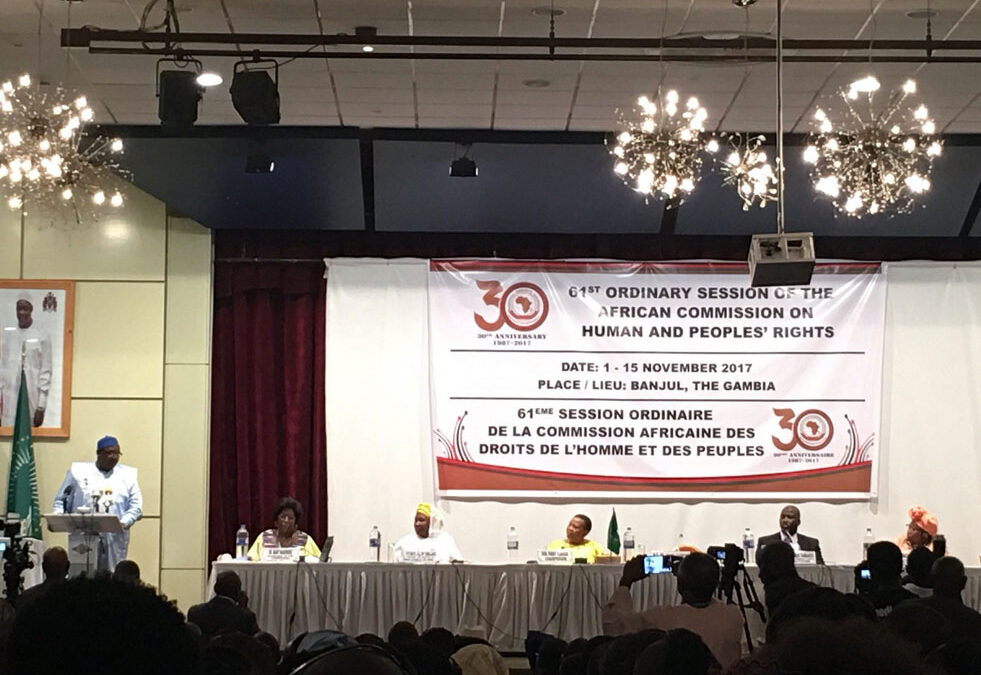
The ICJ made the call in a statement during the public session of the 61st Ordinary Session of the African Commission in Banjul.
The call comes amidst growing threats to the independence of justice in Africa.
In African Union (AU) Member states across the continent, judicial officers and legal practitioners have been targeted for violence and intimidation, or unjustified interference or sanctions.
Recent cases include Burundi, Botswana, Egypt, Lesotho, Libya, Kenya, Swaziland, Zambia, the DRC, Cameroon and Zimbabwe.
The frequency and seriousness of such incidents prompted the ICJ working with the Africa Judges and Jurists Forum to convene a round table meeting in Harare in 2016 to discuss practical steps that could be adopted to minimize the plight of jurists in distress.
The Harare meeting identified the need for a special mechanism for the protection and promotion of judicial independence in Africa, similar to the existing United Nations’ Special Rapporteur on the Independence of Judges and Lawyers.
“It is chilling when a judge is shot in Lubumbashi in the DRC, or a deputy chief justice’s security personnel and driver is shot in Nairobi, Kenya ahead of an important case, or the offices of the Law Association are besieged by militias in Lusaka, Zambia. These are real cases,” said Arnold Tsunga ICJ’s Africa Regional Director.
“An independent, impartial, competent and accountable judiciary and independent and free legal profession are pre-requisites for effective protection of human rights and entrenchment of the rule of law in Africa,” he added.
The ICJ noted that the African Commission have already set out an excellent framework of standards to guarantee independence of the judiciary and access to justice in Africa in the 2003 Principles and Guidelines on the Right to a Fair Trial and Legal Assistance in Africa.
What is needed now is to put in place machinery for their implementation.
The Commission must now to take steps towards establishing a special mechanism for the protection and promotion of judicial independence, including the appointment of a Special Rapporteur on the Independence of Judges and Lawyers, and establishing a Working Group on the Independence of Judges and Lawyers.
Contact
Arnold Tsunga, Director of ICJ’s Africa Regional Programme, t: +27716405926, e: arnold.tsunga(a)icj.org
Banjul- Independence Judges and Lawyers-Advocacy-2017-ENG (Statement in English, pdf)
Nov 2, 2017 | Multimedia items, News, Video clips
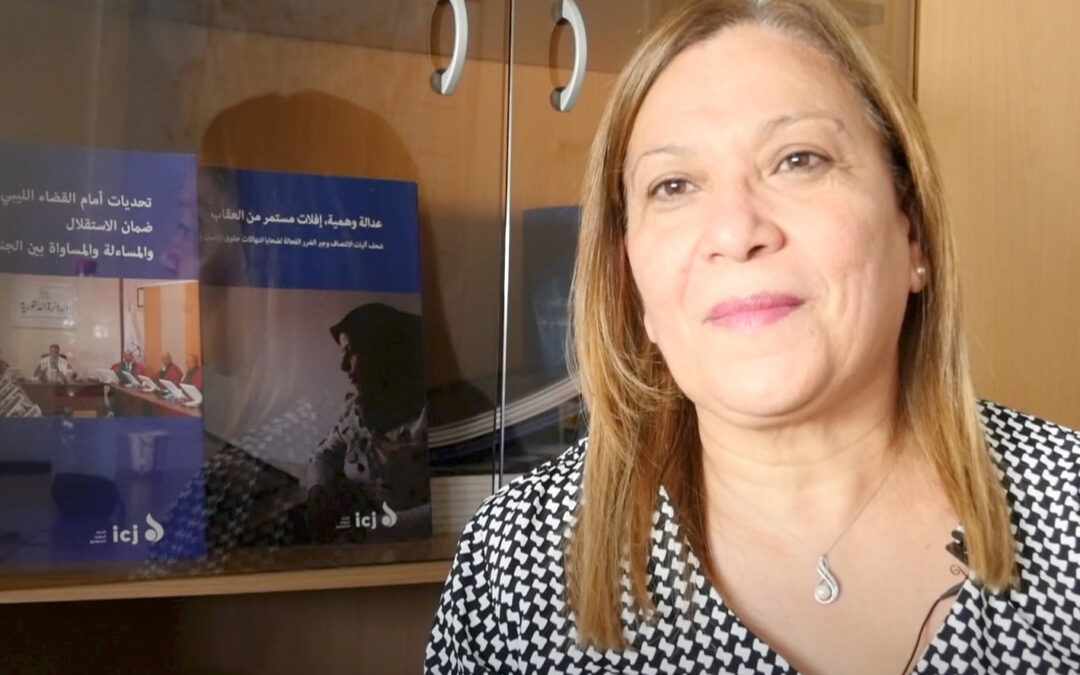
The ICJ ends its series of profiles of its women Commissioners with an interview with Judge Kalthoum Kennou is currently serving her second term as ICJ Commissioner.
Kalthoum Kennou is a Judge of the Tunisian Cassation Court.
She previously served as an investigating Judge at the Tribunal of Tozeur in Tunisia (2010 – 2012), an investigating Judge at the Tribunal of Kairouan (2005 – 2010) and a Judge at the Court of Appeal of Tunis (2001-2005).
She is a strong advocate of the rule of law and the independence of the judiciary in Tunisia, and for women’s rights.
She was active in opposition to the dictatorship of President Zine el-Abidine Ben Ali.
As a consequence of her work, she was subjected to politically motivated personal attacks including arbitrary transfers to remote parts of the country.
After the political revolution in January 2011, she became President of the Association of Tunisian Judges.
She has worked on the new Tunisian Constitution and was the first female candidate in the November 2014 Presidential elections.
In this interview, Judge Kennou speaks about the reasons that prompted her to take up a legal career.
Her father was wrongly accused of high treason and imprisoned and she wanted to show people that there could be fair judges who worked independently.
On his release, her father also supported her decision to study the law.
She was appointed a judge in 1989 but said that other women had been appointed before her so it was not that difficult.
The main problems were that male judges were reluctant to discuss certain issues in front of her and she had to stand up for herself.
“However what was a bit troublesome was with the police when I gave them instructions and I think they would have preferred it was a man and not a woman. But I stood up for myself and I became an investigating judge and I was there to give orders to the police, to the clerk of court, as a judge and as a woman judge.”
Under the dictatorship of Ben Ali, she explains in the interview that there were a quite an important number of judges who resisted and defended the independence of the judiciary.
“… I think our resistance had some results. The proof was that just after the revolution, the question of the independence of the judiciary became a demand of the people, not just the judiciary.”
She explains in the interview that now 43% of the judiciary in Tunisia are women.
This is because there are more women studying law, more women than men, and because the government is promoting women’s equality.
However, many women may take up a legal career without wishing to become a judge.
This is because of family reasons, as they don’t wish to be appointed to a court away from home and in some families, parents might feel that women should be protected from some of the real problems of society.
“But actually I think this kind of thinking is less common now and will disappear bit by bit. Judges have shown that they can have an impact and society accepts female judges more than male judges. They consider that female judges are less corrupt, that they are more serious and are making more efforts to deliver justice.”
The main problems for women in accessing justice in Tunisia are related to pressure from the family not to file complaint in cases of domestic violence.
Also there is a problem with the attitudes of the police who do not take physical aggression against a woman seriously.
The third issue is the mentality of some judges, including some women judges, who are not really convinced that a husband does not have the right to beat his wife.
“The law exists but we should also work on people’s mentalities so that the law is correctly applied.”
Judge Kennou concludes the interview with some advice for young women considering a legal career. She said that a young woman must learn to “stand up for herself and for her rights at home because you cannot be free, you cannot give to others, if your own rights are not realized… I think that a woman who wants to be a judge should be really convinced and well trained about human rights so she can apply the law in a correct manner. “
Watch the interview:
The series of profiles introducing the work of ICJ Commissioners and Honorary Members on women’s rights was launched on 25 November 2016 to coincide with the International Day to Eliminate Violence against Women and the first day of the 16 Days of Activism Against Gender-Based Violence Campaign.

Nov 2, 2017 | News
The ICJ notes that a number of threats and intimidating statements aimed at members of the judiciary, including the Supreme Court, were made during the election campaign period in Kenya.
Now that the elections ordered by the Supreme Court after nullification of the initial elections in Kenya have been concluded, it is important for Kenyan authorities to reaffirm commitment to separation of powers and guarantee the security of judges and the independence of the judiciary in the country, the ICJ says.
On Monday, 30 October 2017, the Indepedent Electoral Boundaries Commission (IEBC) in Kenya declared President Uhuru Kenyatta as the winner of the October 26 repeat polls.
President Uhuru Kenyatta is widely reported to have been heavily critical of the Supreme Court for annulling the 8 August 2017 presidential election on a “technicality”.
It is also reported that he promised to “fix” the bench if re-elected.
The President is also reported to have said he would deal with Chief Justice Maraga, but did not however define the form of action he would take.
Similar sentiments have been attributed to Deputy President William Ruto. It’s unclear at this stage whether these statements should be dismissed as political rhetoric on the campaign trail or warrant further consideration.
However such utterances and threats on the judiciary by senior government officials may be inferred as an attempt to intimidate or unduly influence the bench.
“These threats coming from the highest authorities hinder the ability of the courts to perform their duties, which are indispensable for the rule of law and fair administration of justice in the country,” said Arnold Tsunga, ICJ’s Africa Regional Programme Director.
“Judges must be able to exercise their duties freely, independently and impartially, or else the rule of law in the country will be eroded, and with it, effective protection of the human rights of the Kenyan people,” he added.
The ICJ recalls that the UN Basic Principles on the Independence of the Judiciary provide that judges must be able to perform their professional duties “without any restrictions, improper influences, inducements, pressures, threats or interferences, direct or indirect, from any quarter or for any reason” and that governments have a responsibility to secure this guarantee.
Article 26 of the African Charter on Human and Peoples Rights also imposes an obligation on Kenya to establish an independent judiciary.
Contact
Arnold Tsunga, Director of ICJ’s Africa Regional Programme, t: +27716405926, e: arnold.tsunga(a)icj.org
Nov 1, 2017 | News, Publications, Reports, Thematic reports
The arrest of absconding murder convict Bal Krishna Dhungel, a senior Maoist leader, highlights the weaknesses, as well as the promises, for victims seeking accountability through Nepal’s judicial system, said the ICJ as it released a report on accountability mechanisms in the country.
The ICJ’s report Achieving Justice for Gross Human Rights Violations in Nepal concludes that impunity for gross human rights violations is one of the major obstacles to the creation of a stable and legitimate democratic government and lies at the heart of the rule of law crisis in Nepal.
It found that a lack of commitment by Nepal’s political leadership to address past and ongoing human rights violations continues to allow perpetrators to escape justice and undermines victims’ right to effective remedies and reparation.
“In the past, the promise to shield perpetrators for human rights violations has been used as a bargaining chip to garner political support and build political alliances,” said Frederick Rawski, Director of the ICJ’s Asia Pacific Regional Programme.
“It is imperative that accountability for human rights violations remains a priority for Nepal’s political leadership after Parliamentary elections, and that alliances between political parties are not once again used as an excuse to undermine Nepal’s human rights obligations,” added Rawski.
Attempts to thwart justice have also included the cynical manipulation of justice sector actors, from the police to the Attorney General’s office, in a way that threatens the independence and credibility of the institutions responsible for safeguarding human rights and the rule of law in Nepal, the report highlights.
This pattern of impunity persists despite demands for accountability by civil society and victims’ organizations, as well as the National Human Rights Commission and Nepal’s Supreme Court.
“In many ways, the Supreme Court of Nepal has emerged as a beacon of hope for victims of human rights violations,” said Rawski.
“The Court has given domestic effect to Nepal’s obligations under international law and has set high standards for accountability, remedy and reparations,” he added.
However, the Government’s disregard of key judgments has limited the impact of the Supreme Court’s jurisprudence, the report says.
Attacks on the independence of the judiciary, as demonstrated by the impeachment motion against former Chief Justice Sushila Karki, also indicate a worrying trend.
The ICJ’s report found that the mandate and operation of transitional justice mechanisms fall short of international standards despite the repeated reinforcement of such standards by the Supreme Court.
Though ostensibly formed to provide a measure of public accountability, the practice of forming ad hoc commissions of inquiry to investigate rights violations has promoted impunity by diverting investigations from the criminal justice process – where they belong – into parallel mechanisms that are established by means that make them vulnerable to political interference and manipulation.
The ICJ’s report also concludes that gross human rights violations in Nepal are not a thing of the past, but are ongoing.
Notably in the Terai region, the State has responded to the Madhesh movement with excessive use of force, extrajudicial killings, and torture and other ill-treatment.
Political expediency has trumped calls for justice and accountability and the Government continues to use State machinery to shield perpetrators rather than serve the interests of justice.
“In a seemingly perpetual cycle, the weak rule of law in the country contributes to impunity for human rights violations, and this culture of impunity further erodes the rule of law,” said Rawski.
“The search for truth and justice in Nepal will not be realized unless this cycle is ended,” he added.
Additional information
Dhungel had been absconding since the Supreme Court upheld his conviction for murder in 2010. The arrest comes after a contempt of court petition was filed before the Supreme Court against the Inspector General of Police for failing to implement multiple Supreme Court orders directing Dhungel’s arrest.
Contact
Frederick Rawski, ICJ Asia Pacific Regional Director, t: +66 64 478 1121, e: frederick.rawski@icj.org
Alex Conte, ICJ Global Redress and Accountability Initiative, t: +41.79.957.2733; e: alex.conte@icj.org
Download
Nepal-GRA Baseline Study-Publications-Reports-Thematic reports-2017-ENG (full report in PDF)
Read also
ICJ Discussion Paper Nepal’s Transitional Justice Process: Challenges and Future Strategy (August 2017)
ICJ Report Authority without Accountability: The struggle for justice in Nepal (October 2013)
Nov 1, 2017 | News
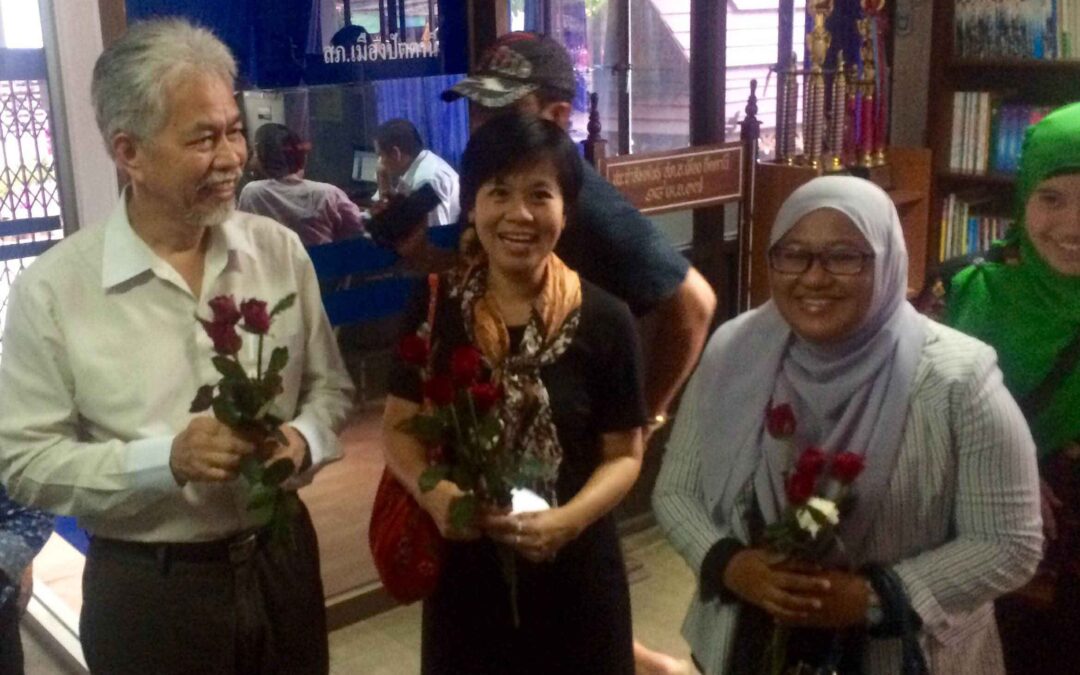
The ICJ welcomes the Pattani Provincial Prosecutor’s decision to end the criminal prosecution of three prominent human rights defenders who raised allegations of torture in Thailand’s restive deep South: Ms Pornpen Khongkachonkiet, Mr Somchai Homlaor, and Ms Anchana Heemmina.
On 24 October 2017, the Region 9 Senior Expert Public Prosecutor, on behalf of the Pattani Provincial Prosecutor, informed the Superintendent of the Muang District Pattani Police Station of the decision to end the prosecution of the three defenders for criminal defamation and violation of the Computer Crime Act.
The ICJ has previously expressed concern that the prosecutions were unwarranted and abusive and were aimed at chilling the exercise of critical human rights work in Thailand.
“While we welcome the decision to end these prosecutions, they have already caused a tremendous amount of damage to complainants of serious human rights violations like torture and ill-treatment, civil society, and the local community in the deep South that must now be repaired,” said Kingsley Abbott, the ICJ’s Senior International Legal Adviser for Southeast Asia.
“An important first step would be to pass legislation which criminalizes torture and ill-treatment and provides meaningful protections for those who wish to come forward with allegations of violations,” he added.
On 28 February 2017, the UN Office of the High Commissioner for Human Rights announced that it had been informed that the Thai National Legislative Assembly (NLA) would not enact legislation then under consideration criminalizing torture and enforced disappearance, the Draft Prevention and Suppression of Torture and Enforced Disappearance Act (Draft Act).
The following day, an NLA official speaking to BBC Thai confirmed that the Draft Act would be “returned [to the Thai Cabinet] for more consultations… with Interior officials, police authorities, the national security sector, military authorities and prosecutors.”
The Draft Act remains with the Thai Cabinet.
“It is long past time for Thailand to make good on its repeated commitments on the international stage to pass this essential piece of legislation in accordance with its international human rights obligations,” added Abbott.
Contact
Kingsley Abbott, Senior International Legal Adviser, ICJ Asia Pacific Regional Office, t: +66 94 470 1345, e: kingsley.abbott(a)icj.org
Background
On 10 February 2016, three Thai organizations, the Cross Cultural Foundation (CrCF), Duay Jai Group (Hearty Support Group), and the Patani Human Rights Organization (HAP), issued a report that documented 54 cases of alleged torture and ill-treatment by the Thai security forces in the deep South since 2004.
In response, the Internal Security Operations Command (ISOC) Region 4 (Forward Command) – created to resolve the situation in the deep South – made complaints of criminal defamation against the three co-editors, Pornpen Khongkachonkiet (Director of the CrCF), Somchai Homlaor (Senior legal advisor to CrCF and Hearty Support Group), and Anchana Heemmina (founder and Director of the Hearty Support Group).
On 26 July 2016, the Thai police charged the three defenders with criminal defamation by means of publication under Article 326 and 328 of the Penal Code, and importing false information to a computer system under Article 14 (1) of the Computer-Related Crime Act B.E. 2550 (2007).
On 7 March 2017, the ISOC 4 Forward Command announced its intention to drop the complaints at a press conference in Bangkok.
Thailand is a State party to the International Covenant on Civil and Political Rights (ICCPR), the Convention against Torture and other Cruel, Inhuman or Degrading Treatment or Punishment (CAT) and has signed, but not yet ratified, the International Convention for the Protection of All Persons from Enforced Disappearance (ICPPED).
Further reading on these criminal proceedings
Thailand: ICJ welcomes dropping of complaints against human rights defenders but calls for investigation into torture
Thailand: stop use of defamation charges against human rights defenders seeking accountability for torture
Thailand: immediately withdraw criminal complaints against human rights defenders
Further reading on the Draft Prevention and Suppression of Torture and Enforced Disappearance Act
Thailand: ICJ commemorates international day in support of victims of enforced disappearances
Thailand: pass legislation criminalizing enforced disappearance, torture without further delay
Thailand-News-Pressreleases-humanrightsdefenders-2017-THAI (full press release in Thai, pdf)