Mar 31, 2016 | News
A Delhi Court acquitted human rights defender Irom Sharmila of an “attempt to commit suicide” charge. The government of Manipur must in turn immediately drop the charges against her, said the ICJ today.
Irom Sharmila, was charged under section 309 the Indian Penal Code.
She has been on a continuous hunger strike for over 15 years, demanding repeal of the Armed Forces Special Powers Act (AFSPA).
“This order is a welcome recognition that Irom Sharmila’s hunger strike is a form of peaceful dissent and protest protected by the right to freedom of expression,” said Sam Zarifi, ICJ’s Asia Director.
This week, Iron Sharmila was acquitted of the charges against her in Delhi. The case against her in Manipur is, however, still on-going.
The decision of the Delhi court is not binding on the courts in Manipur, but the charges are analogous, and similar reasoning should prevail, the ICJ says.
“The government of Manipur should drop the other charges under section 309 against her, and release her immediately and unconditionally,” said Zarifi.
On at least two occasions previously, courts in Manipur have directed that Irom Sharmila be released, saying that charges under section 309 were not applicable.
“The use of section 309 against Sharmila highlights the outdated and absurd nature of this law,” Zarifi said.
“The government should expedite the repeal of 309 and, instead of criminalizing Irom Sharmila’s protest, focus on the reason behind it and repeal the AFSPA,” he added.
The AFSPA gives armed forces a range of “special powers” in “disturbed areas”, which include the power to arrest without warrant, to enter and search any premises, and in certain circumstances, “fire upon or otherwise use force, even to the causing of death”.
Furthermore, under the AFSPA, governmental permission, or sanction, is required before any member of the armed forces can be prosecuted for crimes in a civilian court.
These provisions are inconsistent with a range of human rights, including the right to life and right to remedy.
They have also facilitated torture, rape and enforced disappearances in areas where operational, the ICJ notes.
“This law is inconsistent with India’s human rights obligations, and has led to human rights violations, wide-spread impunity, and immense grief and suffering in the areas where it operates”, Zarifi said.
“It is high time that it was taken off the books”.
Background
Irom Sharmila began a hunger strike in November 2000, calling for the repeal of the AFSPA, following the unlawful killing of 10 civilians by security forces purportedly acting under it in Malom.
She was arrested by the Manipur government in 2000 under section 309 of the Indian Penal Code, which prohibits an “attempt to commit suicide”.
Irom Sharmila has been in custody almost continuously since her initial arrest, and has continued her hunger strike.
She is fed through a nasal tube at the Jawaharlal Nehru hospital in Imphal where she is usually held.
The Delhi government also charged her on similar grounds with respect to an incident from 2006, when she held a protest in their jurisdiction.
In 2014, a Manipur court quashed charges under section 309 against Irom Sharmila, saying “The agitation of Irom Chanu Sharmila is a political demand through lawful means of repealing a valid statute. … she may continue with the fast till her demand is met politically by the Government”.
However, since she continued her hunger strike, she was immediately re-arrested on the same grounds.
In its 210th report, the Indian Law Commission has recommended that section 309 be repealed. In 2011, the Supreme Court said: “the time has come when [section 309] should be deleted by Parliament as it has become anachronistic.”
In 2014, the government announced that it was in the process of repealing 309.
The AFSPA applies to “disturbed areas” in the states of Arunachal Pradesh, Assam, Manipur, Meghalaya, Mizoram, Nagaland and Tripura.
An almost identical law is also applicable in Jammu and Kashmir.

Mar 30, 2016 | News
The Malaysian government must immediately halt the politically motivated sedition investigation launched by the police against members of the Malaysian Bar who had called for the Attorney General’s resignation, the ICJ said today.
“The Malaysian authorities are using the archaic, colonial Sedition Act to harass and silence lawyers who are demanding that the country’s legal authorities observe international standards of propriety and independence,” said Emerlynne Gil, ICJ’s Senior Legal Adviser for Southeast Asia.
“This latest misuse of the Sedition Act constitutes a brazen political attack on the independence of the country’s lawyers,” she added.
On 29 March 2016, lawyers Charles Hector, Francis Pereira, and Shanmugam Ramasamy, received letters from police authorities summoning them to the Bukit Aman Police Headquarters on 31 March 2016 for the purpose of taking down their statements regarding a complaint filed against them under the Sedition Act (1948).
The three had proposed a motion during the Malaysian Bar’s 70th Annual General Assembly, calling for the resignation of Attorney-General Tan Sri Mohamed Apandi Ali. The motion was passed by a majority vote.
Karen Cheah Yee Lynn, Secretary of the Malaysian Bar, was also notified that her statement would likewise be taken but she was not summoned to the Bukit Aman Police Headquarters.
The Malaysian Bar demanded the resignation of Attorney-General Tan Sri Mohamed Apandi Ali after he summarily ended the investigation of alleged corruption by Prime Minister Najib Razak.
The Prime Minister appointed Attorney-General Apandi on 27 July 2015, in the midst of the corruption investigation.
Attorney General Apandi subsequently cleared Prime Minister Najib Razak of any criminal wrongdoing and instructed the Malaysian Anti-Corruption Commission to close the investigations.
“In 2012, Prime Minister Razak had promised to repeal the Sedition Act, but since then his government has increasingly relied on the law’s impermissibly vague and broad language as a useful tool of repression,” Gil said.
International standards highlight that protecting the independence of lawyers and their professional associations is essential for upholding the rule of law and the administration of justice, the ICJ says.
“This police investigation is clearly designed to challenge that independence,” Gil said.
“The Malaysian Bar has been one of the few institutions consistently defending the rule of law and human rights in Malaysia, and it is crucial to maintain the ability of its members to engage critically in upholding the standards of professional integrity and independence,” she added.
The ICJ urges the Malaysian government to repeal the archaic Sedition Act 1948 and fulfill the commitment it made in 2012 to abolish it.
Unless repealed or considerably revised so that it will be consistent with international law, the Sedition Act 1948 will continue to unduly limit and repress the freedom of expression, not only of lawyers and human rights defenders, but of all Malaysians exercising their fundamental rights, the ICJ says.
Contact
Emerlynne Gil, ICJ’s Senior International Legal Adviser, t: +66840923575, e: emerlynne.gil@icj.org
Background
Under the UN Basic Principles on the Role of Lawyers, governments have the obligation to ensure that lawyers are able to perform all of their professional functions without intimidation, hindrance, harassment or improper interference (Principle 16).
Like other citizens, lawyers are entitled to freedom of expression, belief, association, and assembly. Lawyers have the right to take part in the public discussion of matters concerning the law, the administration of justice, and the promotion and protection of human rights (Principle 23).
The UN Basic Principles on the Role of Lawyers also state that lawyers are entitled to form and join self-governing professional associations to represent their interests and protect their professional integrity (Principle 24).
Governments should ensure that these professional associations are able to function without improper interference (Principle 25).
In its 2016 resolution on human rights in the administration of justice, the UN Human Rights Council unanimously affirmed that “the independence and impartiality of the judiciary, the integrity of the judicial system and an independent legal profession are essential prerequisites for the protection of human rights, the rule of law, good governance and democracy, and for ensuring that there is no discrimination in the administration of justice, and should therefore be respected in all circumstances” (Resolution 30/7, 1 October 2015).
Malaysia’s Sedition Act 1948, originally enacted by the British colonial government and amended times over the years, criminalizes speech and publications considered to have “seditious tendencies”.
The term “seditious tendencies” is ambiguously defined to mean any kind of speech or publication that causes “hatred or contempt, or excite disaffection” against any ruler or the government or promotes “ill will and hostility between the different races or classes”.
The law also considers “seditious” any speech or publication that questions the special privileges of the Malay people, as provided in the Constitution.
Furthermore, sedition is a strict liability offence in Malaysia, which means that the intention of a person allegedly making seditious statements is irrelevant.

Mar 29, 2016 | News
Today, the ICJ expressed serious concern at the apparent murder of lawyer Yury Grabovsky who was found dead on 25 March. The lawyer had been missing for two weeks and was reportedly found shot and buried near the Kiev-Odessa main route.
“The death of lawyer Yury Grabovsky must be investigated in a prompt, impartial and effective manner. Other lawyers who may be under threat should be urgently granted the necessary measures of protection”, said Temur Shakirov, ICJ Legal Adivser.
Yury Grabovsky was the managing partner of law firm “Garbovsky and Co”, as well as Deputy Chair of the High Qualification Disciplinary Commission.
He represented Aleksandr Aleksandrov, who along with Evgeniy Yerofeyev, was detained last May in the Lugansk Region in Eastern Ukraine and accused of terrorism and a number of other crimes.
The lawyer’s whereabouts had been unknown since 5 March after he had left for Odessa to stay at “Arkadiya” hotel.
He was apparently supposed to leave the hotel on 7 March but he never took his belongings from there.
On 9 March, a court hearing did not take place because the lawyer was missing.
Garbovsky’s colleagues reportedly doubted the authenticity of a post on his facebook account stated that he had left Ukraine.
On 10 March, the National Association of Lawyers of Ukraine informed the National Police that the lawyer had been missing.
The same day, the Odessa police opened a criminal case on “intentional murder”.
On 20 March, the Chief Military Prosecutor of Ukraine, Anatoly Matios, stated that a suspect in the organization of the disappearance of Grabovsky had been apprehended.
On Friday, 25 March, Prosecutor Matios said that Grabovsky “was killed in a violent way and finished off with a firearm” which according to the Prosecutor was a “specially planned operation.”
The lawyer’s body was found shot and buried 138 km south of Kiev after one of the suspects had reportedly disclosed the place of burial.
The lawyer is said to have had an explosive bracelet on his leg, apparently intended to prevent him from escaping. The names of the suspects have not been made public.
It is the second killing of a lawyer in Ukraine this month, and the fourth such killing since January 2015, including, lawyers Alexandr Gruzkov, Yury Ignatenko, Viktor Loiko, and now Yuri Grabovskiy.
Temur Shakirov stressed that “in order to fulfil their function lawyers must be able to act without fear and free from fear of reprisals of any kind”.
The UN Basic Principles on the Role of Lawyers affirm that“[w]here the security of lawyers is threatened as a result of discharging their functions, they shall be adequately safeguarded by the authorities.”
The ICJ calls on the Government of Ukraine to investigate the case and bring those responsible to justice, including both anyone who directly carried out the killing and anyone who ordered the crime.
Urgent measures to guarantee the security of lawyers should be taken, which should include effective security measures against attempts on their lives and lives of their family members.
Contact:
Róisín Pillay, Director, Europe Programme, roisin.pillay(a)icj.org
Temur Shakirov, Legal Adviser, Europe Programme, temur.shakirov(a)icj.org

Mar 29, 2016 | News
The ICJ expresses its grave concern at the 28 March 2016 conviction and sentencing of 17 Angolan activists to terms of imprisonment ranging from two years to more than eight years, for the peaceful exercise of their human rights of freedom of association and freedom of expression.
Following an unfair trial, they were found guilty of “preparatory actions of rebellion and association of evildoers” [malfeitores], based on having read and discussed reading material on nonviolent means for resisting dictatorship or being associated with others who did so.
The ICJ joins numerous civil society organizations in condemning the failure by the authorities in Angola to conduct the trial in a manner consistent with its obligations under international human rights law.
“Judicial persecution of opponents of the government in Angola must be stopped forthwith” said Arnold Tsunga, ICJ’s Africa Director.
“A worrisome trend and pattern is emerging where the authorities in Angola are increasingly using the law and legal system as an instrument of repression targeting critics of the government as well as human rights defenders,” he added.
The ICJ calls on the Angolan authorities to invalidate the conviction and sentences, and to take concrete measures to strengthen the rule of law by ensuring the independence of the judiciary and legal profession as well as fully implementing international human rights standards in the national legal system.
Contact
Arnold Tsunga, ICJ’s Africa Director, t: +27731318411 or +263777283249 ; e: arnold.tsunga@icj.org
Background
Fifteen of the Accused were arrested in June 2015 and later joined by another two accused.
They were initially charged with rebellion and a conspiracy to mount a coup against the President for studying and discussing reading material on nonviolent means for resisting dictatorship.
The prosecution later dropped the second charge but added a charge of “criminal association” or “association with evildoers”.
The defense maintains that the state did not manage to prove anything beyond the fact that the accused discussed politics, which is allowed under the Angolan constitution.
No independent observers were allowed to attend the trial, raising serious concerns about the right to fair trial.
The African Charter on Human and Peoples’ Rights and the International Covenant on Civil and Political Rights, treaties to which Angola is a party, recognize freedom of expression and freedom of association as human rights, and prohibit governments from arbitrarily or otherwise illegitimately interfering with them.
Domingos da Cruz was sentenced to 8 years and six months; Luaty Beirão to 5 years and 6 months; Nuno Dala, Sedrick de Carvalho, Nito Alves, Inocêncio de Brito, Laurinda Gouveia, Fernando António Tomás “Nicola”, Afonso Matias “Mbanza Hamza”, Osvaldo Caholo, Arante Kivuvu, Albano Evaristo Bingo -Bingo, Nelson Dibango, Hitler Jessy Chivonde e José Gomes Hata were all sentenced to 4 years and 6 months); while Rosa Conde e Jeremias Benedito got 2 years and 3 months in jail.

Mar 28, 2016 | News
The ICJ today calls for the reversal of the Supreme Disciplinary Board’s decisions to force into retirement 47 judges following two separate, mass proceedings known as the “July 2013 Statement Case” and the “Judges for Egypt Case”, which concern over 60 judges.
Today’s final decision in the “July 2013 Statement Case” forcibly removed 32 judges from their offices.
It comes after all of the 15 judges referred to disciplinary proceedings in the “Judges for Egypt” were forcibly removed from their offices last Monday.
In a third case on 7 March 2016, the Disciplinary Board removed from office Zakaria Abdel Aziz, a former President of the Judges Club (Egypt’s representative body of judges) and a leading advocate of judicial independence.
“The intensity of Egypt’s attacks against individual judges is reaching a frightening level,” said Said Benarbia.
“By removing judges from the office following mass, arbitrary and unfair disciplinary proceedings, the authorities are purging from the judiciary the very voices that have promoted its independence, and sending a chilling message to others who might challenge the ongoing crackdown on fundamental rights and freedoms in Egypt,” he added.
The ICJ had previously raised concerns about fairness of these proceedings as well as the nature of the charges against the concerned judges.
In the “July 2013 Statement Case” and the “Judges for Egypt Case,” the Disciplinary Board found that the judges had been involved in politics and were therefore “unfit” to carry out their functions.
Article 73 of Egypt’s Judicial Authority Law prohibits judges from engaging in “political activity”.
This prohibition was interpreted by the Disciplinary Board to include “discussing or commenting on legislative and governmental decisions as long as it does not pertain to a case that he [the judge] is looking into as part of his judicial function”.
The ICJ considers that the interpretation by the Disciplinary Board could result in arbitrary limitations to the judges’ right to freedom of expression, assembly and association, well beyond any restrictions that could possibly be justified as necessary to preserve the dignity of their office and the impartiality and independence of the judiciary.
Furthermore, these disciplinary proceedings have failed to meet international standards of fairness, the ICJ says.
The Geneva-based organization previously highlighted procedural flaws in the proceedings against the judges such as failure to be notified properly, to be represented before the Board and to be provided with adequate time and facility to prepare a defense.
“The Egyptian authorities must reinstate all judges that have been removed from their office as a result of unfair and arbitrary proceedings”, said Benarbia.
“Furthermore, they must amend the Judicial Authority Law to ensure that disciplinary offences are clearly and precisely defined within the law; that the exercise of the rights to freedom of expression, association and assembly in a manner consistent with the dignity of the office and the impartiality and independence of the judiciary does not constitute a disciplinary offence; and that the disciplinary procedure is fair and does not undermine the independence and impartiality of the judiciary,” he added.
Contact:
Nader Diab, Associate Legal Adviser of the ICJ Middle East and North Africa Programme, t: +216 51727023; e: nader.diab(a)icj.org
Background
The UN Basic Principles on the Independence of the Judiciary, which were adopted by the UN in 1985 and elaborate on states’ obligations under international law, include the following provisions:
- In accordance with the Universal Declaration of Human Rights, members of the judiciary are like other citizens entitled to freedom of expression, belief, association and assembly; provided, however, that in exercising such rights, judges shall always conduct themselves in such a manner as to preserve the dignity of their office and the impartiality and independence of the judiciary.
- Judges shall be free to form and join associations of judges or other organizations to represent their interests, to promote their professional training and to protect their judicial independence. (…)
- A charge or complaint made against a judge in his/her judicial and professional capacity shall be processed expeditiously and fairly under an appropriate procedure. The judge shall have the right to a fair hearing. The examination of the matter at its initial stage shall be kept confidential, unless otherwise requested by the judge.
- Judges shall be subject to suspension or removal only for reasons of incapacity or behaviour that renders them unfit to discharge their duties.
- All disciplinary, suspension or removal proceedings shall be determined in accordance with established standards of judicial conduct.
- Decisions in disciplinary, suspension or removal proceedings should be subject to an independent review. This principle may not apply to the decisions of the highest court and those of the legislature in impeachment or similar proceedings.
Egypt- removal of judges-press release-2016-ARA (full text, Arabic, in PDF)
Mar 28, 2016 | News
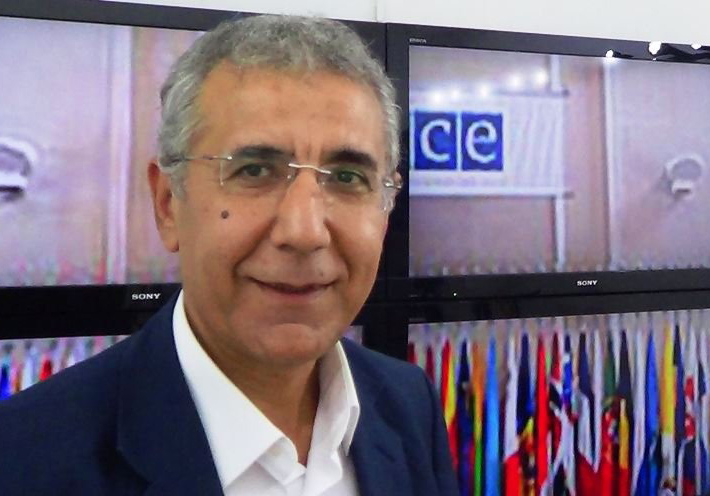
The ICJ welcomes the release of human rights lawyer Intigam Aliyev today after the Supreme Court reduced and suspended his sentence and ordered his immediate release.
Intigam Aliyev, a prominent human rights lawyer and the head of the NGO Legal Education Society, had been convicted on 22 April 2015 of tax avoidance, illegal entrepreneurship and abuse of power and sentenced to seven and a half years of imprisonment by a Baku Court.
A number of credible human rights organizations and international observers who have closely followed the case have stated that they consider the charges he was tried on to have been politically motivated, and that the real reason for his prosecution and conviction was repression by the Government of critical voices in civil society.
In a closed hearing, the Supreme Court reduced his sentence to five years of imprisonment and suspended its execution, after a request to this effect was made by Azerbaijan’s Prosecutor General, Zakir Garalov.
This unusual initiative follows the rejection, on 24 February, by the same Supreme Court of Intigam Aliyev’s complaint against his sentence.
“While the release of Intigam Aliyev is a positive step, the ICJ remains concerned that this decision appears to leave the underlying conviction in place despite credible reports that the charges were politically motivated,” said Massimo Frigo, ICJ Legal Adviser.
“If, as these allegations would suggest, Intigam Aliyev was targeted for his work as a lawyer, this would clearly violate international standards on the independence of lawyers”, said Temur Shakirov, another ICJ Legal Adviser.
Contact
Temur Shakirov, Legal Adviser, Europe Programme, temur.shakirov(a)icj.org
Massimo Frigo, Legal Adviser, Europe Programme, masimo.frigo(a)icj.org