
Mar 28, 2016 | News
The ICJ today calls for the reversal of the Supreme Disciplinary Board’s decisions to force into retirement 47 judges following two separate, mass proceedings known as the “July 2013 Statement Case” and the “Judges for Egypt Case”, which concern over 60 judges.
Today’s final decision in the “July 2013 Statement Case” forcibly removed 32 judges from their offices.
It comes after all of the 15 judges referred to disciplinary proceedings in the “Judges for Egypt” were forcibly removed from their offices last Monday.
In a third case on 7 March 2016, the Disciplinary Board removed from office Zakaria Abdel Aziz, a former President of the Judges Club (Egypt’s representative body of judges) and a leading advocate of judicial independence.
“The intensity of Egypt’s attacks against individual judges is reaching a frightening level,” said Said Benarbia.
“By removing judges from the office following mass, arbitrary and unfair disciplinary proceedings, the authorities are purging from the judiciary the very voices that have promoted its independence, and sending a chilling message to others who might challenge the ongoing crackdown on fundamental rights and freedoms in Egypt,” he added.
The ICJ had previously raised concerns about fairness of these proceedings as well as the nature of the charges against the concerned judges.
In the “July 2013 Statement Case” and the “Judges for Egypt Case,” the Disciplinary Board found that the judges had been involved in politics and were therefore “unfit” to carry out their functions.
Article 73 of Egypt’s Judicial Authority Law prohibits judges from engaging in “political activity”.
This prohibition was interpreted by the Disciplinary Board to include “discussing or commenting on legislative and governmental decisions as long as it does not pertain to a case that he [the judge] is looking into as part of his judicial function”.
The ICJ considers that the interpretation by the Disciplinary Board could result in arbitrary limitations to the judges’ right to freedom of expression, assembly and association, well beyond any restrictions that could possibly be justified as necessary to preserve the dignity of their office and the impartiality and independence of the judiciary.
Furthermore, these disciplinary proceedings have failed to meet international standards of fairness, the ICJ says.
The Geneva-based organization previously highlighted procedural flaws in the proceedings against the judges such as failure to be notified properly, to be represented before the Board and to be provided with adequate time and facility to prepare a defense.
“The Egyptian authorities must reinstate all judges that have been removed from their office as a result of unfair and arbitrary proceedings”, said Benarbia.
“Furthermore, they must amend the Judicial Authority Law to ensure that disciplinary offences are clearly and precisely defined within the law; that the exercise of the rights to freedom of expression, association and assembly in a manner consistent with the dignity of the office and the impartiality and independence of the judiciary does not constitute a disciplinary offence; and that the disciplinary procedure is fair and does not undermine the independence and impartiality of the judiciary,” he added.
Contact:
Nader Diab, Associate Legal Adviser of the ICJ Middle East and North Africa Programme, t: +216 51727023; e: nader.diab(a)icj.org
Background
The UN Basic Principles on the Independence of the Judiciary, which were adopted by the UN in 1985 and elaborate on states’ obligations under international law, include the following provisions:
- In accordance with the Universal Declaration of Human Rights, members of the judiciary are like other citizens entitled to freedom of expression, belief, association and assembly; provided, however, that in exercising such rights, judges shall always conduct themselves in such a manner as to preserve the dignity of their office and the impartiality and independence of the judiciary.
- Judges shall be free to form and join associations of judges or other organizations to represent their interests, to promote their professional training and to protect their judicial independence. (…)
- A charge or complaint made against a judge in his/her judicial and professional capacity shall be processed expeditiously and fairly under an appropriate procedure. The judge shall have the right to a fair hearing. The examination of the matter at its initial stage shall be kept confidential, unless otherwise requested by the judge.
- Judges shall be subject to suspension or removal only for reasons of incapacity or behaviour that renders them unfit to discharge their duties.
- All disciplinary, suspension or removal proceedings shall be determined in accordance with established standards of judicial conduct.
- Decisions in disciplinary, suspension or removal proceedings should be subject to an independent review. This principle may not apply to the decisions of the highest court and those of the legislature in impeachment or similar proceedings.
Egypt- removal of judges-press release-2016-ARA (full text, Arabic, in PDF)

Mar 28, 2016 | News
The ICJ welcomes the release of human rights lawyer Intigam Aliyev today after the Supreme Court reduced and suspended his sentence and ordered his immediate release.
Intigam Aliyev, a prominent human rights lawyer and the head of the NGO Legal Education Society, had been convicted on 22 April 2015 of tax avoidance, illegal entrepreneurship and abuse of power and sentenced to seven and a half years of imprisonment by a Baku Court.
A number of credible human rights organizations and international observers who have closely followed the case have stated that they consider the charges he was tried on to have been politically motivated, and that the real reason for his prosecution and conviction was repression by the Government of critical voices in civil society.
In a closed hearing, the Supreme Court reduced his sentence to five years of imprisonment and suspended its execution, after a request to this effect was made by Azerbaijan’s Prosecutor General, Zakir Garalov.
This unusual initiative follows the rejection, on 24 February, by the same Supreme Court of Intigam Aliyev’s complaint against his sentence.
“While the release of Intigam Aliyev is a positive step, the ICJ remains concerned that this decision appears to leave the underlying conviction in place despite credible reports that the charges were politically motivated,” said Massimo Frigo, ICJ Legal Adviser.
“If, as these allegations would suggest, Intigam Aliyev was targeted for his work as a lawyer, this would clearly violate international standards on the independence of lawyers”, said Temur Shakirov, another ICJ Legal Adviser.
Contact
Temur Shakirov, Legal Adviser, Europe Programme, temur.shakirov(a)icj.org
Massimo Frigo, Legal Adviser, Europe Programme, masimo.frigo(a)icj.org

Mar 24, 2016 | Advocacy, News
The ICJ and ECRE presented today a joint submission on the situation of the asylum and reception systems in Greece to the Committee of Ministers of the Council of Europe.
The submission was presented in view of a meeting of the Committee of Ministers of the Council of Europe on the implementation by Greece of the European Court of Human Rights’ judgment in the case of M.S.S. v Belgium and Greece that will take place next June.
The submission refers to the previous detailed joint submissions of ICJ and ECRE and provides recent information on the state of the asylum procedure, reception conditions and detention practices, which are likely to be of importance to the supervision of the execution of the M.S.S. v. Belgium and Greece ruling. It focuses on:
- ongoing obstacles to accessing the asylum procedure, namely concerning registration before the Asylum Service, the operation of appeals bodies, as well as the likely application of the “safe third country” concept regarding Turkey;
- the state of Greece’s reception system, with a view to properly assessing its capacity to accommodate asylum seekers and migrants on its territory; and
- updated information on the lawfulness and conditions of immigration detention, including new risks of detention stemming from nationality-profiling and the establishment of “hotspots” at points of arrival.
Greece-ICJECRE-MSS-CommitteeMinisters-5thsubmission-legal submission-2016-ENG (download the joint submission)
Mar 24, 2016 | News
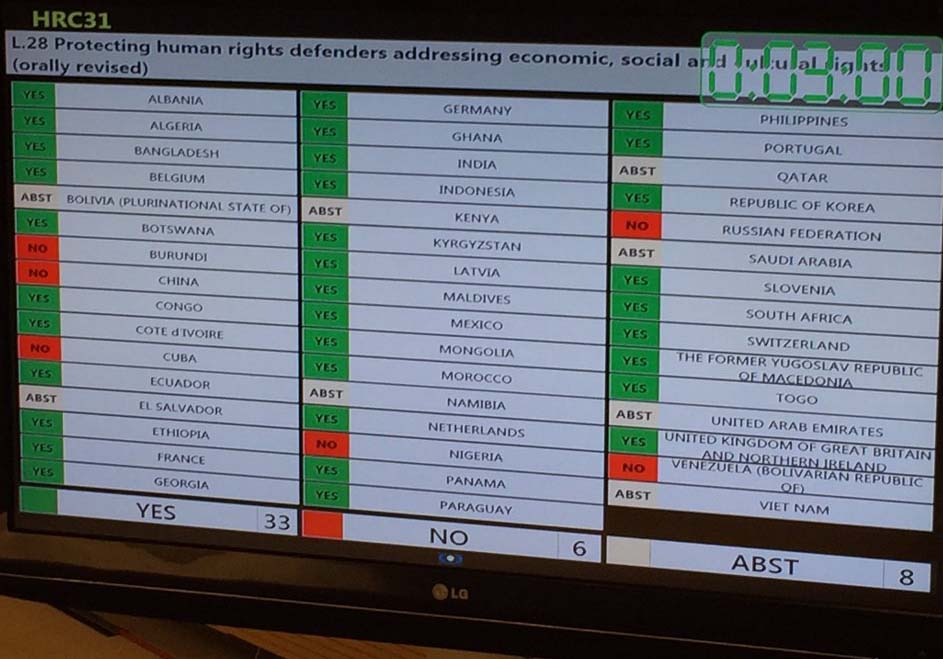
The ICJ welcomes today’s adoption by the UN Human Rights Council of a resolution on human rights defenders addressing economic, social and cultural rights.Negotiation of the resolution was led by Norway, who presented the draft to the Council with co-sponsorship with a large number of states from around the world.
A series of hostile amendments tabled by the Russian Federation, China, Cuba, Egypt and Pakistan, which would have weakened the resolution, were defeated, and the resolution was ultimately adopted by a large majority.
The ICJ had earlier joined advocacy efforts to support the resolution text as presented, and welcomes the strong message the resolution as adopted sends affirming the importance of defenders’ work on economic, social and cultural rights, as well as the need for states to respect, protect and fulfil the human rights of such defenders, including through a range of legislative, policy, and practical measures.
The draft resolution is available in an unofficial version here: 2016 draft resolution HRDs as orally revised.
The voting on the resolution is available here: Result of the vote HRDs
Mar 21, 2016 | News
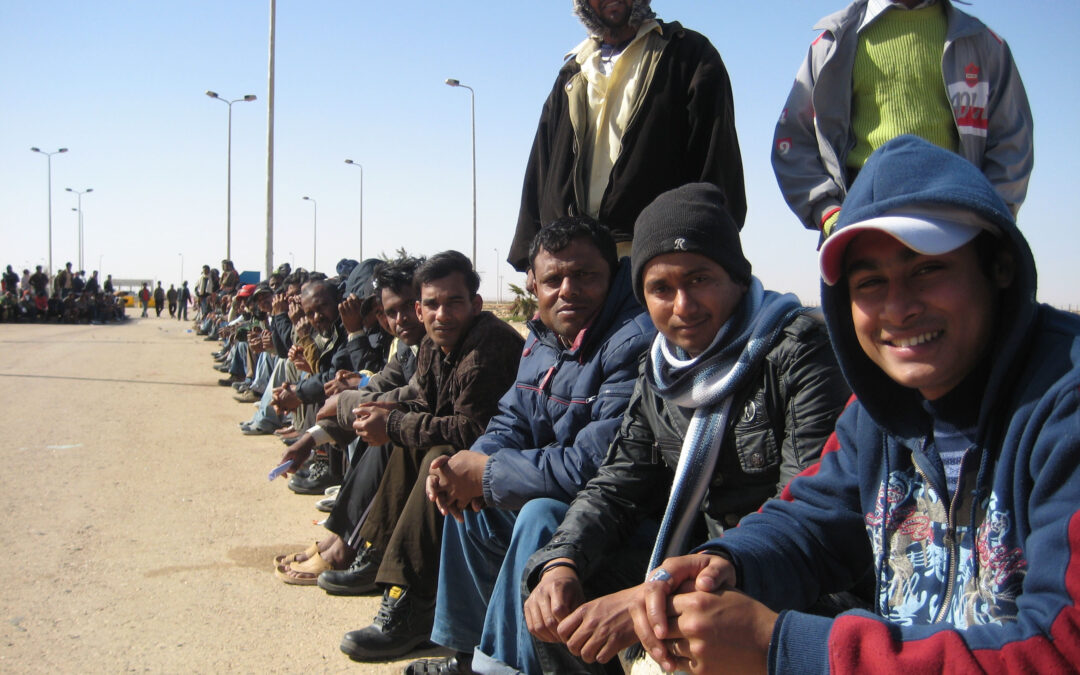
The ICJ today expresses serious concern that the deal concluded on Friday 18 March between the European Union and Turkey on the return of migrants and refugees to Turkey is likely to lead to serious violations of international and EU human rights and refugee law.
“This initiative carries high risks of infringing the right of asylum and the prohibition of non-refoulement, as well as the right to an effective remedy for potential violations of these rights”, said Róisín Pillay, Director of the ICJ Europe Programme.
All EU Member States, including Greece, have obligations to protect these rights under international human rights law, and Member States and EU institutions have similar obligations under the EU Charter of Fundamental Rights.
The agreement seeks to establish swift return from Greece to Turkey of any migrant or asylum seeker attempting to reach Greece who does not apply for international protection there or whose application is deemed unfounded or inadmissible.
In order to facilitate such returns, Turkey may be declared to be a “safe third country” which could allow for the dismissal of asylum requests in Greece based on this element alone, and the rapid return of applicants.
The EU and Turkey, in their joint statement, contend that these operations will not be carried out in violation of international and EU law, including the prohibition of collective expulsions and the principle of non-refoulement, which prohibits return to a country where the returned person faces a real risk of torture or other serious violation of human rights.
It is nevertheless unclear how the system proposed could lead to swift returns, while respecting international human rights and refugee law, the EU Charter of Fundamental Rights and the EU Asylum Procedure Directive, for a number of reasons.
First, the ICJ stresses that Turkey cannot be considered a “safe third country” for the return of migrants and refugees.
Authoritative reports and international jurisprudence on Turkey demonstrate that neither the general human rights situation in Turkey, nor its asylum procedure and reception system are in line with international law, including Turkey’s obligations under the European Convention on Human Rights’ prohibition of inhuman and degrading treatment in article 3 ECHR.
Second, the ICJ affirms that the commitment of Turkey to adapt its asylum system to comply with international law and standards does not in itself allow for returns from EU countries in compliance with the principle of non-refoulement.
International and EU law binding on Greece and other EU Members States requires an assessment of the situation in the country of return at the moment the return is effected to determine whether there is a real risk of violations of human rights.
Therefore, at present, and irrespective of the commitments made on reform, any return to Turkey would be at high risk of infringing the principle of non-refoulement and the returning country’s legal obligations.
Crucially for the prospects of the new system, it is also clear that the Greek asylum system is not in a position to proceed to a swift consideration of asylum applications in compliance with human rights, including procedural guarantees.
“As is clear from ongoing Council of Europe discussions about implementation of European Court decisions against Greece, the Greek asylum procedure cannot yet provide for an effective remedy for cases of arbitrary refoulement. Without respect for such guarantees, many migrants will be left vulnerable,” said Massimo Frigo, Legal adviser at the ICJ.
The ICJ emphasises that, whatever co-operative arrangements are put in place, Greece and Turkey will have responsibility under international human rights and EU law as regards the rights of persons subject either to Greek or Turkish territorial jurisdiction or to Greek or Turkish authority and/or control.
Furthermore, through its direct involvement in and financing of these arrangements, the EU itself may be complicit in any breach of the right of asylum, the prohibition of collective expulsions, the prohibition of non-refoulement or the right to an effective remedy.
The ICJ is further concerned at the “one for one” resettlement mechanism that will be established to settle one Syrian refugee in a EU country for every Syrian returned to Turkey.
It is of serious concern that this mechanism contemplates the return of Syrians to Turkey. Syrians are prima facie entitled to international protection and would likely fall within one of the grounds of international protection of the EU Qualification Directive.
It would therefore be unlawful under EU law to return them to Turkey.
Full text and additional information on the content of the deal available here.
Contact
Róisín Pillay, Director, Europe Programme, roisin.pillay(a)icj.org
Massimo Frigo, Legal adviser, Europe Programme, massimo.frigo(a)icj.org

Mar 21, 2016 | News
The Maldives must stop undermining the independence and integrity of the judiciary through arbitrary and politically motivated actions against judges, the ICJ said today.
“The ICJ visited the Maldives last month for the second time in a year, and we were dismayed to see that the Maldives government has continued to erode the rule of law and weaken the independence of the judiciary,” said Nikhil Narayan, ICJ’s Senior Legal Adviser for South Asia.
“The government must immediately stop targeting judges and other public officials with arbitrary criminal proceedings, threats, intimidation and harassment,” he added.
On 7 February, Magistrate Judge Ahmed Nihan was arrested, along with former Prosecutor General and former Criminal Court Judge Muhthaz Muhsin, in connection with an alleged ‘forged’ arrest warrant against President Yameen.
“The arrest of a judge for issuing a warrant, a function which is well within the ordinary powers and responsibilities of the judiciary, clearly violates basic principles of judicial independence,” Narayan further said. “The fact that the alleged warrant was against the President further suggests that Judge Nihan’s arrest was politically motivated.”
“Moreover, the severity of a charge of ‘terrorism’ for such an act, even if taken at face value, cannot reasonably be viewed as proportionate to the alleged offense,” he added.
On 16 March, more than a month after his arrest, Judge Nihan was charged under sections 4(a)(1)-(2) and 5(a)(2) of the Prevention of Terrorism Act, for attempting to unduly influence the state, attempting to create fear among the public, and attempting to forcefully disappear or hold a person hostage.
The Constitution of the Maldives does not provide immunity for the president from criminal accountability even while still in office.
The ICJ was also concerned to find during its visit that Maldivian authorities have continued to undermine the independence of the judiciary by using the threat of transfer or removal of judges as a tactic of political retribution, harassment and intimidation.
On 14 February, former Criminal Court Chief Judge Abdullah Mohamed was abruptly transferred from the Criminal Court to the Family Court following a sudden and late night meeting of the Judicial Service Commission (JSC), without being given an opportunity to appear on his own behalf during the meeting.
While the JSC has given no reasons for its decision, lawyers, human rights defenders and former government officials with whom the ICJ spoke suggested that the transfer had been taken in retaliation for Judge Abdullah’s failure to remand former Prosecutor General Muhsin following his arrest.
It was also suggested by those interviewed that a further motivation for the transfer was to ensure that Judge Abdullah could not indirectly influence the three-judge bench hearing the former Vice President’s criminal case in favor of the defendant. Judge Abdullah was reported to have close ties with both defendants.
In June 2015, Judge Azmiralda Zahir, one of only three female judges in the entire Maldivian judiciary and the only woman on the High Court, was arbitrarily and unexpectedly transferred by the Supreme Court from the Malé appellate bench to the southern regional bench, a transfer that amounts to a demotion, without formal notice or opportunity to challenge her transfer.
The Supreme Court has neither established clear criteria for its decision-making process in such matters nor informed Judge Zahir of the reasons for her transfer, of which she learned through media reports, despite repeated requests by her to both the Supreme Court as well as the JSC, the ICJ says.
“President Yameen’s government must quickly take genuine steps to restore the rule of law, strengthen the independence and integrity of the judiciary and restart the democratic transition process,” said Narayan.
Contact:
Nikhil Narayan, ICJ Senior Legal Adviser for South Asia, t: +977 9813187821 ; e: nikhil.narayan(a)icj.org
Read also:
Maldives: political crisis erodes rule of law and human rights
Maldives: arrest of Judge Ahmed Nihan further erodes judicial independence