Jul 13, 2017 | News
The ICJ today mourns the passing of Chinese human rights defender and Nobel Peace Prize winner, Liu Xiaobo. Liu Xiaobo was awarded the Nobel Peace Prize in 2010 and was described as the “foremost symbol of the struggle for human rights in China.”
He passed away today at the First Hospital of China Medical University, while still in the custody of Chinese authorities.
He has been imprisoned since 2009, after being found guilty for “subverting state power”, for calling for a new constitution in China. His wife, poet Liu Xia, remains under house arrest in Beijing.
In May 2017 authorities announced that he had been diagnosed with late-stage liver cancer.
Chinese authorities refused calls that he be allowed to travel to receive medical treatment abroad.
The ICJ honors Liu Xiaobo for his peaceful and unrelenting pursuit for human rights in China, and calls on the government to end the house arrest, and guarantee the freedom of movement, of Liu Xia.
Sam Zarifi, ICJ’s Secretary General said: “Liu Xiaobo will continue to serve as an inspiration not only for those fighting for human rights in China, but also for all human rights defenders working to promote and protect human rights all over the world.”
The ICJ believes that the death of Liu Xiaobo should serve as a wake up call to the Government of China that they cannot simply and brutally silence dissenting voices.
Liu Xiaobo’s death only serves to amplify his call for human rights and upholding the rule of law in China.
The ICJ has consistently called upon the Chinese government to end the harrassment and unlawful detention of lawyers and human rights defenders.
Jun 30, 2017 | News
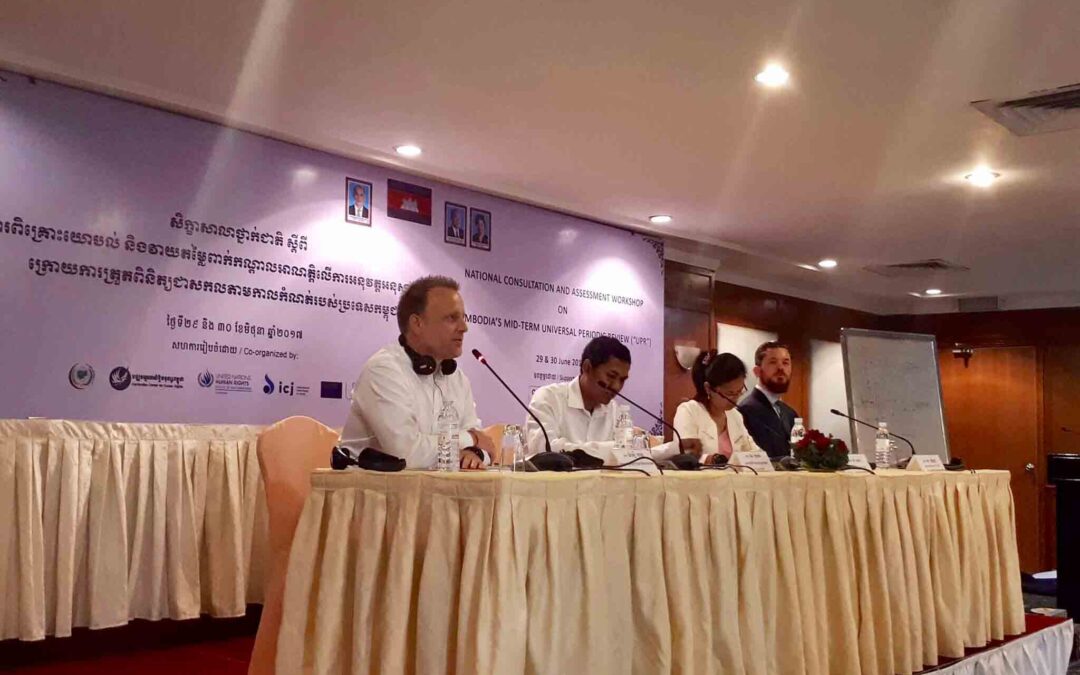
On 29 and 30 June, the ICJ co-organized a workshop for Cambodian civil society on the UPR.
The workshop was organized with the Cambodian Center for Human Rights, the Cambodia Country Office of the Office of the High Commissioner for Human Rights, UPR Info, and the Cambodian Human Rights Committee on the mid-point review of the Human Rights Council’s (HRC) Universal Review (UPR) of Cambodia.
The Royal Government of Cambodia (RGC) underwent its second UPR in January 2014.
The objectives of the workshop were to:
1. conduct a comprehensive mid-term assessment of the progress and challenges as of late June 2017 of the RGC’s implementation of those recommendations made during the second UPR cycle of Cambodia that the RGC had accepted with a view to informing advocacy around the September 2017 session of the HRC;
2. To take stock of the situation of UPR implementation to provide a basis for preparation of NGO shadow reports during the 3rd cycle of the UPR;
3. To discuss a specific set of UPR recommendations among relevant government bodies and civil society organizations in order to build relationships and raise awareness of the recommendations;
4. To advocate for the full implementation of the recommendations accepted during the second UPR cycle of Cambodia; and
5. To increase awareness of and demand among the Cambodian public for the implementation of the accepted UPR recommendations and to increase awareness of the HRC and UPR process.
Kingsley Abbott, Senior International Legal Adviser for Southeast Asia for the ICJ, moderated a panel discussion on “developing strategic advocacy plans for monitoring the implementation of UPR recommendations” and delivered a presentation on “strategies to effectively implement recommendations and lessons learned from other countries” focusing on past UPR cycles of Thailand Lao PDR.
After a comprehensive review of the recommendations accepted by the RGC during the last UPR cycle it was determined that many of the recommendations had not been implemented.
Civil society agreed that it was important to further strengthen coordinated efforts to monitor and conduct advocacy around the UPR process, engage constructively with the RGC, and begin preparation for the third UPR cycle focusing on lessons learned from the last cycle and regional experiences.
Contact
Kingsley Abbott, ICJ Senior International Legal Adviser for Southeast Asia, t: +66 94 470 1345 ; e: kingsley.abbott(a)icj.org

Jun 29, 2017 | Advocacy, News, Non-legal submissions
The ICJ, together with other 60 national and international human rights organizations urged today the Myanmar authorities, and in particular the Ministry of Transport and Communication and the Parliament, to ensure the repeal of the offence of criminal defamation.
Myanmar-JointStatement-CriminalDefamation-2017-ENG (joint statement in English)
Myanmar-JointStatement-CriminalDefamation-2017-BUR (joint statement in Burmese)
Jun 23, 2017 | News
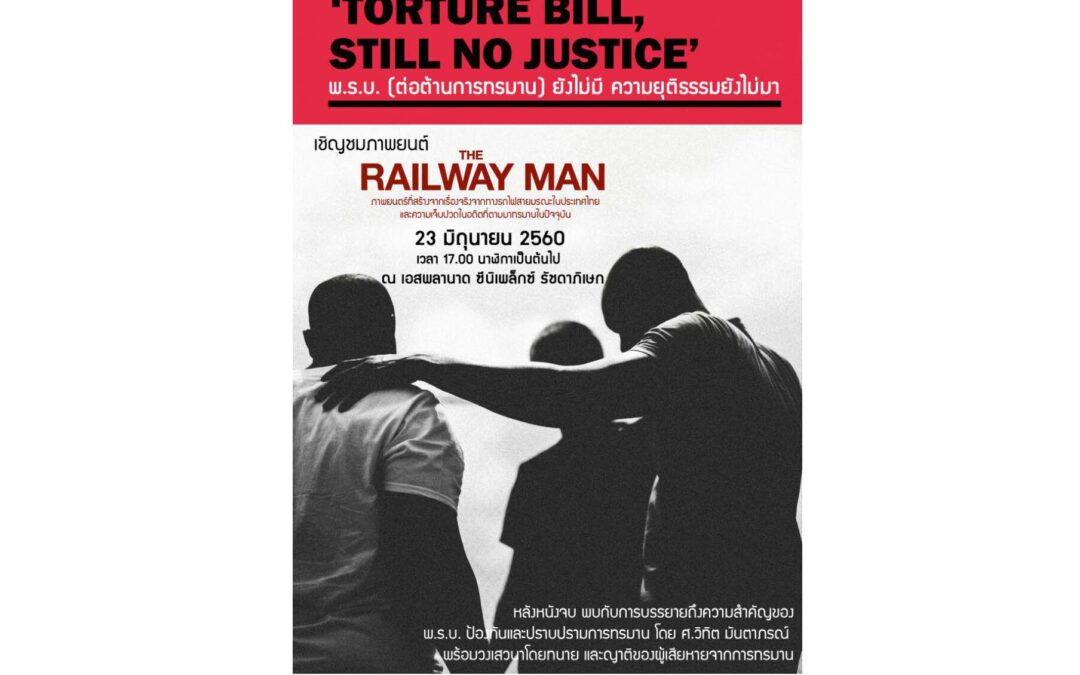
Today, the ICJ co-hosted an event in Bangkok, Thailand, named “Torture Bill, Still No Justice” to commemorate International Day in Support of Victims of Torture.
The event began with a keynote address by Professor Vitit Muntarbhorn, Special Rapporteur on violence and discrimination based on sexual orientation and gender identity and former ICJ Commissioner.
Following a screening of the film “The Railway Man”, the ICJ moderated a panel discussion which included victims of torture.
The event focused on the decision in February this year of Thailand’s National Legislative Assembly (NLA) to further delay the passage of essential legislation criminalizing torture and enforced disappearance.
Thailand is a State party to the International Covenant on Civil and Political Rights (ICCPR), the Convention against Torture and other Cruel, Inhuman or Degrading Treatment or Punishment (CAT), and has signed, but not yet ratified, the International Convention for the Protection of All Persons from Enforced Disappearance (ICPPED).
The other organizers of the event were the Southeast Asia Regional Office of the Office of the High Commissioner for Human Rights, Amnesty International Thailand, the Cross-Cultural Foundation (CrCF), the Association for the Prevention of Torture (APT) and the Canadian Embassy in Bangkok.
A comic in English and Thai named “Torture is a Crime” was produced especially for the event by Shazeera Zawawi of APT.
Contact
Kingsley Abbott, ICJ Senior International Legal Adviser for Southeast Asia, t: +66 94 470 1345 ; e: kingsley.abbott(a)icj.org
Thailand-Comic-Torture is A Crime-Advocacy-2017-ENG (English version of the comic, PDF)
Thai version here
Jun 22, 2017 | News
Pakistani authorities need to ensure a prompt, impartial and effective investigation into a barrage of assaults and threats against lawyers in the premises of the Lahore High Court, the ICJ, Human Rights Watch and Amnesty International said today.
The Government needs to defend the rule of law and prosecute those responsible for any criminal conduct.
On 20 June, during proceedings of a case involving the alleged abduction and subsequent “disappearance” of a 26-year old woman and her two-year old son, supporters of the accused, a prominent lawyer, physically assaulted the complainant’s counsel Shabbir Hussain and Usama Malik, and made abusive remarks and threats against another member of the complainant’s legal team, Noor Ejaz Chaudhry.
The attackers were mostly lawyers and members of the local bar association.
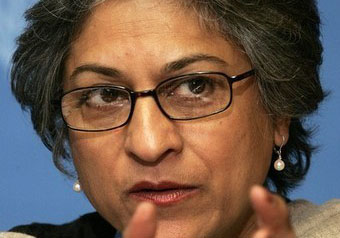
The attackers also made abusive and threatening remarks against Asma Jahangir (photo), a notable human rights lawyer, Honorary Commissioner of the ICJ, and former President of the Supreme Court Bar Association.
Asma Jahangir was not present in the court but was represented by her legal team comprising of Shabbir Hussain, Usama Malik, Mian Liaquat Ali and Noor Ejaz Chaudhry.
“The legal profession is one of the pillars of the administration of justice. It is deeply worrying that instead of discharging their responsibility to uphold the rule of law, certain lawyers would resort to threats and violence in a clear attempt to obstruct justice,” said Ian Seiderman, ICJ’s Legal and Policy Director.
Under international standards, including the UN Basic Principles on the Role of Lawyers, Pakistan has an obligation to ensure that lawyers are able to perform all of their professional functions without intimidation, hindrance, harassment or improper interference.
Where lawyers are threatened as a result of discharging their functions, authorities must ensure they are adequately safeguarded.
“Lawyers must be able to go to court without fearing violent assaults and abuse,” Brad Adams, Asia director at Human Rights Watch said. “That such assaults take place with increasing frequency in Pakistan and without accountability represents a serious failure of the Pakistani authorities to ensure rule of law.”
It is the responsibility of the bar councils and associations to ensure that allegations of professional misconduct against their members are promptly, independently and impartially investigated, and if lawyers are found in breach of their codes of conduct after a fair hearing, disciplinary action is taken against them.
Any disciplinary action must be subject to an independent judicial review.
Threatening and assaulting opposing counsel is not just against the law, but also in breach of lawyers’ professional code of ethics,” said David Griffiths, Amnesty International’s Senior Adviser on South Asia. “The respective Bar Councils must take notice of the allegations, and use this condemnable incident as an opportunity to tackle the culture of impunity which impacts even the legal profession in Pakistan.”
Background
In May 2017, Bilquis Zareena filed a habeas corpus petition in the Lahore High Court for the recovery of her daughter Ayesha and grandson Alyan Ali, who have allegedly been missing since November 2016.
According to Bilquis Zareena, her daughter had secretly been married to Maqsood Buttar, a prominent lawyer and member of the Pakistan Bar Council, the highest regulatory body for lawyers in the country.
Bilquis Zareena claims her daughter and grandson’s lives could be in danger as Maqsood Buttar had previously threatened and even attempted to kill Ayesha.
The next hearing in the case is on Friday, 23 June 2017.
Contact:
Ian Seiderman, ICJ Legal and Policy Director, e: ian.seiderman(a)icj.org
Reema Omer, ICJ International Legal Adviser (South Asia), e: reema.omer(a)icj.org
Jun 16, 2017 | News
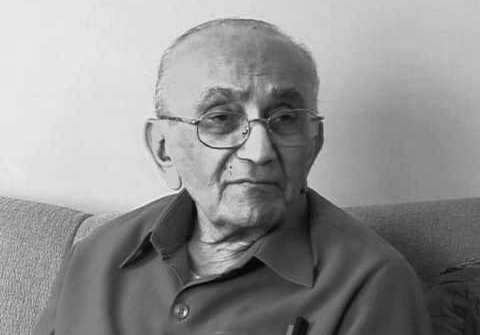
Justice Prafullachandra Natwarlal Bhagwati, former ICJ Commissioner and Honorary Member and Chief Justice of the Supreme Court of India, passed away at the age of 95, on 15 June 2017, following a brief illness.
“The International Commission of Jurists benefited greatly from Justice Bhagwati’s engagement and leadership. He was a giant of the human rights movement, dedicated to enlarging and ensuring access to justice for everyone, including those who couldn’t seek and receive justice due to their economic or social status,” said Sam Zarifi, ICJ’s Secretary-General.
“His dedication and ground-breaking approach to human rights accountability inspired many within and outside of the ICJ, and the values he represented will continue to inspire and inform our work,” he added.
Justice Bhagwati had a long history of promoting and protecting human rights, both at home and on the international stage, particularly for the most marginalized and vulnerable individuals and groups.
Former Chief Justice of India, Justice P.N. Bhagwati held a long and illustrious career within the Indian judiciary.
He introduced many innovative reforms within the Indian judicial system that increased access to justice for the poorest and most disadvantaged, including as a pioneer of public interest litigation and absolute liability.
Outside of India, Justice P.N. Bhagwati played a prominent role in the international human rights movement, for example as a member of the Committee of Experts of the International Labour Organization and Chair of the United Nations Human Rights Committee.
He was also actively involved in a number of non-governmental organizations, including the ICJ, where he committed to a high number of missions, seminars, publications and other activities on behalf of the organization.
He also served as a long-standing Chair of the Advisory Board for the ICJ’s Centre for the Independence of Judges and Lawyers.