Leading legal voices intervene at UN level in the case of detained Swazi lawyer Thulani Maseko
Alleging a range of human rights violations by Swaziland in the cases of Thulani Maseko and Bheki Makhubu, leading legal advocates today filed a petition with the UN Working Group on Arbitrary Detention (UNWGAD) in Geneva.
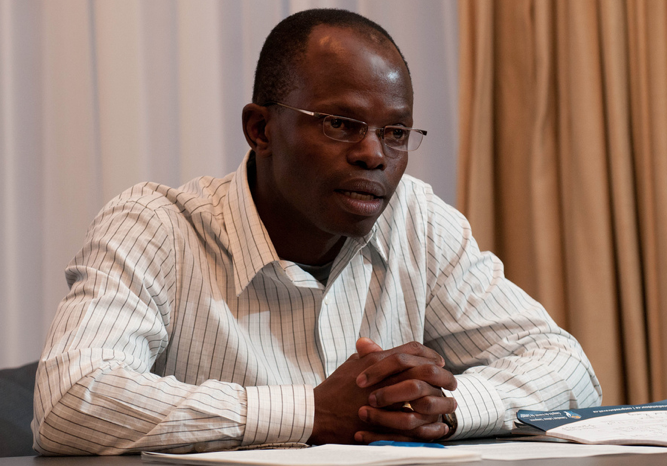
The American Bar Association’s Center for Human Rights, the global law firm Hogan Lovells and the ICJ jointly produced a petition calling for the UNWGAD to issue an opinion regarding the lawfulness of the continued incarceration of Thulani Maseko, an internationally recognized human rights lawyer and feature writer for The Nation magazine.
“The consequences of this arbitrary action against Thulani Maseko have not only violated his rights and exacted a heavy personal toll, but have also highlighted the rule of law deficit in Swaziland,” said Wilder Tayler, ICJ’s Secretary General. “Thulani Maseko has been denied his right to express an opinion on public affairs and the administration of justice, guaranteed under international law and affirmed in the UN Basic principles on the Role of lawyers.”
Thulani Maseko and journalist Bheki Makhubu were charged with two counts of contempt of court emanating from articles published in February and March 2014, in which they questioned circumstances surrounding the arrest of a government vehicle inspector.
They were sentenced to two years of imprisonment, without the alternative option of a fine at the end of a trial largely condemned by leading international rights groups as unfair and not complying with international standards on the right to a fair trial.
Some of the fair trial guarantees that have been breached, according to the legal petition filed with the UNGWAD, include the right to be tried by an independent and impartial tribunal; right to a public hearing; right to a legal counsel; right to the presumption of innocence; right to bail; and right to protection of the law.
“The use of contempt of court proceedings to suppress the right to freedom of expression is a violation of international human rights law,” said Marc Gottridge, partner at Hogan Lovells. “The right to freedom of expression is guaranteed in the Swazi constitution and international law, including treaties to which Swaziland is a party.”
“The general failings of the Swazi judiciary with respect to independence and impartiality makes it reasonable to conclude that there cannot be an effective domestic remedy for Thulani Maseko,” he added.
Contact:
Arnold Tsunga, Director, ICJ Africa Regional Programme, t +27 716 405 926 or +41 762 399 032, e arnold.tsunga(a)icj.org,
Matt Pollard, Senior Legal Adviser, ICJ, Centre for Independence of Judges and lawyers, t +41 22 979 38 12, e matt.pollard(a)icj.org
Marc Gottridge, Partner Hogan Lovells, t +1 212 918 3000, e marc.gottridge(a)hoganlovells.com
Ginna Anderson, Senior Counsel, Center for Human Rights, American Bar Association, t +1 202 442 3438, e ginna.anderson(a)americanbar.org
Background:
Thulani Maseko was arrested on 17th March 2014 following a warrant of arrest that was issued by the Chief Justice Michael Ramodibedi on his own motion.
This was after he had written an article titled “Where the Law Has No Place” criticising the courts for the way that a fellow Swazi citizen Mr Gwebu Bhantshana had been arrested and detained and the wider implications of that case on the rule of law in Swaziland.
Save for 3 days in April 2014 when he was released following Judge Mumcy Dlamini’s judgment declaring his arrest and detention wrongful and illegal, Thulani has been in custody since his initial arrest. Mr. Maseko was initially held at Sidwashini Correctional facility before he was taken to Big Bend Correctional facility, where he is currently lodged.
Further background material can be found here:
http://www.americanbar.org/news/abanews/aba-news-archives/2014/04/statement_of_jamesr.html
https://www.icj.org/swaziland-icj-concerned-at-detention-of-human-rights-lawyer-and-journalist/
Download the petition:
Swaziland-Maseko WGAD Petition-Advocacy-2015-Eng (full text in PDF)
The lawyers at Hogan Lovells US LLP who worked on this petition are Marc Gottridge, Dianne Milner, Allison Holt and Hans H. Hertell.