Mar 14, 2016 | Advocacy, Non-legal submissions
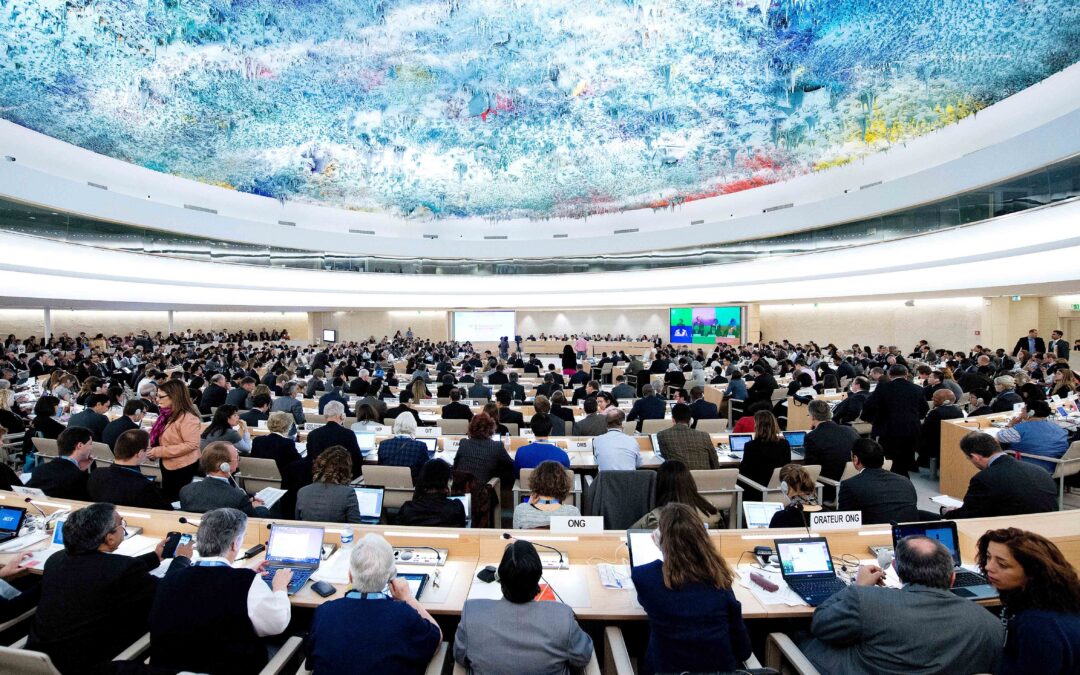
The ICJ today joined the International Bar Association’s Human Rights Institute in an oral statement during the interactive dialogue with the UN Special Rapporteur on the situation for human rights in Myanmar.The statement focussed on the situation of the legal profession and judiciary.
It is available to download in PDF format here: HRC31-Advocacy-OralStatement-SRMyanmar-2016

Mar 10, 2016 | News
The ICJ welcomes the decision of the Magistrate Court to dismiss the charges against Lena Hendry for her involvement in 2013 screening of No Fire Zone: The Killing Fields of Sri Lanka, an award-winning human rights documentary on the civil war in Sri Lanka.
Magistrate Mohamad Rehab Mohd Aris determined that the prosecution failed to prove a prima facie case against Lena Hendry (photo).
As a consequence, she did not have to enter her defense.
“We welcome the decision of the Magistrate’s Court to clear Lena Hendry from all charges,” said Emerlynne Gil, ICJ’s Senior International Legal Adviser.
“We must emphasize though that subjecting Lena Hendry in the first place to criminal prosecution simply for screening this documentary violated her human rights and contravenes Malaysia’s obligations to uphold freedom of expression,” she added.
“We should remember that the provision in the Film Censorship Act 2002 used against Lena Hendry remains on the books and still operative. It can still be used to stifle the voices of other human rights defenders in Malaysia,” Gil further said.
Lena Hendry was charged under section 6(1)(b) of the Film Censorship Act 2002 for allegedly showing the film without prior authorization by the Board of Censors.
The said provision prohibits any person to circulate, exhibit, distribute, display, manufacture, produce, sell, or hire any film or film publicity material that has not been approved by the Board of Censors.
If Lena Hendry had been found guilty, she could have faced a fine of up to RM30,000 (approximately US$6,900) and/or a sentence of up to three years imprisonment.
The ICJ reiterates its call to the Government of Malaysia to safeguard freedom of expression and uphold the right of individuals to elaborate and disseminate information, including on questions of public import and the documentation of human rights abuses.
Contact:
Emerlynne Gil, Senior International Legal Adviser for Southeast Asia, t: +66 840923575 ; e: emerlynne.gil@icj.org

Mar 10, 2016 | Advocacy, Non-legal submissions
The ICJ today delivered an oral statement on counter-terrorism legislation in these countries, in an interactive dialogue at the UN Human Rights Council with the the Special Rapporteur on the promotion and protection of human rights and fundamental freedoms while countering terrorism.
The text of the statement follows:
COUNTER-TERRORISM LEGISLATION IN EGYPT, TUNISIA AND PAKISTAN
10 March 2016
Mr President,
The International Commission of Jurists (ICJ) welcomes the attention given by Special Rapporteur Ben Emmerson, to defective counter-terrorism legislation that facilitates violations of human rights, as reflected for example by communications on Egypt, Tunisia and Pakistan in the Communications Report of Special Procedures (A/HRC/31/79).
Numerous counter terrorism laws promulgated or applied in these and other countries include overly broad or imprecise definitions of terrorism-related offences. These extend the laws’ reach beyond acts of a truly terrorist character. Such laws can be and are abused or misapplied to criminalize the legitimate and peaceful exercise of fundamental rights and freedoms.
Further, these laws provide sweeping immunities that contribute to pervasive impunity for unlawful killings by security forces.
These laws also facilitate violations of the right to liberty and fair trial rights and insufficiently safeguard against abuses in detention. In Tunisia a person can be held in police custody without being brought before a judge for up to 15 days. In Pakistan, suspects can be held in preventive detention without charge, and without being brought before a judge, for up to 90 days.
Egypt and Pakistan continue to use military courts to conduct unfair trials of civilians in terrorism cases, contrary to international standards. At least eight civilians sentenced to death in secretive trials by military courts in Pakistan have been hanged since January 2015. “Expedited” procedures in terrorism circuit courts in the Egyptian civilian system also give rise to fair trial concerns.
The ICJ invites the Special Rapporteur to comment on measures or mechanisms that states, inter-governmental organisations, and civil society can take to help ensure that states such as Tunisia, Egypt and Pakistan repeal or amend counter-terrorism legislation to bring it into line with their international human rights obligations and commitments.

Mar 9, 2016 | News
The recent decision of the Thai Supreme Court in the case of the enforced disappearance of Somchai Neelapaijit demonstrates Thailand must urgently ratify the Convention against Enforced Disappearance and enact domestic laws consistent with the Treaty, said the ICJ today.
On 29 December 2015, the Supreme Court of Thailand upheld the acquittals of five police officers charged with gang-robbery and coercion. These charges related to Somchai’s abduction and the taking of his property.
The authorities have blamed the failure to charge anyone to date with Somchai’s actual enforced disappearance or presumed death, in part, on the absence of physical remains.
The Supreme Court further held that Somchai Neelapaijit’s wife, Angkhana Neelapaijit, and his children could not participate in the proceedings as plaintiffs as, under Thai law, it had to be shown that Somchai Neelapaijit was either injured or killed such that he could not represent himself.
The Court reasoned that this was not the case as “it is not currently known whether or not Mr. Somchai is alive” and the accused had only been charged with gang-robbery and coercion.
“The Supreme Court decision does not in any way end Somchai’s case,” said Sam Zarifi, ICJ’s Asia Director.
“The Thai government is obliged to seek and provide truth and justice for Somchai and his family,” he added.
The Department of Special Investigations (DSI), often described as the FBI of Thailand, has been conducting an ongoing investigation into Somchai Neelapaijit’s fate or whereabouts since 2005.
“The glacial pace of the DSI’s investigation and unfortunate decision of the Supreme Court after all these years is heart-breaking,” said Zarifi.
Before the United Nations Human Rights Council in May 2008, the Royal Thai Government pledged “to do its utmost and leave no stone unturned in order to bring to justice the case of Mr Somchai.”
“But to do its ‘utmost’ to resolve this case, Thailand must take urgent and concrete steps to ratify the Convention against Enforced Disappearance and pass domestic laws that retrospectively recognize enforced disappearance as a distinct offence and the full rights of victims, including family members,” Zarifi added.
Promisingly, the Ministry of Justice is in the process of drafting a Prevention and Suppression of Torture and Enforced Disappearance Bill, which, in a draft seen by the ICJ, defines and criminalizes enforced disappearance and torture in Thailand.
Contacts
Sam Zarifi, ICJ Regional Director, Asia-Pacific Programme, t: +66807819002 ; e: sam.zarifi(a)icj.org
Kingsley Abbott, International Legal Adviser for Southeast Asia, t +66 94 470 1345 ; e: kingsley.abbott(a)icj.org
Additional information
Angkhana Neelapaijit, now Commissioner of the Thai Human Rights Commission, told the ICJ: “The decision of the Supreme Court acquitting the five accused and denying my children and me the right to participate in the proceedings shows that victims of enforced disappearance have nowhere to turn to obtain justice in Thailand. It is clear that nothing will change until Thailand urgently ratifies the Convention against Enforced Disappearance and amends its laws to ensure the rights of victims are upheld.”
Thailand signed, but has not yet ratified, the Convention Against Enforced Disappearance in January 2012. Pending the ratification, Thailand must desist from any acts that would defeat the objective and purpose of the Convention, which among other things places an obligation on State Parties to make enforced disappearance a criminal offence, to thoroughly and impartially investigate cases, bring those responsible to justice and treat family members of a ‘disappeared’ person as victims in their own right.
Forthcoming event
On 11 March 2016, the ICJ, together with Amnesty International (Thailand), Human Rights Watch, and the Justice for Peace Foundation will hold “a discussion on enforced disappearance in Thailand focusing on the recent decision of the Supreme Court in Somchai Neelapaijit’s case and the draft Prevention and Suppression of Torture and Enforced Disappearance Bill” to mark the 12-year anniversary since Somchai Neelapaijit “disappeared” on 12 March 2004.
Date: 11 March 2016
Time: 10.00am -12.00pm
Location: The Sukosol Hotel, room Kamolthip 3, Sriayutthaya Road, Bangkok
The speakers will be:
- Angkhana Neelapaijit
- Kingsley Abbott, International Legal Advisor, the International Commission of Jurists
- Sunai Phasuk, Senior Researcher, Human Rights Watch
- Laurent Meillan, Acting Representative, Office of the High Commissioner for Human Rights Office for South-East Asia
- A representative from the Department of Rights and Liberty Protection, Ministry of Justice
Related readings
To mark the 10-year anniversary of Somchai Neelapaijit’s “disappearance”, the ICJ released a report Ten Years Without Truth: Somchai Neelapaijit and Enforced Disappearances in Thailand, in which it documented the tortuous legal history of the case.
On 11 December 2015, the ICJ published an English version of its Practitioners Guide “Enforced Disappearance and Extrajudicial Execution: Investigation and Sanction”, originally published in Spanish in March 2015.
Thailand-Somchai disap anniversary 2016-News-Press releases-2016-THA (full text in Thai, PDF)