Mar 16, 2021 | Advocacy
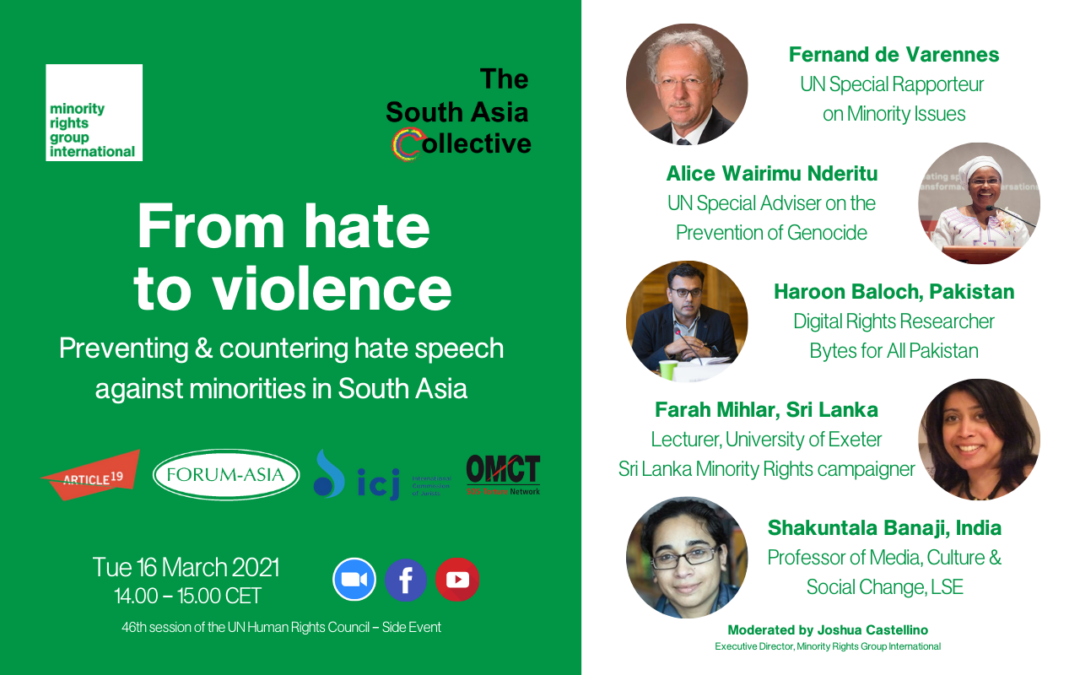
This side event will take place on Tuesday 16 March 2021, from 14:00-15:00 (CET) at the 46th session of the UN Human Rights Council. For registration: https://bit.ly/3llCCMF
Minority Rights Group International and South Asia Collective, along with ICJ, OMCT, Article 19 and FORUM-ASIA, are hosting a side event at 46th session of the Human Rights Council, on hate speech and incitement in South Asia. The aim is to instigate discussion on the causes and consequences of hate speech in South Asia, in the hope of encouraging UN and its agencies to engage better on preventive and early warning actions in the region.
Speakers
- Fernand de Varennes – UN Special Rapporteur on Minority Issues
- Alice Wairimu Nderitu – UN Special Advisor on the Prevention of Genocide
- Haroon Baloch, Pakistan – Digital Rights Researcher, Bytes for All Pakistan
- Farah Mihlar, Srilanka – Lecturer, University of Exeter; Srilanka Minority Rights campaigner
- Shakuntala Banaji, India – Professor of Media, Culture and Social Change at London School of Economics
Moderator
- Joshua Castellino – Executive Director, Minority Rights Group International
Mar 15, 2021 | Advocacy, News
The ICJ and a group of Sri Lankan judges have agreed on the importance of taking effective measures to address discrimination and equal protection in accessing justice in the country.
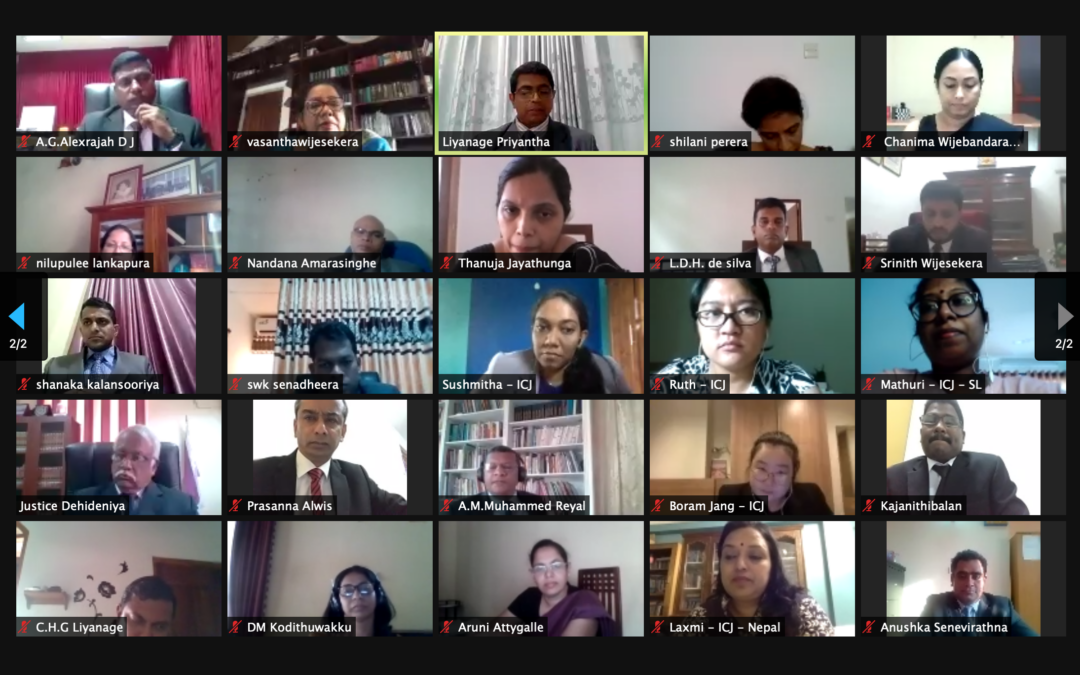
On 6 and 13 March 2021, the ICJ, in collaboration with the Sri Lanka Judges’ Institute (SLJI), organized the National Judicial Dialogue on the Elimination of Discrimination against Women and Enhancing Women’s Access to Justice. This event was organized under the ‘Enhancing Access to Justice for Women in Asia and the Pacific’ project funded by the Swedish International Development Cooperation Agency (SIDA).
Twenty magistrates and District Court judges from around Sri Lanka, with judicial and legal experts from other countries, participated in this judicial dialogue which was conducted virtually due to the COVID-19 pandemic.
The dialogue highlighted how Sri Lankan women continue to face a myriad of challenges including legal, institutional and cultural barriers when accessing justice. Gender biases and discriminatory behaviour prevalent in every aspect of justice delivery needs to be dealt with in order to effectively enhance women’s access to justice.
Boram Jang, ICJ International Legal Advisor remarked that “judiciaries have an important role to play in eliminating gender discrimination in justice delivery as it is a critical component in promoting women’s access to justice. In order to do so, the judges should be equipped with a full understanding of Sri Lanka’s obligations under the CEDAW and other human rights instruments.”
Honorable L. T. B. Dehideniya, Justice of the Supreme Court of Sri Lanka and Executive Director of the SLJI expressed hope that judicial dialogues such as this would “enhance the capacity of participant judges to use the international legal instruments, which Sri Lanka has ratified, in domestic judicial work especially with regard to the elimination of gender inequalities and biases.”
Ms. Bandana Rana, Vice Chair of the CEDAW Committee led a discussion with the judges on the application of the Convention on the Elimination of All Forms of Discrimination Against Women (CEDAW), pointing out that “judges play a pivotal role in identifying the incongruences between existing laws and international human rights standards and ensuring that the full gamut of women’s human rights is retained in line with the CEDAW framework.”
Justice Ayesha. M. Malik, High Court Judge, Lahore, Pakistan affirmed the importance applying the right to access to justice under international human rights law and suggested strategies for reflecting these international standards in judicial decisions.
Attorney Evalyn Ursua addressed on gender stereotypes and biases in justice delivery and engaged the participants on how these could be effectively eliminated. She stated that “the judiciary as a part of the State has the obligation to eliminate gender discrimination.” She encouraged the judges to use the cultural power of law to change language and attitudes surrounding gender discriminatory behaviour and stigma.
The second day featured a discussion on the specific barriers that women in Sri Lanka face when they access justice. Hon. Shiranee Tilakawardane, former Justice of the Supreme Court of Sri Lanka led a discussion on the role and measures available to the judiciary as an institution to enhance access to justice for Sri Lankan women.
Justice Tilakawardane stated that “While theoretically, the Sri Lankan constitution enshrines equality before the law, in reality women continue to feel disadvantaged when they try to access justice” and added “the Sri Lankan judiciary can empower its women only when it understands, acknowledges and addresses the disadvantages they face owing to their gender.” She impressed upon the participant-judges that “ensuring equality is no longer a choice, nor is it merely aspirational, but a pivotal part of judicial ethics.”
The panelists on the second day surveyed the legal, institutional and cultural challenges faced by women at every step of the judicial process. The panel comprised of Prof. Savitri Goonesekere, Emeritus Professor of Law and Former member of the CEDAW Committee, Mrs. Farzana Jameel, P.C, Additional Solicitor General of the Attorney General’s Department and Mrs. Savithri Wijesekara, Executive Director of Women in Need.
Contact
Osama Motiwala, Communications Officer – osama.motiwala@icj.org
Mar 15, 2021 | Advocacy, Non-legal submissions
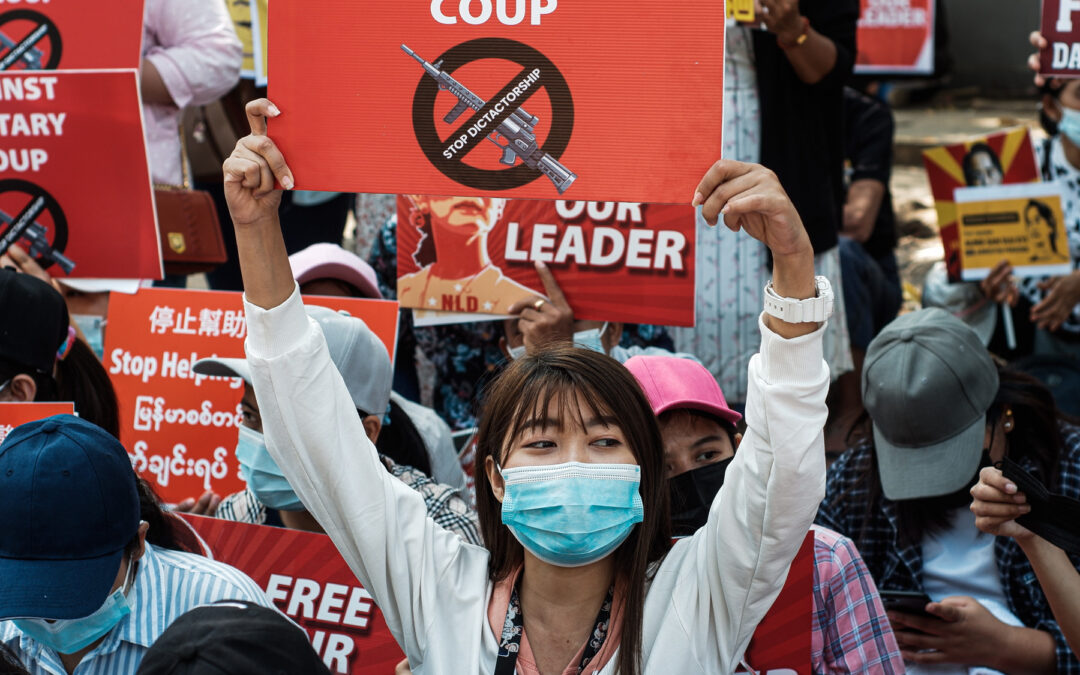
Today, during a General Debate, the ICJ called on the UN Human Rights Council to condemns a set of laws amendend by the military governmentn in Myanmar and restricting human rights, and to demand the return to of Myanmar civilian rule respecting the rule of law.
The statement reads as follows:
“Madame President,
The International Commission of Jurists (ICJ) condemns the illegitimate attempts to “amend” several laws by the Military appointed Myanmar’s State Administration Council (SAC) following its unlawful seizure of power on 1 February 2021.
The implementation of the Amended Law Protecting the Privacy and Security of Citizens (2017) would undermine the democratic process, criminalize peaceful protests and remove various human rights protections. It would provide for broad and unchecked power to the military to arrest anyone without a warrant and aim to remove basic protections, including the rights to be free from arbitrary detention and from warrantless surveillance and search and seizure.
The amendments to the Penal Code and the Criminal Procedural Code have made non-bailable certain offenses, specifically targeting persons criticizing the coup or the military junta, as well as those encouraging others to support the “Civil Disobedience Movement.”
In addition, Amendments made to other existing laws, such as the Ward and Tract Administration Law and Electronic Transactions Law, allow for search and seizure at night without arrest warrant and allow for the silencing of critical voices against the coup and human rights violations of the military, in violation of international standards.
The ICJ calls on the Council to adopt a resolution, which, among other things, univocally condemns and demands the repeal of these laws and the return to of Myanmar civilian rule respecting the rule of law.
Thank you.”
Mar 12, 2021 | Advocacy, Non-legal submissions
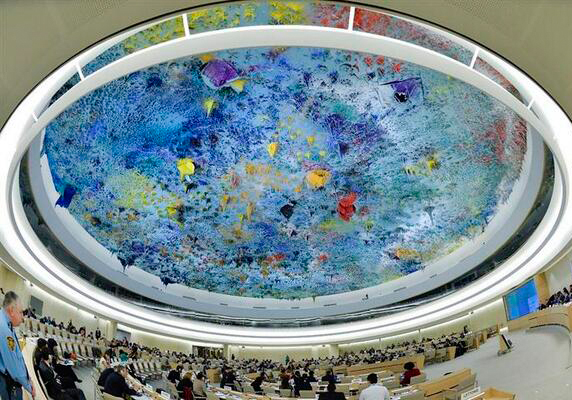
Today, the ICJ delivered a statement to the UN Human Rights Council calling for accountability for crimes against humanity committed in Myanmar during the Interactive Dialogue on the report by the UN Special Rapporteur on the situation of human rights in Myanmar.
The statement reads as follows:
“Madame President,
The International Commission of Jurists (ICJ) welcomes the recent report of the Special Rapporteur on the situation of human rights in Myanmar.
The widespread gross violations of human rights documented in the report – including extrajudicial killings, arbitrary arrests and detention- underscore the need for urgent measures of accountability to redress these and to deter further violations.
ICJ has documented further evidence that the unlawful crackdown against peaceful protestors have continued to worsen leading to more extrajudicial killings. More than 50 people have already been unlawfully killed and several hundreds have been severely injured.
Hundreds of others have been arbitrarily arrested and detained, with some subjected to torture and ill-treatment. As the scale of violations continues to increase in many parts of the country, these attacks have become systematic and widespread, and must be investigated as crimes against humanity.
The ICJ therefore supports the recommendations made by the Special Rapporteur, including for referral of the situation to the ICC.
The ICJ urges the Council to adopt a resolution that would strengthen and support the IIMM’s work to collect and preserve evidence for accountability; and to extend the mandate of the Special Rapporteur, including to ensure the immediate, full and unrestricted monitoring of the situations and prompt and effective implementation of their recommendations.
Thank you.”
Contact:
Massimo Frigo, ICJ UN Representative, e: massimo.frigo(a)icj.org, t: +41797499949
Mar 4, 2021 | News
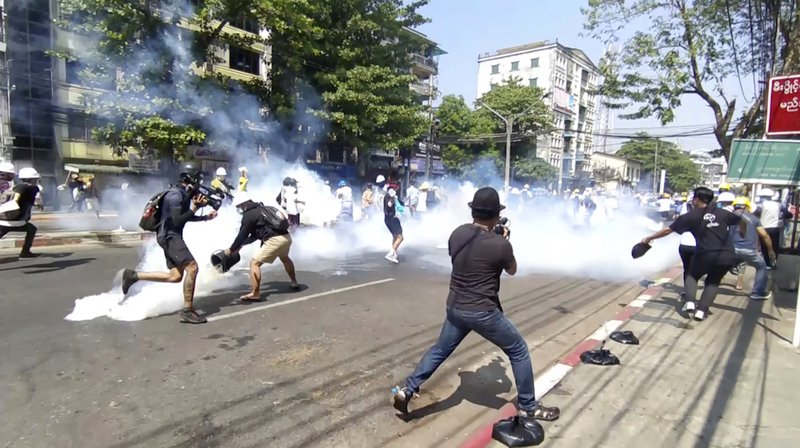
The escalating killing of peaceful protestors by Myanmar’s security forces should be independently investigated as possible crimes against humanity, said the ICJ today on the eve of a closed-door UN Security Council session on the situation.
According to reliable information provided to the ICJ, security forces have unlawfully killed approximately 50 unarmed people – including at least five children – in more than 10 cities on different days since the military overthrew the civilian government on 1 February 2021. On 3 March, at least 38 people were reported killed by security forces.
In addition, numerous protestors have been injured and a total of 1,498 people have been arrested, charged or sentenced in relation to the military coup, according to The Assistance Association for Political Prisoners (AAPP).
“As the scale of the violence continues to increase, seemingly as part of a systematic, centralized policy to use lethal force against peaceful protestors, it is hard to escape the conclusion that Myanmar’s security forces are perpetrating crimes against humanity,” said Kingsley Abbott, Director of Global Accountability and International Justice at the ICJ. “This underscores the urgent need for all states, including the permanent members of the UN Security Council, to stop shielding the Myanmar military and work together towards opening avenues to justice for the Myanmar people.”
The UN Security Council will meet this Friday for a closed-door session at the request of the United States which is President of the Council in March 2021.
“The UN Security Council should immediately refer Myanmar to the International Criminal Court for a full independent and effective investigation,” added Abbott.
In addition to acts that may constitute murder as a crime against humanity, security forces have also reportedly committed acts which, when committed in a widespread and systematic manner, would amount to other crimes against humanity, including imprisonment, torture, and enforced disappearance – all of which also go towards supporting the existence of an attack.
“These killings and other crimes under international law are a direct result of the culture of impunity that has been allowed to persist in Myanmar for decades,” added Abbott. “All states should support the different accountability initiatives underway, including the Independent Investigative Mechanism for Myanmar which is collecting evidence for use in future legal proceedings.”
“It is long past time for perpetrators of serious human rights violations in the country to be brought to justice before the International Criminal Court or in any national jurisdictions willing and able to exercise universal jurisdiction.”
Background
On 12 September 2018, following an independent investigation, the United Nations Independent International Fact-Finding Mission on Myanmar called for Myanmar’s military to be “…investigated and prosecuted in an international criminal tribunal for genocide, crimes against humanity and war crimes” concerning alleged violations in Shan, Kachin and Rakhine States and elsewhere throughout the country.
Under general international law, including customary international law and treaties and statutes of international criminal courts, crimes against humanity must be prosecuted. The authoritative definition of crimes against humanity is contained in the Rome Statute of the International Criminal Court (ICC).
Under Article 7 of the Rome Statute, for killings to amount to crimes against humanity, they must be committed as part of a widespread or systematic attack directed against any civilian population, with knowledge of the attack. According to the elements of crimes of the Rome Statute, “’Attack directed against a civilian population’ in these context elements is understood to mean a course of conduct involving the multiple commission of acts referred to in Article 7, paragraph 1, of the Statute against any civilian population, pursuant to or in furtherance of a State or organizational policy to commit such attack. The acts need not constitute a military attack. It is understood that ‘policy to commit such attack’ requires that the State or organization actively promote or encourage such an attack against a civilian population.”
Generally speaking, “widespread” refers to the geographical scope of the attack and the number of victims, but not exclusively. “Systematic” refers to the organized nature of the acts of violence and the improbability of their random occurrence.
Myanmar is not a State Party to the Rome Statute of the ICC. However, the ICC is investigating crimes committed against the Rohingya minority as part of waves of violence in Rakhine State in 2016 and 2017 where one element or part of the crime was committed inside Bangladesh, which is a party to the Rome Statute. The ICC would be able to conduct a full investigation of the situation in Myanmar if the UN Security Council used its Chapter VII powers to refer the matter to the ICC pursuant to Article 13(b) of the Rome Statute.
Universal jurisdiction refers to the legal concept that States have the authority, and in some cases the obligation, to bring proceedings in relation to certain crimes, including crimes against humanity, because they are so serious it does not matter where the crimes were committed or the nationality of the perpetrators or the victims. States are generally entitled to exercise jurisdiction for serious under crimes under international law.
Contact
Kingsley Abbott, ICJ Director of Global Accountability and International Justice; e: kingsley.abbott(a)icj.org
Sam Zarifi, ICJ’s Secretary General, sam.zarifi(a)icj.org