Oct 6, 2015 | Multimedia items, News, Video clips
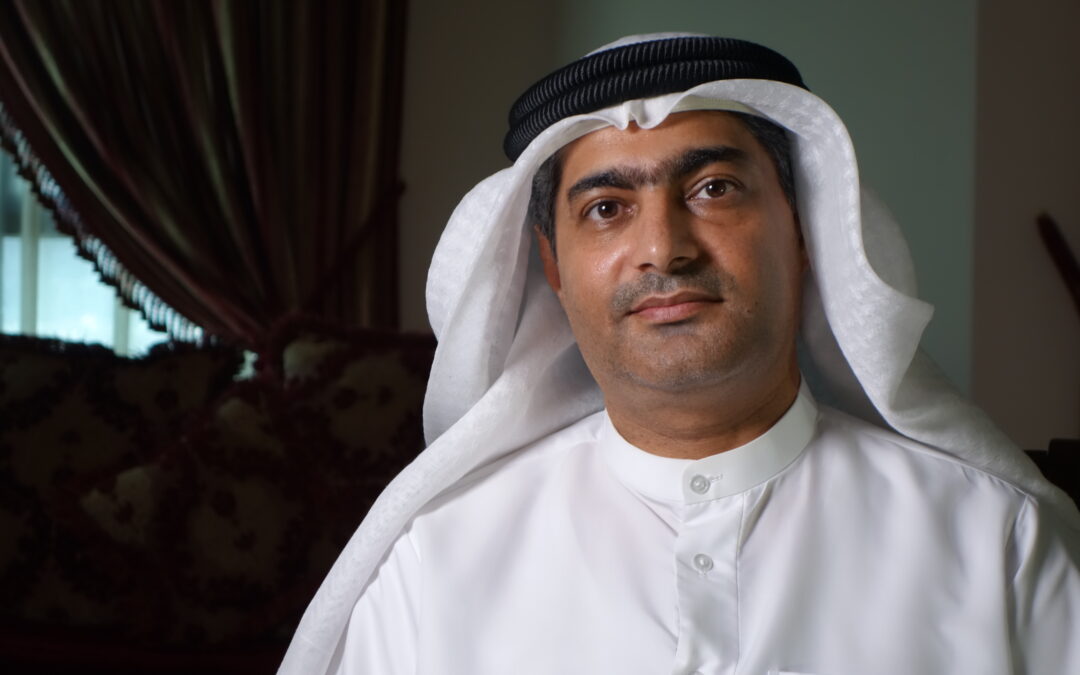
Selected by a jury of 10 Global Human Rights organizations, including the ICJ, Ahmed Mansoor could not come to Geneva to collect the 2015 Award, as he has been banned from travelling. Robert Sann Aung (Myanmar) and Asmaou Diallo (Guinea) receive Martin Ennals Prizes.
Emirati blogger and prominent human rights defender Ahmed Mansoor is one of the very few independent voices to whom international NGOs can turn for a credible independent assessment of human rights developments in the United Arab Emirates.
He regularly raises concerns on arbitrary detention, torture, international standards for fair trials, non-independence of the judiciary, and domestic laws that violate international law.
Since 2006, he has focussed on initiatives concerning freedom of expression, civil and political rights.
He successfully campaigned in 2006-2007 to support two people jailed for critical social comments, who were released and the charges dropped.
Shortly after, the Prime Minister of UAE issued an order not to jail journalists in relation to their work.
He has faced repeated intimidation and harassment, including imprisonment in 2011 after being convicted of “insulting officials” and sentenced to three years’ in prison, although he was released after eight months.
Since being jailed in 2011, he has been denied a passport and banned from travelling.
The Martin Ennals Jury has publically urged the government of the UAE to lift this travel ban and allow him to travel.
“Ahmed Mansoor continues to pay the price for speaking out on human rights issues in his country, we urge his government to lift the travel ban,” said Martin Ennals Foundation Chair Micheline Calmy-Rey.
“There is little attention for the massive crackdown on free expression and assembly in the UAE, and Ahmed Mansoor is one of the few independent voices who refuses to be silenced,” said Olivier van Bogaert, ICJ Director of Media and Communications, and ICJ Representative on the MEA Jury.
“Without him, we would probably not know that behind the UAE’s shopping malls, high-rise towers and tourism hub, there is a nasty underside, there are dark prisons where inmates are hidden for years without trial, and tortured,” he added.
Honored with a Martin Ennals Prize, Robert Sann Aung (Myanmar) has courageously fought against human rights abuses since 1974.
He has been repeatedly imprisoned in harsh conditions, physically attacked as well as regularly threatened. He was disbarred from 1993 – 2012.
Currently, he represents students detained for peacefully protests.
Asmaou Diallo (Guinea) founded l’Association des Parents et Amis des Victimes du 28 septembre 2009 (APIVA), after the Guinean military attacked peaceful demonstrators on that day.
APIVA assists those affected, and supports them to testify in court proceedings.
Background
The “Nobel Prize of Human Rights”, the Martin Ennals Award for Human Rights Defenders (MEA) is a unique collaboration among ten of the world’s leading human rights organizations to give protection to human rights defenders worldwide.
Strongly supported by the City of Geneva, the award is given to Human Rights Defenders who have shown deep commitment and face great personal risk. Its aim is to provide protection through international recognition.
The Jury is composed of the following NGOs: ICJ, Amnesty International, Human Rights Watch, Human Rights First, Int’l Federation for Human Rights, World Organisation Against Torture, Front Line Defenders, EWDE Germany, International Service for Human Rights, and HURIDOCS.
Contact:
Michael Khambatta, Director Martin Ennals Foundation, t: +41 79 474 8208, e: khambatta(a)martinennalsaward.org
Olivier van Bogaert, ICJ Director of Media and Communications, and ICJ Representative on the MEA Jury, t: +41 22 979 38 08, e: olivier.vanbogaert(a)icj.org
Watch the Martin Ennals Award Ceremony 2015:
Watch the Ahmed Mansoor film:

Sep 16, 2015 | News
Myanmar’s government must end the practice of appointing newly retired military officials as judicial officers to its courts and ensure that the judiciary carries out its functions as a separate branch and independent of the Executive, said the ICJ today.
At least 20 former military officers who have just recently resigned from the military were reportedly appointed as vice director generals to the country’s Supreme Court this month.
They will be performing administrative functions but according to section 310 of the Myanmar Constitution will be in line for senior judicial appointments at the state or regional level after 5 years or sooner if the President considers them to be ‘eminent jurists’.
“One of the fundamental aspects of an independent, impartial and accountable judiciary is the appointment of judges, through proper procedures, on the basis of their legal competencies,” said Sam Zarifi, ICJ’s Asia Director. “The process for appointing and promoting judges must be transparent and ensure judicial independence and impartiality.”
A group of leading members of the Myanmar bar launched a “yellow ribbon” campaign last Friday in Yangon to protest the practice of assigning military officers to serve as judicial officers.
“The process of selecting these officers and assessing their legal qualifications is totally opaque,” Zarifi added. “The lawyers wearing yellow ribbons are emphasizing the belief of people in Myanmar that strengthening the rule of law is essential to guaranteeing justice and the country’s political and economic development, so it’s important to improve the judiciary’s qualifications and increase public trust.”
The Supreme Court of Myanmar launched its Strategic Plan 2015-2016, citing “judicial independence and accountability” as one of its key strategy areas.
The UN Basic Principles on the Independence of the Judiciary provide that that “Persons selected for judicial office shall be individuals of integrity and ability with appropriate training or qualifications in law.”
“The Myanmar judiciary is trying to shake off decades of interference from the Executive branch in order to assert its proper role as defender of the rights of people in Myanmar, and it can’t do so without a clear and transparent appointment and promotion process,” Zarifi said.
An exposition and analysis of international law and standards are available in English and Myanmar language in the ICJ’s authoritative Practitioners’ Guide on the Independence and Accountability of Judges, Lawyers and Prosecutors.
Contact:
Sam Zarifi, ICJ Regional Director for Asia and the Pacific, t: +66 807819002; e: sam.zarifi(a)icj.org
Vani Sathisan, ICJ International Legal Adviser for Myanmar, t: +95 9250800301; e: vani.sathisan(a)icj.org
Jul 8, 2015 | News
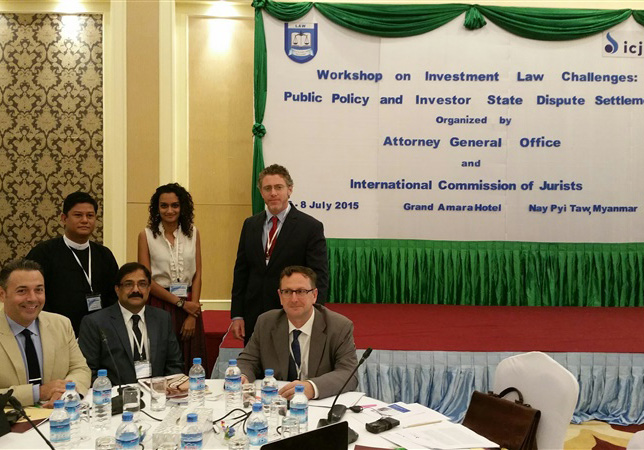
The ICJ held a successful workshop with the Office of the Attorney General (OAG) on ‘Investment Law Challenges: Defending Public Policy in Investor State Arbitration’.
The event took place in Nay Pyi Taw from 6 to 8 July 2015 and was attended by 60 participants from the OAG and other Ministries.
The workshop was designed to raise awareness about Myanmar’s human rights obligations in relation to investment and to build the OAG’s capacity to draft law that carves out regulatory space for public policy making.
The workshop also prepared the OAG for challenges to public policy through arbitration with a moot court exercise.
The topic is timely as Myanmar rushes to draft new investment law and sign Bilateral Investment Treaties that give investors standing to challenge public policy promoting and protecting human rights.
In opening the workshop, Director General U Kyaw San spoke of the rapid increase of investment in Myanmar and the corresponding changes in its regulatory system.
Dr. Na Chi Oo, a speaker for the OAG, outlined the challenges this poses to the drafting of new public policy.
Participants heard from ICJ Commissioner Prof Andrew Clapham who discussed globalization, investment arbitration and public policy.
He examined the use of human rights law in investment arbitrations.
Guest speaker Prof. Anthony Daimsis introduced bilateral investment treaties and highlighted provisions that can restrict state regulatory space.
Prof. Errol Mendes gave examples of international cases in which public policy has been challenged.
Ms. Harpreet Kaur Dhillon, from the Centre for International Law, National University of Singapore gave practical advice for drafting law that protects the regulatory role of the state.
Dr. Daniel Aguirre, ICJ Legal Adviser, added that “Myanmar needs to update its regulatory system to protect the environment and human rights. It must make sure it does not sign away its regulatory role through investment law and bilateral treaties.”
The event culminated with a moot arbitration exercise where OAG participants engaged in a mock consultation process and a simulated arbitration over a public health policy.
The ICJ was impressed by the interest and genuine commitment of the participants to promote the rule of law and public policy in Myanmar.
The ICJ staff enjoyed open and frank discussion with the Attorney General and is Director Generals on relevant legal developments and looks forward to further discourse.
The ICJ remains committed to provide support in this field in line with the promotion and protection of human rights.
Jun 9, 2015 | News
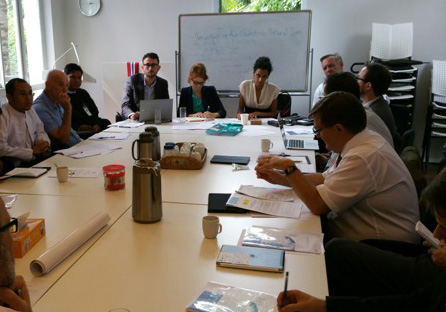
The ICJ today organized a diplomatic dialogue, in advance of the Universal Periodic Review (UPR), with ambassadors and high-level diplomatic representatives, to share the state of human rights in Myanmar.
Jun 1, 2015 | News
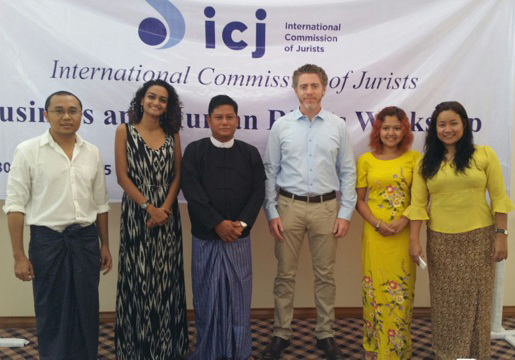
The ICJ conducted a two-day workshop on “Business and Human Rights” in Kyauk Phyu, Rakhine State on 30-31 May. The event was attended by 40 participants representing civil society organizations in Sittwe, Kyauk Phyu, Ann and Ponna Kyaunn.
It also included members from the township and district courts, township police force and members of parliament, focused on investment in Rakhine state in the absence of credible and transparent mechanisms to prevent human rights abuses.
The workshop occurred against the backdrop of myriad longstanding human rights issues in Rakhine State, including the humanitarian crisis confronting the state’s Rohingya population.
The State has also witnessed ongoing government repression of the State’s ethnic Rakhine population in response to demands for autonomy and their opposition to unregulated development of the State’s ample natural resources, including extensive gas deposits, at the expense of their livelihoods and rights.
The development of gas fields in the State has been fraught with human rights violations, including of forced labour and forced eviction of thousands of farmers from their lands.
As discussed during the workshop, since Myanmar’s relative opening up, the government has continued to invite and approve of foreign investors to develop resource extraction projects in Rakhine State, while locals resist the potential harmful effects of such projects on their livelihoods, properties and environment.
In 2013, hundreds of villagers protested against the adverse impacts of the Shwe gas pipeline construction – a large scale natural gas project developed by Daewoo International of South Korea in a joint venture with Myanmar Oil and Gas Enterprise.
Daewoo has once again ventured into Rakhine State, proposing a coal power plant in Kyaukphyu township, that could have adverse effects on the economic and environmental landscapes in local communities.
During ICJ’s previous trips to Sittwe and Kyaukphyu, local civil society activists had asked for information on responsible investment and national and international standards relating to displacement, land confiscations, and environmental and social impact assessments.
In the first day of the workshop, U Kyaw Min San, ICJ’S National Legal Adviser, led the discussion on fundamental citizen rights guaranteed in Myanmar legislation as well as an analysis of the land laws in Myanmar.
Daniel Aguirre, ICJ’s International Legal Adviser, gave an overview of international human rights law and the role of States and business corporations in protecting and respecting economic, social and cultural rights.
Vani Sathisan, ICJ’s International Legal Adviser, provided a legal analysis of Myanmar’s law on Special Economic Zones (SEZ), highlighting how the law fails to guarantee the protection of human rights and the environment while providing tax reliefs and exemptions, as well as land leases, to win over investors and developers.
On the second day, Daw Tin Tin Wai, Private Sector Policy Officer from Oxfam GB and a Campaign Officer from EarthRights International shared their experiences from Dawei SEZ and Thilawa SEZ, respectively.
They shared that lack of consultations with local communities and large-scale land confiscations through intimidation and threats occurring in the two SEZs reflected flaws in the government and judiciary to protect human rights and provide for access to remedy.
The workshop included a group discussion among the participants focusing on the role of local and international non-governmental organizations in Kyauk Phyu, Ponna Kyunn and Sittwe, the current situation of Kyauk Phyu SEZ and Ponna Kyunn industry zone and land issues related to such development projects.
Hayman Oo, ICJ’s Legal Researcher, facilitated the discussion, which served to highlight the specific themes around which the CSOs were organizing their advocacy and research.
At the closing dinner, U Kyaw Min San extended the ICJ’s appreciation to all the local CSOs for their participation and active engagement, and reiterated the ICJ’s support to work with community-driven organizations to work on recommendations to the government and businesses on transparency, prior consent and consultation, and compensations, and to push for a more rights-compliant approach to investments in Kyaukphyu.