Aug 30, 2019 | News
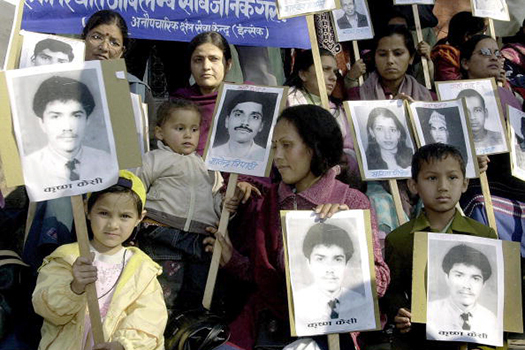
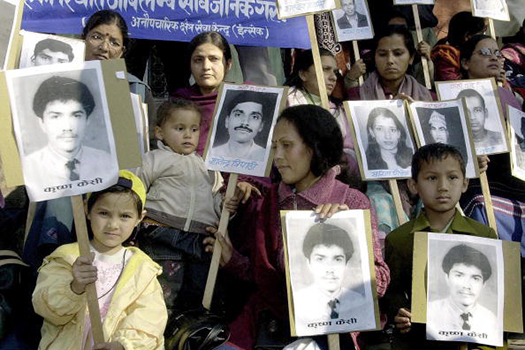
On the occasion of the International Day of the Victims of Enforced Disappearances, Advocacy Forum-Nepal, the Terai Human Rights Defenders Alliance (THRD), and the ICJ voiced their concern about the Government’s failure to provide justice for the victims of the country’s decade-long armed conflict, including victims of enforced disappearance.
The organizations also remembered the victims of enforced disappearances in Nepal and recognized the unceasing efforts of victims and their families and others advocating and campaigning for truth and justice for serious human rights violations in Nepal for over a decade.
Nepal faced a protracted internal armed conflict from 1996 to 2006. In the decade-long conflict, serious human rights violations and abuses were committed by both sides: the Government, including the Royal Nepal Army; and the Communist Party of Nepal (Maoist). Approximately 1,300 people were “disappeared” during the conflict. The fate of many of “disappeared” is yet to be known.
The Comprehensive Peace Agreement (CPA) put an end to the conflict on 21 November 2006, with both sides agreeing to hold perpetrators of human rights violations and abuses accountable and provide access to effective remedies and reparation to victims, including a commitment to publicize the fate or whereabouts of “disappeared”. However, nearly 13 years after the signing of the Comprehensive Peace Agreement in November 2006, these promises remain unfulfilled.
The Truth and Reconciliation Commission and Commission on Investigation of Disappeared Persons, both established in February 2015, have failed to resolve the many thousands of complaints brought to them by victims and their families, and have yet to publicize their findings. Furthermore, in 2015, the Supreme Court ruled the 2014 Act creating the legal framework for the Commissions to be unconstitutional, due in part to the inclusion of provisions that could be used to grant amnesty to perpetrators. In February 2019, the tenure of the commissions was extended to 2020, but the terms of the commissioners expired on 13 April 2019. As of August 2019, no formal replacements had been announced, though a committee to recommend appointments has been established. The ICJ and other organizations have called for a suspension of the current appointment process until amendments to the legal framework are made, and a more consultative and transparent process is initiated.
Nepal has also enacted a new Penal Code, with effect from August 2018. For the first time, the Penal Code recognized enforced disappearance as a distinct crime. While the intent behind this measure is commendable, the law does not meet Nepal’s obligations concerning crimes under international law. In particular, the definition of enforced disappearance falls short of international standards; the crime of enforced disappearance is not absolutely prohibited; provisions related to superior and command responsibility are inadequate; and the penalties for enforced disappearance are inconsistent with international standards. The provisions will apply retroactively to the more than 1,300 conflict era cases.
The organizations urged the Government of Nepal to:
- Amend the 2014 Transitional Justice Act to ensure it is consistent with international human rights standards and Supreme Court rulings, including removing amnesty for perpetrators;
- Revise the criminal code to bring it in line with international standards. At the minimum, this should include:
- amending the definition of enforced disappearances to bring it in line with Nepal’s international obligations and the Convention on the Protection of All Persons from Enforced Disappearance (CED)
- revising the penalty provisions in the Criminal Code Bill to comply with relevant provisions of the CED and other international law and standards
- removing the statute of limitations for enforced disappearance cases
- Ratify International Convention for the Protection of All Persons from Enforced Disappearances;
- Publicize the findings of the CIEDP; and
- Ensure that in Nepal’s legal system, the victims of enforced disappearance, including family members of “disappeared” persons, have the right to obtain reparation and prompt, fair and adequate compensation; and they can effectively exercise that right in practice.
Contact:
For the ICJ: Frederick Rawski, ICJ Asia-Pacific Director, t: +66 64 478 1121; e: frederick.rawski(a)icj.org
Background:
The International Day of the Victims of Enforced Disappearances falls on 30 August every year. Nepal is bound by international legal obligations under the International Covenant on Civil and Political Rights (ICCPR) and Convention against Torture and Other Cruel, Inhuman or Degrading Treatment or Punishment (CAT) – both of which it has acceded to – to investigate, prosecute, punish and provide remedies and reparation for the crimes of torture, other acts of ill-treatment, and enforced disappearance.
Nepal-International Day Enforced Disappearances-Press releases-2019-NEP (Story in Nepali)
Jul 29, 2019 | News
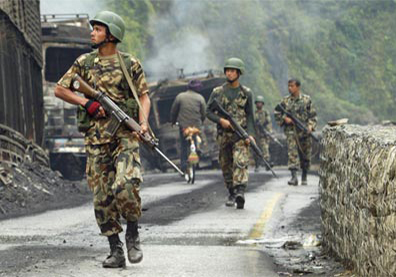
The Government of Nepal has failed to fulfill its commitment to provide justice for the victims of the country’s decade-long armed conflict, the ICJ, Amnesty International, Human Rights Watch, and TRIAL International said today.
The organizations echoed statements by victims and human rights groups about the Nepal government’s inaction on addressing conflict-era human rights violations, and a lack of transparency in the appointment of commissioners to the Truth and Reconciliation Commission and to the Commission on the Investigation of Enforced Disappearances.
“The lack of progress in holding perpetrators accountable for the suffering inflicted upon victims, their families and Nepali society as a whole, is appalling,” said ICJ Asia-Pacific Director Frederick Rawski.
“Nearly 13 years after the signing of the Comprehensive Peace Agreement, political leaders inside and outside of government are still playing games by politicizing the process. It is about time that they showed some courage, and took action to ensure access to justice, instead of continually looking after their own short-term self-interests,” he added.
“We have seen no evidence so far that the authorities of Nepal are serious about fulfilling their obligation to investigate conflict-era violations and bring all those suspected of criminal responsibility to justice in fair trials before ordinary civilian courts,” said Raju Chapagai, South Asia researcher at Amnesty International. “If the commitment to human rights obligations was as unflinching as claimed by Prime Minister KP Sharma Oli, the government would have acted diligently to deliver on its transitional justice responsibilities.”
After being elected in 2018, Prime Minister Khadga Prasad Oli renewed promises that the legal framework governing the transitional justice process would be brought into conformity with Nepal’s international human rights law obligations, as the Supreme Court had repeatedly directed. However, the government never amended the law, and instead pushed forward – without adequate consultation – with the establishment of a committee to recommend appointments to the transitional justice bodies.
“The failure of the government to deliver on its commitment to ensure truth, justice and reparations for the victims of conflict-era abuses shows a dismaying disregard for the protection of human rights,” said Meenakshi Ganguly, South Asia Director at Human Rights Watch.
The organizations called on the government to: 1) suspend the current process, and initiate a consultative and transparent process for the nomination and appointment of commissioners; 2) follow through on commitments to amend the 2014 transitional justice law to ensure that the legal framework is consistent with international human rights standards and Supreme Court rulings; and 3) adopt and publicize a plan for taking the transitional justice process forward.
“The legitimacy of Nepal’s transitional justice process lies both on a transparent and consultative appointment process for commissioners, and a strong legal foundation to allow the commissions to fulfil their mandate,” said Helena Rodríguez-Bronchú, Head of TRIAL International’s Nepal program. “Societal consensus is crucial for both factors.”
Amnesty International, ICJ and TRIAL International had previously submitted their analysis of the draft transitional justice legislation circulated in 2018 and had made recommendations on ensuring compliance with international human rights law. Human Rights Watch had also alerted for reform of the transitional justice law before appointing the commissioners. In April 2019, United Nations experts also wrote a joint letter to the foreign minister reminding the government of its commitment to amend the law and calling for a transparent process for appointing new commissioners after the terms of the previous commissioners expired.
Contact
Frederick Rawski, ICJ Asia-Pacific Director, t: +66 644781121 ; e: frederick.rawski(a)icj.org,
Nepal-trans just-News-Press releases-2019-NEP (story in Nepali, PDF)
Feb 11, 2019 | News
The ICJ, Amnesty International and TRIAL International today called for the Government of Nepal to commit to a transparent and consultative transitional justice process that complies with international law and the judgments of the Supreme Court of Nepal.
On 6 February, the Government of Nepal extended the mandates of the Truth and Reconciliation Commission (TRC) and the Commission on the Investigation of Enforced Disappearance of Persons (CIEDP) for an additional year and committed to the selection of new commissioners by April 2019.
Following the announcement, the ICJ, Amnesty International and TRIAL International voiced concerns about past approach to transitional justice and urged the Government to ensure that the next two months are used to get the flawed process on track.
The organizations warned that this should not become another missed opportunity to ensure that victims are provided the justice, truth and reparation that they so desperately seek.
“A further one-year extension will be meaningless if measures are not taken to secure the independence and impartiality of the commissions,” said Frederick Rawski, ICJ Asia Pacific Director.
“This can only be achieved through a transparent selection process driven by a genuine will to combat impunity – not just for conflict victims, but for future generations,” he added.
The three organizations reiterated their view that the process to date has failed to deliver justice, truth or reparation for victims of crimes under international law and gross human rights violations or establish laws and institutional safeguards to ensure that such crimes are never repeated.
The organizations underscored the need for independent, competent and impartial commissions, compliance with international law, and the meaningful participation of conflict victims, civil society and National Human Rights Commission in the design and implementation of the process.
“This is a great opportunity for Nepal to learn from its past, as well as experiences from other post-conflict societies, that the credibility of transitional justice process ultimately lies on the integrity, competence, independence and expertise of the commissioners. The independence of the Commission, together with a legal framework in accordance with international law, will make or break the success of the commitment to guarantee justice, truth and reparation,” said Biraj Patnaik, South Asia Director of Amnesty International. “The process for appointing new commissioners must be transparent and open to public scrutiny. Victims and civil society must have a robust opportunity to propose and vet candidates.”
The organizations also noted with disappointment that substantive legal concerns raised repeatedly by victims, civil society and the international human rights community have gone unanswered.
The government has not given a clear indication as to whether or how these concerns will be addressed.
“In addition to its obligation to ensure that conflict victims have access to an effective remedy and reparation, the authorities have a separate and independent obligation to investigate and if there is sufficient admissible evidence, prosecute those suspected of criminal responsibility in fair trials before ordinary civilian courts – and, if found guilty, punish them with appropriate penalties which take into account the grave nature of the crimes,” said Helena Rodríguez-Bronchú, Head of TRIAL International’s program in Nepal.
“These obligations are clearly established in international law, as well affirmed in ruling after ruling by the Supreme Court. It is about time that the Government stopped proposing measures that are clearly inconsistent with the letter and spirit of those judgements,” she added.
Concerns raised about existing, and proposed, legislation include: disparities between the definitions of specific crimes under international law and human rights obligations and violations under national, and international law; inadequate provisions to ensure that serious crimes under international law are subject to criminal accountability (including punishment proportionate to the seriousness of the crimes); and a reliance on compensation at the expense of other forms of reparation and remedy for conflict survivors and their families
The ICJ, Amnesty International and TRIAL International had previously submitted a legal analysis of draft transitional justice legislation circulated in 2018, including recommendations on how to ensure compliance with international law and good practices.

Dec 18, 2018 | Multimedia items, News, Video clips
Lawyers from a diverse range of countries, including Egypt, Lebanon, Nepal, the Philippines, Tunisia and Uzbekistan have identified the many barriers that women typically face in accessing justice in their countries.
Common trends and practices identified included socio-economic marginalization, gender stereotypes and patriarchal attitudes.
The observations came during two training workshops held in Geneva in June and September to coincide with sessions of the UN Human Right Council and UN Committee on the Elimination of Discrimination against Women. The workshops were part of a project on enhancing women’s access to justice through UN human rights mechanisms, supported by the Permanent Mission of the Federal Republic of Germany to the UN in Geneva.
A lawyer from Uzbekistan noted that domestic violence flourishes in states where common attitudes hold that this is an internal matter to be resolved within families.
A particular concern raised in respect of Lebanon was discrimination linked to transference of nationality, where Lebanese women married to a foreigner cannot pass their nationality to their children but Lebanese men married to a foreigner can.
Meera Maharjan, lawyer from Nepal, noted the cultural, educational and economic barriers that impede women from being able to take on decision-making roles and the impact this has on the exercise of their rights.
Malaysian lawyer Yvonne Lim explained that the women who are often in need of access to justice tend to be from the lower rungs of the socio-economic strata and lack the resources, support and basic awareness about their human rights and the remedies that may be available to them.
During the September training session the ICJ organized a side event to the 39th session of the Human Rights Council on ‘applying a women-centred approach to access to justice’ to further explore these issues.
Secretary-General Saman Zia-Zarifi moderated the event and panelists included:
• ICJ Commissioner Justice Sanji Monageng, former Vice-President of the International Criminal Court
• Lisa Gormley, Research Officer for the Centre for Women, Peace and Security at the London School of Economics
• Meera Maharjan, Nepalese lawyer and legal officer for Resilience for Sustainable Women Empowerment (RISE)
You can watch a recording of the event, and interviews with two of the workshop participants below.
https://www.facebook.com/ridhglobal/videos/565112000574216/UzpfSTQ3MTQ2NzA4NjIyMTM3MzoyMjEyNTUzNjc1NDQ2MDMw/
Dec 2, 2018 | Events, News
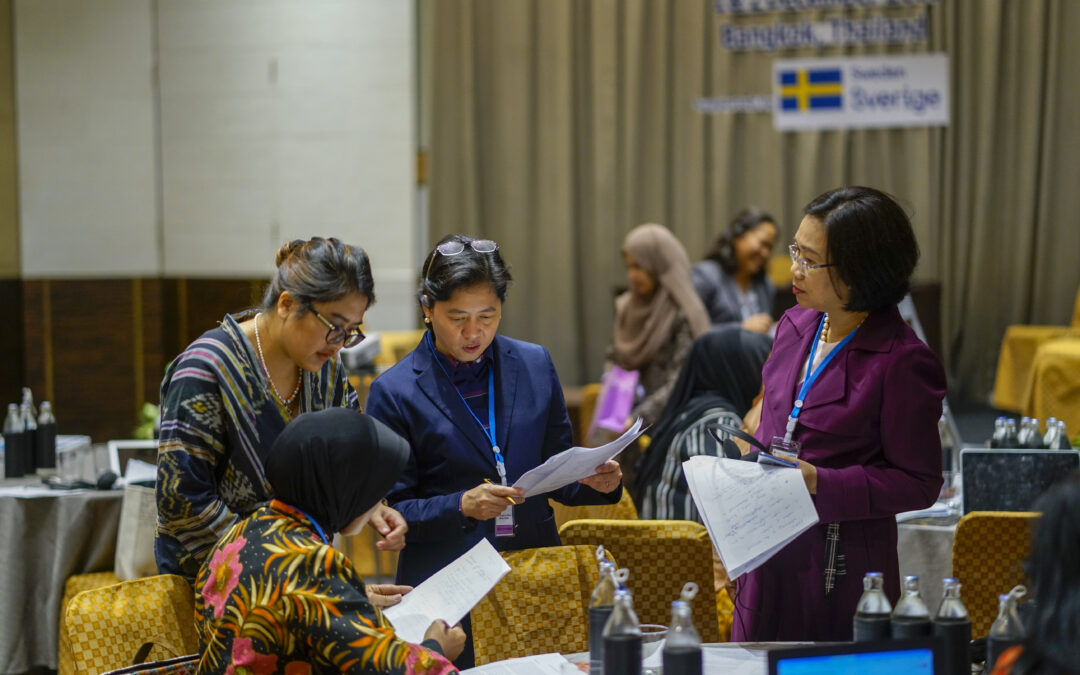
On 1-2 December 2018, the International Commission of Jurists (ICJ) held its 2018 Southeast Asia Regional Judicial Dialogue on enhancing access to justice for women in the region.
Participants included judges from Cambodia, Indonesia, Nepal, Pakistan, Philippines, Sri Lanka and Thailand.
The discussions, held in Bangkok, were focused around resources important for judges to aid in enhancing the capacity of their peers in eliminating gender discriminatory attitudes and behaviours towards women in their work. These resources include a training manual on the use of the Bangkok General Guidance for Judges in Applying a Gender Perspective, and a draft reference manual on women’s human rights and the right to a clean, healthy, safe and sustainable environment.
Frederick Rawski, ICJ’s Director of the Asia and the Pacific Programme, opened the dialogue by emphasizing how important it is for judges to be gender sensitive in their delivery of justice. This could only be done by applying a framework that gives primary attention on ensuring recognition of the applicable human rights, institutional support for the promotion of these rights, and accountability mechanisms for their implementation.
Roberta Clarke, Commissioner of the ICJ and Chair of the organization’s Executive Committee, noted that this judicial dialogue demonstrates the ICJ’s commitment to have a sustainable contribution to the implementation of international human rights standards at the domestic level. She hoped that the judges could contextualize the resources presented and bring these back to their countries for trainings of their peers.
This judicial dialogue is part of a joint project on access to justice for women that ICJ is implementing with UN Women.
Anna Karin Jatfors, UN Women-Asia Pacific’s Interim Regional Director shared that gender stereotypes and social norms which discriminate women are not unique in each country. She pointed out the importance of the ICJ and UN Women collaborating in this project to deconstruct this image to bring better access to justice to women in the region.
Overall, the dialogue was rich and substantive, with the full and active participation from all participating judges who shared their views and experiences on countering gender discrimination in cases before them. At the end of the judicial dialogue, the participating judges expressed strong interest to use the resources for capacity building initiatives of their peers in their own countries.
Contact
Emerlynne Gil, Senior International Legal Adviser, t: +662 619 8477 (ext. 206), email: Emelynne.gil(a)icj.org