Oct 11, 2018 | News
The ICJ today condemned the appointment by President Andrzej Duda of 27 judges to the Supreme Court in place of those forcibly “retired” last July.
“These appointments are patently illegitimate and deal a severe blow to the rule of law in Poland,” said Róisín Pillay, Director of the ICJ Europe and Central Asia Programme.
The new appointments purport to replace the Supreme Court Justices including President of the Supreme Court Małgorzata Gersdorf, whose forced “retirement” is in clear violations of international standards on the security of tenure and independence of judges.
The decision of the President is even more concerning since it contravenes an order of the Supreme Court suspending the law under which these appointments were made, pending a decision by the Court of Justice of the European Union.
It is a fundamental tenet of the rule of law and principles on the independence of the judiciary that the executive respect decisions duly made by the judiciary.
“In announcing these appointments now, while cases on the forced retirement of Supreme Court judges are still pending at the EU Court, President Duda has disregarded the proceedings of the EU’s apex judicial body,” Róisín Pillay added.
The ICJ considers that the legality of the appointments of the new judges is further compromised by the role played by the now politicized National Council for the Judiciary, whose independence and impartiality has been seriously compromised following recent legislative amendments.
The ICJ urges the Polish authorities to cease all interference with the Supreme Court in carrying out its legitimate functions, and to reverse the measures taken to force the retirement of Supreme Court judges.
Background
This attack against the actions of the Supreme Court occurs amid a systematic undermining of the independence of the judiciary in Poland by the Polish executive and legislative authorities, which attempt to increase political influence in the judiciary and which the ICJ has repeatedly condemned.
Earlier this year Poland issued a new law on the Supreme Court that attempts to force the “retirement” of one third of the Supreme Court judges, including the First President, by lowering the mandatory retirement age for its judges from 70 to 65. This measure clearly contravenes international human rights law and standards.
The European Commission has launched an infringement procedure for lack of compliance of this law with EU law.
In the absence of satisfactory reforms by Poland, on 24 September, the Commission referred Poland to the Court of Justice of the European Union (CJEU) and asked for interim measures to restore Poland’s Supreme Court to its situation before 3 April 2018.
At the same time Supreme Court of Poland submitted a preliminary ruling request to the CJEU seeking its interpretation on the compliance of the legislation on retirement ages of judges with EU law, in particular with the prohibition of discrimination on grounds of age under Directive 2008/78.
Following the jurisprudence of the CJEU, the Supreme Court suspended the effect of national law on the forcible retirement of the judges.
An ICJ letter of 11 July 2018, signed by 22 senior judges from all regions of the world, urged the Polish government to act immediately to reinstate the forcibly retired judges in office.

Sep 18, 2018 | Advocacy, Non-legal submissions
The ICJ today put the spotlight on serious threats to the rule of law in Hungary, Poland and Turkey, speaking at the UN Human Rights Council in Geneva.The statement, made during general debate on situations that require the Council’s attention, read as follows:
“The International Commission of Jurists (ICJ) would like to bring to the Council’s attention the serious threats to the rule of law in Hungary, Poland and Turkey.
In Poland, the Government has adopted legislation to arbitrarily force into involuntary “retirement” one third of its Supreme Court Justices, delivering a fatal blow to the independence of the judiciary, already strained by past reforms.
In Hungary, multiple legal reforms have weakened judicial independence and effectively criminalized the activities of certain human rights NGOs and curtailed their financing.
Finally, in Turkey, consolidation of emergency measures in ordinary law, regressive constitutional reforms, and the mass dismissal of judges and prosecutors have removed essential protection for the independent functioning of the judiciary.
The ICJ is further concerned by the protest ban against the Saturday Mothers to hold weekly protests in memory of their disappeared family members, in breach of their right to freedom of assembly.
The ICJ is alarmed at the escalation of such threats to the very basic tenets of the rule of law in Europe, without specific action being taken by this Council to address them.
The ICJ urges the Council to give attention to these developments, which indeed form part of a broader global attack on the rule of law,[1] and to keep under observation the human rights situation in these countries.”
[1] See ICJ, “The Rule of Law under Global Threat” (statement in general debate on the oral update of the High Commissioner), 11 September 2018: https://www.icj.org/hrc39-gd2-hc/
Sep 14, 2018 | News
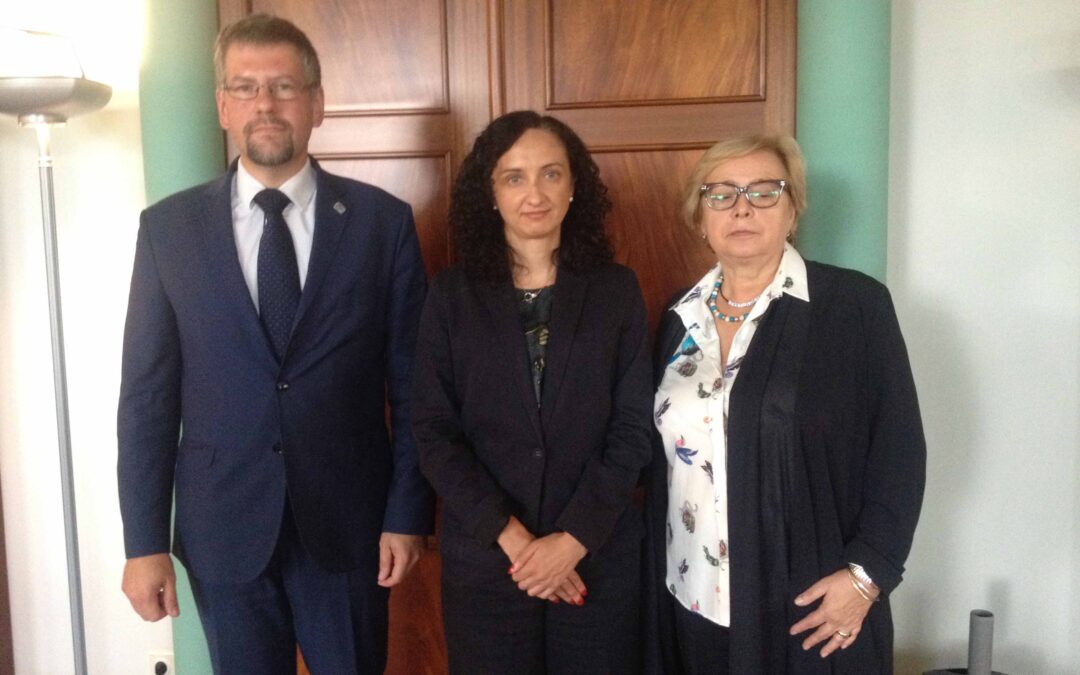
The ICJ met this week in Warsaw with the First President of the Polish Supreme Court, Małgorzata Gersdorf.
Róisín Pillay, Director of the ICJ Europe and Central Asia Programme, met with President Gersdorf to convey the support of the ICJ for the Court’s defence of the rule of law and the independence of the judiciary in Poland, in the face of government attacks.
The ICJ emphasized that a new law on the Supreme Court that attempts to force the “retirement” of 27 of the 72 Supreme Court judges, including the First President, by lowering the mandatory retirement age for its judges from 70 to 65 years, contravenes international human rights law and standards, including the right to a fair hearing.
The measure is contrary to the principle of the security of tenure of judges and therefore to the independence of the judiciary, as expressed in the UN Basic Principles on the Independence of the Judiciary.
In August, the Supreme Court submitted a preliminary ruling request to the Court of Justice of the EU (CJEU) seeking its interpretation on the compliance of the measure with EU law. The Supreme Court has suspended implementation of the law pending the proceedings before the CJEU.
The European Commission has recognized the current situation as undermining “the principle of judicial independence, including the irremovability of judges” and has triggered a procedure under Article 7 of the Treaty of the European Union that could ultimately lead to suspension of Poland’s EU voting rights.
The Commission has also launched infringement proceedings against Poland in respect of the law on the Supreme Court.
An ICJ letter of 11 July 2018, signed by 22 senior judges from all regions of the world, urged the Polish government to act immediately to reinstate the forcibly retired judges in office.

Aug 21, 2018 | News
The ICJ and its Polish Section (ICJ Poland) today expressed their support for the actions of the Supreme Court to defend the rule of law and the independence of the judiciary in Poland, including by recourse to the European Court of Justice (CJEU).
This happened in the face of repeated attack by political figures and authorities.
Preserving and safeguarding the independence of the courts is essential for the protection of human rights in Poland, the organizations said.
The ICJ and ICJ Poland urged the Polish executive and legislative authorities to cease all interference with the conduct of the Supreme Court in the carrying out of its legitimate functions.
The law on the Supreme Court that has led to the forced “retirement” of one third of the Supreme Court, including the President of the Court, Małgorzata Gersdorf, must be repealed and the judges reinstated in office, the ICJ and ICJ Poland stressed.
On 2 August, the Supreme Court of Poland took the welcome step, in accordance with European Union law, of submitting a preliminary ruling request to the Court of Justice of the European Union (CJEU) seeking its interpretation on the compliance of the recent legislation on retirement ages of judges with EU law.
Specifically, the Supreme Court enquired as to the legislation’s compliance with the principle of irremovability of judges and the prohibition of discrimination on grounds of age under Directive 2000/78. The Supreme Court has suspended the implementation of the law during the proceedings before the CJEU.
The ICJ and ICJ Poland condemn the attacks against the Supreme Court by political authorities, including President Andrzej Duda, who claimed that the suspension of the law’s implementation has no legal basis.
On the contrary, the Supreme Court of Poland acted in compliance with its duties under article 267 of Treaty of the Functioning of the European Union to raise a question concerning the interpretation of the Treaties and, in conformity with the case-law of the CJEU, to suspend the application of such measures which may violate the law of the European Union, pending resolution of the question.
The legislation raises serious issues of EU law, both in regard to protection of the rule of law under Article 2 of the TFEU, and in regard to discrimination on grounds of age.
This attack against the actions of the Supreme Court occurs amid a systematic undermining of the independence of the judiciary in Poland by the Polish executive and legislative authorities, which the ICJ, ICJ Poland, and judges of the global ICJ network have repeatedly condemned.
The organizations emphasize that irremovability of judges is one of the main pillars of judicial independence and therefore of the rule of law. An ICJ letter of 11 July 2018, signed by 22 senior judges from all regions of the world, urged the Polish government to act immediately to reinstate the forcibly retired judges in office.
Jul 11, 2018 | Advocacy, News, Open letters
Twenty-two senior judges from across the globe wrote today to Polish President Andrzej Duda to condemn the recent attacks on the independence of the judiciary.
The judges, all Commissioners or Honorary Members of the International Commission of Jurists, criticized the forced resignation of 27 of 72 judges of Poland’s Supreme Court as a severe blow to the independence of the Polish judiciary in violation of international standards.
The letter was organized by the ICJ and its Centre for the Independence of Judges and Lawyers in consultation with jurists from 17 countries.
“The Polish government’s assault on the country’s judiciary is a major blow to the rule of law in Poland,” said Sam Zarifi, ICJ Secretary General.
He added:
“The situation in Poland is of concern to judges in the country, as well as in the European Union and around the world.”
“The ICJ and jurists everywhere will speak out against this surge of attacks on the judiciary that is increasingly a pattern in many countries, including several that until recently were at least rhetorically champions of the rule of law.”
“This letter shows that the commitment to the rule of law and judicial independence is not limited to just one part of the world or one legal system, but rather reflects the views of the global community of jurists.”
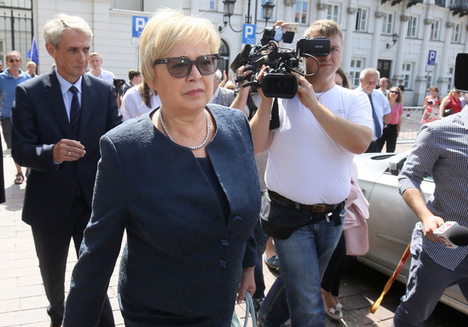
In their letter, the ICJ senior judges “condemn the recent forced retirement of 27 out of 72 Polish Supreme Court justices, including its President Małgorzata Gersdorf (photo), and urge President Duda to act immediately to restore the independence of the judiciary by reinstating them in office.”
They express grave concern “that the effective dismissal of one third of the Supreme Court, coupled with the broad discretion given to the President’s office to make exceptions, has taken place in contravention of international human rights law and standards, including the right to a fair hearing, and is contrary to basic principles of the rule of law.”
Finally, the “undersigned jurists urge the President of the Republic of Poland to act immediately to restore the independence of the judiciary by reinstating the Supreme Court justices forced into retirement, follow the recommendations of the European Commission on judicial reform, and take action to repeal the law on the Supreme Court that strikes at the very core of judicial independence.”
The signatories
- Justice Adolfo Azcuna, former Associate Justice of the Supreme Court of the Philippines
- Justice Solomy Balungi Bossa, Ugandan Judge on the International Criminal Court
- Justice Ian Binnie, retired Justice of the Supreme Court of Canada
- Justice Azhar Cachalia, Judge of the Supreme Court of Appeal of South Africa
- Dame Silvia Cartwright, former Judge of the High Court in New Zealand and of the Extraordinary Chambers in the Courts of Cambodia
- Justice Moses Chinhengo, Judge of the High Court of Botswana
- Justice Martine Comte, former President of the Orleans Court of Appeal, France
- Justice Radmila Dracigevic-Dicic, Acting President of the Supreme Court of Appeals, Judge of the Supreme Court of Serbia
- Justice Elizabeth Evatt, former Chief Justice of the Family Court of Australia
- Justice Claire L’Heureux-Dubé, former Justice of the Supreme Court of Canada
- Justice Paul J. G. Kapteyn, former Judge of the European Court of Justice
- Justice Michael Kirby, former Justice of the High Court of Australia and former President of the International Commission of Jurists
- Justice Kalthoum Kennou, Judge of the Tunisian Cassation Court
- Justice Ketil Lund, former Justice of the Norwegian Supreme Court
- Justice Qinisile Mabuza, Judge of the High Court of Swaziland
- Justice Egbert Myjer, former Judge of the European Court of Human Rights
- Justice Michèle Rivet, former President of the Quebec Human Rights Tribunal
- Justice Kalyan Shrestha, former Chief Justice of the Nepalese Supreme Court
- Justice Philippe Texier, Judge of the French Court of Cassation
- Justice Lillian Tibatemwa-Ekirikubinza, Justice of the Supreme Court of Uganda
- Justice Stefan Trechsel, former ad litem Judge at the International Criminal Tribunal for the former Yugoslavia
- Dr Rodrigo Uprimny Yepes, former Assistant Justice of the Constitutional Court of Colombia
Poland-Reinstate forcibly retired judges-Advocacy-Open letters-2018-ENG (full text of letter in PDF)