Apr 1, 2019 | News
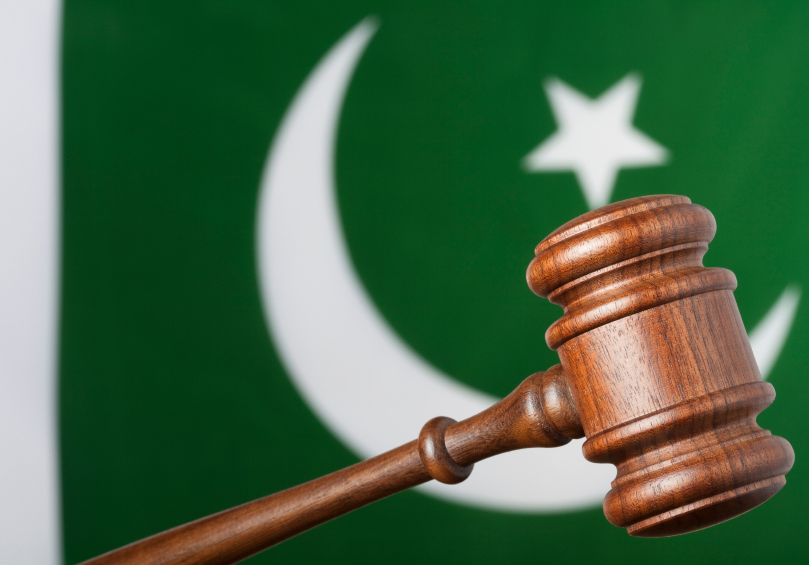
As military courts in Pakistan once again cease to have jurisdiction over civilians for terrorism-related offences, the Government must bring reforms to strengthen the country’s criminal justice system, the ICJ said today.
Perpetrators of terrorist attacks and other serious crime must be brought to justice fair trials before competent, independent and impartial courts as required under international law, the ICJ added.
“The lapse of the jurisdiction of military courts over civilians is a step in the right direction, but unsurprisingly – even four years after military courts were empowered to try civilians – there is no sign of the promised reforms to strengthen the ordinary criminal justice system to effectively and fairly handle terrorism-related cases,” said Frederick Rawski, ICJ’s Asia Director.
The 23rd Amendment and corresponding amendments to the Army Act, 1952, lapsed on 30 March 2019, as their respective two-year sunset clauses expired. So far, the Government has failed to get support from opposition parties for a constitutional amendment to once again extend the jurisdiction of military courts to conduct trials of civilians.
“The Government must not re-enact legislation to continue secret military trials of civilians, nor resort to more short-term, short-sighted security measures that are contrary to Pakistan’s obligations to protect human rights,” Rawski said.
“Instead, the Government should urgently invest in enhancing the capacity and security of judges, investigators and prosecutors to make the regular criminal justice system more effective in conducting fair, credible terrorism trials, and bringing perpetrators to account without imposing the death penalty.”
According to military sources and ICJ’s monitoring of military trials in Pakistan since January 2015, military courts have convicted 617 people for terrorism-related offences, out of which 346 people have been sentenced to death and 271 people have been given prison sentences. At least 56 people have been hanged. Only four people have been acquitted.
The ICJ has documented serious fair trials violations in the operation of military courts, including: denial of the right to counsel of choice; failure to disclose the charges against the accused; denial of a public hearing; failure to give convicts copies of a judgment with evidence and reasons for the verdict; and a very high number of convictions based on “confessions” without adequate safeguards against torture and ill treatment.
Contact
Frederick Rawski, ICJ Asia Pacific Regional Director (Bangkok), e: frederick.rawski(a)icj.org
Reema Omer, ICJ International Legal Adviser for Pakistan (London), t: +447889565691; e: reema.omer(a)icj.org
Additional information
Military courts were first empowered to try civilians for certain terrorism-related offences in January 2015 through the 21st Amendment to the Constitution and amendments to the Pakistan Army Act, 1952, which were in operation for a period of two years.
The expansion of the jurisdiction of military tribunals was a key part of the Government’s 20-point National Action Plan, adopted following the attack on the Army Public School in Peshawar in December 2014. NAP envisioned military courts to be a short-term “solution” to try “terrorists”, to be operational only for a two-year period during which the government would bring about necessary “reforms in criminal courts system to strengthen the anti-terrorism institutions”.
Despite promises that military courts were only temporary, after the expiration of the 21st Amendment, on 31 March 2017, Parliament enacted the 23rd Amendment and amendments to the Army Act to renew military courts’ jurisdiction over civilians. The amendments were given retrospective effect from 7 January 2017, and were due to lapse two years after their date of “commencement”. The expanded jurisdiction of military courts lapsed on 30 March 2019 (even though earlier reports suggested the amendments would expire on 6 January 2019) — two years after the date of “operation” of the 23rd Amendment).
The ICJ opposes the death penalty in all circumstances as a form cruel, inhuman and degrading punishment and an arbitrary denial of the right to life. The ICJ recalls that the UN General Assembly has by overwhelming majorities repeatedly called on all states the retain the death penalty to place a moratorium on the practice with a view to abolition. Pakistan previously had such a moratorium from 2008 to 2014.
Mar 20, 2019 | Advocacy, Non-legal submissions
The ICJ today called at the UN for prompt establishment of a judicial accountability mechanism with international involvement, for Sri Lanka.The statement, delivered during an interactive dialogue on the OHCHR report on Sri Lanka at the Human Rights Council in Geneva, read as follows:
“The ICJ welcomes the comprehensive report of the OHCHR on promoting reconciliation, accountability and human rights in Sri Lanka (A/HRC/40/23). We share OHCHR’s observation that there is a lack of progress and absence of a comprehensive strategy for implementation of all commitments made under Resolution 30/1.
ICJ is particularly concerned about the lack of progress in the area of criminal accountability (as noted in Paragraph 27 of the report). We believe that there is an urgent need to establish a judicial mechanism with the involvement of foreign judges. We echo the sentiments of the OHCHR regarding the inability of the Sri Lankan courts, on their own, to address the impunity of security forces for crimes under international law.
Failure of the criminal justice system to effectively address emblematic cases (as reflected in Paragraph 38 of the report) clearly indicates the level of capacity and willingness on the part of the State even today to prosecute and punish perpetrators of serious crimes when they are linked to the security forces or other positions of power.
ICJ also notes that women are grossly under-represented in the judiciary in Sri Lanka, which prevents women human rights defenders and female victims from having confidence in the ordinary criminal justice system, impeding their full engagement and participation in pursuing accountability for crimes committed against them during the conflict and other transitional justice processes.
A judicial mechanism with the involvement of foreign judges is particularly urgent for women in conflict-affected areas who still live in a highly militarized environment and are compelled to live among their perpetrators – those who have been accused of war crimes including rape and other forms of sexual violence.
We therefore reject calls for a purely domestic mechanism. Indeed, the ICJ considers that the continuing failure of the Government to ensure justice means that referral to the International Criminal Court or the creation of another international mechanism to facilitate criminal accountability would be fully warranted. The draft resolution before this session of the Council, reaffirming all elements of resolution 30/1, thus already represents a deep compromise and anything less than the existing text would be wholly unacceptable.
Mar 12, 2019 | Events, News
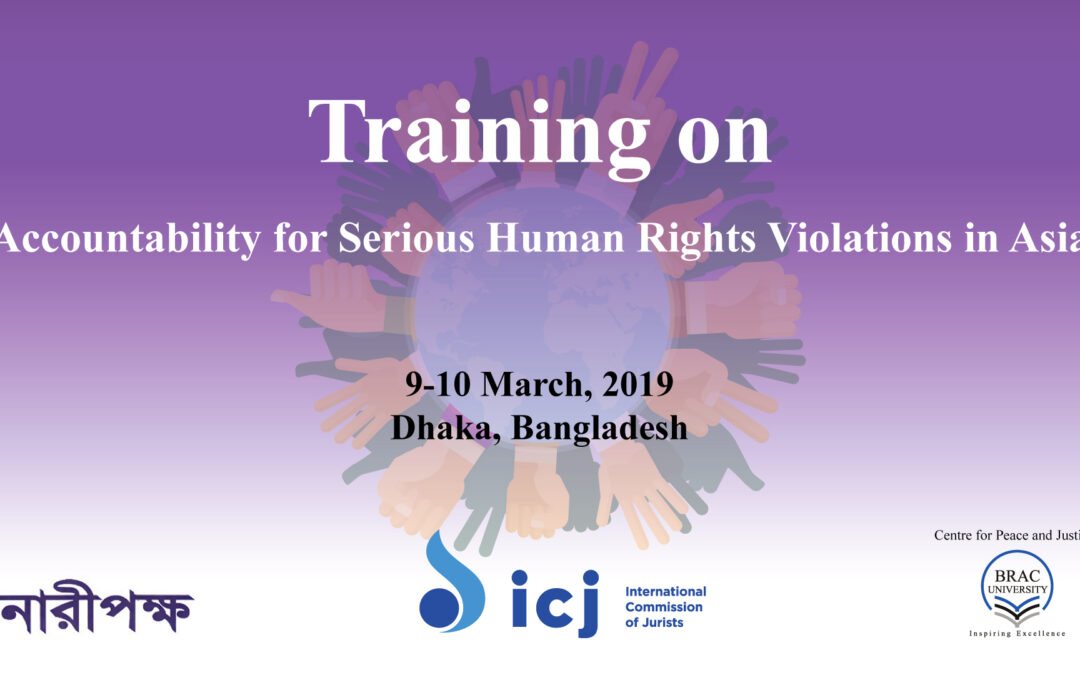
The ICJ convened a two-day workshop from 9th to 10th March 2019 in Dhaka, Bangladesh to discuss applicable international legal mechanisms designed to achieve accountability for serious human rights violations in Asia.
Bangladesh-based non-government organizations the Centre for Peace and Justice and Naripokkho co-hosted the event with the ICJ, with a representative of AJAR (Asia Justice and Rights) also joining. Twenty Bangladeshi lawyers, activists and academics attended the event.
Legal advisers from the ICJ provided an overview of the Independent Investigative Mechanism for Myanmar (IIMM), currently being established following a UN Human Rights Council resolution in September 2018.
They also discussed the structure and procedures of the International Criminal Court (ICC), whose prosecutors are currently conducting a preliminary examination into the deportation of Rohingyas from Myanmar into Bangladesh. Unlike Myanmar, Bangladesh is a State Party to the Rome Statute of the ICC, and its pre-trial chamber has indicated the Court has jurisdiction over crimes listed in the Rome Stature were one element, or part of a crime, was committed inside the territory of Bangladesh.
AJAR’s co-founder provided an overview of transitional justice processes, drawing upon international and regional experiences of truth-seeking, prosecutions, reparations and reforms to guarantee non-repetition of human rights violations.
Two of the ICJ’s legal advisers also travelled to Cox’s Bazar, Bangladesh, where they met relevant stakeholders to discuss the situation of Rohingya refugees from Myanmar, and to share information about accountability mechanisms, including about expected timelines, outcomes and limitations.
The activity is part of the ICJ’s global work on promoting accountability and redress for gross human rights violations to facilitate justice and deter repetition.
Contact: Kingsley Abbott, ICJ Senior Legal Advisor for Global Redress and Accountability e: kingsley.abbott@icj.org
Mar 8, 2019 | Advocacy, Non-legal submissions
The ICJ today addressed the UN Human Rights Council on the need for a time-bound implementation plan, developed with the Office of the High Commissioner for Human Rights, for Sri Lanka to implement its commitments and obligations on transitional justice.
The statement, delivered during an interactive dialogue with the UN High Commissioner for Human Rights on her annual report, read as follows:
“Madame High Commissioner,
The International Commission of Jurists (ICJ) appreciates the efforts undertaken by the OHCHR in advancing transitional justice in Sri Lanka, mentioned in paragraph 69 of your report.
Any progress made by Sri Lanka, especially in relation to the implementation of transitional justice mechanisms under Resolution 30/1, albeit slow and wholly insufficient, has been primarily due to the continued engagement of the Council, OHCHR and international community. Therefore, keeping Sri Lanka on the agenda of the Council is paramount to ensure progress on all remaining commitments set out in Resolution 30/1.
As the Council is poised to provide Sri Lanka with an extension of two years to fulfill its commitments under Resolution 30/1, ICJ considers the expeditious development of a time-bound implementation plan with a deadline for delivery as essential. It is also pertinent that the implementation process is not a mere procedural exercise, but holistic and contextually appropriate.
At present, it appears that women are largely excluded from meaningfully participating in transitional justice processes, despite having been at the forefront in demanding truth and justice. Even mechanisms that have been put in place so far lack a comprehensive gender strategy. It is imperative that problems faced by women during and in the aftermath of the conflict are effectively identified and addressed in order to ensure that they are not left behind as the country seeks to move forward. The OHCHR with its expertise and experience in the field is well-placed to provide the necessary advice and technical assistance, especially in relation to matters that often get ignored or marginalized.
Madam High Commissioner, how would you see OHCHR fulfilling its role in relation to the development of the time-bound implementation plan and the due accomplishment of all remaining commitments made under Resolution 30/1?”
The statement can be downloaded in PDF format here: HRC40-OralStatement-IDwHCitem2-2019
The oral statement follows a joint open letter from NGOs, calling for such a plan, here.
The ICJ earlier submitted a written statement on Sri Lanka, available here.
Feb 28, 2019 | Events, News
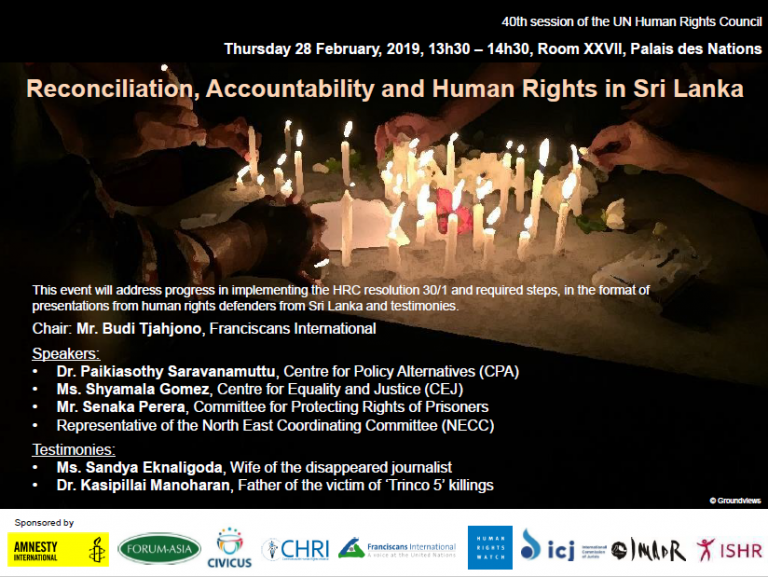
This event will address progress in implementing Human Rights Council resolution 30/1 and required steps, in the format of presentations from human rights defenders from Sri Lanka and testimonies.
Date: Thursday, 28 February 2019
Time: 13.30 – 14.30
Venue: Room XXVII, Palais des Nations
Chair: Mr. Budi Tjahjono, Franciscans International
Speakers:
- Dr. Paikiasothy Saravanamuttu, Centre for Policy Alternatives (CPA)
- Ms. Shyamala Gomez, Centre for Equality and Justice (CEJ)
- Mr. Senaka Perera, Committee for Protecting Rights of Prisoners
- Representative of the North East Coordinating Committee (NECC)
Testimonies:
- Ms. Sandya Eknaligoda, Wife of the disappeared journalist
- Dr. Kasipillai Manoharan, Father of the victim of ‘Trinco 5’ killings
Sponsors:
- Asian Forum for Human Rights and Development (FORUM-ASIA)
- Amnesty International
- CIVICUS
- Commonwealth Human Rights Initiative (CHRI)
- Franciscans International
- Human Rights Watch (HRW)
- International Commission of Jurists (ICJ)
- International Movement Against all forms of Discrimination and Racism (IMADR)
- International Service for Human Rights (ISHR)