Nov 17, 2017 | News
Pakistan’s third Universal Periodic Review (UPR) has drawn global attention to a number of serious human rights failures in the country, said the ICJ today.
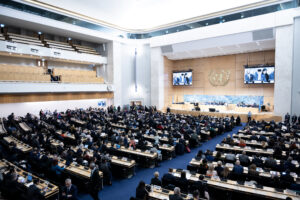
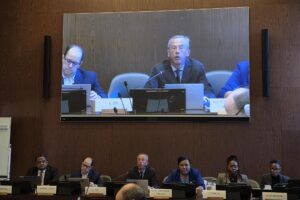
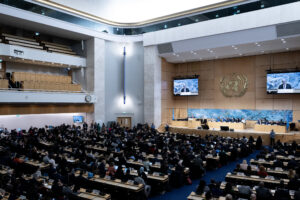
On 16 November, the UPR Working Group of the Human Rights Council adopted a draft UPR outcome report for Pakistan. Pakistan received a total of 289 recommendations – a substantial increase from its previous UPR in 2012, when Pakistan received 167 recommendations. As many as 111 State delegations took the floor to make statements, and 14 States submitted their questions in advance.
“That well over a hundred delegations participated in the review indicates the global community’s interest in Pakistan’s human rights situation,” said Frederick Rawski, ICJ’s Asia Director.
Key recommendations urge Pakistan to:
- Reinstate a moratorium on executions with the view to abolishing the death penalty;
- Repeal or amend “blasphemy laws” to bring them in line with international human rights law;
- Ratify the International Convention for the Protection of All Persons from Enforced Disappearance and a number of other human rights treaties;
- Ensure effective protection of the rights of religious minorities, human rights defenders, journalists and other vulnerable groups;
- Strengthen the National Commission for Human Rights;
- Ensure prompt, impartial and effective investigations of human rights violations and bring perpetrators to justice;
- Set 18 as the minimum legal age for marriage; and
- Ensure effective implementation of laws on violence against women.
“The States’ recommendations echo the concerns of dozens of civil society organizations and even the National Commission of Human Rights – who all agree that the Government must take urgent measures to address the downward spiral of rights in the country”, Rawski said.
Pakistan will now examine the recommendations and respond to the Human Rights Council at latest by the Council’s next session in March 2018.
Pakistan’s review comes at a time of serious concern about the rights situation in the country.
The Government lifted the informal moratorium on the death penalty and carried out nearly 500 executions in less than three years – among the highest execution rates in the world; Parliament enacted laws allowing military courts to try civilians for certain terrorism-related offences in secret trials; and the authorities started a new wave of crackdowns on NGOs, journalists and human rights defenders, including subjecting them to enforced disappearance.
Persecution of religious minority communities also continues despite the Government’s claims that religious minorities “enjoy equal rights as equal citizens of Pakistan”. Last month, three Ahmadi men were sentenced to death for blasphemy for allegedly scratching anti-Ahmadi pamphlets that had the “Mohr-e-Nabbuwat” (seal of the Prophet Muhammad) printed on them. And earlier this week, the Islamabad High Court directed the Government to respond to a petition demanding a separate database for Ahmadis in the civil service to ensure they are not “posted in offices involving sensitive matters”.
“As a member of the Human Rights Council, Pakistan is expected to uphold the highest standards in the promotion and protection of human rights, something it has clearly failed to do,” added Rawski.
“Pakistan should make use of this process by accepting the recommendations made during the review and adopting a concrete, action-based national human rights plan to ensure their effective implementation.”
Contact
Frederick Rawski, ICJ Asia Pacific Regional Director, t: +66 64 478 1121, e: frederick.rawski@icj.org
Reema Omer, ICJ International Legal Adviser for Pakistan (London), t: +447889565691; e: reema.omer(a)icj.org
Pakistan-UPR-PressRelease-2017-eng (download the press release)
Additional information
UN Member States reviewed Pakistan’s human rights record for the third time on Monday, 13 November, through the UPR process.
The UPR is a unique mechanism of the UN Human Rights Council aimed at improving the human rights situation of each of the 193 UN Member States. Under this mechanism, the human rights record of all UN Member States is peer-reviewed every four to five years by the UPR Working Group, consisting of the 47 UN Member States of the Human Rights Council; however, any UN Member State can take part in the discussions and the dialogue during the UPR of the reviewed States. States then make recommendations to the country under review, which has the option of accepting or noting the recommendations.
Nov 10, 2017 | News
As Pakistan is set to undergo its third Universal Periodic Review (UPR) on 13 November, the ICJ has urged Pakistani authorities to meaningfully engage with the process to improve the human rights situation in the country.
“Pakistan’s past engagement with the UPR has been characterized by denial and defensive posturing,” said Frederick Rawski, ICJ’s Asia Director.
“As a recently-elected member of the UN Human Rights Council, it is more important than ever for the Pakistan to show that it takes its human rights obligations seriously by engaging with the upcoming UPR in its true spirit,” he added.
During its second UPR in 2012, Pakistan received 167 recommendations, of which it rejected seven, noted 34, and accepted 126.
The seven recommendations rejected by Pakistan relate to some of the most serious human rights violations in the country, including recommendations to adopt an official moratorium on the death penalty with a view to abolishing capital punishment in law and practice, repeal blasphemy laws, and decriminalize adultery and non-marital consensual sex.
Even accepted recommendations have been largely ignored in the four years since the previous UPR, the ICJ notes.
Enforced disappearances are still not recognized as a distinct, autonomous crime; perpetrators of gross human rights violations continue to escape justice; there has been complete inaction to prevent abuse of so-called blasphemy laws; and freedom of expression is often restricted on vague grounds such as “national security” and “immorality”.
“Pakistan’s human rights situation has in many ways deteriorated since 2012,” Rawski added.
“Yet – as reflected by Pakistan’s national report for the upcoming UPR – the authorities apparently remain in a state of denial about the dire human rights implications of these new measures,” he said.
These measures include the lifting the informal moratorium on the death penalty and carrying out nearly 500 executions in less than three years – among the highest in the world; passing laws allowing military courts to try civilians for certain terrorism-related offences; and a new wave of crackdowns on NGOs, journalists and human rights defenders, including retaliating against NGOs for presenting “a very bleak picture” of the country’s human rights situation to the UN.
“UN member states on Monday should urge Pakistan to end the dangerous downward spiral on rights by ending repression, respecting fundamental freedoms, and holding perpetrators of violations responsible,” Rawski said.
Contact
Frederick Rawski, ICJ Asia Pacific Regional Director, t: +66 64 478 1121, e: frederick.rawski(a)icj.org
Reema Omer, ICJ International Legal Adviser for Pakistan (London), t: +447889565691; e: reema.omer(a)icj.org
Additional information
The UPR is a unique mechanism of the UN Human Rights Council aimed at improving the human rights situation of each of the 193 UN Member States. Under this mechanism, the human rights record of all UN Member States is peer-reviewed every four to five years by the UPR Working Group, consisting of the 47 UN Member States of the Human Rights Council; however, any UN Member State can take part in the discussions and the dialogue during the UPR of the reviewed States. States then make recommendations to the country under review, which has the option of accepting or noting the recommendations.
Nov 1, 2017 | News, Publications, Reports, Thematic reports
The arrest of absconding murder convict Bal Krishna Dhungel, a senior Maoist leader, highlights the weaknesses, as well as the promises, for victims seeking accountability through Nepal’s judicial system, said the ICJ as it released a report on accountability mechanisms in the country.
The ICJ’s report Achieving Justice for Gross Human Rights Violations in Nepal concludes that impunity for gross human rights violations is one of the major obstacles to the creation of a stable and legitimate democratic government and lies at the heart of the rule of law crisis in Nepal.
It found that a lack of commitment by Nepal’s political leadership to address past and ongoing human rights violations continues to allow perpetrators to escape justice and undermines victims’ right to effective remedies and reparation.
“In the past, the promise to shield perpetrators for human rights violations has been used as a bargaining chip to garner political support and build political alliances,” said Frederick Rawski, Director of the ICJ’s Asia Pacific Regional Programme.
“It is imperative that accountability for human rights violations remains a priority for Nepal’s political leadership after Parliamentary elections, and that alliances between political parties are not once again used as an excuse to undermine Nepal’s human rights obligations,” added Rawski.
Attempts to thwart justice have also included the cynical manipulation of justice sector actors, from the police to the Attorney General’s office, in a way that threatens the independence and credibility of the institutions responsible for safeguarding human rights and the rule of law in Nepal, the report highlights.
This pattern of impunity persists despite demands for accountability by civil society and victims’ organizations, as well as the National Human Rights Commission and Nepal’s Supreme Court.
“In many ways, the Supreme Court of Nepal has emerged as a beacon of hope for victims of human rights violations,” said Rawski.
“The Court has given domestic effect to Nepal’s obligations under international law and has set high standards for accountability, remedy and reparations,” he added.
However, the Government’s disregard of key judgments has limited the impact of the Supreme Court’s jurisprudence, the report says.
Attacks on the independence of the judiciary, as demonstrated by the impeachment motion against former Chief Justice Sushila Karki, also indicate a worrying trend.
The ICJ’s report found that the mandate and operation of transitional justice mechanisms fall short of international standards despite the repeated reinforcement of such standards by the Supreme Court.
Though ostensibly formed to provide a measure of public accountability, the practice of forming ad hoc commissions of inquiry to investigate rights violations has promoted impunity by diverting investigations from the criminal justice process – where they belong – into parallel mechanisms that are established by means that make them vulnerable to political interference and manipulation.
The ICJ’s report also concludes that gross human rights violations in Nepal are not a thing of the past, but are ongoing.
Notably in the Terai region, the State has responded to the Madhesh movement with excessive use of force, extrajudicial killings, and torture and other ill-treatment.
Political expediency has trumped calls for justice and accountability and the Government continues to use State machinery to shield perpetrators rather than serve the interests of justice.
“In a seemingly perpetual cycle, the weak rule of law in the country contributes to impunity for human rights violations, and this culture of impunity further erodes the rule of law,” said Rawski.
“The search for truth and justice in Nepal will not be realized unless this cycle is ended,” he added.
Additional information
Dhungel had been absconding since the Supreme Court upheld his conviction for murder in 2010. The arrest comes after a contempt of court petition was filed before the Supreme Court against the Inspector General of Police for failing to implement multiple Supreme Court orders directing Dhungel’s arrest.
Contact
Frederick Rawski, ICJ Asia Pacific Regional Director, t: +66 64 478 1121, e: frederick.rawski@icj.org
Alex Conte, ICJ Global Redress and Accountability Initiative, t: +41.79.957.2733; e: alex.conte@icj.org
Download
Nepal-GRA Baseline Study-Publications-Reports-Thematic reports-2017-ENG (full report in PDF)
Read also
ICJ Discussion Paper Nepal’s Transitional Justice Process: Challenges and Future Strategy (August 2017)
ICJ Report Authority without Accountability: The struggle for justice in Nepal (October 2013)
Oct 16, 2017 | Advocacy
The ICJ, Amnesty International and Human Rights Watch are urging Pakistan to take immediate steps towards meeting “the highest standards in the promotion and protection of human rights,” following the country’s election to the Human Rights Council.
Today, the UN General Assembly selected 15 states to serve as members of the UN Human Rights Council from January 2018 to December 2020.
From the Asia-Pacific region, Nepal, Qatar, Afghanistan and Pakistan were selected out of five candidates.
To secure the UN Human Rights Council membership, Pakistan pledged its commitment to the promotion and protection of human rights.
However, the pledge failed to address directly many of the most serious human rights issues facing Pakistan, including enforced disappearances, the use of the death penalty, blasphemy laws, the country’s use of military courts, women’s rights including the right to education, and threats to the work of human rights defenders, lawyers and journalists.
According to UN General Assembly Resolution 60/251, “members elected to the Council shall uphold the highest standards in the promotion and protection of human rights.” The Resolution also provides that, “when electing members of the Council, Member States shall take into account the contribution of candidates to the promotion and protection of human rights and their voluntary pledges and commitments made thereto.”
Pakistan’s abuses have been highlighted by various national and international human rights organizations, UN treaty-monitoring bodies, and special procedures of the UN Human Rights Council.
Pakistan has affirmed in its election pledge that it is “firmly resolved to uphold, promote and safeguard universal human rights and fundamental freedoms for all.”
Given the pressing human rights issues in the country, the ICJ, Amnesty International, and Human Rights Watch urge Pakistan to take the necessary action to fulfill these responsibilities.
Contact
Frederick Rawski (Bangkok), ICJ Asia Pacific Regional Director, e: frederick.rawski(a)icj.org
Reema Omer (London), ICJ International Legal Adviser, South Asia t: +447889565691; e: reema.omer(a)icj.org
Download
The full statement with additional information: Pakistan-ElectiontoHRC-Advocacy-2017-ENG (in PDF)
Sep 21, 2017 | Advocacy, Non-legal submissions
Speaking at the UN today, the ICJ called on India to reconsider its refusal to accept recommendations for decriminalisation of consensusal same-sex relations, abolition of the death penalty, and ensuring accountability for human rights violations.
The oral statement was made during the consideration by the UN Human Rights Council of the outcome of India’s Universal Periodic Review (UPR) process. It read as follows:
“The International Commission of Jurists (ICJ) regrets that India has not supported recommendations related to decriminalizing consensual same-sex relations, abolishing the death penalty, and combatting impunity for serious human rights violations.
The ICJ has documented how by allowing the criminalization of consensual same-sex relations, section 377 of the Indian Penal Code has facilitated numerous human rights violations, including violations of the principle of non-discrimination and the rights to equality before the law and equal protection of the law, liberty and security of person, freedom of expression, health, and privacy. Section 377 has also perpetuated homophobic and transphobic attitudes in India, leading to discrimination and violence against LGBT individuals.
The Government has also failed to take steps to combat impunity for serious human rights violations such as extrajudicial killings, enforced disappearances, and torture and other ill treatment, which are facilitated by laws such as the Armed Forces Special Powers Act (AFSPA) and other national security and public safety legislation. Despite repeated commitments to do so, India has also not enacted legislation to recognize torture as a distinct, autonomous offence in its penal code.
The ICJ therefore urges the Government to reconsider, accept and implement UPR recommendations to:
- Decriminalize consensual same-sex sexual relations (161.71, 161.76, 161.77, 161.78, 161.79);
- Enact legislation consistent with the Supreme Court’s recognition of the rights of transgender persons and international human rights standards (161.80);
- Repeal AFSPA and other state and central level laws that similarly violate international human rights law (161.97, 161.248, 161.249);
- Become a party to the CAT; OPCAT; the Second OP to the ICCPR; the ICPPED and other international instruments (161.13, 161.15, 161.29, 161.30, 161.31); and
- Establish a moratorium on the use of the death penalty, with a view towards its abolition (161.104 – 161.115).”