Nov 14, 2020 | Advocacy, News
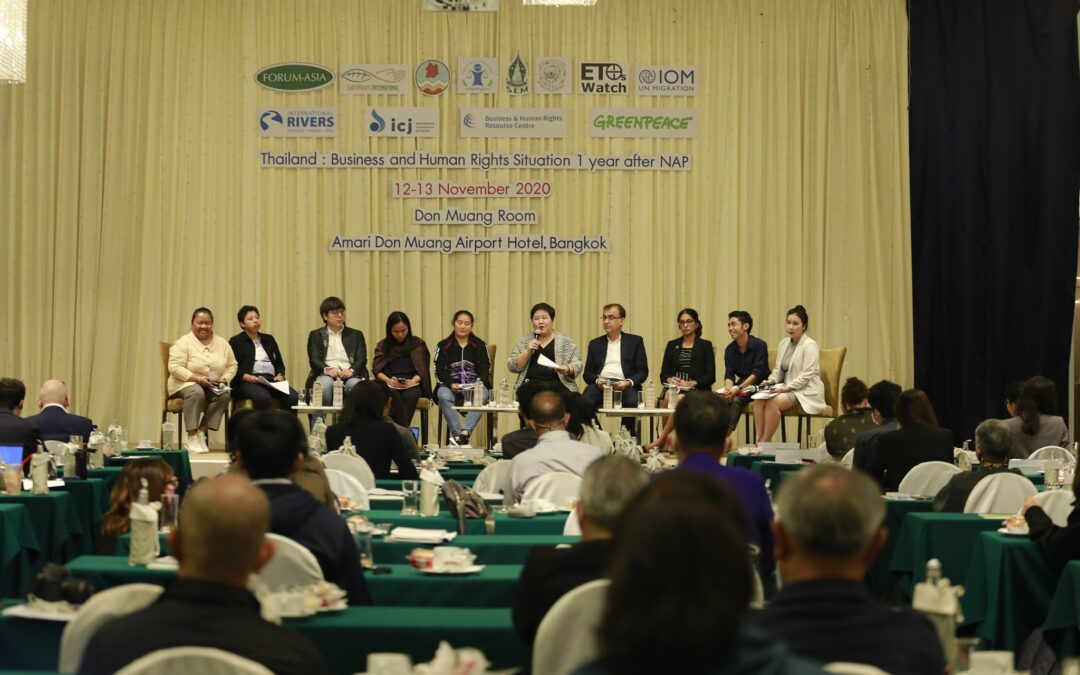
On 12-13 November 2020, the ICJ co-hosted a discussion on “Thailand’s National Action Plan on Business and Human Rights: 1-Year Progress Review” in Bangkok. The forum was co-organized with other 11 organizations.
Participants on the first day included some 95 individuals representing populations affected by business operations from all regions of Thailand and members of civil society organizations. The considered reviewed the progress that has been made by Thailand over the past year towards fulfilling its commitments in the four priority issues in its First National Action Plan on Business and Human Rights (NAP): (1) Labor; (2) Land, environment and natural resources; (3) Human rights defenders; and (4) Cross border investment and multi-national enterprises.
Several participants noted a lack of any evident and tangible progress in the NAP implementation and questioned the effectiveness of the NAP because it does not have the status of a law but is merely a resolution from the Council of Ministers. They further expressed concern at the lack of a comprehensive monitoring system in place to monitor NAP and its achievement according to the key recommendations aligned with the UN Guiding Principle on Business and Human Rights, and on legal harassment and intimidation faced by human rights defenders.
In the session regarding cross border investment and multi-national enterprises, the ICJ participants led the discussion regarding challenges to hold Thai companies accountable for human rights abuses which took place abroad. The participants looked into several obstacles to accessing to justice for victims of business-related human rights abuses in the context of cross-border investment. The discussion was based on the ICJ’s work and analysis in the draft report on the human rights legal framework of Thai companies operating in Southeast Asia, which is expected to be launched in December 2020.
Comments and recommendations raised by participants on the first day were presented to representatives from the Ministry of Justice, Thailand National Human Rights Commission, Global Compact Network Thailand and UN agencies, in the public seminar on the second day. The outcomes of the discussion and recommendations will also be submitted to the NAP Monitoring/Steering Committees, chaired by Director-General of Rights and Liberties Protection Department, Ministry of Justice.
Background
On 29 October 2019, the Cabinet approved and adopted the First National Action Plan on Business and Human Rights (2019-2022), making Thailand the first country in Asia to adopt the stand-alone NAP.
The NAP emphasizes the duties of State agencies to review and amend certain laws, regulations and orders that are not in compliance with human rights laws and standards and ensure their full implementation; ensure accessibility of mechanisms for redress and accountability for damage done to affected communities and individuals; overcome the barriers to meaningful participation of communities and key affected populations; and strengthen the role of businesses to “respect” human rights on a variety of key priority issues.
The event was co-hosted with:
- International Organization for Migration (IOM)
- Community Resource Centre Foundation (CRC)
- Asian Forum for Human Rights and Development (FORUM-ASIA)
- EarthRights International (ERI)
- The Mekong Butterfly (TMB)
- International River (IR)
- Spirit in Education Movement (SEM)
- Thai Extra-Territorial Obligations Working Group (Thai ETOs Watch)
- Green Peace Thailand
- Green South Foundation
- Business and Human Rights Resource Center (BHRRC)
Further reading
Thailand’s Legal Frameworks on Corporate Accountability for Outbound Investments
Thailand: ICJ co-hosts discussion on National Action Plan on Business and Human Rights
Nov 11, 2020 | Advocacy, News
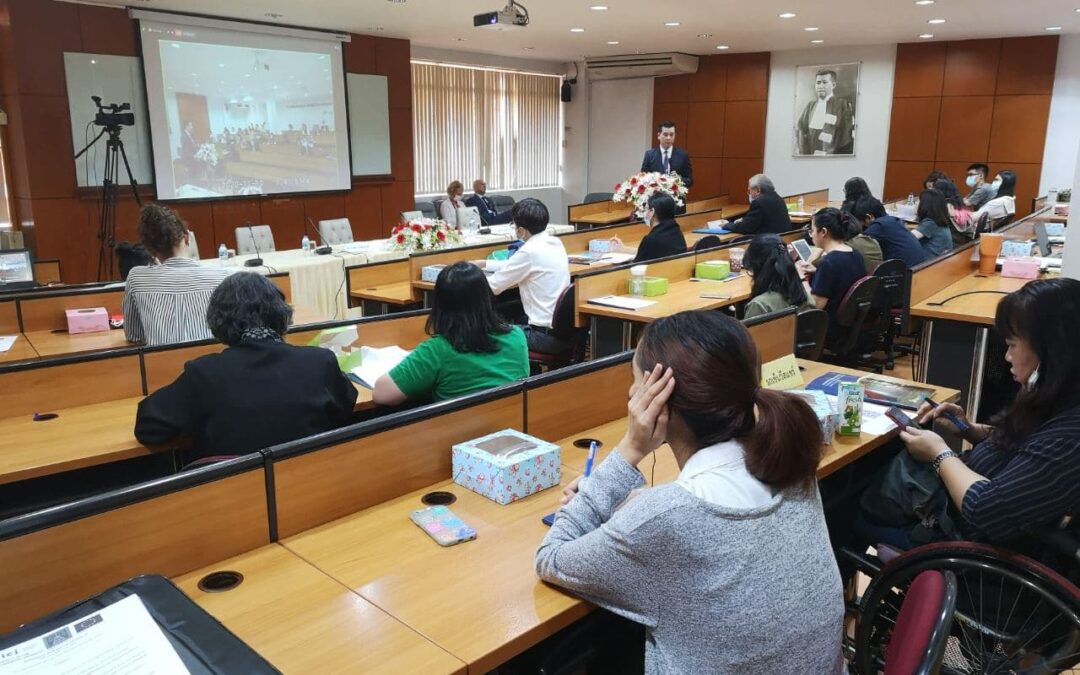
The ICJ, human rights advocates and other experts emphasized the State obligation to protect that right to health of all persons without discrimination at a public seminar held on 10 November 2020.
The ICJ sponsored the event on “Human Rights, Right to Health, and the Coronavirus Disease (COVID-19) Pandemic” in collaboration with the Delegation of the European Union to Thailand, Thammasat University’s Faculty of Law, and the Ministry of Justice’s Department of Rights and Liberties Protection Department.
Participants in the event included interested members of the public, students, human rights academics, and members of civil society organizations.
Welcome remarks were delivered by Giuseppe Busini, Deputy Head of the European Union Delegation to Thailand and Professor Jaturon Tirawat, Director of Thammasat University’s Public International Law Centre.
Dr. Seree Nonthasoot, Member of the UN Committee on Economic, Social and Cultural Rights in an opening address recalled the obligations of Thailand under International Covenant on Economic, Social and Cultural Rights to protect the right of everyone to the enjoyment of the highest attainable standard of physical and mental health. This includes ensuring the right of access to health facilities, goods and services on a non-discriminatory basis. Among these elements are access to housing and sanitation, potable water and essential drugs. He also highlighted the need to implement a national public health strategy and plan of action to make COVID-19 vaccine a global common good.
ICJ Legal Adviser Timothy Fish Hodgson provided a briefing about human rights effects wrought by the COVID-19 pandemic, as exposed in the ICJ report – Living Like People Who Die Slowly: The Need for Right to Health Compliant COVID-19 Responses. He emphasized the particularly acute and discriminatory impact of the pandemic on already marginalized people around the world, particularly on non-citizens, older persons, women and girls, LGBT persons, persons deprived of their liberty, persons with disabilities, sex workers and healthcare workers.
A panel discussion regarding the economic social and cultural rights during and post COVID-19 pandemic, moderated by Chonlathan Supphaiboonlerd, Associate National Legal Advisor of the ICJ, addressed the measures taken by the Thai government to control the spread of COVID-19 and to mitigate social and economic impacts of the pandemic, especially their human rights effects on persons with disabilities, refugees, asylum seekers, persons deprived of their liberty, indigenous peoples and migrant workers in Thailand.
The panel included Nareeluc Paichaiyapoom, Director of International Human Rights Law Division, Department of Rights and Liberties Protection, Ministry of Justice; Dr. Lalin Kovudhikulrungsri, Faculty of Law, Thammasart University; Naiyana Thanawattho, Executive Director, Asylum Access Thailand; Dr. Siwanoot Soitong, Bangkok Legal Clinic, Faculty of Law, Thammasat University; Nattaya Petcharat, Stella Maris Seafarer’ Center Songkhla; and Suebsakun Kidnukorn, Researcher, Area Based-Social Innovation Research Center (Ab-SIRC), Mae Fah Luang University.
Watch the recording of the seminar here.
Further reading
Thailand: The ICJ and other human rights groups make supplementary submission to the UN Human Rights Committee
Sep 14, 2020 | Advocacy, News
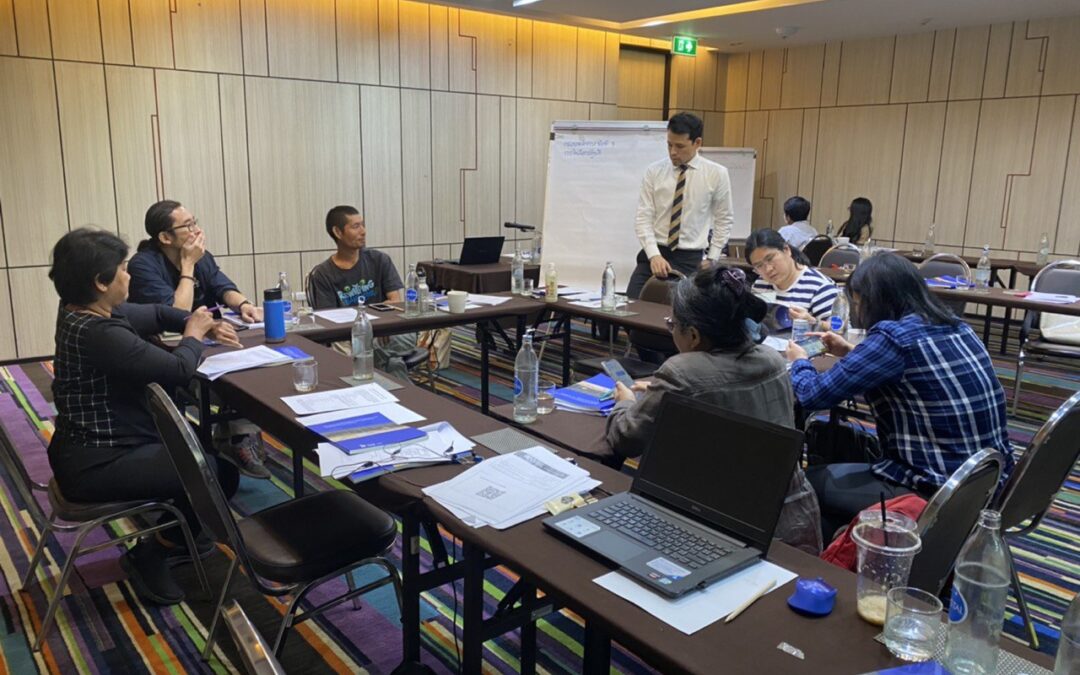
On 13 September 2020 the ICJ hosted a workshop on the impacts on economic, social and cultural rights associated with the development of Special Economic Zones (SEZs) in Thailand. Lawyers, members of civil society organizations and academics from across Thailand attended the Workshop.
The event began with an introduction to ICJ’s report – the Human Rights Consequences of the Eastern Economic Corridor and Special Economic Zones in Thailand – and outlined the deficiencies in the legal and regulatory framework governing economic development in Special Economic Zones and the Eastern Economic Corridor.
During the group discussions, participants were introduced to the international laws and standards that are applicable in the context of Thailand and can be applied to allegations of human rights violations and negative environmental impacts. They were urged to use these standards for their advocacy work.
These included economic, social and cultural rights contained in the International Covenant on Economic, Social and Cultural Rights (ICESCR), to which Thailand is a State party and other internationally recognized principles, including:
- Right to an adequate standard of living and housing under article 11 of the ICESCR, General Comments 4 and 7 of the Committee on Economic Social and Cultural Rights and the Basic Principles and Guidelines on Development-Based Evictions and Displacement – which stress the need to provide adequate legal protection from forced eviction, due process, alternative accommodation, and access to an effective remedy of those that are affected by eviction orders;
- Human rights obligations that are exercised in relation to the environment, such as obligation to facilitate public participation in decision making related to the environment, and duties to protect human rights defenders and to conduct the prior assessment of the possible environmental impacts of proposed projects and policies; and
- Rights to and at work under article 6 to 8 of the ICESCR, General Comment No. 19 and 23 of the Committee on the Economic, Social and Cultural Rights, and several ILO Conventions, particularly regarding rights abuses suffered by migrant, seasonal and subcontracted workers, as well as restrictions on freedom to join and form trade unions.
At the conclusion of the Workshop, participants exchanged views on strategies and collaboration for action to mitigate potential impacts of the Special Economic Zones and the Eastern Economic Corridor and to advance the protection of economic, social and cultural rights.
Further reading
Thailand: laws governing development of Eastern Economic Corridor and Special Economic Zones fail to adequately protect human rights – ICJ report
Thailand: ICJ hosts discussion on human rights consequences of Special Investment Zones
ICJ and Chiang Mai University discuss Special Economic Zones in Myanmar and Thailand

Apr 27, 2020 | News
Today, the ICJ and Lawyers’ Rights Watch Canada (LRWC) jointly submitted a legal brief (amicus curiae) to the Court of Appeal in criminal defamation proceeding against Thai journalist Suchanee Rungmuanporn (Cloitre).
The journalist is being charged after making a post on Twitter highlighting labour rights violations by Thammakaset Company Limited. The post detailed an order by Thailand’s Court of Appeal for Specialized Cases for Thammakaset to provide compensation to its 14 former employees from Myanmar, with the word “slavery” included in the post. This inclusion is the basis for defamation claim.
On 24 December 2019, Suchanee was sentenced to two years’ imprisonment by Lopburi Provincial Court.
The intervention reviews the nature and scope of Thailand’s international legal obligations relating to the right to freedom of expression. It makes clear that the imposition of harsh penalties such as imprisonment has a “chilling effect” on the exercise of freedom of expression, which Thailand is bound to protect pursuant to its international legal obligations. It particularly undermines the work of journalists and human rights defenders seeking to bring to light these violations and whose activities must be protected.
The brief underscores that under international law and standards, criminal sanction involving imprisonment must never be imposed for defamation.
Criminal defamation, under sections 326 of the Criminal Code, carries a maximum sentence of one year of imprisonment, a fine of up to 20,000 Baht (approx. USD 640) or both. Section 328 criminalizes defamation “by means of publication” with up to two years’ imprisonment and a fine of up to 200,000 Baht (approx. USD 6,400).
This case is one of 36 cases brought by Thammakaset against several individuals who have expressed views and conducted advocacy on or released information relating to labour rights violations alleged to have been committed by Thammakaset. These include criminal defamation complaints against human rights defenders, including Mr. Nan Win, Ms. Sutharee Wannasiri, Ms. Ngamsuk Rattanasatiean, Ms. Angkhana Neelapaijit, Ms. Puttanee Kangkun, and Ms. Thanaporn Saleephol.
Download
Legal brief (amicus curiae) to the Court of Appeal in Thai and English.
Apr 24, 2020 | News
On 24 April 2020, the ICJ, Thai Lawyers for Human Rights (TLHR) and the Cross Cultural Foundation (CrCF) made a joint supplementary submission to the UN Human Rights Committee on Thailand’s implementation of its human rights obligations under the International Covenant on Civil and Political Rights (ICCPR).
In their submission, the ICJ, TLHR and CrCF detailed their concerns in relation to Thailand’s failure to implement the Committee’s recommendations, including the ongoing human rights shortcomings of the country’s Constitutional and legal framework; the continued lack of domestic legislation criminalizing torture, other ill-treatment and enforced disappearance; and reports of torture and other ill-treatment. In addition, the three human rights organizations expressed concern over the use of the Emergency Decree on Public Administration in Emergency Situation to combat the COVID-19 outbreak, and measures imposed under the Decree that may constitute a blanket restriction on fundamental freedoms, including the rights to free expression, opinion, information, privacy and freedom of assembly and association, with no opportunity for the courts to review these extraordinary measures.
The organizations’ submission also describes human rights concerns with respect to the following:
Constitution and legal framework
- Head of the NCPO Order No. 22/2561; and
- Head of the NCPO Order No. 9/2562
Extrajudicial killings, enforced disappearances and torture
- continued lack of domestic legislation criminalizing torture, other ill-treatment and enforced disappearance;
- reports of extrajudicial killings, torture, other ill-treatment, enforced disappearances, and the progress and results of investigations;
- the application of security-related laws; and
- threats and reprisals against persons working to bring to light cases of alleged torture, ill–treatment and enforced disappearance.
Download
Thailand-UN-Human-Rights-Committee-Supplementary Submission-2020-ENG (English, PDF)
Thailand-UN-Human-Rights-Committee-Supplementary Submission-2020-THA (Thai, PDF)
Background
On 23 March 2017, during its 119th Session, the Human Rights Committee adopted its Concluding Observations on the second periodic report of Thailand under article 40 of the ICCPR.
Pursuant to its rules of procedure, the Committee requested Thailand to provide a follow up report on its implementation of the Committee’s prioritized recommendations made in paragraphs 8 (constitution and legal framework) 22 (extrajudicial killings, enforced disappearances and torture) and 34 (conditions of detention), within one year of the adoption of its Concluding Observations – i.e., by 23 March 2018.
On 18 July 2018, Thailand submitted its follow-up report to the Committee. The report was published on 9 August 2018.
On 27 March 2018, the ICJ, TLHR and CrCF made a joint follow-up submission to the UN Human Rights Committee. However, since then, there have been several developments that the three organizations wish to bring to the attention of the Committee through this supplementary submission.
The UN Human Rights Committee will review Thailand’s implementation of the prioritized recommendations during its 129th Session, in June/July 2020.
Further reading
ICJ and TLHR, Joint submission to the UN Human Rights Committee, 13 February 2017
ICJ, TLHR and CrCF, Joint follow-up submission to the UN Human Rights Committee, 27 March 2018