Oct 2, 2017 | News
The ICJ, APT, OMCT, FIACAT, Redress, Amnesty, IRCT, and Alkarama have constructed a checklist for membership to guide the States parties to the Convention against Torture and Other Cruel, Inhuman or Degrading Treatment or Punishment in selecting five new members later this month.
See Checklist here:
Universal-CriteriaMembership-News-2017-ENG
Sep 5, 2017 | Events, News
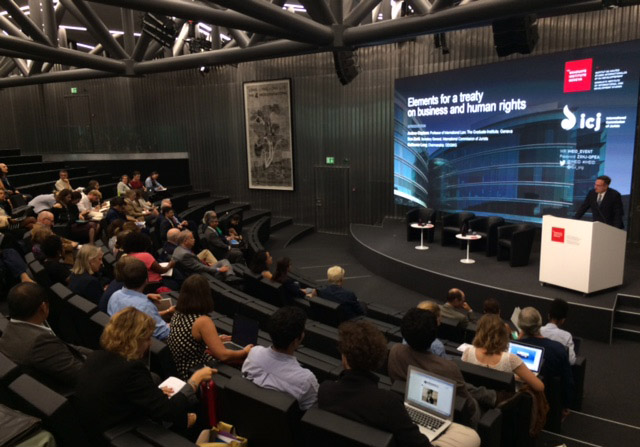
Today the ICJ and the Graduate Institute of International and Development Studies co-organized a public conference: Elements of a treaty on Business and Human Rights.
In June 2014, the United Nations Human Rights Council established an inter-governmental working group to “elaborate an international legally binding instrument to regulate, in international human rights law, the activities of transnational corporations and other business enterprises”.
The third session of the working group will take place from 23-27 October 2017 at the Palais des Nations.
Today’s event took place at a critical moment to inform the process of elaboration by the working group.
It fosters the exchange of views among international actors, with the aim of creating the basis for consensus on possible contents of a legally binding instrument in the field of business and human rights.
The prospective treaty is expected to contribute to fill some accountability gaps in the international normative framework, in relation to the operations of business enterprises in terms of human rights.
The treaty should also enhance States’ action to ensure effective remedies and reparations for the victims of abuses.
This treaty will be the first in the international human rights law framework to address directly activities of business corporations.
The issue of human rights impacts by business enterprises has reached the top of the international agenda, and several non-treaty instruments have been developed, foremost among them the Guiding Principles on Business and Human Rights.
The process towards a treaty in this field is expected to build on the achievements so far, filling remaining gaps and enhancing rules for and action by states and businesses alike.
For additional information & registration click here
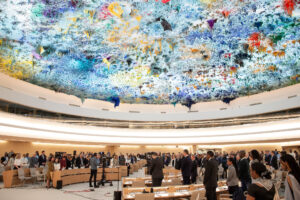
See also the photo of the week on Genève Internationale
Jul 20, 2017 | News
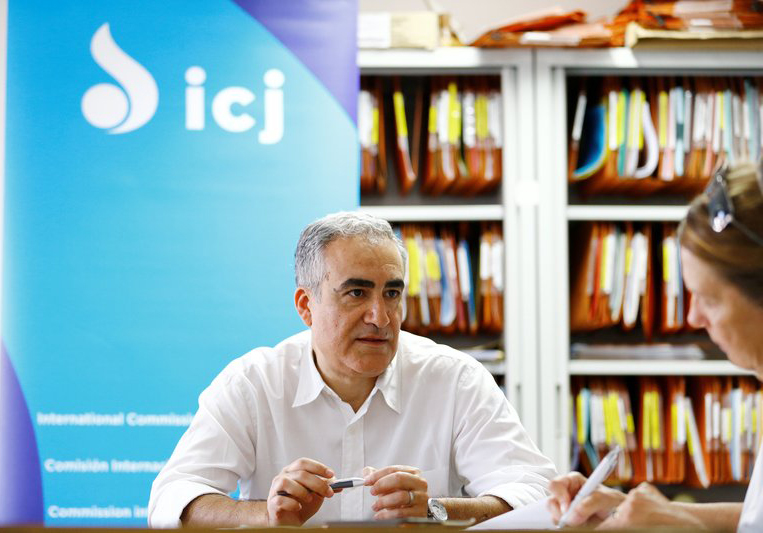
An interview of ICJ Secretary General Sam Zarifi with Reuters journalist Stephanie Nebehay.
GENEVA (Reuters) – Donald Trump is one of a new breed of leaders around the world who seek to use their democratic mandate to undermine the rule of law, the head of a legal and human rights watchdog said on Wednesday.
Branding the U.S. president an “authoritarian populist”, Saman Zia-Zarifi, secretary-general of the Geneva-based International Commission of Jurists (ICJ), compared him to the leaders of Turkey, the Philippines, Hungary and Venezuela.
Zarifi cited as an example Trump’s travel ban on nationals from six Muslim-majority countries, a policy that he called “highly problematic” under the U.S. constitution and international law.
“What is different now is that a certain kind of populism is being used to actually counter the notion of the rule of law,” Zarifi said in an interview at the headquarters of the ICJ, which is composed of 60 eminent judges and lawyers from all regions who seek to protect human rights and the rule of law.
“The new populism has a certain shamelessness about it that is new. It’s not that people are denying that they are violating rights, what they are saying is they can violate rights because somehow they are empowered by the people,” he said.
Zarifi, who took over at the ICJ in April, said the new breed of populists included Turkey’s President Tayyip Erdogan, Venezuela’s Nicolas Maduro, the Philippines’ Rodrigo Duterte, Hungary’s Prime Minister Viktor Orban and Jaroslaw Kaczynski, head of Poland’s ruling party.
“I would say that in the U.S., Trump is an authoritarian populist. He has authoritarian tendencies but he still is facing checks and balances,” Zarifi said. “So he is not a full-blown authoritarian figure.”
The U.S. Supreme Court revised parts of Trump’s executive order banning travellers from Iran, Libya, Somalia, Sudan, Syria and Yemen, a policy Trump says is aimed at tackling terrorism.
“Looking at it again from the point of view of U.S. law – I’m an American lawyer – it seems highly problematic,” said the Iranian-born Zarifi, who moved to the United States as a teenager and holds a law degree from Cornell University.
Supreme Court rulings would be, he said, “a test for the health of the system of checks and balances in the U.S.”
Turkish Judiciary “Politically Compromised”
A crackdown by Erdogan’s government has led to the arrest of 50,000 people and the suspension of 150,000 in the year since a failed military coup in Turkey where the judiciary is “now politically compromised”, Zarifi said.
The Turkish government has said the action is justified by the gravity of the threat to the state from the coup attempt.
On Monday, the state prosecutor asked a court to remand the local Amnesty International director and nine other activists in custody pending trial for membership of a terrorist organisation.
Erdogan was quoted by Turkish media this month as saying they were detained on the basis of intelligence and that the judiciary would make its own decision.
But Zarifi said the judiciary should have thrown the case out.
“The handling of the case highlights the very serious concerns – and alarm in fact at this point – that we have raised about the independence of the judiciary and the legal system in Turkey over the last few years.”
Photo Credit: Reuters / Pierre Albouy
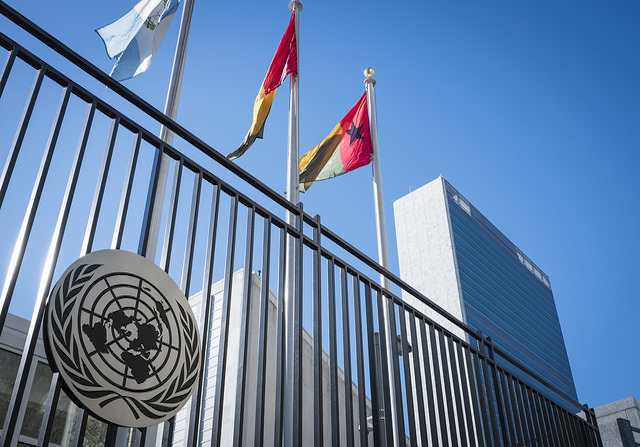
Jun 30, 2017 | Advocacy
A Joint NGO Statement was issued on the occasion of the Twenty-ninth meeting of UN treaty body chairs 27-30 June 2017, New York
This statement includes some reflections and recommendations, by the undersigned organisations (see list on p.6-7), in relation to the programme of work for the 2017 annual meeting.
Some of the comments and recommendations stem from a two-day consultation involving representatives of NGOs, States, treaty body members, OHCHR and academics, which took place in Geneva on 23-24 May 20171.
The consultation focused on developing a strategy for the Treaty Body strengthening process.
A report will shortly be made public.
The comments and recommendations below are structured around the substantive treaty body chairs meeting agenda items.
Universal-MeetingTreatyBodies-Advocacy-2017-ENG (full text in PDF)