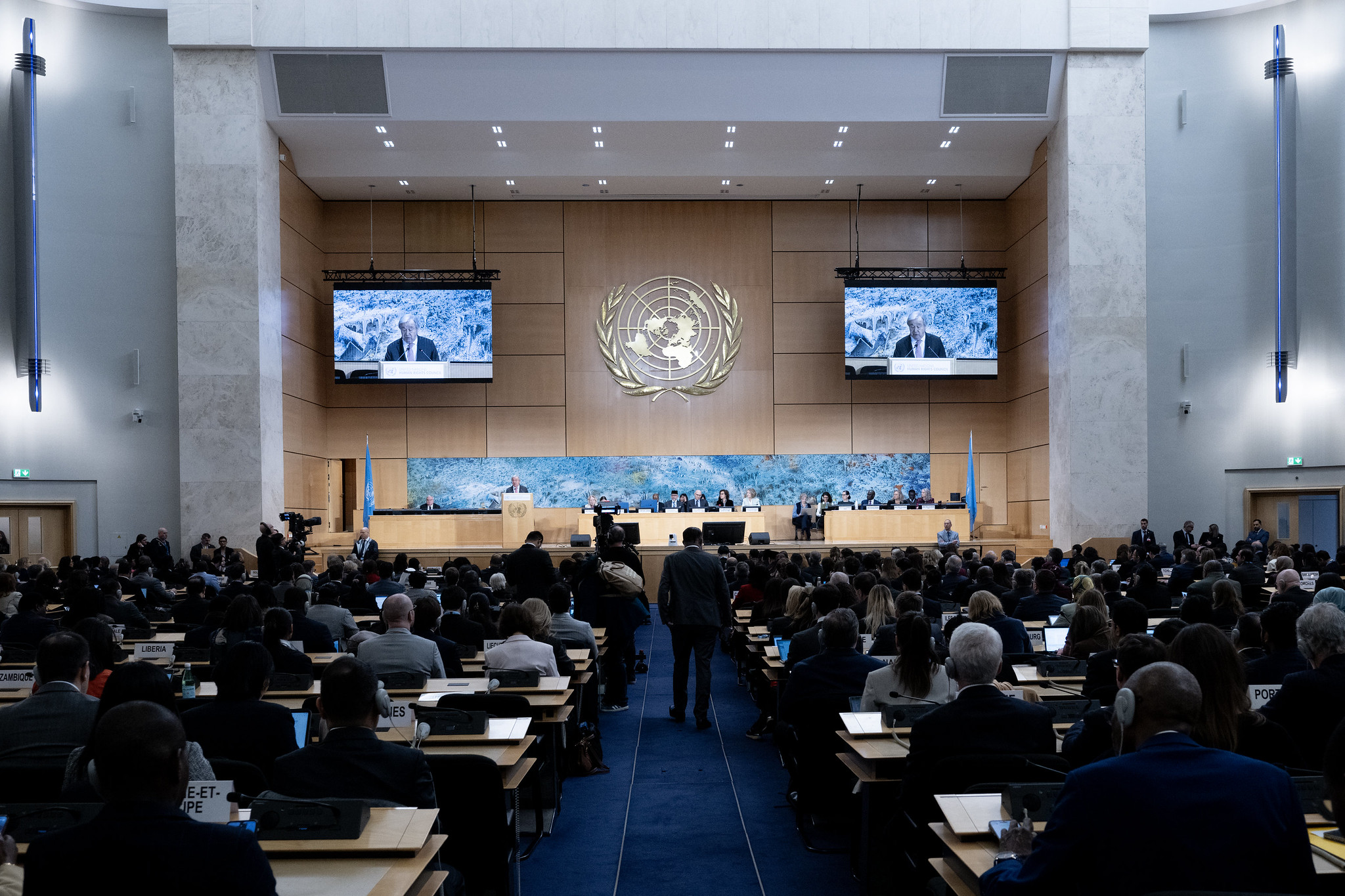
United Nations Human Rights Council
63rd Regular Session
Item 3
Oral Statement for the ID with the Working Group on Arbitrary Detentions
Thank you, Vice-President,
The ICJ calls attention to the opinions of the Working Group in the cases of Abdel Farouq and Ahmed Gika, in Egypt.
Those and numerous other opinions of the Working Group reveal that the practice of arbitrary detention is often used in response to the victims’ legitimate exercise of their human rights.
The National Security Agency (NSA) officers frequently arrest victims without the provision of warrants or providing reasons for arrest and hold them incommunicado at NSA headquarters. In many cases, NSA officers subject victims to enforced disappearance and/or torture during their detention.
Furthermore, while detained, victims are systematically denied their fair trial rights, including the right to have their detention reviewed by an independent judicial officer and to challenge the lawfulness of their detention. Typically, public prosecutors summarily extend pre-trial detention while spuriously charging them with unsubstantiated “terrorism”-related offences. As noted in the Working Group’s Opinions, a key feature of arbitrary detention in Egypt is the resort to the practice of “case rotation”, whereby release is ordered but never effected and new identical charges are brought against victims, to indefinitely extend their pre-trial detention.
Given the Working Group’s concern that the high volume of cases received regarding these practices might indicate that arbitrary detention in Egypt is widespread and systematic, the ICJ considers that an investigation for the possible commission of crimes against humanity is warranted.
The ICJ calls on Egypt to urgently implement the Working Group’s Opinions and immediately release all persons currently arbitrarily detained.
Statement delivered by: Sandra Epal-Ratjen, ICJ International Advocacy Director – For more information, contact: Sandra.epal@icj.org