Oct 31, 2019 | News
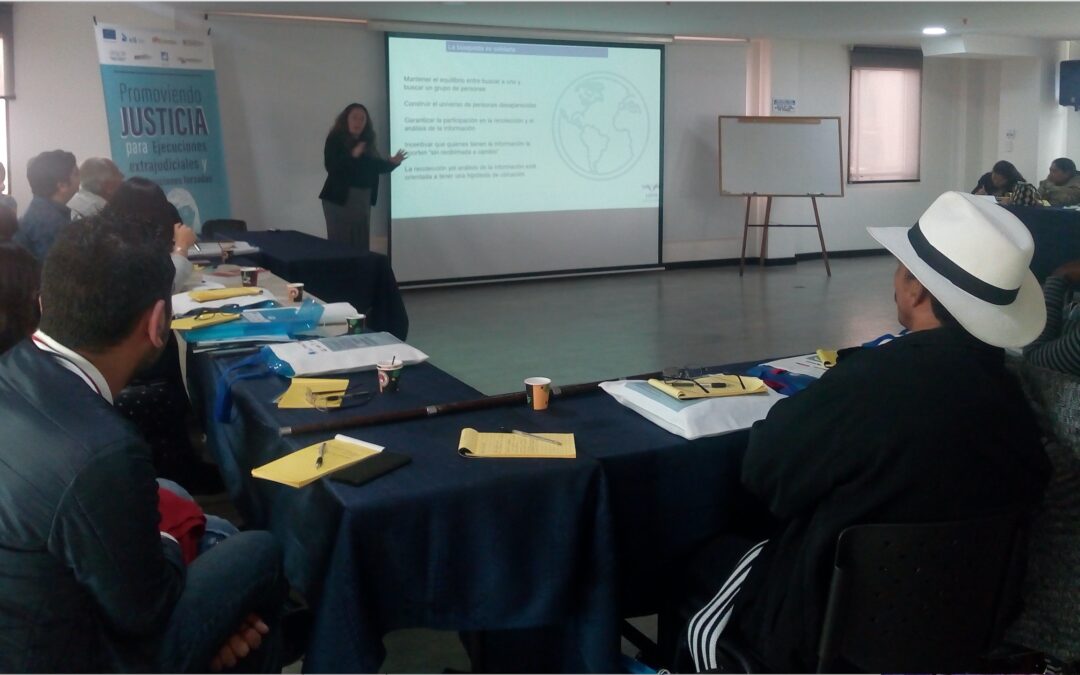
On 29-30 October the ICJ, in partnership with dhColombia and the Argentine Forensic Anthropology Team (EAAF), hosted a two-day training workshop in Bogotá on the legal framework around enforced disappearance and extrajudicial killings.
The training aimed to improve the understanding of victims and human rights lawyers of the domestic law on extrajudicial killings and enforced disappearances in Colombia. It included an analysis of both the ordinary justice system, as well as transitional justice mechanisms. It also explored the role of the forensic sciences in tackling impunity for those crimes.
The ICJ in furtherance of its objective to promote accountability, justice and the rule of law in Colombia, has been continuously monitoring the investigation and prosecution of serious human rights violations and abuses, particularly extrajudicial killings and enforced disappearances. Perpetrators of such violations, which constitute crimes under international law, have enjoyed a high level of impunity. While there are numerous unresolved cases dating back to the 1970s, violations have continued even after a comprehensive peace agreement was signed in 2016 following decades of armed conflict.
In Colombia, achieving accountability for those crimes has proven difficult for several reasons, including the ineffective functioning of the justice system. Victims and their lawyers have faced serious obstacles in gaining access to effective remedies. In addition, the creation of new institutions by the Peace Agreement has changed some basic rules and procedures for the investigation and prosecution of those crimes. Consequently, the Colombian justice system is more complicated to understand not only for victims but for lawyers.
The training workshop was part of a broader regional project addressing justice for extrajudicial killings and enforced disappearances in Colombia, Guatemala and Peru. Participants were victims and human rights lawyers from different regions of the country, especially those where that is less opportunity to access legal and forensic training. Considering that capacity building activities are essential to the effective achievement of accountability, it is expected that participants of the training will obtain valuable tools to demand justice and remedy and reparations for serious human rights violations.
Contacts:
Rocío Quintero M, Legal Adviser, Latin America. Email: rocio.quintero(a)icj.org
Carolina Villadiego, ICJ Legal and Policy Adviser, Latin America, and Regional Coordinator of the Project. Email: carolina.villadiego(a)icj.org
Oct 15, 2019 | News
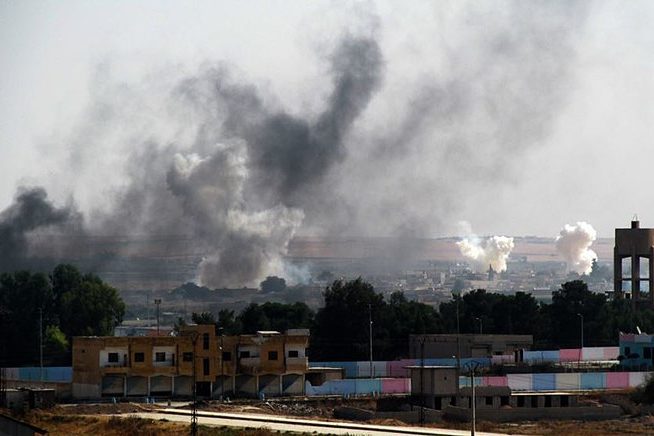
Today, ICJ called on Turkey to comply with its obligations under the UN Charter, international humanitarian law and international human rights law, immediately end its military operations in Syria, and protect and ensure the protection of the Syrian civilian population.
The ICJ also reiterated its call on all parties to the Syrian conflict to respect and comply with international humanitarian law and international human rights law.
On October 9, Turkey initiated operation “Peace Spring” in Rojava, the Kurdish-led Syrian Democratic Forces (SDF)-held territory in north-east Syria, with the stated aim of securing Turkey’s border, “fighting terrorism” and facilitating the return of refugees to Syria. Turkey claimed to be acting pursuant to its right to self-defence under article 51 of the UN Charter, as well as UN Security Council resolutions on the fight against terrorism.
The ICJ recalled that none of these UN Security Council resolutions authorizes the use of armed force in violation of international law, and that the UN Charter prohibits the use of armed force by States, save when authorized by the UN Security Council or in self-defence.
Use of force in self-defence is lawful only when necessary to repel an armed attack and when proportionate to such attack. Military operations failing to abide by such requirements are in breach of the UN Charter.
“Turkey’s military operations violate the UN Charter and exemplify how the banalization of the illegal use of armed force continues to erode and dismantle the very fabric of the international legal order,” said Said Benarbia, the ICJ MENA Programme Director.
He added, “Instead of standing by while international law is being violated, the UN Security Council must take swift, appropriate measures to address the situation and to restore and maintain international peace and security.”
While UN Security Council member States have failed to find an agreement on even a statement on Turkey’s military operations in Syria, Turkish military operations continue to have a devastating impact on the general population, including multiple civilian casualties, attacks against civilian objects, including medical facilities and water supplies and infrastructure, and the displacement of more than 150,000 people, mainly civilians.
Turkish forces and the Turkish-backed armed groups have allegedly been responsible for violations of international humanitarian law and international human rights law. Members of one of these groups, the Ahrar Al-Sharqiya, have been accused of the extrajudicial execution of at least nine civilians, among whom is Kurdish politician and women’s rights activist Harvin Khalaf; torture and other ill-treatment; kidnapping; and looting and seizure of private property.
Turkey’s Defence Ministry said 595 “terrorists” were “neutralized” since the start of “Peace Spring.”
Under international humanitarian law, parties to an armed conflict must respect and protect the civilian population, and refrain from any direct, indiscriminate or disproportionate attack against civilians and civilian objects. International human rights law also continues to apply during the conflict.
“Turkish authorities must investigate and prosecute unlawful killings committed in the context of operation “Peace Spring,” including extrajudicial executions amounting to war crimes,” Benarbia said.
He added, “If no action is taken by these authorities, States must act, collectively and individually, to hold to account all those responsible for such crimes.”
Contact
Said Benarbia, Director of the ICJ Middle East and North Africa Programme, t: +41-22-979-3817; e: said.benarbia(a)icj.org
Syria-Turkey operations-News-Press releases-2019-ARA (Arabic version, in PDF)
Syria-Turkey operations-News-Press releases-2019-TUR (Turkish version, in PDF)
Oct 4, 2019 | Advocacy, News
Reform of the 1959 Defence Services Act is a necessary step to address ongoing military impunity. The case of Ko Par Gyi’s killing should be reopened to satisfy the State’s international law obligations and deter repetition of serious crimes by soldiers.
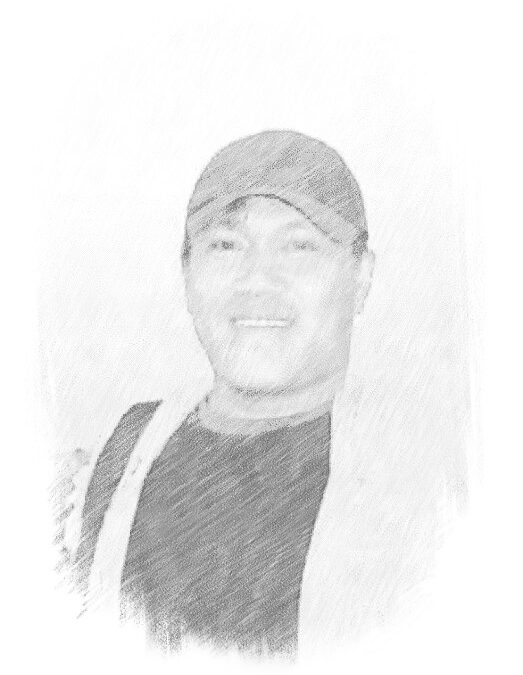
Five years after the death of journalist Ko Par Gyi, the ICJ calls on the Government of Myanmar to reform the 1959 Defence Services Act, which was used to shield soldiers from accountability for involvement in his killing.
“The case is emblematic of the 1959 Defence Services Act being used to enable impunity for human rights violations by soldiers throughout Myanmar, by transferring to military courts the authority to investigate and prosecute serious crimes against civilians,” said Frederick Rawski, Asia Pacific Region Director for the ICJ.
“Impunity for Ko Par Gyi’s death is another example of this law being used to shield soldiers from accountability for serious crimes,” added Rawski. “Legislators should reform the 1959 law to enable the public criminal prosecution of soldiers for serious crimes in all circumstances, and take other steps to address the accountability gap.”
After being detained by police in Mon State and transferred into military detention on 30 September 2014, Ko Par Gyi died four days later in the custody of Tatmadaw soldiers. Unceremoniously buried in a shallow grave, Ko Par Gyi’s death was hidden from his family and the public for weeks. Nobody has been held accountable for his death and his family lacks access to redress, including their right to know the truth.
A deeply flawed inquiry carried out secretly in military courts, pursuant to the 1959 Act, resulted in the acquittal of the soldiers allegedly involved. This effectively ended other efforts to hold the perpetrators accountable, including through an inquest at the Kyaikmaraw Township Court in Mon State. It also flouted the Myanmar National Human Rights Commission’s recommendation for a police investigation and public criminal trial to be undertaken by civilian authorities.
“Five years on, Myanmar authorities must finally initiate a thorough, independent and impartial investigation into the killing of journalist Ko Par Gyi,” said Sean Bain, legal adviser for the ICJ. “The truth must be established and recognized, and those responsible for his apparently unlawful killing need to be brought to justice in fair trials,” he added.
Several provisions of the 1959 Act are used to facilitate a transfer of cases involving military personnel from civilian to military courts, including for serious crimes against civilians. This has been used as a tool to avoid accountability in cases throughout Myanmar, such as its use to justify the early release of soldiers who were convicted by a military court in the killing of ten Rohingya civilians in Rakhine State in 2017.
International legal standards prohibit the use of military courts to try military personnel for gross human rights violations and crimes under international law. The detention and prosecution of journalists, based solely on their lawful activities undertaken while doing their job, violates the right to freedom of expression, and the rights to seek, receive and impart information and to participate in public affairs.
Myanmar authorities have an obligation to reopen the case of Ko Par Gyi with a view to establishing the circumstances of his death, as with any potentially unlawful killing by either State or non-State actors.
“By empowering civilian courts to oversee such cases, the NLD Government would send a powerful message to all justice sector institutions, including police, prosecutors and judges, that they can and should review potential crimes involving the military with independence and impartiality, in line with the rule of law,” added Bain.
The National League for Democracy (NLD)-led Government has the legislative authority to immediately reform the 1959 Act to align it with international standards. The ICJ has called for reform of this law, including by allowing the prosecution of soldiers for serious crimes to be undertaken under the jurisdiction of civilian courts.
See also:
ICJ, “The investigation and prosecution of potentially unlawful death: ICJ Practitioners’ Guide no. 14,” 14 September 2019, available here.
ICJ, “Achieving Justice for Gross Human Rights Violations in Myanmar – a baseline study,” 16 January 2018, available here.
Contact
Sean Bain, ICJ legal adviser, e: sean.bain(a)icj.org
Full statement with additional information, in English: Myanmar-Ko Par Gyi killing-Press-Releases-2019-ENG (PDF)
Full statement, in Burmese: Myanmar-Ko Par Gyi killing-Press-Releases-2019-BUR (PDF)
Oct 2, 2019 | News
This support comes as the ICJ documents failure of criminal justice system on human rights accountability with its report Accountability for Serious Crimes under International Law in Libya: An Assessment of the Criminal Justice System.
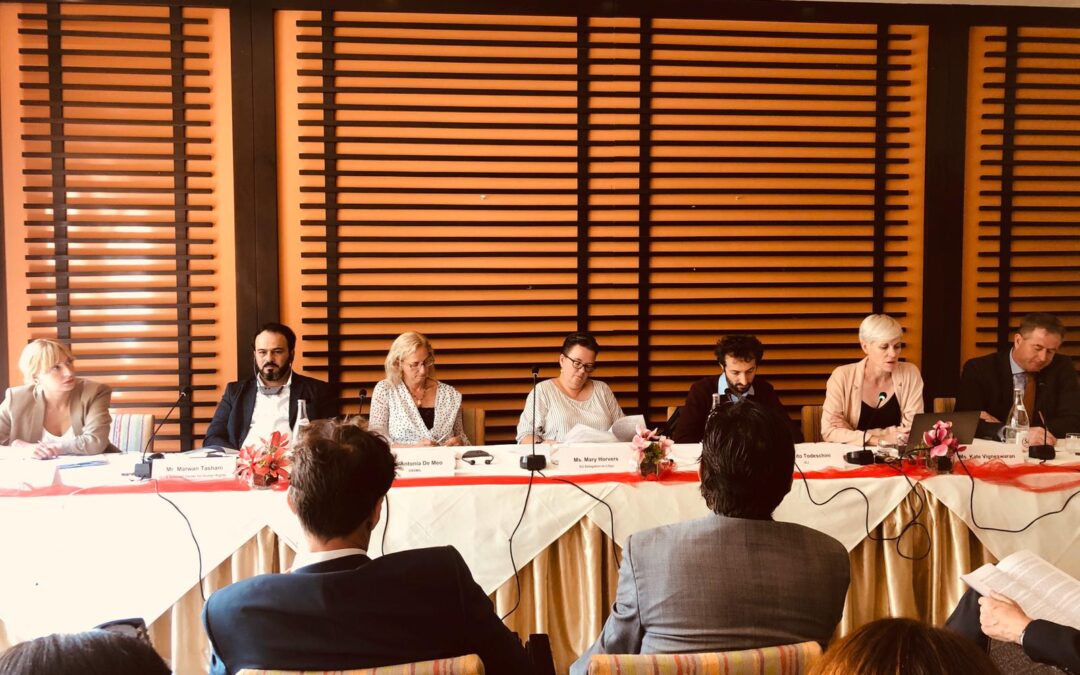
At today’s launch of the publication, the UN Support Mission in Libya (UNSMIL), the Delegation of the European Union to Libya (EUDEL) and the European Union Border Assistance Mission (EUBAM) supported calls for the establishment of a UN Commission of Inquiry for Libya.
The ICJ’s report examines the criminal justice framework in Libya and finds that investigations and prosecutions of crimes under international law have been limited to a handful of cases, and that future cases are unlikely meet international standards necessary to ensure fair and effective justice, in particular the rights to liberty and a fair trial and the prohibition on torture and ill-treatment.
The support by international actors echoes the ICJ’s call for the establishment of a Commission of Inquiry or similar mechanism to monitor, document and report on human rights violations in order to identify perpetrators, and gather and preserve evidence for future prosecutions, either national or international.
UNSMIL, the EU and a number of States expressed their support for the establishment of a Commission of Inquiry or similar mechanism at the 42nd session of the Human Rights Council.
The ICJ also advocated for such a mechanism in its statement to the Council on 25 September.
At the launch, ICJ Senior Legal Adviser Kate Vigneswaran said that “it’s time for States to stop working on the premise that the Libyan criminal justice system can effectively ensure accountability for crimes committed by State and non-State Actors and instead look at options for ensuring they don’t go unpunished.”
The ICJ’s report also calls on States and UN actors to ensure they adopt human rights-compliant terms in their engagement with Libya and to refrain from entering into or implementing agreements with Libyan authorities that could give rise to support for or complicity in violations of international law.
Kate Vigneswaran stated: “Human rights and accountability should underpin any agreements and engagement with Libyan actors entered into by States, rather than being sidelined in the interests of a political solution. Time has shown that the absence of human rights at the forefront of dialogue and engagement with stakeholders has failed to ensure the cessation of egregious human rights violations and abuses being perpetrated throughout the country.”
The launch, which was held in partnership with the Embassy of the Netherlands in Libya, was opened by the Netherlands’ Ambassador, H. E. Mr. Lars Tummers.
Kate Vigneswaran discussed the key findings and recommendations contained in the report. A panel comprised of ICJ Commissioner Marwan Tashani and representatives of EUDEL, EUBAM and UNSMIL responded to the report and provided insights into their work in Libya.
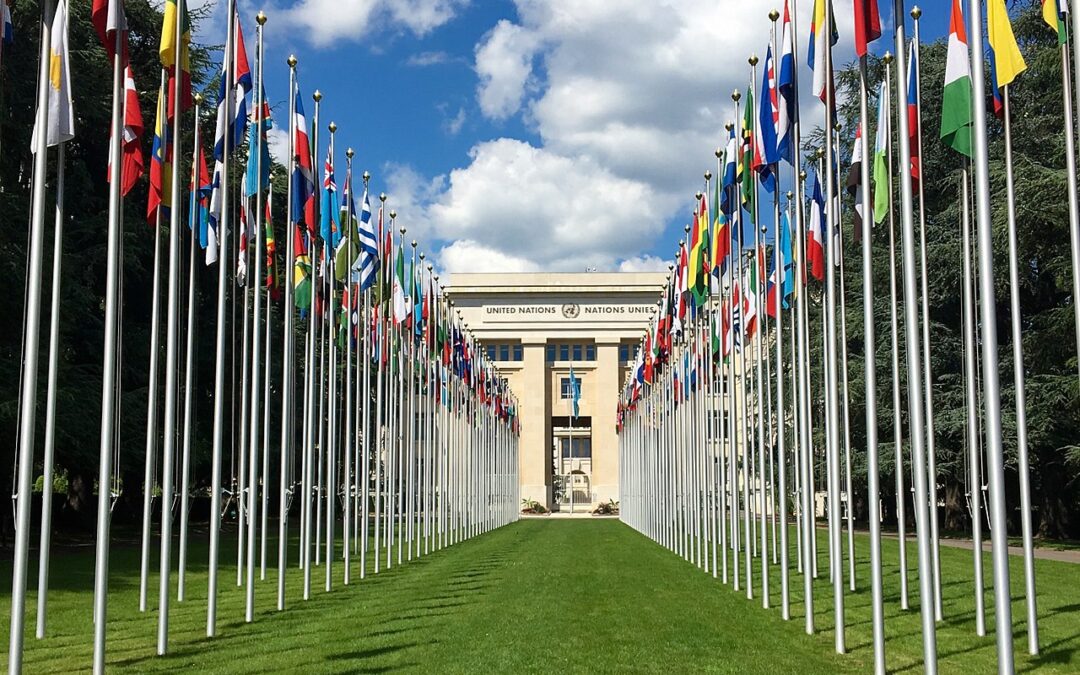
Sep 27, 2019 | Advocacy, Non-legal submissions
Today, at the close of the 42nd regular session of the UN Human Rights Council in Geneva, the ICJ and other NGOs highlighted key acheivements and failures.
The joint civil society statement, delivered by International Service for Human Rights (ISHR) on behalf of the group, read as follows (not all text could be read aloud due to time limits):
“The Council reaffirmed that reprisals can never be justified. Council members rejected attempts to weaken the text including attempts to delete the references to the roles of the Assistant Secretary-General and the Human Rights Council Presidents. The resolution listed key trends such as the patterns of reprisals, increasing self-censorship, the use of national security arguments and counter-terrorism strategies by States as justification for blocking access to the UN, acknowledged the specific risks to individuals in vulnerable situations or belonging to marginalized groups, and called on the UN to implement gender-responsive policies to end reprisals. The Council called on States to combat impunity and to report back to it on how they are preventing reprisals, both online and offline. The Bahamas and the Maldives responded to this call during the interactive dialogue and we encourage more States to follow their good practice. We also encourage States to follow the good practice of Germany and Costa Rica in raising specific cases of reprisals. The Council also welcomed the role of the Assistant Secretary-General and invited the General Assembly to step up its efforts to address reprisals and ensure a coherent system-wide response.
We welcome the creation of a Fact-Finding Mission (FFM) on Venezuela as an important step towards accountability for the grave human rights violations documented by the High Commissioner. We urge Venezuela to cooperate with the FFM and to honor the commitments they have made during this session, including by allowing OHCHR unfettered access to all regions and detention centers and implementing their recommendations. Cooperation and constructive engagement and measures for international accountability and justice should be seen as complementary and mutually reinforcing.
We welcome the renewal and strengthening of the mandate of the Group of Eminent Experts on Yemen, sending a clear message to parties to the conflict – and to victims – that accountability is at the center of the mandate, and providing a crucial and much-needed deterrent to further violations and abuses. States should support the recommendations made by the GEE in their recent report, including prohibiting the authorization of transfers of, and refraining from providing, arms that could be used in the conflict to such parties; and clarifying the GEE’s role to collect and preserve evidence of abuses.
We welcome the renewal of the mandate of the Special Rapporteur on Cambodia, but regret that calls to strengthen the mandate of the OHCHR to monitor and report on the situation have been ignored. We regret that the resolution fails to accurately depict the continuing crackdowns on civil society and the severity and scale of recent attacks on the political opposition.
We welcome the renewal of the mandate of the Commission of Inquiry on Burundi. Its work is vital as the country heads towards elections in 2020. The Burundian Government should desist from denial and insults, and should cooperate with the Commission and other UN bodies and mechanisms.
We welcome that the EU and OIC have jointly presented a resolution on Myanmar requesting the High Commissioner to report on the implementation of the recommendations of the Fact-Finding Mission at HRC 45. However, the international community needs to take stronger action to ensure accountability for and cessation of grave international crimes, in particular by referring Myanmar to the ICC and imposing a global arms embargo – and by acting on the FFM’s reports, including those on economic interests of the military and on sexual and gender-based violence in Myanmar and the gendered impact of its ethnic conflicts.
The joint EU/OIC resolution on Myanmar welcomes the FFM report on the military’s economic interests, which identifies companies contributing to abuses. The High Commissioner, however, has still not transmitted the database of companies facilitating Israel’s illegal settlements more than 2 and a half years after its mandated release. The High Commissioner pledged in March to fulfil the mandate “within the coming months”. The ongoing unexplained and unprecedented delays have become a matter of credibility, for both the High Commissioner and the HRC. Mr. President, we request that you confer with the High Commissioner and advise as soon as possible when this important Council mandate will be fulfilled.
‘Cautious optimism’ best defines our approach to Sudan. While this year’s resolution, which welcomes the peaceful popular uprising, renews the Independent Expert’s mandate, supports the opening of an OHCHR country office, and highlights the role and needs of civil society, is an improvement on 2018, significant challenges remain. Ensuring accountability for the perpetrators of grave human rights and humanitarian law violations should be a central priority for the new Government, and the Council should assist in this regard.
We regret the lack of Council action on Kashmir and urge the Council, as well as India and Pakistan, to act on all the recommendations in the report of the UN High Commissioner for Human Rights.
On terrorism and human rights, we are deeply disappointed that Mexico and other States have partially acquiesced in attempts by Egypt to dilute or distract the work of the Special Rapporteur on counter-terrorism away from its appropriate focus on human rights violations while countering terrorism and human rights of victims of terrorism. We regret that States have asked the Special Rapporteur to spend the limited time and resources of the mandate, to comment on the overbroad concept of the “effects” of terrorism, by which Egypt and some other States seem primarily to mean macroeconomic, industrial, and investment impacts, rather than the human rights of individual victims. The length to which States seem willing to put the existing Special Rapporteur’s mandate at risk, in the name of protecting it, while failing even to incorporate stronger consensus text on human rights issues included in the most recent merged parallel resolution at the General Assembly, suggests that the merger of the previous Mexican and Egyptian thematic resolutions no longer holds any real promise of positive results for human rights.
We welcome the adoption of the resolution on the question of the death penalty, which is an important reflection of the movement towards the international abolition of this cruel punishment. Significantly, this resolution reiterates and affirms the position of international law that the abolition of the death penalty is an irrevocable commitment and that an absolute prohibition exists to guard against its reintroduction. We also welcome the acknowledgement of the ‘most serious crimes’ threshold that acts to restrict the death penalty, in States that have yet to abolish it, only to crimes of extreme gravity; this resolution plainly identifies that criminal conduct that does not result directly and intentionally in death can never meet the threshold test and can never serve as a basis for the use of the death penalty. We are very pleased to acknowledge that the adoption of this resolution is complimentary to the General Assembly’s resolution calling for an international moratorium on the death penalty and, together, they serve to illustrate the advancing global commitment to abolition.
We welcome the Council’s renewed attention to the protection of the right to privacy in the digital age: fully integrating human rights into the design, development and deployment of Artificial Intelligence, machine learning technologies, automated decision-making, and biometric systems, is essential to safeguard not only the right to privacy, but also to freedom of expression, peaceful assembly, and association, and economic social and cultural rights.
On human rights in the administration of justice, we welcome the focus in this year’s resolution on concrete measures to prevent and respond to violence, death and serious injury in situations of deprivation of liberty, which illustrates the potential of thematic resolutions to set out specific practical, legal and policy steps that can be drawn on by governments, civil society, and other stakeholders to have real positive impact at the national level.
We commend Australia for its leadership on Saudi Arabia, as well as the other States who stood up for women’s rights activists and accountability. We urge more States to live up to their commitment to defend civil society and sign the statement in the coming 2 weeks.
We appreciate the attention paid by individual governments to the situation in China, including the dire situation facing Uyghurs and other Turkic Muslims; the crackdown on human rights defenders, including those working to draw attention to violations of economic, social and cultural rights; and the suppression of fundamental freedoms in Tibet. However, we deplore that the Council and many of its members have once again failed to take decisive action to ensure monitoring and reporting on the human rights situation in the country, especially Xinjiang, and press for access for the High Commissioner.
For five years since the last joint statement in March 2014, the Council has failed to hold Egypt accountable for continuing systematic and widespread gross human rights violations. In the latest crackdown on peaceful protests, reports indicate that more than 2000 people have been arrested in the past week. When will the Council break its silence and convene a Special Session to address the grave and deteriorating human rights situation in Egypt?”
Signatories:
- International Service for Human Rights (ISHR)
- DefendDefenders (the East and Horn of Africa Human Rights Defenders Project)
- Commonwealth Human Rights Initiative (CHRI)
- CIVICUS: World Alliance for Citizen Participation
- Cairo Institute for Human Rights Studies
- Asian Legal Resource Centre
- Asian Forum for Human Rights and Development (FORUM-ASIA)
- International Commission of Jurists (ICJ)
- Amnesty International
- Association for Progressive Communications (APC)
- Human Rights Watch
- International Federation for Human Rights (FIDH)