Nov 28, 2023 | Cases, News
FOR IMMEDIATE RELEASE
Berlin, November 28, 2023 – A German court in the city of Celle is expected to deliver a verdict on November 30, 2023, in the first trial in Germany for crimes committed in The Gambia, Gambian and international civil society groups said today in releasing a question and answer document about the trial.
The groups are: the African Network against Extrajudicial Killings and Enforced Disappearances (ANEKED), the European Center for Constitutional and Human Rights (ECCHR), the Gambian Center for Victims of Human Rights Violations, Human Rights Watch, the International Commission of Jurists, Reporters Without Borders (RSF), the Rose Lokissim Association, the Solo Sandeng Foundation, and TRIAL International.
This trial is possible because Germany recognizes universal jurisdiction over certain serious crimes under international law, allowing for the investigation and prosecution of these crimes no matter where they were committed and regardless of the nationality of the suspects or victims.
The trial concerns Bai L., an alleged member of the “Junglers,” a paramilitary unit also known as the “Patrol Team,” which was set up by then-president Yahya Jammeh in the mid-1990s. Jammeh’s 22-year rule was marked by systematic oppression and widespread human rights violations, including torture, extrajudicial killings, enforced disappearances, and sexual violence against actual and perceived opponents.
German prosecutors accuse Bai L. of being a Junglers driver involved in the attempted murder of Ousman Sillah, a lawyer; the murder of Deyda Hydara, a journalist; the attempted murder of Ida Jagne and Nian Sarang Jobe, who worked with the independent newspaper Hydara; and the murder of a former Gambian soldier, Dawda Nyassi
The verdict in the Bai L. case represents a major step in the search for justice for years of abuses committed under Jammeh’s rule in The Gambia, the groups said. The Bai L. trial reinforces the role that governments like Germany can play in advancing justice for atrocities committed abroad under the principle of universal jurisdiction.
Civil society groups will hold a news conference online on Thursday, November 30 after the verdict is issued – scheduled for 3:30 pm CET – at the following link: https://us06web.zoom.us/j/81236784593?pwd=tvLgbtT3I8N9rF2Db2XTIRyH3Kn1gv.1
To read the question-and-answer document, please see the attached PDF:
Questions and Answers on first German trial for serious crimes
For more information, please contact:
For Reporters Without Borders, in Dakar, Sadibou Marong (English, French): +221-70-960-40-92 (mobile); or smarong@rsf.org. Twitter: @cheikhsadbu
For TRIAL International, in Geneva, Babaka Mputu (English, French, German): +41-775-07-04-56 (mobile); or media@trialinternational.org. Twitter: @Trial
For Human Rights Watch, in New York, Elise Keppler (English, French): +1-917-687-8576 (mobile); or kepplee@hrw.org. Twitter: @EliseKeppler
For Solo Sandeng Foundation, in Germany, Fatoumatta Sandeng (English, German, Mandinka, Wollof): +49-163-174-7519 (mobile); or solosandengfoundation@gmail.com. Twitter: @solosandengfound
For ANEKED, in New York, Nana-Jo Ndow (English, French, Spanish, Portuguese): +1-929-684-5734 (mobile); or nanajo.ndow@aneked.org. @theANEKED
For Reporters Without Borders, in Berlin, Nicola Bier (German, English, French, Spanish, Italian): +49-160-9957-6073 (mobile); or nicola.bier@reporter-ohne-grenzen.de. Twitter: @ReporterOG
Lawyer for Baba Hydara and Omar and Modou Nyassi, in Celle, Patrick Kroker (German, English, French): +49-170-813-6258 (mobile); or info@patrickkroker.net. Twitter: @pkroker2
For International Commission of Jurists, in New York, Reed Brody (English, Spanish, French, Portuguese): +1-917-388-6745 (mobile); or reedbrody@gmail.com. Twitter: @reedbrody
Oct 13, 2023 | Human Rights Council, News, Statements, Work with the UN
Geneva, 13 October 2023
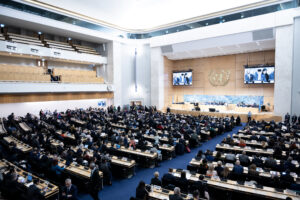
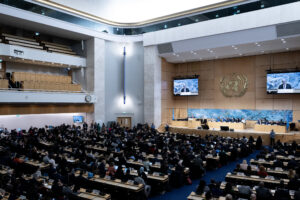
In this statement, the International Commission of Jurists (ICJ) looks back at five weeks of consideration of a wide range of country situations and human rights thematic concerns, and at intense negotiations during the 54th session of the United Nations Human Rights Council (HRC) that ended today in Geneva.
This session resulted in some positive actions for the protection and promotion of human rights and for accountability for grave human rights violations. However, States also failed to address the dire human rights situation in a number of countries. They also failed to support unanimously a number of important initiatives towards the greater enjoyment of human rights for all without discrimination.
Welcoming the renewal of a number of Special Procedures’ mandates
The ICJ welcomes the renewal of a number of Special Procedures’ mandates on both country situations and themes. In particular, the mandates on the situation of human rights in Afghanistan, Cambodia and Russia have been extended. With regard to thematic mandates, the ICJ particularly salutes the adoption of resolutions enabling the continuation of the work of the UN Special Rapporteur on Truth, Justice, Reparation and Guarantees of Non-Recurrence, as well as of the Working Group on Enforced or Involuntary Disappearances. With respect to this, the ICJ considers it very positive that the resolution on Enforced or Involuntary Disappearances explicitly encourages States to participate in the upcoming world congress to promote the ratification of the International Convention for the Protection of All Persons from Enforced Disappearance in 2024.
Continued intergovernmental negotiations on the issue of private security companies
The ICJ is actively engaged in supporting the elaboration of new standards to enhance human rights protection in respect of the activities of private military and security companies. In this context, the ICJ has followed the HRC’s thematic debates on both the use of mercenaries and the work of the intergovernmental working group tasked with the elaboration of a new regulatory framework on private military and security companies. In light of this, the organization welcomes the renewal of the mandate of the intergovernmental working group to negotiate such standards.
Celebrating the creation of a new investigative mechanism on the situation in the Sudan
The ICJ applauds the creation of a robust independent international fact-finding mission on the human rights and humanitarian crises resulting from the ongoing armed conflict in the Sudan. The ICJ had joined a group of 120 civil society organizations that sent a letter to States, on 1 September 2023, in advance of the HRC session, urging the creation of such an independent investigative mechanism.
Adoption of important thematic resolutions
The ICJ also considers that the adoption of a new resolution providing more capacity for the Office of the UN High Commissioner for Human Rights (OHCHR) to support States in the realization of economic, social and cultural rights (ESCR) is a positive step.
However, the ICJ urges States to ensure:
• respect for the independence of the OHCHR in carrying out additional work in this area;
• that ESCR be treated on an equal footing with other human rights; and
• that any new work builds upon the existing work carried out by the HRC and by the OHCHR for several decades in this area.
After intense negotiations, the HRC eventually adopted the resolution on preventable maternal mortality and morbidity and the one on the question of the death penalty. Fortunately, all amendments aimed at weakening human rights protections in both texts were defeated.
However, the ICJ deplores the persistence of ploys intentionally engineered during the negotiations of these two resolutions, which, if successful, would have been detrimental to the enjoyment of women and girls’ human rights, including to sexual and reproductive health and comprehensive sexuality education. In addition, purported concern over States’ sovereignty negatively impacted a number of debates and threatened to impair progress in the protection of universal human rights.
Regretting the inability of the HRC to address key situations
These controversies took place at a very polarized HRC session and reflect the broader geopolitical realities and ideological tensions worldwide.
In this regard, the ICJ regrets that the HRC failed to continue the mandate of the International Commission of Human Rights Experts on Ethiopia. This commission was established to respond to the dramatic human rights situation after the conflict between the Federal Government and the Tigray People’s Liberation Front (TPLF) broke out in 2020. Since then, widespread violations of human rights and serious violations of international humanitarian law have been committed in Tigray, Amhara and Afar in northern Ethiopia. As the situation is deteriorating even further, the failure of the HRC to renew the mandate of the Commission terminates the international independent investigation of atrocity crimes committed in the context of this conflict and is an abject dereliction of duty on the part of Member States of the HRC.
With regard to Afghanistan, while the extension of the mandate of the Special Rapporteur on the human rights in the country, with additional resources to carry out his work, is an important measure towards monitoring the dire human rights and humanitarian situation, the ICJ deeply regrets that the HRC was not able to give a response commensurate with the gravity of the situation and failed to create a robust independent accountability mechanism to investigate, collect and preserve evidence of the widespread and systematic human rights violations and atrocities crimes committed in the country.
Last but not least, the ICJ regrets that the Council could not take action on the violations of international human rights law and international humanitarian law committed by all parties in Israel and the OPT since the attacks in Israel by Palestinian armed groups started on 7 October 2023.
https://www.icj.org/israel-occupied-palestinian-territory-immediately-end-attacks-on-civilians/
Sep 1, 2023 | Advocacy, News
Escalating Attacks on Free Expression
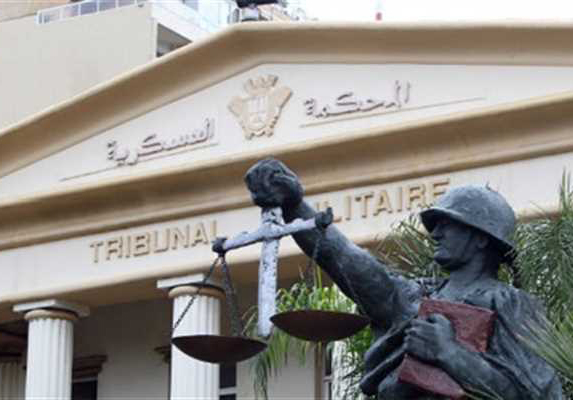
Lebanese authorities’ arrest and investigation of prominent comedian Nour Hajjar, solely in retaliation for his jokes, represents a new escalation in Lebanon’s crackdown on public criticism, the Coalition to Defend Freedom of Expression in Lebanon said today.
Apr 19, 2023 | News
The Egyptian authorities must open an independent and impartial investigation into allegations of serious human rights violations perpetrated against detainees at the Badr prison complex and ensure that those responsible be held accountable, said the International Commission of Jurists (ICJ) today.