Oct 13, 2014 | News
The Royal Thai Government should comply with its international human rights obligations to provide remedies and reparation to victims of torture or other ill-treatment, the ICJ, Human Rights Watch and Amnesty International said today.
Sep 26, 2014 | News
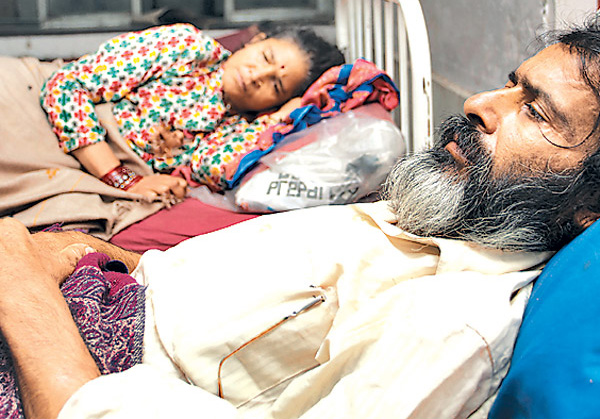
The government of Nepal has failed for over a decade to deliver justice for the killing of Krishna Prasad Adhikari. In protest his father, Nanda Prasad Adhikari, died on September 22, 2014, after over 300 days on hunger strike, the ICJ and Human Rights Watch said today.
Nanda Prasad Adhikari and his wife, Ganga Maya Adhikari (photo), began their hunger strike on October 23, 2013, to protest the failure of successive Nepali governments to ensure a credible investigation of the killing in 2004 of their son, allegedly by members of the United Communist Party of Nepal–Maoists (UCPN-M).
The ICJ and Human Rights Watch call on the Nepali government to protect the human rights of Ganga Maya Adhikari, who is reported to be in critical but stable condition in Kathmandu’s Bir Hospital. She continues to refuse food even after her husband’s death.
“Nanda Prasad Adhikari made the ultimate sacrifice in the pursuit of justice for his son, but it should never have come to this sad moment,” said Sam Zarifi, ICJ’s Regional Director for Asia and the Pacific. “The Adhikari couple symbolize the thousands of people in Nepal who demand justice for the violations and abuses they suffered at the hands of the government’s armed forces as well as the Maoists.”
Despite several promises by the government, there has been little movement towards accountability for Krishna Adhikari’s death.
In September 2013, after initial protests by the Adhikari couple, Nepali authorities announced that they would follow the Supreme Court’s directive to investigate the killing.
One year later, in April 2014, the Chitwan District Attorney filed charges against 13 people allegedly involved in the killing of Krishna Prasad Adhikari.
But when two men were arrested and produced in court, UCPN-M leaders protested, with leader Babu Ram Bhattarai saying publicly that if Parsuram Poudel, one of the accused, could be arrested, the government should arrest Bhattarai as well.
After three days of protests and threats by the UCPN-M, the Chitwan District Court granted bail to the two suspects. The case is still pending in court.
Throughout this period, the Adhikaris continued their hunger strike, pointing out serious flaws and shortcomings in the investigation carried out by Nepali authorities.
“Nepali politicians should stop making empty promises and investigate all allegations of human rights abuses and violations during the conflict,” said Brad Adams, Asia director for Human Rights Watch. “Nanda Prasad Adhikari’s death highlights Nepal’s flawed attempts at reconciliation and redress for conflict-era crimes, and looks like a desire to sweep all wartime injustice under the rug.”
The Comprehensive Peace Accord (CPA) that ended the conflict in 2006 explicitly recognizes Nepal’s obligations under international human rights law without reservation.
The CPA is unequivocal about the need to investigate and prosecute human rights violations in line with Nepal’s laws.
A promised Truth and Reconciliation Commission remains stalled, and the draft legislation to promulgate it is deeply flawed.
The ICJ and Human Rights Watch call on Nepali authorities to continue investigations and prosecutions for Krishna Adhikari’s death, as well as hundreds of unresolved cases of enforced disappearances and extrajudicial executions.
Contact:
Sam Zarifi, ICJ’s Regional Director for Asia and the Pacific, t +66-807-819-002 (mobile); e: sam.zarifi(a)icj.org
Sep 23, 2014 | News
The ICJ today called on the Syrian authorities to request that all pending criminal charges against Mazen Darwish (photo), Hussein Gharir and Hani Al-Zitani be quashed, and to release the three prominent Syrian human rights defenders immediately and unconditionally.
Sep 13, 2014 | News
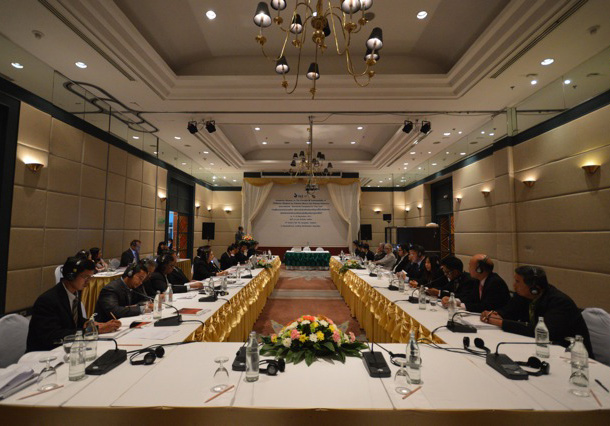
On 11-12 September 2014, the ICJ held an academic seminar on “The Principle of Inadmissibility of Evidence Obtained by Unlawful Means and Hearsay Evidence: International Standards Compared to Thai Law” for Judges, prosecutors and lawyers working in Thailand’s deep South.
The objective of the seminar held in Hat Yai was to discuss the provisions of the Thai Criminal Procedure Code that address hearsay and unlawfully obtained evidence and compare them to international standards.
Speakers at the seminar included Justice Jaran Pakdeethanakul of the Constitutional Court of Thailand; Associate Professor Narong Jaiharn, Dean of the Faculty of Law, Thammasat University; and two international Judges who spoke about the approach to hearsay and unlawfully obtained evidence in the inquisitorial and adversarial legal systems.
Aug 29, 2014 | News
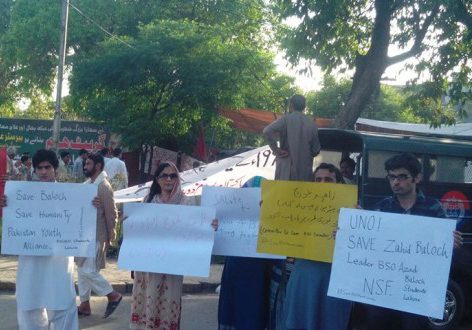
The ICJ, Amnesty International, and Human Rights Watch urge Pakistan’s government to stop the deplorable practice of state agencies abducting hundreds of people throughout the country without providing information about their fate or whereabouts.

![Smoke rises after an Israeli air strike on the village of Taybeh in southern Lebanon [Source: Al Jazeera]](https://www.icj.org/wp-content/uploads/2026/03/Screenshot-2026-03-20-at-15.56.24-300x200.png)