Jun 10, 2013 | Agendas, Events
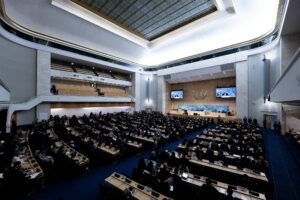
On Friday 7 June 2013, the ICJ convened a parallel event during the Human Rights Council’s 23rd regular session held in Geneva.
The event, held in Room IX of the Palais des Nations, addressed key issues concerning past and present challenges to the rule of law in Zimbabwe in the context of the upcoming elections and the need for the international community to remain vigilant about the necessity for free, fair and peaceful elections in the country. The event was chaired by Martin Okumu-Masiga, Deputy Director of the ICJ’s Africa Regional Programme. Panelists were MacDonald Lewanika, Director of Crisis Coalition; Okay Machisa, Director of the Zimbabwe Human Rights Association; and Irene Petras, Executive Director of Zimbabwe Lawyers for Human Rights.
Zimbabwe is scheduled to hold general elections before the end of 2013. Past elections in the country have been marred by violence and attacks on human rights defenders and the rule of law more generally. In the period leading to the 2013 elections, there have been several incidents of crackdown on political dissents and independent voices. The impunity enjoyed by past and current perpetrators electoral violence has continued to exacerbate fears for the integrity, peaceful conduct and fairness of the upcoming elections.
Zimbabwe-HR Council side event on elections in Zimbabwe-event-2013 (event flyer in pdf)
ICJ draws attention to risks of violence in the forthcoming general elections in Zimbabwe
May 31, 2013 | Agendas, Events
Some 30 judges from the highest national courts from 16 countries in Asia and the Pacific will meet in Bangkok, Thailand on 2-4 June to discuss the role of the judiciary in the AIDS response.
The meeting is convened by the Joint United Nations Programme on HIV/AIDS (UNAIDS), the United Nations Development Programme (UNDP) and the ICJ as part of efforts to address concerns that legal environments, including laws and policies, law enforcement practices and access to justice across the Asia and the Pacific do not consistently protect people most at risk of HIV infection and those living with HIV from violations of their human rights including health, privacy, non-discrimination and freedom from violence.
The judges’ discussions will be supported by experts and resource people from communities living with HIV, representatives of sex workers and men who have sex with men, people who use drugs and transgender people and United Nations entities.
The ICJ has always believed that an independent judiciary is essential in delivering justice to vulnerable populations, including those living/infected with HIV.
As Mr. Sam Zarifi, Regional Director for Asia and the Pacific, said: “The judiciary has a crucial role to play in establishing a legal environment that assists the struggle against the spread of HIV. In Asia and the Pacific, those most at risk of contracting HIV are often among those with the least access to justice. An independent judiciary can help protect at-risk populations from discriminatory laws, negative stereotypes, and misguided policies.”
May 5, 2013 | News, Op-eds
An opinion piece by Benjamin Zawacki, Senior Legal Adviser for Southeast Asia at the International Commission of Jurists.
Thailand’s government recently passed up an opportunity for a new approach to the deep South, by declining to replace the Emergency Decree, which violates international standards on human rights, with the somewhat less heavy-handed Internal Security Act (ISA).
Equally concerning is why the government has not looked beyond the South in reconsidering the use of its other extraordinary security legislation: no fewer than 31 of Thailand’s 77 provinces are at least partially under Martial Law.
International law is clear that the extraordinary powers under security laws like the Emergency Decree and Martial Law may only be invoked under a strict set of circumstances, none of which is even arguably applicable in Thailand outside of the southern insurgency (four of the 31 provinces).
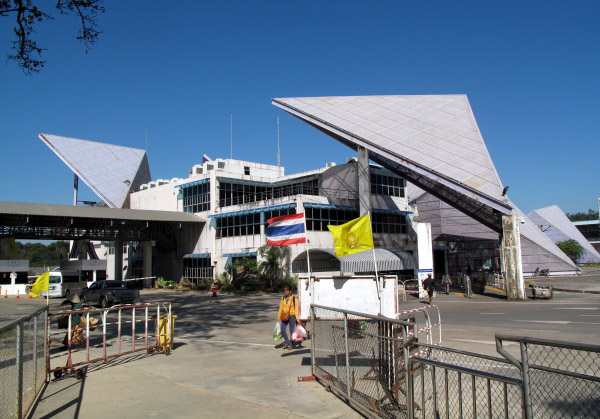
Martial Law may be invoked in Thailand “when a situation arises that makes it necessary to maintain law and order and to defend against the danger of attack”, or “when there is an outbreak of war or unrest”. All of Thailand’s provinces that are situated on one of the country’s four international borders are under Martial Law in whole or in part (including the 27 not in the deep South). Among them is Phitsanulok, whose shared border with Laos is roughly only 50km.
This province featured in Thailand’s last war, a three-month affair with Laos that ended in 1988.
Otherwise, Thailand’s border challenges are well-known: trafficking in persons, drugs, and weapons; landmines; refugees and migrants; smuggling of logs, oil, and other contraband; demarcation disputes. While doubtless all of these call for robust law enforcement, only the dispute with Cambodia over the Preah Vihear temple even arguably involves defending against the danger of armed attack.
Several minor but deadly skirmishes with Cambodian forces, as well as considerable mutual saber-rattling, have occurred in several districts of Si Sa Ket province since 2009. It is not credible to claim that Thailand needs to impose Martial Law because of external threats.
A more likely explanation is that Martial Law’s expansive application in Thailand is due to what is common to most security legislation around the region, namely vague language that lends itself to broad interpretation and granting wide powers to the military.
The Martial Law term “law and order”, in addition to more typically applying to civilian law enforcement agencies than to the military, could apply to any situation in which a law is implicated – which is nearly all situations. “Order” and “unrest” are particularly ill-defined.
Moreover, “maintain” suggests law and order need only be threatened to invoke Martial Law, rather than be lost and in need of being restored.
What constitutes an “attack” and the likelihood of such required for Thailand to be in “danger” are also essentially judgment calls. And when is an attack (or a series of attacks) tantamount to an “outbreak of war”?
A second and related reason that Martial Law is so pervasive in Thailand is the large number of military personnel empowered to invoke the law, coupled with, inversely, the difficulty in revoking it later.
While order by royal decree is required for invoking Martial Law on the first set of grounds, even local military commanders can invoke Martial Law in the area under their control on the second set (“when there is an outbreak of war or unrest”), affording them enormous discretion and authority.
In contrast, any and all revocations of the law require order by royal decree, a level of involvement as centralized and bureaucratic as a district military commander’s invocation is local and simple.
Martial Law’s use in Thailand historically supports the analysis that imprecise grounds combined with bureaucratic inertia account for the wide geographical application of the law.
Twice in the past 22 years, orders by royal decree referencing “law and order” have imposed Martial Law on the whole of Thailand, both times via coups d’état in 1991 and 2006.
On only three occasions after the 1991 coup (twice later the same year and once in 1998) was Martial Law lifted in some but not all of Thailand’s provinces. On the eve of the 2006 coup, it was still in effect in all or part of 18 provinces.
Similarly, following the blanket invocation of Martial Law on the whole country in 2006, on only two occasions since (in January 2007 and 2008, respectively) has an order by royal decree revoked the law in 46 of Thailand’s 77 provinces. Why not everywhere?
International law requires that extraordinary security legislation be invoked only in response to an exceptional situation.
Powers granted to security forces and any derogation from human rights must be strictly necessary and proportionate to the situation, and must have a time limitation attached to them.
None of these elements is met in the case of Thailand’s application of Martial Law to its international borders.
Indeed, Martial Law in Thailand allows security forces to arrest people without a warrant, and to detain them for seven days prior to charging them.
Critically, it does not require that detainees be promptly brought before a judge, in flagrant violation of Thailand’s legal obligations under the International Covenant on Civil and Political Rights (ICCPR).
This leaves detainees particularly vulnerable to torture or other ill-treatment at the hands of the security forces, which Thailand has also agreed to prevent and punish as a party to the ICCPR and the Convention against Torture.
In cases under Martial Law of alleged misconduct by security forces, victims are unable to institute a criminal prosecution (though they may initiate a civil action) or to choose their own lawyer; only a military prosecutor is entitled to institute a criminal charge. No appeal can be lodged against judgments or orders of military courts during this period.
The Thai government should reconsider its decision to keep the Emergency Decree in place throughout most of the deep South.
At the same time, it should take the long overdue step of lifting an equally heavy-handed Martial Law everywhere else.
Apr 24, 2013 | Feature articles, News
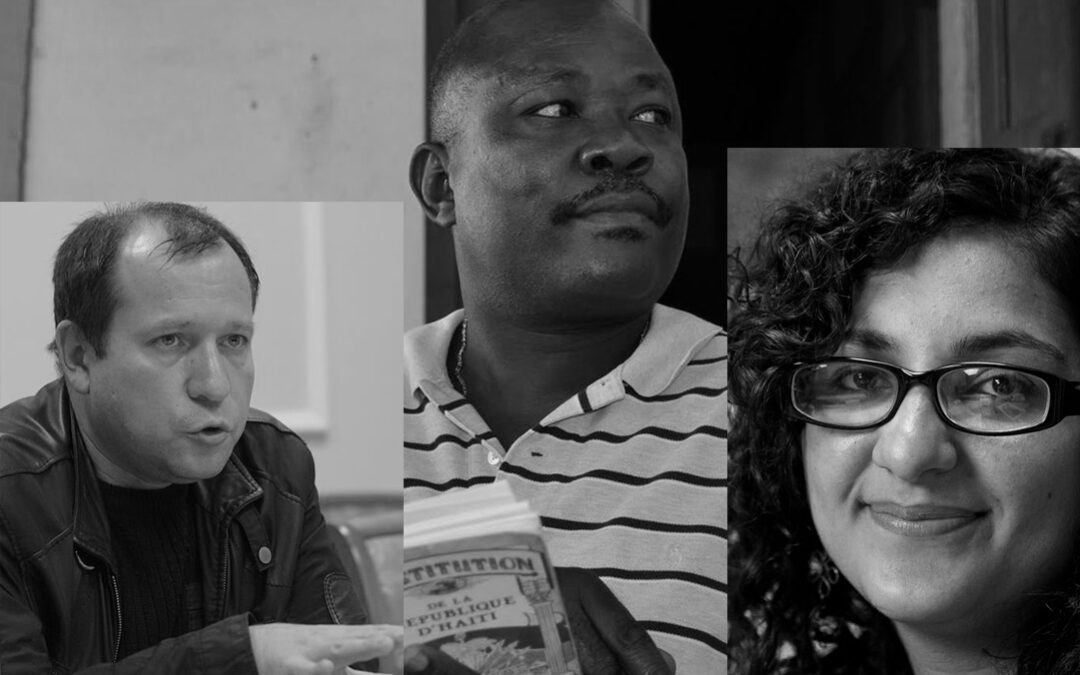
The three final nominees for the Martin Ennals Award for Human Rights Defenders are Mona Seif (Egypt), Joint Mobile Group (Russia) and Mario Joseph (Haiti). The ICJ is one of the ten members of the jury.
The Martin Ennals Award is given to Human Rights Defenders who have shown deep commitment and face great personal risk. The aim of the award is to provide protection through international recognition.
Selected by ten leading human rights organizations (ICJ, Amnesty International, Human Rights Watch, Human Rights First, International Federation of Human Rights, Front Line Defenders, HURIDOCS, Diakonie – German Protestant Welfare, World Organization Against Torture and International Service for Human Rights) it is the world’s most important Human Rights Prize.
The 2013 Award will be presented on Oct. 8th at a ceremony hosted by the City of Geneva.
Mona Seif (Egypt) is the core founder of the” No To Military Trials for Civilians”, a grassroots initiative which is trying to stop military trials for civilians.
Since February 25, 2011, Mona has brought together activists, lawyers, victims’ families, local stakeholders and started a nationwide movement against military trials.
As part of the recent crackdown on the Freedom of Speech in Egypt she has been charged along with other Human Rights activists.
She noted that “International solidarity, and I mean people’s support not governments, empowers us to continue our battle and stop military trials for civilians“.
After the murder of several human rights activists working in Chechnya, Igor Kalyapin started the Joint Mobile Group. To reduce the risk they send investigators on short missions to Chechnya to document Human Rights abuses.
This information is then used to publicise these abuses to seek legal redress. Igor Kalyapin speaking of the effect of international publicity said “… when the international community is watching us it is more difficult for the authorities to take steps against us…”
Mario Joseph, Haiti’s most important Human Rights lawyer, has worked on some of the most important cases in Haiti, including the current case against the former dictator Jean-Claude “Baby Doc” Duvalier.
His family received asylum in the United States in 2004, while he chose to return to Haiti. He has faced threats and harassment for much of his 20 years as a lawyer although it has intensified in recent months.
He says: “this recognition from the Ennals Award shines a vital spotlight on my work, and on the work of everyone who is fighting for human rights in Haiti. That spotlight will make our work safer and more effective.”
MEA-Short Summary-2013 (read the pdf)
MEA-MONA SEIF bio-2013 (read the pdf)
MEA-JOINT MOBILE GROUP bio-2013 (read the pdf)
MEA-MARIO JOSEPH bio-2013 (read the pdf)
Apr 14, 2013 | News
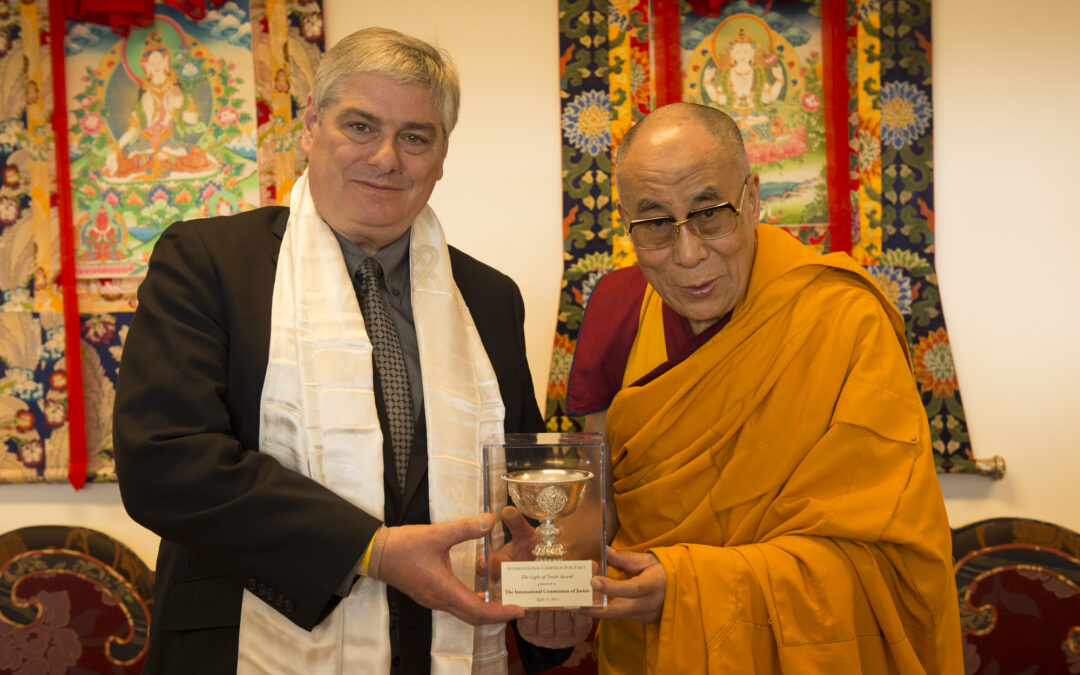
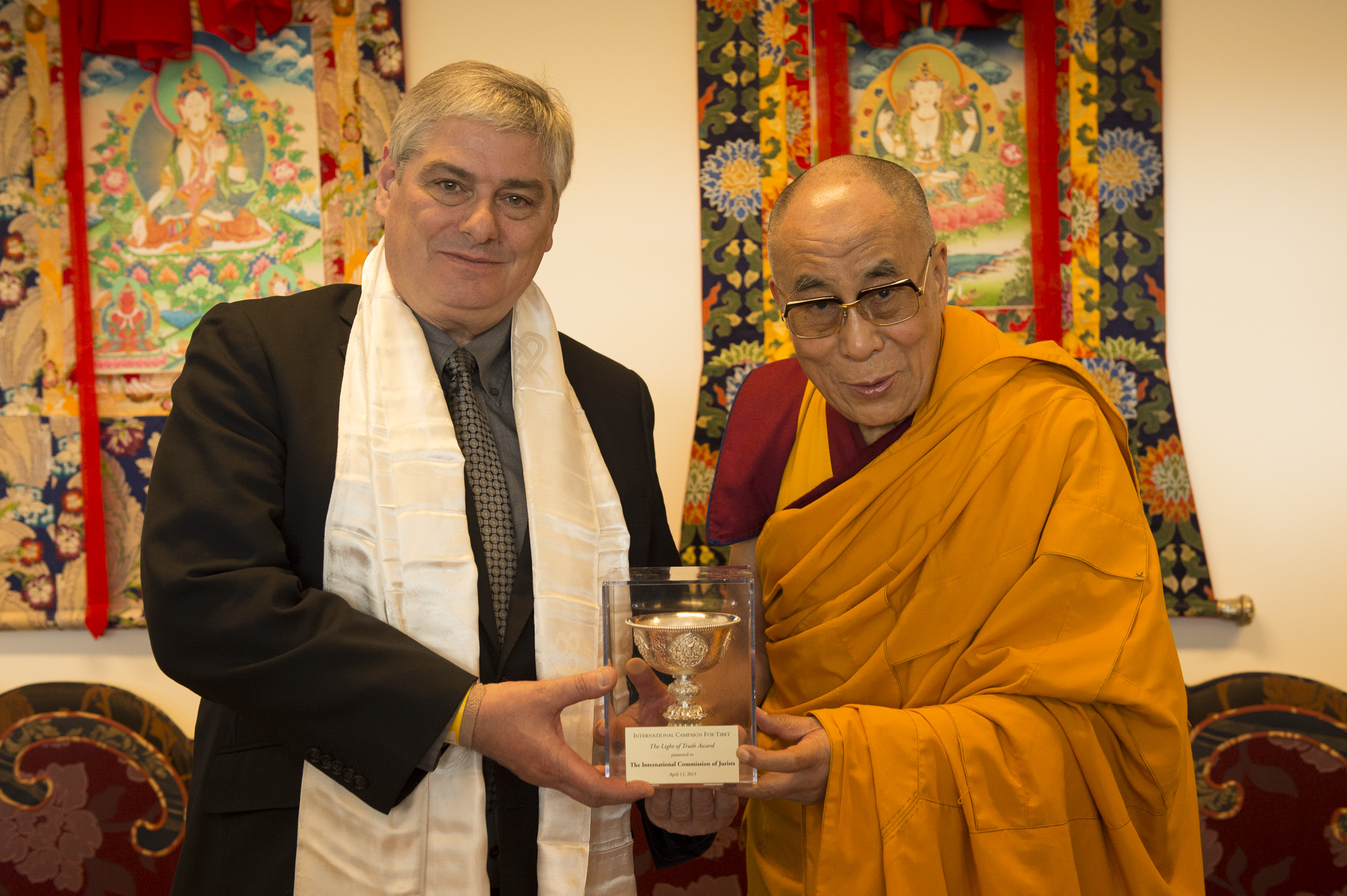 The Dalai Lama honoured ICJ Secretary General Wilder Tayler with the Light of Truth Award in recognition of ICJ’s consistent support of the Tibetan cause over six decades.
The Award was presented to Wilder Tayler at a ceremony in Fribourg, Switzerland, on Saturday 13 April 2013.
The International Campaign for Tibet (ICT) presented the Light of Truth Award to individuals and institutions who have made significant contributions to the public understanding of Tibet and the struggle for human rights and democratic freedoms for the Tibetan people.
The ICJ was awarded for its reports documenting the experience, trials and tribulations of Tibetan people at the hands of Chinese forces, and drawing attention to the rights of Tibetans.
“You cannot imagine the outpouring of emails I have received even from very old members of the ICJ and the pride and joy in receiving the recognition of the work of ICJ by the Tibetan community, by His Holiness, by the solidarity organizations. Really it has been so moving,” said ICJ Secretary General Wilder Tayler (photo). “This prize will be dedicated to the late Nick Howen, my immediate predecessor and very dear friend who passed away quite tragically three years ago. Nick was a devoted activist of the Tibet cause; he not only put a lot of hours, he actually put his life at risk when there was need of it in order to pursue the cause, to bring information out of Tibet.”
The award itself is an antique Tibetan butter lamp, symbolizing the light that each recipient has shed on the Tibet issue.In addition to the ICJ, the Light of Truth Award 2013 was given to four other honorees, including ICJ Honorary Member Theo van Boven.
Professor van Boven is a Dutch jurist and professor emeritus in international law, a former UN Rapporteur on Torture and served as ICJ Vice-President in the 1990s. He was awarded for putting the spotlight on Tibet within and beyond the United Nations system.
Other awardees include Professor Dr. Christian Schwarz-Schilling, former German Minister and Parliamentarian, who has been working in a low-key manner for many years on the issue of the Tibetan-Chinese relationship; Ms. Sigrid Joss-Arnd, the longest-standing member of the Swiss Red Cross officials who was involved in helping Tibetans in the diaspora from the early 1960s; and Mr. Robert Ford, CBE, for his tireless advocacy on Tibet for more than half a century. Mr Ford is the only Westerner who was given official ranking in the Tibetan government before 1950 and he was imprisoned by the Chinese authorities for nearly five years.
“All of you have been long-standing friends and supporters of Tibet, for which we are immeasurably grateful. As you know, the spirit of the Tibetan people is undiminished and the power of truth remains strong,” the Dalai Lama said at the ceremony.
The Light of Truth Award is the most prestigious award in the Tibet movement and has been presented by His Holiness the Dalai Lama, on behalf of the ICT, for many years.
Previous recipients include Archbishop Desmond Tutu, the late Václav Havel, Chinese scholar and writer Wang Lixiong, and film director Martin Scorsese.
Photo/Manuel Bauer

![Smoke rises after an Israeli air strike on the village of Taybeh in southern Lebanon [Source: Al Jazeera]](https://www.icj.org/wp-content/uploads/2026/03/Screenshot-2026-03-20-at-15.56.24-300x200.png)