May 9, 2018 | News
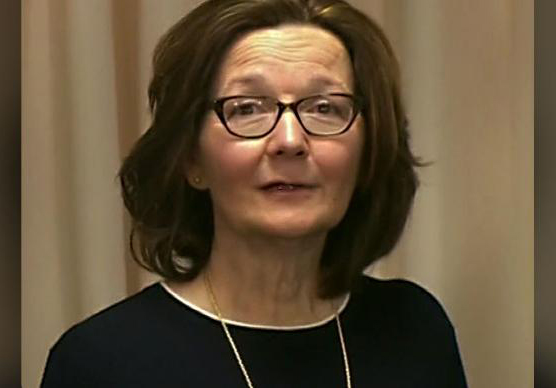
The ICJ said today that Gina Haspel, nominated by Donald Trump to be Director of the CIA, should be subject to a full criminal investigation for her alleged involvement torture and other serious crimes, rather than elevated to serve as the country’s highest intelligence office.
The ICJ statement came as the United States Senate Intelligence was poised to beginning hearings on her confirmation to the position.
“If Gina Haspel becomes CIA Director, the United States will be sending a signal to the world that it has dropped the pretence of caring about even the most serious human rights violations,” said Sam Zarifi, ICJ Secretary General.
“It will show that torturing and disappearing people by US officials will not only be met with impunity, but will be no bar to career advancement.”
Following the terror attacks against the United States of 11 September 2001 until 2007, the CIA held at least 119 terror suspects or persons it suspected to have intelligence value in places of secret detention outside of US territory.
The black sites were situated in several countries, including Afghanistan, Lithuania, Poland Romania, and Thailand.
The detainees, who had no contact with the outside world, were placed beyond the protection of the law and subjected to torture and cruel, inhuman and degrading treatment.
The torture included near drowning (“waterboarding”), prolonged sleep deprivation, placement in painful stress positions for extended periods, forced rectal feedings, and slamming against walls.
Gina Hapel oversaw at least one “black site” detention centre in Thailand in 2002, while detainee Abd al-Rahim al Nashiri was being tortured there.
She is credibly alleged to have played a significant role in destroying video evidence of interrogations that were carried out under torture.
“The European Court of Human Rights has already condemned Poland for violating the rights of Abd al-Rahim al Nashiri, after he was transferred to secret CIA detention facility in Poland, yet nobody directly responsible CIA has ever been held accountable for these serious crimes,” said Sam Zarifi.
Contact
Ian Seiderman, ICJ Legal and Policy Director, t +41 22 979 3837 ; e: ian.seiderman(a)icj.org
Apr 17, 2018 | Events, Multimedia items, News, Video clips
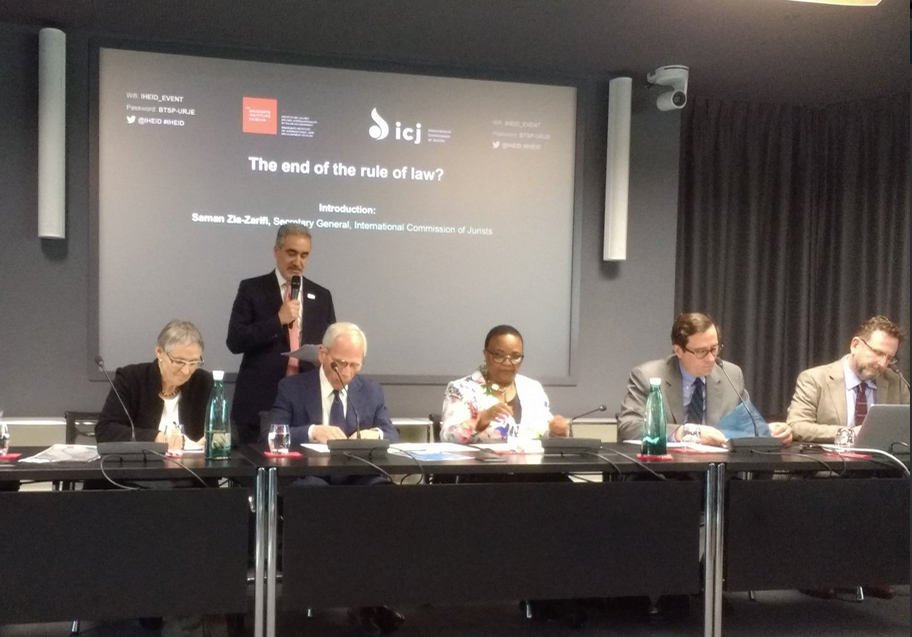
International commitment to the rule of law is under assault around the world, said a global panel of eminent academics, diplomats, and jurists.
The panelists, speaking at a public event by the ICJ and the Geneva Graduate Institute, commented that this assault is threatening to reverse the progress made over the last 70 years since the Universal Declaration of Human Rights(UDHR) came into force.
The panelists addressed progress in asserting the rule of law since the UDHR, for instance through the development of the International Criminal Court and greater awareness and commitment to rights, but also highlighted current challenges at the national level, such as in Venezuela, and at the global level, with ongoing discrimination and violence against women.
“The rule of law is a principle that helps the world and also helps individuals,” said ICJ Secretary General Saman Zia-Zarifi, in his introductory remarks.
“It is a principle that elevates democracy from mob rule and is necessary to harness the energy of democracy and give it a direction and progression towards the protection and promotion of human rights and sustainable development for the betterment of the lives of people around the world,” he added.
Professor Carlos Ayala, ICJ Vice-President and former President of the Inter-American Commission on Human Rights, spoke about the importance of having regional rights frameworks that were accessible to individuals when the rule of law has been eradicated at a national level.
Speaking in relation to Venezuela, Professor Ayala explained that the rule of law cannot be simply overturned by a political party, even with a majority, as the erosion of the rule of law puts all human rights at risk and these rights must be safeguarded regionally and internationally.
Next Patricia Schulz, member of the UN Committee on the Elimination of Discrimination against Women, pointed out that in many countries, the rule of law has been weak or never even properly existed.
She addressed failings where access to justice is undermined by systems that are gender discriminatory and explained that in almost all countries, even where the rule of law seems strong, there is a lack of will and/or means to fight gender-based violence.
Professor Andrew Clapham, Professor of Public International Law at the Graduate Institute and member of the UN Commission on Human Rights in South Sudan, evaluated issues of accountability and the rule of law in the context of international criminal law.
He noted the important role international criminal law and its operational mechanisms have in holding individuals to account, but warned that focusing on prosecution and focusing on issues such as genocide and the use of chemical weapons ran the risk of undermining the universality of ideas enshrined in the UDHR.
His Excellency Luis Gallegos, the Permanent Representative of Ecuador to the United Nations, raised concerns about the politicization of human rights and the capacity of UN mechanisms to address transnational rights issues such as migration.
He said that addressing the rule of law was not a simple question but that states had to come together to consistently and systematically address the rights violations that arose from a break-down in the rule of law.
Final panelist, Sanji Monageng, ICJ Commissioner and Justice of the International Criminal Court, spoke about the need for international organizations to rethink their approach to the rule of law and the way they apply this to cases, to avoid focusing narrowly on singular issues when rights violations need to be addressed homogenously.
Justice Monageng explained that for victims, sexual violence, for instance, is rarely a singular incident but part of broader array of rights violations that have far-reaching impacts.
In his concluding remarks, Professor Robert Goldman, who moderated the event, said that “the rule of law deals with a central tenet of any just society, not only equal protection and equal access but it is something that protects the vulnerable.”
He explained that the treat to the rule of law today is endemic and it is global, but the ICJ is uniquely placed to robustly address these difficult questions and to continue to use the rule of law to defend and advance rights protections.
The event, which took place at the Graduate Institute at the Maison de la Paix, promoted by the Permanent Mission of Germany, was attended by 150 persons including academics, diplomats, lawyers and representatives of civil society and international rights mechanisms. The event was also streamed online by RIDH Global.
You can watch the full event here.
https://www.facebook.com/ridhglobal/videos/10158134493084616/UzpfSTQ3MTQ2NzA4NjIyMTM3MzoxOTk5MjM0NDc2Nzc3OTUy/
https://www.youtube.com/watch?v=ije_iAegxFs&feature=youtu.be
Apr 10, 2018 | News
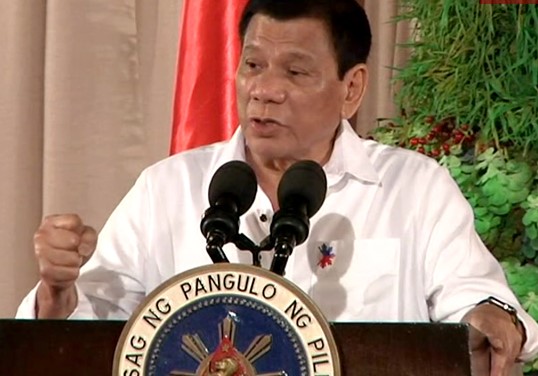
The ICJ today condemned a threatening statement made by Philippine President Rodrigo Duterte attacking Chief Justice Maria Lourdes Sereno of the Philippines Supreme Court.
The ICJ said that the President’s remarks constituted an assault not just on the Chief Justice, but on the independence of the judiciary in the country.
The ICJ urged President Duterte to respect judicial independence and not to exert political pressure on any government official or agency to undermine the independence of the judiciary.
In a press conference on 9 April 2018, President Duterte told reporters: “I’m putting you on notice that I’m your enemy and you have to be out of the Supreme Court.”
He also called on the House of Representatives to expedite impeachment proceedings presently underway against Chief Justice Sereno.
“It is absolutely unacceptable for President Duterte to make such a statement not only because it constitutes direct intimidation of the Chief Justice, but the chilling effect it may have on other independent judges who carry out their professional duties,” said Emerlynne Gil, Senior International Legal Adviser of ICJ.
“By expressing his personal feelings against the Chief Justice and by directing the House of Representatives to accelerate the impeachment proceedings, the President is actively influencing and interfering with the functions of other co-equal branches of government,” Gil added.
The ICJ reminds President Duterte that as enunciated in the UN Basic Principles on the Independence of the Judiciary, “[i]t is the duty of all governmental and other institutions to respect and observe the independence of the judiciary.”
The Principles affirm that the judiciary must be able to carry out its work “without any restrictions, improper influences, inducements, pressures, threats or interferences, direct or indirect, from any quarter or for any reason.”
The ICJ strongly urges President Duterte to retract his comments and to refrain in the future from making any statements attacking individual judges or in any way interfering with the independence of the judiciary.
Contact
Emerlynne Gil, Senior International Legal Adviser, t: +662 619 8477 (ext. 206) ; e: emerlynne.gil@icj.org.
Background
In September 2017, two impeachment complaints against the Chief Justice were filed before the Committee of Justice of the House of Representatives, the Lower House of Congress.
The Committee of Justice approved only one of the complaints, which is scheduled to be put before the plenary of the House of Representatives in May 2018 when Congress resumes its session.
If it obtains one-third vote of all members in the House of Representatives, the articles of impeachment will be transmitted to the Senate, which is the Upper House of Congress.
Any impeachable officer may be removed from office by a vote of two-thirds of all the members of the Senate sitting as the impeachment court.
Some of the points raised in the approved impeachment complaint are the Chief Justice’s failure to report certain income in her statements of assets, liabilities and net worth (SALN), allegations of use of public funds to finance her extravagant and lavish lifestyle, and manipulation of judicial appointments for personal and political reasons, among others.
The Chief Justice maintains she correctly filed her SALNs. She also further claims that the other allegations in the impeachment complaint are baseless or mere fabrications.
In March 2018, the Philippines’ Solicitor General Jose Calida filed a petition before the Supreme Court questioning the Chief Justice’s appointment due to her alleged failure to fully disclose her wealth. Oral arguments on this petition were made on 10 April 2018.
Apr 3, 2018 | Events, News
The ICJ will present a panel discussion on the continued role of the rule of law in the 70th anniversary year of the Universal Declaration of Human Rights on Monday 16 April, 18.30-20.00, Room C1, Maison de la Paix, Geneva.
In a global context where pushback against rights protection is becoming increasingly more pronounced this panel discussion, organized in co-ordination with the Graduate Institute and supported by the Permanent Mission of Germany, will address critical areas of concern for the rule of law in upholding the universal rights set out in the UDHR 70 years ago.
The event, composed of diplomats, academics and legal experts from around the world, will look at issues around the realisation of rights set out in the UDHR, particularly in relation to gender and women’s rights, and will consider how these have been implemented domestically as well as how breaches of the UDHR have been treated as international crime.
Panellists will also comment on the role of the rule of law as set out in the Sustainable Development Goals in ensuring rights protection as an essential element of sustainable development.
The event will also assess how problems in human rights frameworks can be addressed in a way that strengthens the rule of law and human rights and will consider the increasing role of developing countries in taking ownership of the international rights framework initiated by the UDHR.
Introduction:
- Saman Zia-Zarifi, Secretary General of the ICJ
Panellists:
- Carlos Ayala, ICJ Vice-President and former Chair of the Inter-American Commission on Human Rights
- Andrew Clapham, Professor of Public International Law, The Graduate Institute, Geneva; Member of the UN Commission on Human Rights in South Sudan
- Luis Gallegos, Permanent Representative of Ecuador to the United Nations in Geneva
- Sanji Monageng, ICJ Commissioner and Judge at the International Criminal Court, The Hague
- Patricia Schulz, Member of the UN Committee on the Elimination of Discrimination against Women
Moderator:
- Robert Goldman, Acting ICJ President and Professor of Law, Washington College of Law, American University, Member of Eminent Jurists Panel on Terrorism, Counter-terroism and Human Rights
Sign up to the event via the link on the Graduate Institute’s website.
Universal – Rule of Law UDHR 70 – News – Events – 2018 – ENG (Event flyer in PDF)
Mar 16, 2018 | News
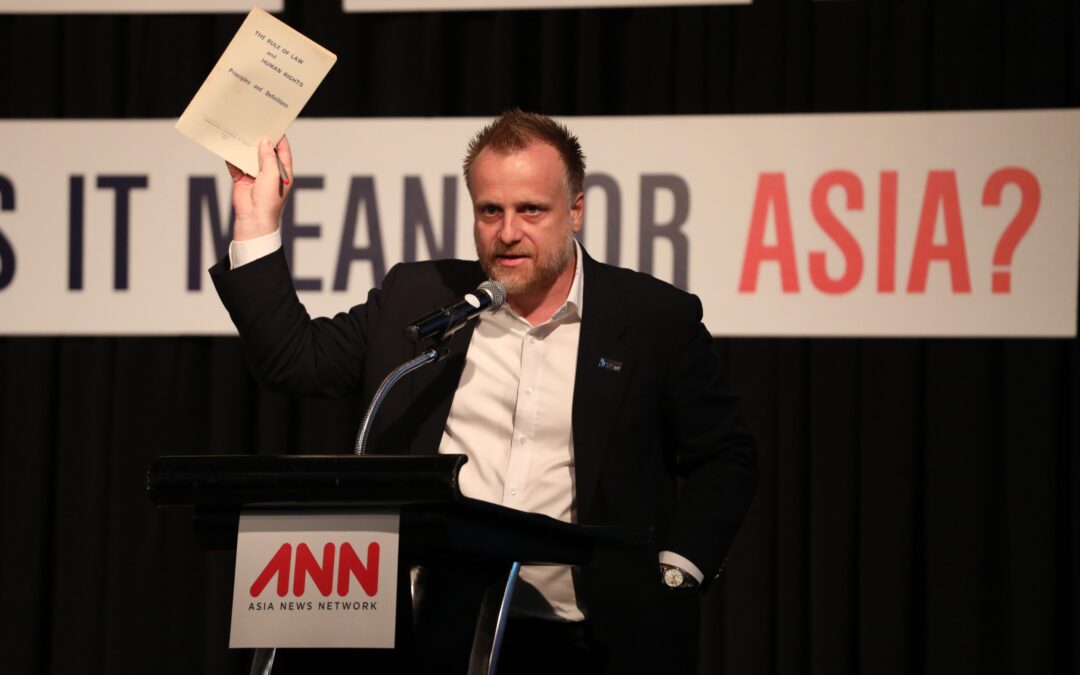
Today, Kingsley Abbott, ICJ’s Senior International Legal Adviser, gave the keynote address on the human rights and rule of law situation in Asia at the Asia News Network’s (ANN) international symposium on upcoming elections in Asia.
The event, held at a hotel in Bangkok, Thailand, was attended by nearly 300 diplomats, business leaders, academics and members of civil society.
ANN is an alliance of 24 leading media in 20 Asian countries.
The full speech can be downloaded here:
Asia-ANN Speech-News-web story-2018-ENG