Mar 12, 2019 | Advocacy, Non-legal submissions
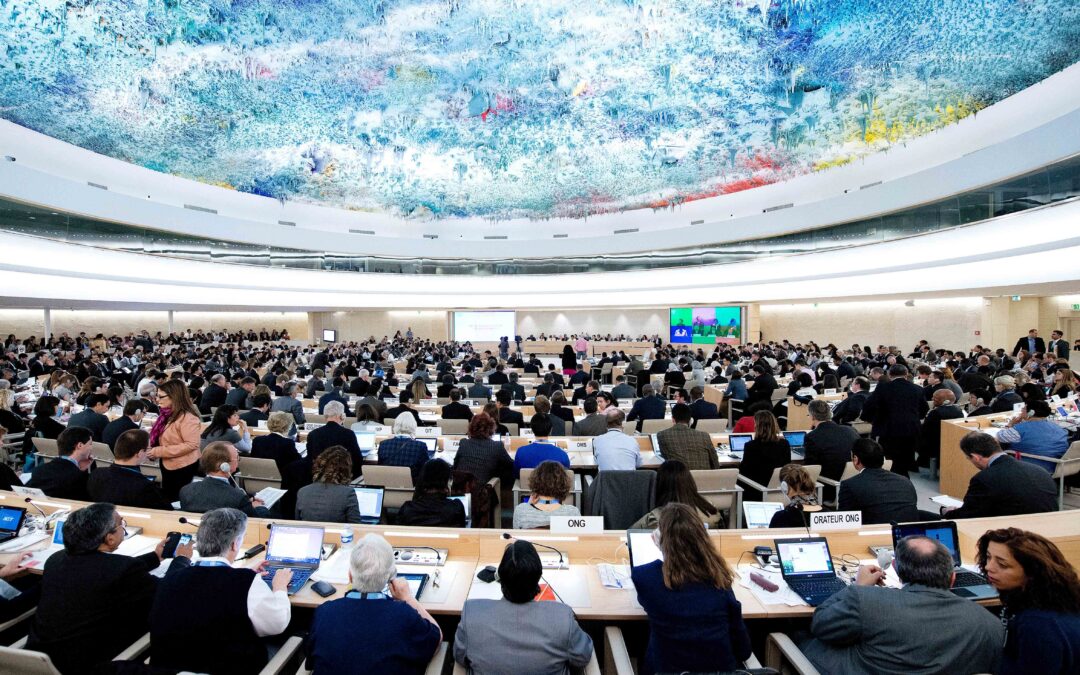
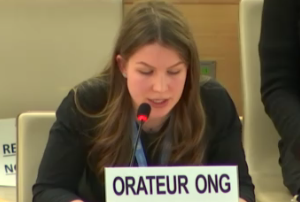
The ICJ today highlighted threats to the rule of law in Turkey, Poland, Hungary and Azerbaijan, and the need to address corporate complicity in South Sudan, at the UN Human Rights Council in Geneva.The statement, delivered during general debate, read as follows:
“The situation remains grave for the rule of law and legal protection of human rights in Turkey and Poland.
In Turkey, constitutional reforms in 2017 that undermined the independence of the judiciary should be abolished. Civil society members are prosecuted under overbroad and vague terrorism offences.
In Poland, the Legislature is trying arbitrarily to remove one third of the Supreme Court, a measure that is on hold only temporarily. Unjustified disciplinary proceedings are also being pursued against Polish judges for having sought a ruling of the Court of Justice of the EU.
Elsewhere, in Hungary civil society is ostracized and subject to legislation that risks criminalizing their legitimate activities. In Azerbaijan, as one example of a broader pattern of interference with lawyers and other human rights defenders, lawyer Elchin Sadigov was reprimanded for advising in a confidential manner to his client in detention to complain about torture to which he allegedly had been subjected.
The ICJ is also concerned at the findings by the Commission on Human Rights in South Sudan (A/HRC/40/69, A/HRC/40/CRP.1) that point to the oil industry as a “major driver” in the continuation of the armed conflict and resulting human rights violations. Potential corporate complicity with crimes under international law demand investigation and a strong monitoring mechanism for the use of oil revenues should be established.”
Mar 8, 2019 | Advocacy, Non-legal submissions
Speaking at the UN, the ICJ today urged all States from all regions to participate actively in the process towards a treaty on business and human rights.
The statement, delivered during a general debate on thematic issues at the UN Human Rights Council in Geneva, read as follows:
“Mr President,
The report on the Fourth session of the Intergovernmental Working Group to establish a legally binding instrument in the field of business and human rights opens opportunities for States and the international community to build a multilateral legal framework in this field.
We continue to urge all States from all regions – especially those that have been reluctant to engage- to actively participate in this process.
The ICJ considers that this draft should be based on transparent consultation and participation and respect standards of clarity and precision.
Recent dramatic events in Brazil and South Sudan show the central place that a system of legal responsibility for businesses, including for complicit participation in abuses, should have in an international treaty.
The dam collapse in the Brazilian locality of Brumadhino and the evidence pointing to oil industry complicity with serious human rights violations in South Sudan show the global scale of the problem and the involvement of companies from all corners of the world.
A treaty should also provide to all states a set of common standards effective collective action to guarantee access to justice in a transnational setting.
The creation of an international legally binding framework for States to maximize action and cooperation regarding human rights abuses in the context of business operations remains a compelling necessity of our times.
I thank you.”
The statement may be downloaded in PDF format here: HRC40-OralStatement-GDitem3-2019
Mar 8, 2019 | Advocacy, Non-legal submissions
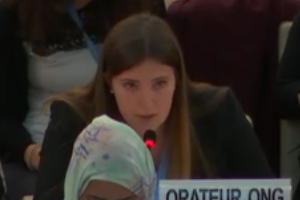
The ICJ today addressed the UN Human Rights Council on the need for a time-bound implementation plan, developed with the Office of the High Commissioner for Human Rights, for Sri Lanka to implement its commitments and obligations on transitional justice.
The statement, delivered during an interactive dialogue with the UN High Commissioner for Human Rights on her annual report, read as follows:
“Madame High Commissioner,
The International Commission of Jurists (ICJ) appreciates the efforts undertaken by the OHCHR in advancing transitional justice in Sri Lanka, mentioned in paragraph 69 of your report.
Any progress made by Sri Lanka, especially in relation to the implementation of transitional justice mechanisms under Resolution 30/1, albeit slow and wholly insufficient, has been primarily due to the continued engagement of the Council, OHCHR and international community. Therefore, keeping Sri Lanka on the agenda of the Council is paramount to ensure progress on all remaining commitments set out in Resolution 30/1.
As the Council is poised to provide Sri Lanka with an extension of two years to fulfill its commitments under Resolution 30/1, ICJ considers the expeditious development of a time-bound implementation plan with a deadline for delivery as essential. It is also pertinent that the implementation process is not a mere procedural exercise, but holistic and contextually appropriate.
At present, it appears that women are largely excluded from meaningfully participating in transitional justice processes, despite having been at the forefront in demanding truth and justice. Even mechanisms that have been put in place so far lack a comprehensive gender strategy. It is imperative that problems faced by women during and in the aftermath of the conflict are effectively identified and addressed in order to ensure that they are not left behind as the country seeks to move forward. The OHCHR with its expertise and experience in the field is well-placed to provide the necessary advice and technical assistance, especially in relation to matters that often get ignored or marginalized.
Madam High Commissioner, how would you see OHCHR fulfilling its role in relation to the development of the time-bound implementation plan and the due accomplishment of all remaining commitments made under Resolution 30/1?”
The statement can be downloaded in PDF format here: HRC40-OralStatement-IDwHCitem2-2019
The oral statement follows a joint open letter from NGOs, calling for such a plan, here.
The ICJ earlier submitted a written statement on Sri Lanka, available here.
Mar 7, 2019 | Events, News
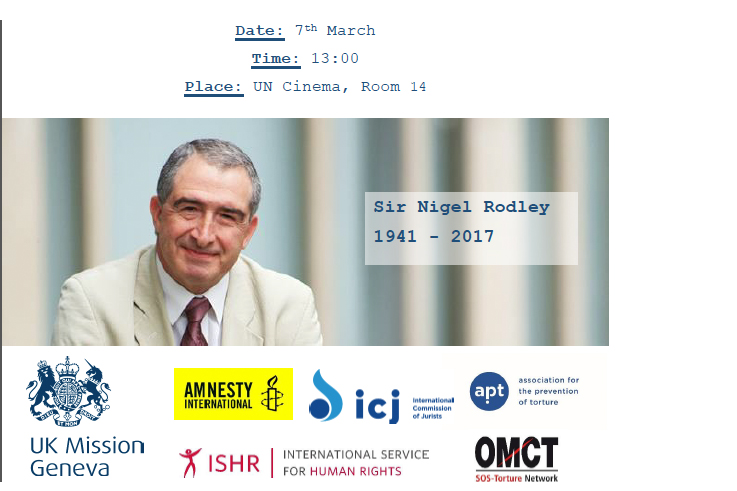
The ICJ is proud to join in presenting the documentary film The Long Haul, to be screened during the UN Human Rights Council session in Geneva.
Inspired by the life of the late Nigel Rodley—one of the principal architects of the modern human rights framework— the documentary The Long Haul addresses the current backlash on human rights and how best to respond.
Sir Nigel’s remarkable life story is an inspiration to stand up against wrongdoing and to continue fighting for equality and justice. At the same time, his family history is a reminder of the WWII tragedies that gave birth to the modern human rights regime and what could happen if we fail to honour these basic rights.
Nigel Rodley dedicated his career to the protection of those most at risk, including as Amnesty International’s first legal adviser and later as UN Special Rapporteur on Torture as then as a member and eventually Chair of the Human Rights Committee. He had a longstanding association with the ICJ as Commissioner and in other roles, and was President of the ICJ at the time he passed away.
The film will be screened at a side event to the UN Human Rights Council session, at 13h00 on Thursday 7 March, in Room XIV (UN Cinema) of the Palais des Nations in Geneva. Access is available only to those who already hold grounds passes for the UN in Geneva, or accreditation for the Council session.
The event is organised by the Permanent Mission of the United Kingdom in Geneva, with participation of the International Commission of Jurists (ICJ), Amnesty International, the World Organisation against Torture (OMCT), Association for the Prevention of Torture (APT), and International Service for Human Rights (ISHR).
For more information contact un(a)icj.org
A flyer for the event can be downloaded in PDF format here: Events-NigelRodleyFilm-2019-En
Mar 5, 2019 | News
States at the United Nations Human Rights Council in Geneva should ensure that Egypt is not allowed to seize a leading role in relation to the mandate of the United Nations’ expert on human rights and counter-terrorism, nine international human rights organizations, including the ICJ, have said.
In light of Egypt’s record of severe and widespread abuse of counter-terrorism measures to violate human rights, the organizations warned against attempts by Egypt to undermine the expert’s mandate.
The mandate of the UN Special Rapporteur on the promotion and protection of human rights and fundamental freedoms while countering terrorism is due to be renewed in the coming weeks at the ongoing Human Rights Council session in Geneva.
Mexico has for many years led the resolution that established and maintained the expert, but is understood now to be in discussions with Egypt about a possible leadership role for Egypt.
Other changes to the resolution text may also be under consideration.
“Egypt has an appalling record of abusing counter-terrorism measures against human rights defenders and other dissenting voices, and was recently denounced by the UN Special Rapporteur on human rights defenders for severe reprisals against people who spoke with another visiting UN expert,” said Matt Pollard, Senior Legal Adviser and UN representative for the ICJ.
“To give such a country shared leadership on the renewal of the mandate of the UN’s expert on human rights and counter-terrorism would only do further harm to civil society and others in Egypt and elsewhere, undermine the work of the expert and the UN as a whole, and badly tarnish the long history of leadership Mexico has shown on these issues,” he added.
Nine organizations – ICJ, Amnesty International, ARTICLE 19, Cairo Institute for Human Rights Studies, CIVICUS/World Alliance for Citizen Participation, International Federation for Human Rights (FIDH), Human Rights Watch, International Service for Human Rights, and Privacy International – had earlier sent a joint letter to all countries representatives in Geneva highlighting their concerns.
This was followed by a joint oral statement at the Human Rights Council session on 1 March, during an interactive dialogue with the special rapporteur.
Egypt has gradually sought to dilute or distort the longstanding focus of the UN Human Rights Council’s work to protect and promote human rights and fundamental freedoms while countering terrorism, the groups said.
In 2018 it succeeded in watering down the council’s longstanding thematic resolution on the topic, in which states annually recognize concerns about abuses and urge respect for human rights at a global and abstract level.
However, any move to gain control over the resolution on which the mandate of the special rapporteur depends, or to dilute or reframe her mandate, would have far deeper and further-ranging damaging effects.
The special rapporteur acts on individual complaints, reports on the situation in particular countries, and addresses in detail topics relating to counterterrorism work around the world on an ongoing basis.
The special rapporteur also serves an essential function in providing independent oversight of counterterrorism measures from a human rights perspective within the overall UN system.
The mandate holds a uniquely important role in the UN counterterrorism architecture, as the only UN entity with the exclusive mandate to ensure the promotion and protection of human rights while countering terrorism.
The organizations have been urging other countries to strongly oppose any attempts to weaken the mandate of the special rapporteur.
The special rapporteur’s role should not be diluted by including the flawed Egyptian-led approach into the resolution for its renewal, or by sharing the leadership of the mandate renewal resolution with Egypt or other countries that have such an appalling record in relation to the very issues the mandate is to address, they said.
Allowing Egypt to jointly lead the mandate renewal would only serve to encourage a continuation of its pattern of gross human rights violations and abuses against civil society and others within Egypt in the name of countering terrorism, while shielding it from international scrutiny, the groups said.
It would also pose a long-term threat to the UN’s role in ensuring that counterterrorism measures are consistent with human rights, and that measures to uphold human rights for all and the rule of law are the fundamental basis for the fight against terrorism.
Contact
Matt Pollard, ICJ Senior Legal Adviser & UN Representative, t: +41 79 246 54 75 ; e: matt.pollard(a)icj.org