Jun 25, 2018 | Advocacy, Non-legal submissions
The ICJ today spoke at the UN on the role of judicial councils, judicial independence in Turkey and Poland, and on business and human rights in Peru.
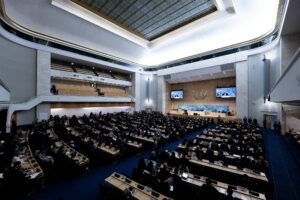
The statement was made at the UN Human Rights Council during the interactive dialogue with the Special Rapporteur on Independence of Judges and Lawyers and the Working Group on Business and Human Rights.
The statement on judicial councils and independence was made jointly with the Commonwealth Magistrates’ and Judges’ Association. The whole statement read as follows:
“Mr President,
The International Commission of Jurists (ICJ) and Commonwealth Magistrates’ and Judges’ Association (CMJA) welcome the report of the Special Rapporteur on the Independence of Judges and Lawyers (A/HRC/38/38) on the role of judicial councils and similar bodies.
Based on many decades of relevant experience around the world, we urge that:
All countries should consider establishing an independent judicial council. Reliance on constitutional customs, cultures, and traditions alone often proves insufficient if a crisis arises.
To guarantee independence, a majority of members should be judges elected by their peers. Any other members must also be independent. The Head of State, executive or legislative officials, or political candidates, should not be members. Proactive measures should address under-representation of women or persons from minority or marginalized groups.
Such bodies should be responsible for all decisions relating to the selection, appointment, promotion, transfer, discipline, suspension and removal of judges.
As an example of concern, in Turkey following constitutional reform in 2017 no member of the Council of Judges and Prosecutors is elected by their peers, contributing to a lack of institutional independence of the judiciary. We also share the concerns for lawyers in Turkey already expressed by The Law Society and other colleagues today.
On the report on the visit to Poland (A/HRC/38/38/Add.1), we concur that reforms in the name of efficiency and accountability have undermined the independence of the Constitutional Tribunal, the Supreme Court and the National Council of the Judiciary, and effectively placed the entire judiciary under “control of the executive and legislative branches” (para 74). Mr Special Rapporteur, how can other States assist in securing full implementation of your recommendations on Poland?
The findings of the Working Group on Business and Human Rights report on its mission to Peru (A/HRC/38/48/Add.2) are of great concern, that “large number of human rights defenders and local leaders” were reportedly killed, attacked or threatened for defending the environment and land rights, legitimate social protest is criminalized, and wide use of states of exception and the armed forces have lead to serious abuses. The ICJ urges Peru to implement the recommendations and asks the Working Group what it will do to follow up?
Thank you.”
Jun 22, 2018 | Events, News
This side event to the UN Human Rights Council session addresses equal and effective access to justice for indigenous people, people living with a disability and people from ethnic, religious or linguistic minorities.
Monday 25 June | 16:30-18:00 | Room XXVII, Palais des Nations
Sustainable Development Goal 16 calls for the realisation of peaceful and inclusive societies in which all individuals have equal access to justice.
Achieving access to justice, which includes due process and equality before the law, is a complex challenge. It demands not only examining the letter of the laws that are in force, but also identifying and overcoming systemic and practical barriers that preclude equal access to justice.
The International Commission of Jurists, Minority Rights Group International, the International Bar Association Human Rights Institute, the Permanent Mission of Austria to the UN and the Permanent Mission of Australia to the UN invite you to attend a panel discussion in the margins of the 38th Session of the Human Rights Council that will reflect on the multiple and intersecting barriers still experienced by those who are frequently among the most marginalised and at risk in society more generally: Indigenous people, people living with a disability and people from ethnic, religious or linguistic minorities.
The discussion will also explore the responses (systematic, legislative, practical, international or otherwise) that can include and legally empower such persons when they come into contact with the legal system as a means to promote their equal access to justice.
Speakers:
Mr Matthew Pollard, Senior Legal Advisor, UN Representative, International Commission of Jurists (Moderator)
Dr June Oscar AO, Australia’s Aboriginal and Torres Strait Islander Social Justice Commissioner, Australian Human Rights Commission
Mr Glenn Payot, UN Representative, Minority Rights Group International
Ms Victoria Lee, Programme Manager, Human Rights and Disability Team, Office of the High Commissioner for Human Rights
For more information contact un(a)icj.org
Jun 22, 2018 | Advocacy, Non-legal submissions
The ICJ today issued a statement on online violence against women and girls.
The statement was issued on the occasion of an interactive dialogue at the UN Human Rights Council, with the UN Working Group on discrimination against women. The ICJ was unable to read the statement due to the limited time provided for NGO statements. The statement is as follows:
“International Commission of Jurists (ICJ) welcomes the Report of the Special Rapporteur focusing on online violence against women and girls.
This is timely considering the noted rise in incidents of women being attacked online for expressing their opinions. In many countries, women political dissenters and women human rights defenders, who express their views through social media, face backlash from the subjects of their criticisms and their supporters. They are persecuted and are threatened with sexual and physical violence. Many of the attacks against them clearly embody harmful gender stereotypes.
The ICJ notes that these harmful stereotypes exist in many countries around the world and they hinder women from accessing justice. Unfortunately, technology and social media play a role in spreading and proliferating these harmful gender stereotypes.
The ICJ continues to assist in strengthening the capacities of formal justice actors such as judges to help women access justice and to eliminate gender stereotypes. In 2016, the ICJ engaged with judges from the Philippines, Thailand, Timor Leste, and Indonesia when they developed and adopted the Bangkok General Guidance for Judges in Applying a Gender Perspective.
The ICJ joins the Special Rapporteur’s recommendation for States to provide training for all justice actors, including judges, to ensure their ability to bring perpetrators of cases of online and ICT-facilitated violence to justice. The ICJ offers the General Guidance as a tool for justice actors to consider evidence in these cases without resorting to gender stereotypes and to decide cases based on the principle of equality under international human rights standards.
The ICJ shall persist in its work to enable women to access justice and to eliminate gender-based violence and discrimination.”
Jun 20, 2018 | Advocacy, Non-legal submissions
The ICJ issued a statement today on the occasion of an interactive dialogue with the UN Special Rapporteur on the human rights of migrants, on an effective accountability mechanism for the European Border and Coast Guard Agency.The ICJ was not able to read the statement during the interactive dialogue due to the limited time provided for NGO statements. The statement was as follows:
“The International Commission of Jurists (ICJ) welcomes that the report (A/HRC/38/41) of the Special Rapporteur on the human rights of migrants recognizes the importance of monitoring mechanisms, access to justice, and accountability in the context of returns (para 78).
The ICJ, which is a member of the Frontex Consultative Forum on Fundamental Rights, shares the conclusion of the Special Rapporteur that the current implementation of an individual complaints mechanism for Frontex is “rather ineffective, since it largely relies on the discretionary powers of internal oversight bodies” and deficient in its follow-up procedure (para 84).
Furthermore, the ICJ considers that giving the Executive Director of Frontex competence to decide the merits of complaints creates a reasonable perception of bias. This, together with the lack of any requirement to publish its decisions, mean the existing complaint mechanism cannot constitute an effective remedy for human rights violations.
The ICJ is particularly concerned at these shortcomings in light of, as the Special Rapporteur noted, the “externalization of States’ obligations through the actions of international or regional organizations during return procedure” (para. 82). Such externalisation prevents victims of human rights violations from accessing effective remedies.
Finally, the ICJ notes that actions such as the closure of harbours to ships rescuing migrants, including refugees, are in clear breach of the international law of the sea and effectively prevent any access to legal remedies. Such actions should be condemned by this Council.
The ICJ supports the Special Rapporteur’s recommendation that States and international and regional organisations must ensure accountability for human rights violations and invites him to explore further such organisations’ responsibility in this regard under human rights law.”
Jun 20, 2018 | News
The Trump administration’s broader rejection of multilateralism and rule of law, its actual practices, and paralysis of other States, are the real issues, says the ICJ.
On the evening of 19 June, the United States of America announced it was formally abandoning its membership of the UN Human Rights Council.
“The withdrawal of the United States from the United Nations Human Rights Council is symptomatic of its broader rejection of multilateralism and rule of law, and how it acts in practice, both at home and abroad,” said ICJ Secretary General Sam Zarifi in reaction.
The inhuman caging of thousands of migrant and refugee children, and turning a blind eye to the grave human rights violations in North Korea, are but two recent and glaring examples, along with a recent highly critical report by the UN Special Rapporteur on extreme poverty and human rights, Philip Alston, following his visit to the US last year.
Even more concerning, the US retreat comes at the same time as openly racist and nationalist authoritarianism rises across Europe. Even where they are not immediately succeeding in coming to power, such movements are slowly paralyzing Europe at exactly the time its moderating or progressive influence on world affairs in general, and human rights in particular, is most needed.
The US in fact is cooperating in New York with the very same countries it publicly condemns, to cut the funding and mandate for the day-to-day human rights work of the UN – whether through the Office of the High Commissioner for Human Rights, the Secretary General’s Rights up Front Initiative, or UN country offices. And many many other countries are complicit in that exercise by their silence.
With moves by other powerful States to seize and dilute the UN’s human rights machinery, it has never been more important for other States sincerely committed to defending human rights and the rule of law to step into the empty seats the US is leaving behind.