Jun 9, 2017 | Advocacy, Non-legal submissions
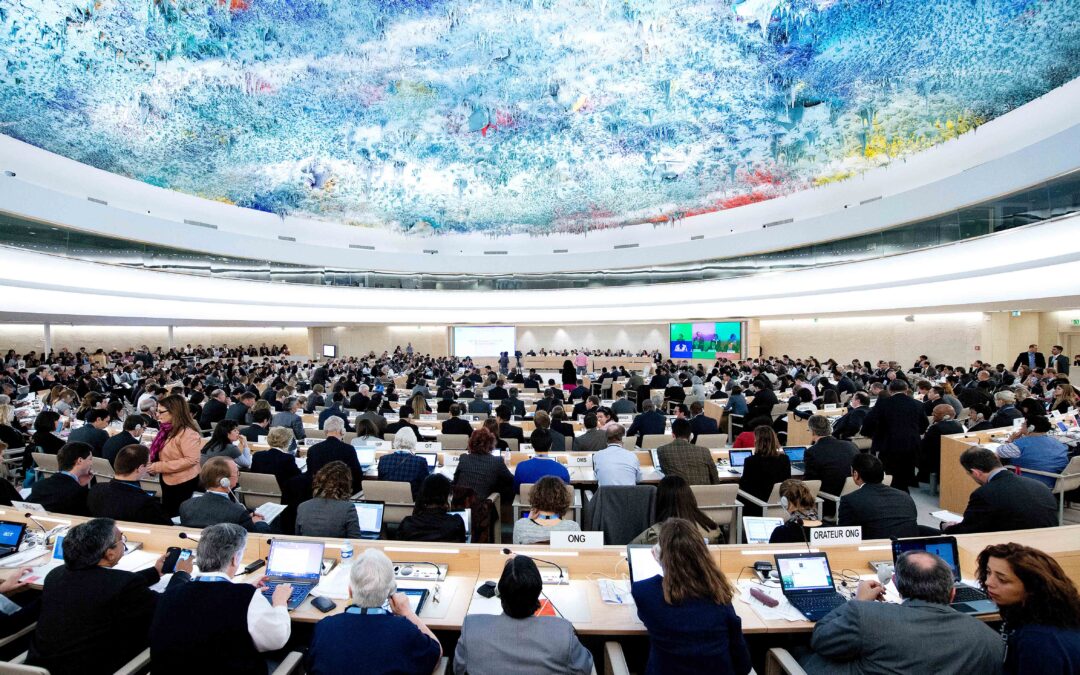
Today the ICJ delivered an oral statement on discrimination against women in access to justice at the UN Human Rights Council in Geneva.
The statement came during an interactive dialogue with the Working Group on the issue of discrimination against women in law and in practice. Ms Alda Facio, Chair of the Working Group, presented the Working Group’s latest report which highlighted examples of good practice in eliminating discrimination against women.
The ICJ stated as follows:
The ICJ would like to thank the Working Group for its report and welcomes its positive focus in highlighting examples of good practice, whilst continuing to note that discrimination against women remains a multifaceted and systemic problem.
The ICJ shares the Working Group’s concerns about the intense backlash against women’s rights gains in national, regional and international spheres. We are particularly concerned about the levels of discrimination women continue to face in accessing the justice required to uphold their human rights.
The ICJ has been working for a number of years, in different regions and with different stakeholders, to identify the discriminations women face in accessing justice and to consider the opportunities that can be used to address these discriminations. The importance of applying a gendered analysis to the law and the way that this is accessed and applied is essential to the elimination of discrimination in this area.
The ICJ supports the Working Group’s identification of the fundamental importance of incorporating international human rights standards into domestic legal frameworks to ensure gender equality protections. In the context of the 2030 Agenda, and with particular reference to Sustainable Development Goals 5 and 16, the ICJ encourages States to ensure that any laws and practices that discriminate against women in accessing justice are repealed, and to recall that any exceptions on the grounds of culture, religion or tradition are unacceptable.
Whilst discrimination against women in access to justice has been well documented and is by no means a new phenomenon, it is highly alarming that the problem is worsening in a number of states. The ICJ would ask that the international community remains vigilant about these potential regressions and commits to holding to account any States that fail to fulfil their international obligations to ensure access to justice for women.
Jun 9, 2017 | Advocacy, Non-legal submissions
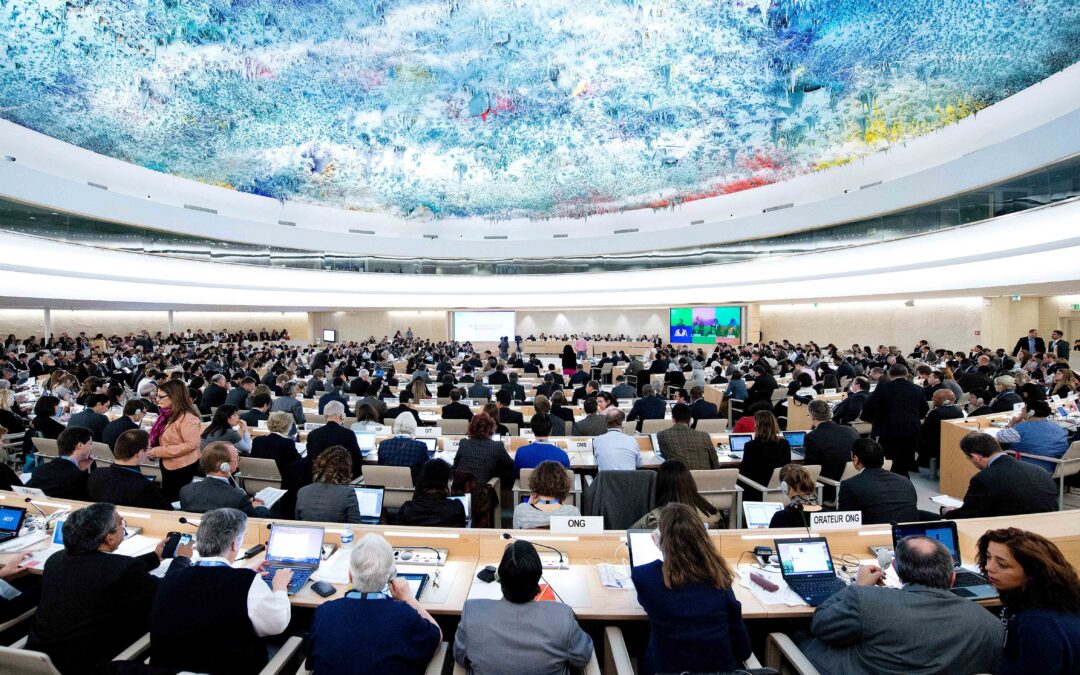
The ICJ today delivered an oral statement at the UN Human Rights Council, addressing global responses to corporate impunity, and addresing the role of judges and lawyers in relation to refugees and migrants.
The statement came in a clustered interactive dialogue with the UN Working Group on Business and Human Rights and the Special Rapporteur on the Human Rights of Migrants. These independent experts appointed by the Council were presenting their respective annual reports to the Council.
The ICJ stated as follows:
The ICJ welcomes the Study of the Working Group on Business and Human Rights, on cross-border cooperation between States with respect to law enforcement in relevant cases (A/HRC/35/33). The ICJ concurs with the Working Group’s concern for the “lack of political will by States to address business-related human rights abuses through the lens of criminal law” (para. 4) and the near-total lack of investigations and prosecutions against companies regarding human rights abuses and international crimes (para. 87).
The ICJ also concurs that a global approach is needed to address corporate impunity and supports the Working Group’s recommendations for adoption of legal frameworks imposing liability on legal entities (para. 93), creation of specialized investigative and prosecutorial units in cross-border human rights cases, and joint investigations. The ICJ would like to ask how the Working Group will support States to put these recommendations into practice?
The ICJ also welcomes the proposal of the Special Rapporteur on the Human Rights of Migrants for a 2035 agenda for facilitating human mobility. We particularly support the goal of effective access to justice for all migrants, and the targets and indicators on access to lawyers and courts for this goal, and in relation to returns and detention.
The ICJ has published a set of Principles on the Role of Judges and Lawyers in Relation to Refugees and Migrants, developed in consultation with leading practitioners and experts from around the world. We encourage States and other actors to take account of the detailed guidance in the ICJ Principles, including during the process for adoption of the Global Compacts foreseen by the New York Declaration for Refugees and Migrants, and in considering the Special Rapporteur’s proposal. We would like to ask the Special Rapporteur how States can better recognise and enable the role of judges and lawyers in relation to migrants?
The Chair of the Working Group on Business and Human Rights, in his concluding remarks, recognised the statement of the ICJ, and answered that the Working Group plans to follow up its report with a continuing conversation about its recommendations, and will reach out to stakeholders for further consultation on what more the WG can do in this regard.
The Special Rapporteur on Human Rights of Migrants also recognised the statement of the ICJ, and in his reponse emphasised that access to justice for migrants is key, including competent well-resourced lawyers, access to meaningful recourse, better funding for National Human Rights Institutions and ombudspersons, and providing in administrative law procedural safeguards that are commensurate to the risks that migrants face when such decisions are applied to them.
Jun 8, 2017 | Events, News
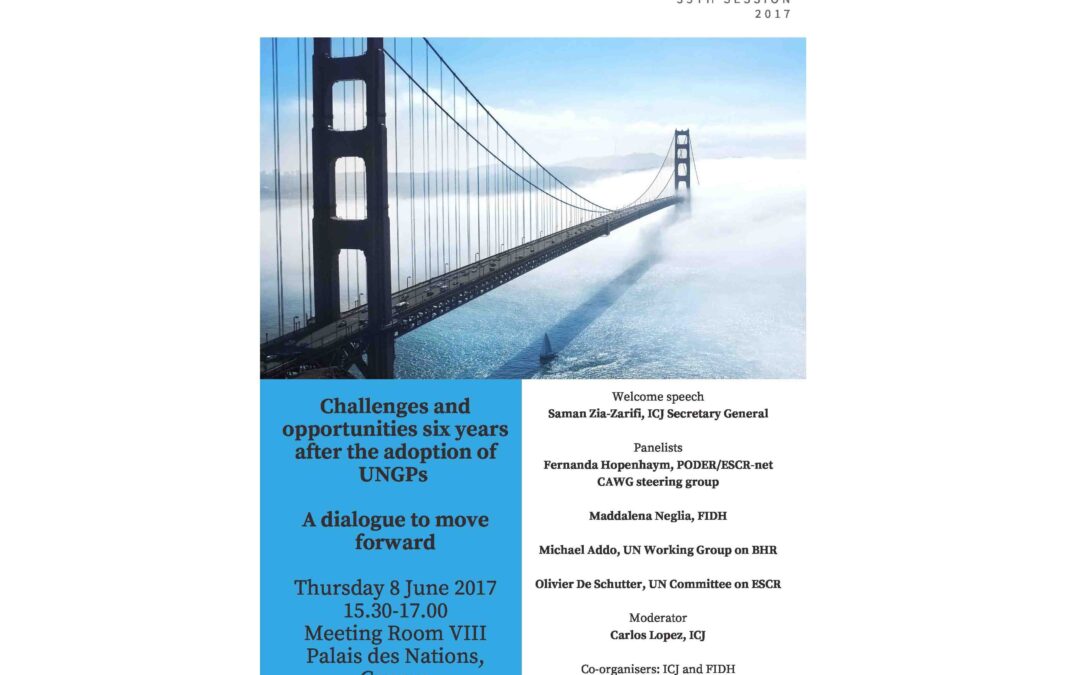
Today, the ICJ and FIDH are organizing a side event to to the 35th Regular session of the Human Rights Council on business and human rights.
Business responsibility to respect human rights
Challenges and opportunities six years after the adoption of UNGPs
A dialogue to move forward
Thursday 8 June 2017, 15.30-17.00
Meeting Room VIII
Palais des Nations, Geneva
After the adoption of the UNGP in 2011, standards on business responsibility to respect human rights and business human rights due diligence have gained prominence in the global debate on business accountability.
Many companies claim to comply with the UNGP by performing a human rights due diligence including across their global supply chain.
Several initiatives have emerged at regional and national level to promote companies’ due diligence processes, including the EU Directive on non-financial reporting, the UK Modern Slavery Act, the French law on company devoir de vigilance.
Despite the progress, serious human rights abuses still occur in both developing and developed countries.
The ability of companies to identify, monitor and prevent negative human rights impacts in their operations and relationships is still weak and the access to effective remedy remains difficult if not impossible.
This is an opportune moment to take stock of the progresses made to date and the challenges ahead in order to create a level playing field that will effectively promote the respect of human rights in business global operations.
Welcome speech
Saman Zia-Zarifi, ICJ Secretary General
Moderator
Carlos Lopez, ICJ
Panelists
Fernanda Hopenhaym, PODER/ESCR-net CAWG steering group
Maddalena Neglia, FIDH
Michael Addo, UN Working Group on BHR
Olivier De Schutter, UN Committee on ESCR/University of Louvain
Jun 7, 2017 | Events, News
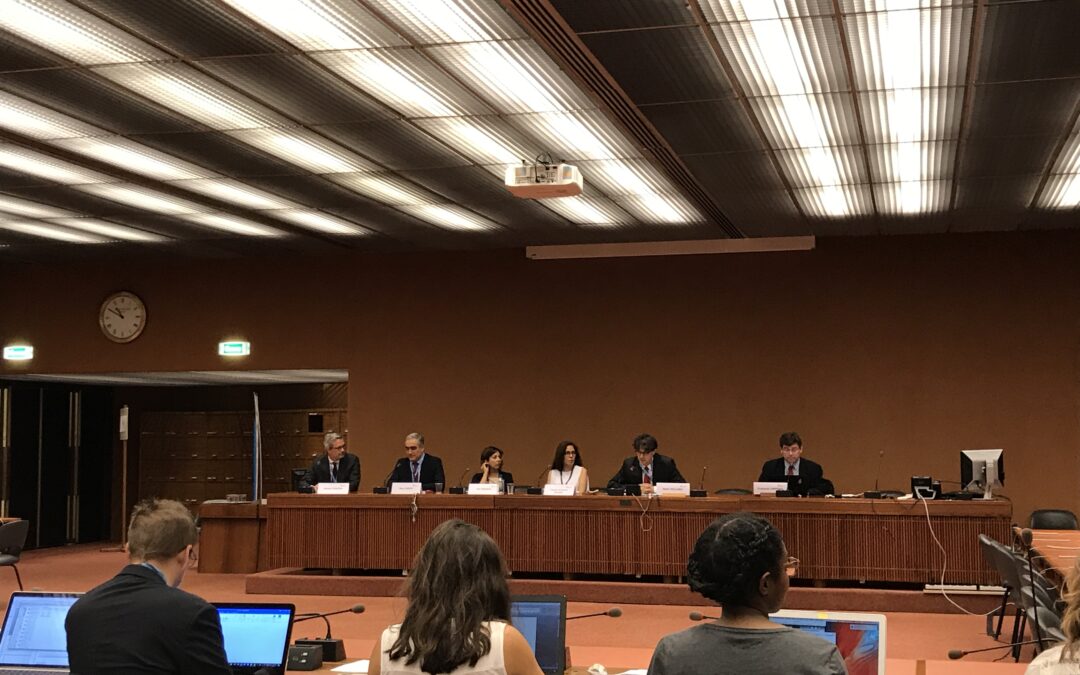
The ICJ organised a panel discussion on 8 June 2017, on the role of judges and lawyers in relation to refugees and migrants, at a side event to the 35th session of the UN Human Rights Council in Geneva.
The Panel was held on the occasion of the publication of ICJ Principles and Commentary on the topic, developed in consultation with judges, lawyers and other expert practitioners from around the world.
The event took place on Thursday, 8 June 2017, from 10:30 to 11:30, in Room XXI of the Palais des Nations, Geneva.
Welcome remarks were delivered by:
- Saman Zia-Zarifi, Secretary General of the ICJ.
- Olivier Coutau, Délégué à la Genève internationale, Republic and Canton of Geneva
Panelists included:
- François Crépeau, UN Special Rapporteur on the human rights of migrants.
- Carole Simone Dahan, Senior Legal Advisor on Judicial Engagement, UNHCR.
- Pia Oberoi, Advisor on Migration and Human Rights, OHCHR.
The discussion was moderated by Matt Pollard, ICJ Senior Legal Adviser.
At the event, each of the panelists emphasised the importance of access to independence courts and lawyers for securing the rights of refugees and migrants, and highlighted the importance and utlity of the ICJ Principles in this regard.
More background on the ICJ Principles and Commentary is available by clicking here.
For more information, email un(a)icj.org
A flyer for the event may be downloaded in PDF format here: Refugees-Migrants-ICJ-Event-HRC35-June2017
The consultations, development and publication of the ICJ Principles were made possible with the financial support of the Republic and Canton of Geneva, for which the ICJ is grateful.
Jun 5, 2017 | Advocacy, Non-legal submissions
The ICJ has made a submission to the UN Human Rights Committee in advance of its forthcoming examination of Pakistan’s initial report under International Covenant on Civil and Political Rights (ICCPR).
In its submission, the ICJ has brought to the Committee’s attention concerns in relation to the following issues:
- The compliance of Pakistan’s counter-terrorism laws with the State’s obligations under Articles 6, 9 and 14 of the Covenant, particularly in the context of its “military justice” system;
- Shortcomings in the legal framework relevant to torture and other ill-treatment;
- The continuing practice of enforced disappearances and, in this context, the ongoing impunity of law enforcement and military agencies;
- The compliance of Pakistan’s blasphemy laws with Articles 14, 18, and 19 of the Covenant; and
- The compatibility of Pakistan’s “International Non-Governmental Organizations Policy” with the State’s obligations under Article 22 of the Covenant.
The Human Rights Committee will examine Pakistan’s initial report during its 120th session, which will be held in Geneva from 3-28 July 2017.
Following the review, the Committee will adopt Concluding Observations setting out recommendations to the Pakistani Government.
Pakistan -ICCPR submission-Advocacy-non legal submission-2017-ENG (full text in PDF)