Mar 15, 2017 | Advocacy, Non-legal submissions
The ICJ and Human Rights Commission of Pakistan (HRCP) made a statement to the UN Human Rights Council highlighting the alarming human rights situation developing in Pakistan.
The statement addressed the situation for human rights defenders, abuse of blasphemy laws, and violations in the context of countering terrorism.
“Pakistan has increased its clamp down on human rights defenders, even attempting to shut down NGOs for reasons such as the NGO “presenting a very bleak picture of human rights” to the UN.
State agents have subjected human rights defenders exercising their right to freedom of expression and peaceful assembly to excessive force and even prosecution under Pakistan’s anti-terrorism laws. Others have been assaulted, killed or forcibly disappeared. Not a single perpetrator has been successfully brought to justice.
Misuse and persecution are inherent in the logic, structure and formulation of blasphemy laws in Pakistan: vague and over-broad language leaves them open to abuse; they blatantly discriminate against minority religions and sects; they are incompatible with the rights to freedom of expression and religion; and their implementation raises serious fair trial concerns.
Finally, Pakistan’s counter-terrorism laws and policies disregard human rights protections, including in the practice of enforced disappearances of terrorism suspects and others, and in the exposure of civilians accused of terrorism-related offences to unfair, secret and opaque trials in military courts. Laws such as the Actions (in Aid of Civil Powers) Regulations allow indefinite detention without judicial supervision.
The statement can be downloaded in PDF format here: HRC34-Pakistan-OralStatement-2017
Mar 13, 2017 | Events, News
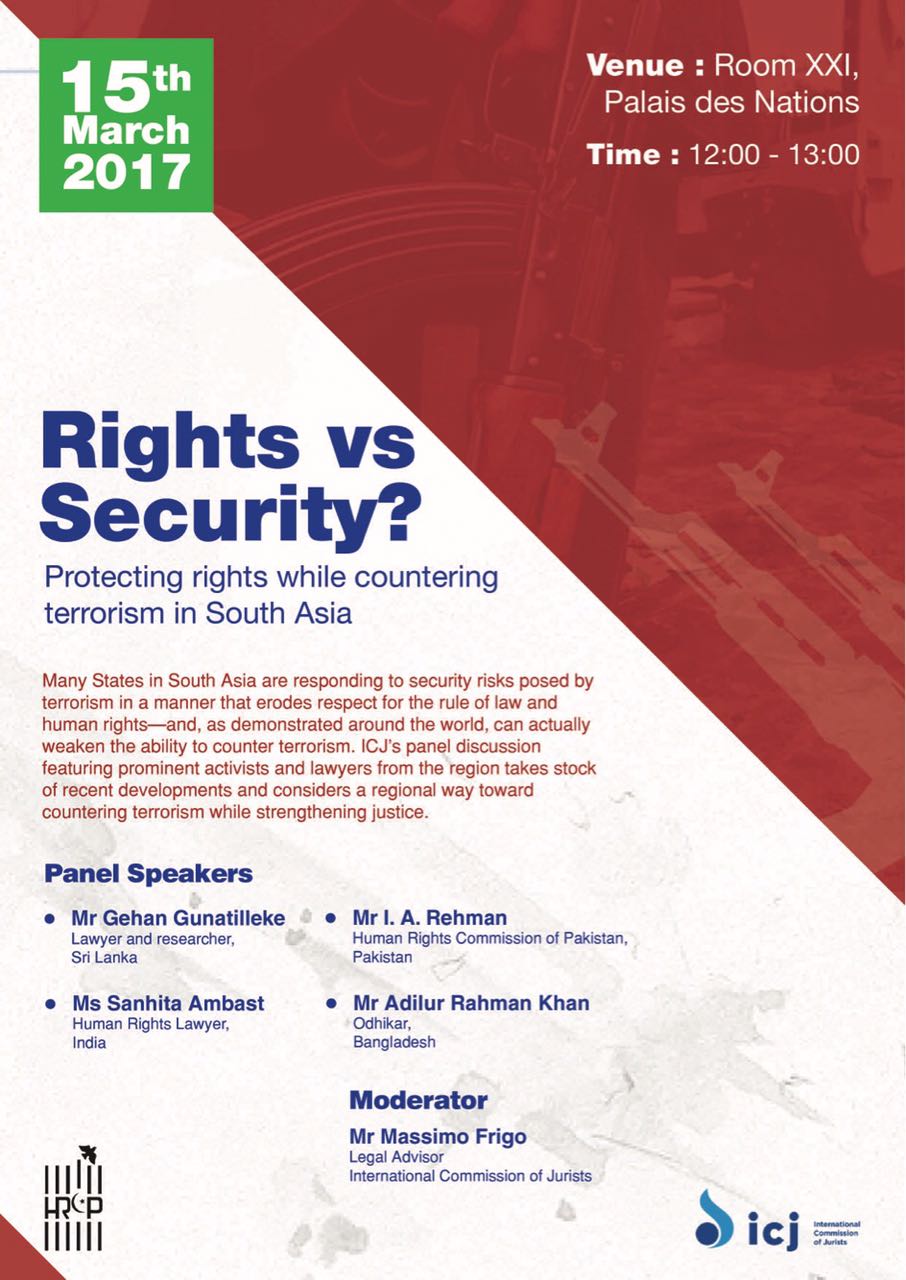
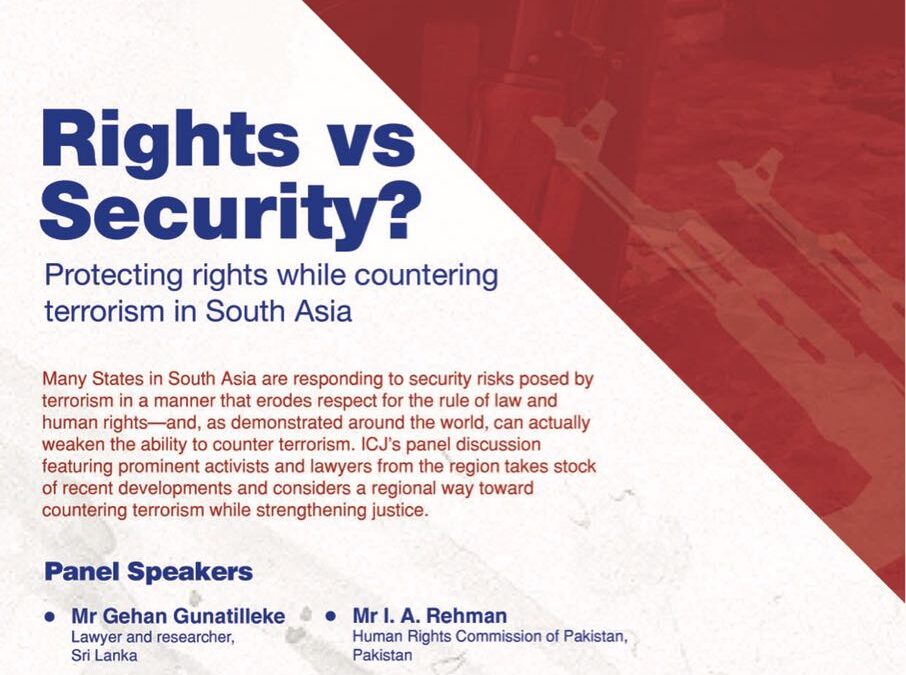
The ICJ and the Human Rights Commission of Pakistan are convening a side event at the UN Human Rights Council, entitled “Rights vs Security? Protecting human rights while countering terrorism in South Asia”.
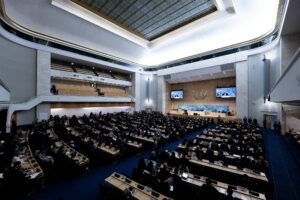
The event takes place 15 March 2017, 12:00-13:00, Palais des Nations, Room XXI
Many States in South Asia are responding to security risks posed by terrorism in a manner that erodes respect for the rule of law and human rights—and, as demonstrated around the world, can actually weaken the ability to counter terrorism. ICJ’s panel discussion featuring prominent activists and lawyers from the region takes stock of recent developments and considers a regional way toward countering terrorism while strengthening justice.
Panelists:
Mr I. A. Rehman: Human Rights Commission of Pakistan (Pakistan)
Mr Adilur Rahman Khan: Odhikar (Bangladesh)
Mr Gehan Gunatilleke: Lawyer and researcher (Sri Lanka)
Ms Sanhita Ambast: Human rights lawyer (India)
Moderator:
Mr Massimo Frigo: International Commission of Jurists
A flyer may be downloaded here.
Mar 13, 2017 | Advocacy, Non-legal submissions
The ICJ today delivered a joint NGO oral statement to the UN Human Rights Council on the need in Myanmar for an international Commission of Inquiry and for an independent and self-governing legal profession.
In the statement, the International Commission of Jurists, joined by the International Bar Association’s Human Rights Institute and Lawyers’ Rights Watch Canada, welcomed the report of the Special Rapporteur on the situation for human rights in Myanmar, and her recommendation for a Commission of Inquiry to investigate persecution of Rohingya and other minorities in Rakhine State.
Since 9 October 2016, Myanmar’s security forces have reportedly targeted Rohingya during “clearance operations” which have no basis in law. Attacks against women, men, and children allegedly have involved extrajudicial killings; enforced disappearances; torture and other ill-treatment including rape and other sexual violence; hundreds of arbitrary arrests and detentions; forced displacement; and looting and destruction of homes, food and other property.
To date, authorities in Myanmar appear to have been unwilling or unable to investigate abuses or hold perpetrators accountable. Several national investigation commissions have lacked impartiality and independence. National judicial and law enforcement authorities lack capacity and independence to address this situation. Accordingly, we urge Council to adopt a resolution at this session establishing an international, independent Commission of Inquiry to assess facts, identify causes and perpetrators, and issue recommendations including remedies for victims.
The recent killing of lawyer U Ko Ni, who strongly advocated against religious discrimination and for inter-communal peace, must be subject to a prompt, impartial and effective investigation capable of identifying all those responsible and holding them accountable in a fair trial. It also underscores the urgent need for an independent and self-governing legal profession in Myanmar, enabled to uphold human rights and the rule of law without fear.
The statement may be downloaded in PDF format here: HRC34-OralStatement-Myanmar-2017
Mar 12, 2017 | Events, News
A side event to the UN Human Rights Council, Tuesday 14 March, 16.00 – 17.00, Palais des Nations room XXI.
TORTURE AND ENFORCED DISAPPEARANCE IN THAILAND
THE STATE RESPONSE
Tuesday 14 March/16.00-17.00
room XXI
Panelists:
Angkhana Neelapaijit, National Human Rights Commissioner and family victim of enforced disappearance
Yuval Ginbar, Amnesty International legal advisor
Moderated by Matt Pollard, ICJ Senior Legal advisor
The event follows the Human Rights Committee’s examination of Thailand’s second periodic report on its implementation of the International Covenant on Civil and Political Rights on 13 and 14 March 2017.
The event will focus on the measures Thailand has taken to implement its international human rights obligations with respect to the prohibition of enforced disappearance, torture and ill-treatment – with a particular focus on the draft Prevention and Suppression of Torture and Enforced Disappearance Act (Draft Law).
Background
Eighty-two cases of enforced or involuntary disappearance in Thailand were reported to the Working Group on Enforced or Involuntary Disappearances between 1980 and 2016. Civil society has also issued several reports containing allegations of torture by security forces, particularly in the restive deep South. These allegations were made against a culture of impunity which pervades Thailand.
In October 2016, after 11 years and three months of investigation, the Department of Special Investigation (‘DSI’) declared the emblematic enforced disappearance case of Somchai Neelapaijit closed, saying no culprits had been found. In January 2017, the DSI further announced it would not investigate the apparent enforced disappearance of Pholachi “Billy” Rakchongcharoen, a Karen minority human rights defender. These cases underscore the difficulties victims face in obtaining justice under the current legal framework in Thailand.
For several years, Thailand has pledged its commitment to ratifying the International Convention on Enforced Disappearance (ICCPED) and passing domestic legislation criminalizing torture and enforced disappearance. In May 2016, the Cabinet approved a Draft Law, which was subsequently transmitted to Thailand’s legislature, the National Legislative Assembly (NLA). However, last month, the NLA announced it would send the Draft Law back to the Cabinet for further consultation, effectively ending the possibility of it being enacted in the foreseeable future.
For further information on recent developments concerning this piece of legislation, please see: https://www.icj.org/thailand-prioritize-the-amendment-and-passage-of-legislation-on-torture-and-enforced-disappearances/.
A flyer for the event may be downloaded here.
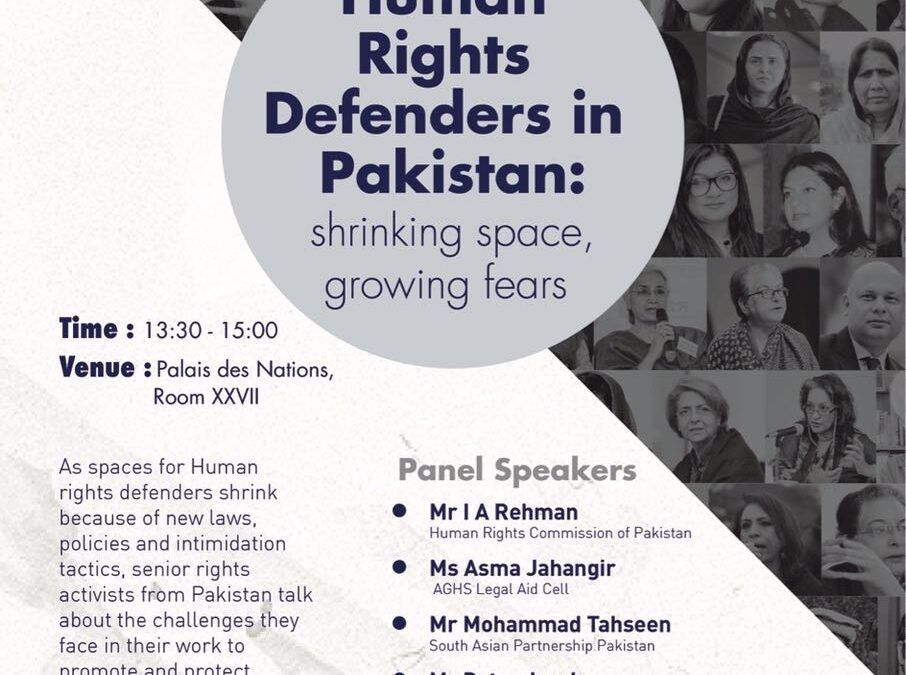
Mar 12, 2017 | Events, News
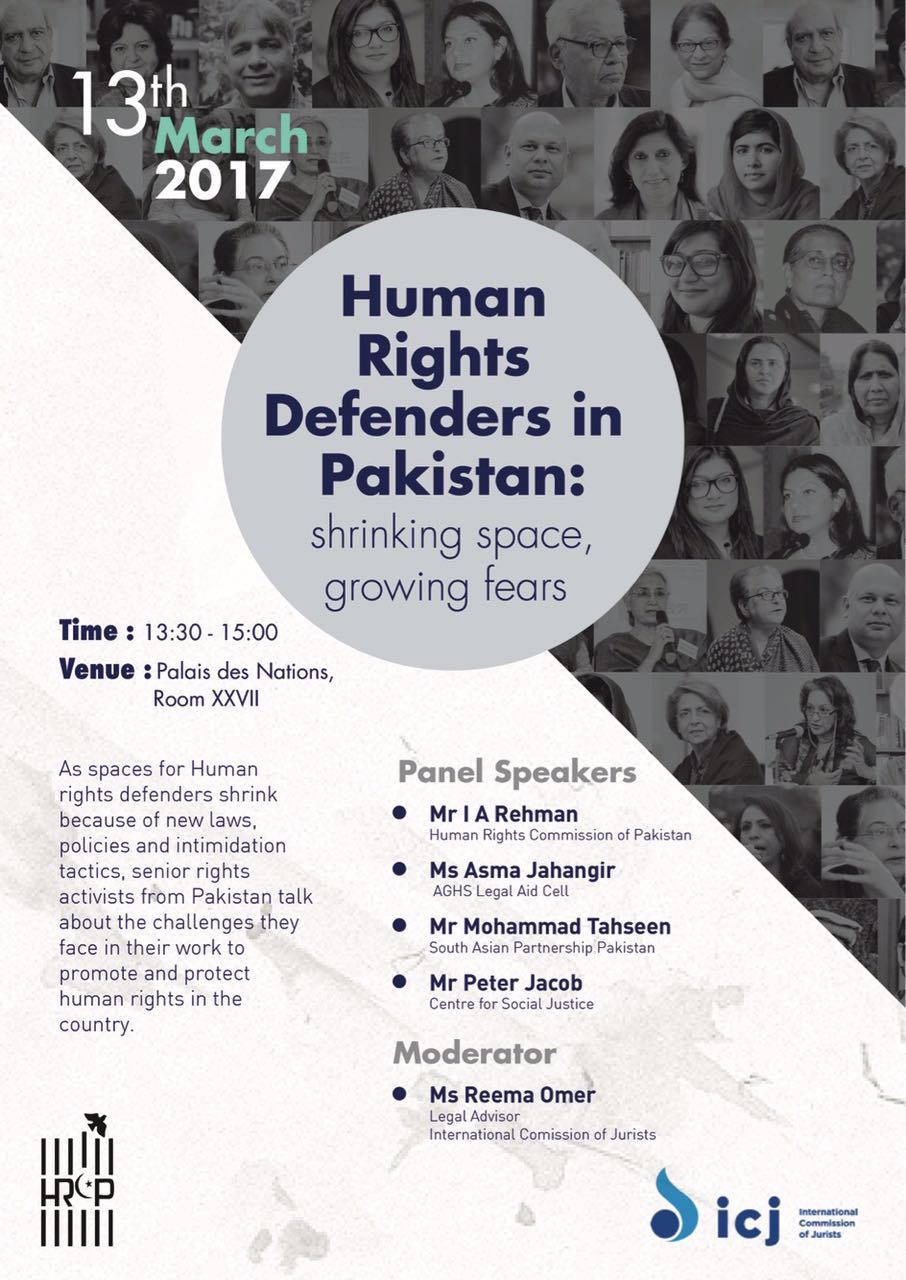
A side event at the UN Human Rights Council, 13 March 2017.
13 March, 13:30-15:00
Palais des Nations, Room XXVII
As spaces for human rights defenders shrink because of new laws, policies and intimidation tactics, senior rights activists from Pakistan talk about the challenges they face in their work to promote and protect human rights in the country.
Panelists:
Mr I. A. Rehman: Human Rights Commission of Pakistan
Ms Asma Jahangir: AGHS Legal Aid Cell
Mr Mohammad Tahseen: South Asia Partnership Pakistan
Mr Peter Jacob: Center for Social Justice
Moderator:
Ms Reema Omer: International Commission of Jurists
Flyer available here.