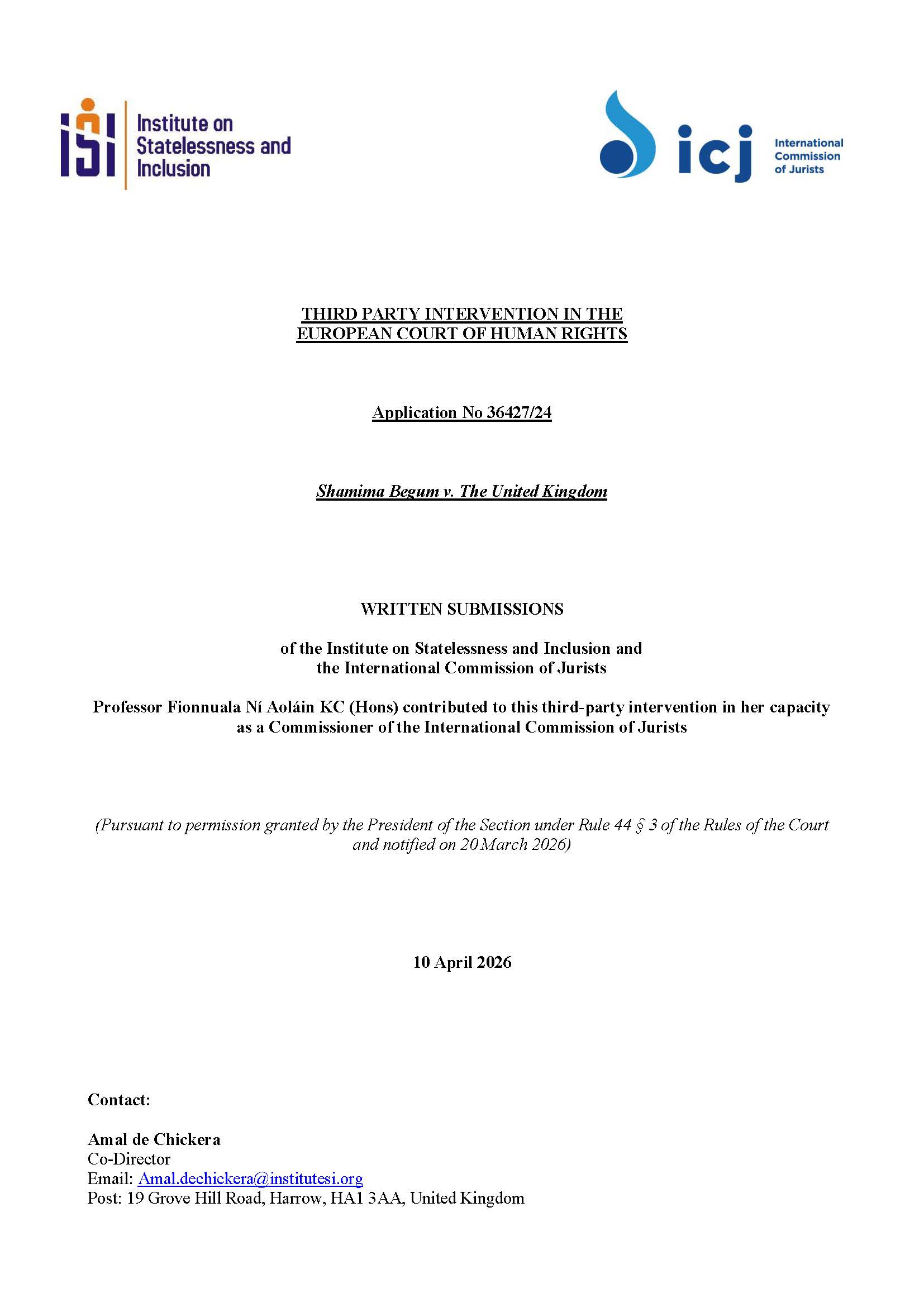
On 10 April 2026, the Institute on Statelessness and Inclusion (ISI) and the International Commission of Jurists (ICJ) filed a joint third-party intervention in the landmark case before the European Court of Human Rights (ECtHR), Shamima Begum v. the United Kingdom, making submissions on critical human rights concerns arising from trafficking, citizenship deprivation, and State responsibility under the European Convention on Human Rights (ECHR).
The intervention highlights that, under the ECHR, States cannot use citizenship stripping to evade their human rights obligations, particularly where there are credible indicators that an individual may have been a victim of trafficking.
Drawing on international human rights law and standards, including those referenced in the Principles on Deprivation of Nationality, the intervention makes submissions on matters relevant to the Court’s ultimate determination of the questions it put to the parties, focusing on:
- Jurisdiction under the ECHR: States may bear responsibility for harms occurring abroad where their actions or omissions contributed to those harms.
- Trafficking: States have an ongoing obligation to identify, protect, and assist victims of trafficking under Article 4 of the ECHR – which enshrines the prohibition of slavery and forced labour – especially children, and this must inform their decisions, including on citizenship deprivation.
- Citizenship deprivation: Decisions to remove citizenship must be assessed under both Article 4 and Article 8 of the ECHR – which guarantees the right to private and family life – with due regard to the individual’s right to nationality and to safeguards against arbitrariness, discrimination and statelessness. Citizenship deprivation is analogous to a criminal prosecution and is a “penalty”, raising serious concerns under the ECHR and international law more broadly.
The ISI-ICJ joint intervention comes at a critical moment, as the ECtHR considers the State’s duty to take into account trafficking risks and other human rights obligations whenever exercising citizenship deprivation powers. The full intervention is available here.
Professor Fionnuala Ní Aoláin KC (Hons) contributed to the third-party intervention in her capacity as a Commissioner of the International Commission of Jurists.
Background
Shamima Begum’s application to the ECtHR concerns the UK Home Secretary’s February 2019 decision on purported national security grounds to deprive her of her British citizenship after she left the UK in 2015, aged 15, to travel to Syria where she is said to have aligned herself with the Islamic State of Iraq and the Levant.
In her application to the ECtHR, Shamima Begum has complained under Article 4 of the ECHR that the UK Home Secretary’s citizenship deprivation decision failed to consider: “(a) whether she might have been a victim of trafficking and whether that led to the acts for which the State was considering depriving her of her citizenship; (b) whether there had been any potential failures by the State to take reasonable steps to protect her from being trafficked, in breach of the protective duty and, if so, whether restitutionary obligations might be owed; (c) whether depriving her of her citizenship would frustrate or prevent the discharge of the Article 4 investigative and operational duties, or the restitutionary obligations arising from a prior breach of the protective duty; and (d) whether in all the circumstances of case, deprivation could nevertheless be justified on national security grounds.”