Feb 9, 2016
The ICJ wrote to Thailand’s Department of Special Investigations (DSI) today further to the latest setback in the enforced disappearance case of Somchai Neelapaijit, who was reportedly abducted by police officers and forcibly disappeared in central Bangkok on 12 March 2004.
Following the Supreme Court’s decision of 29 December 2015 to acquit one police officer and exonerate four others of coercion and robbery, the ICJ wrote to the DSI to urge it to reinvigorate its investigation and provide access to an effective remedy and reparation for Somchai Neelapaijit’s family.
Reminding the DSI of its obligations under international human rights law, the ICJ’s letter drew attention to the fact that enforced disappearance is considered to be a continuing crime until the fate and whereabouts of a ‘disappeared’ person are disclosed or otherwise become known.
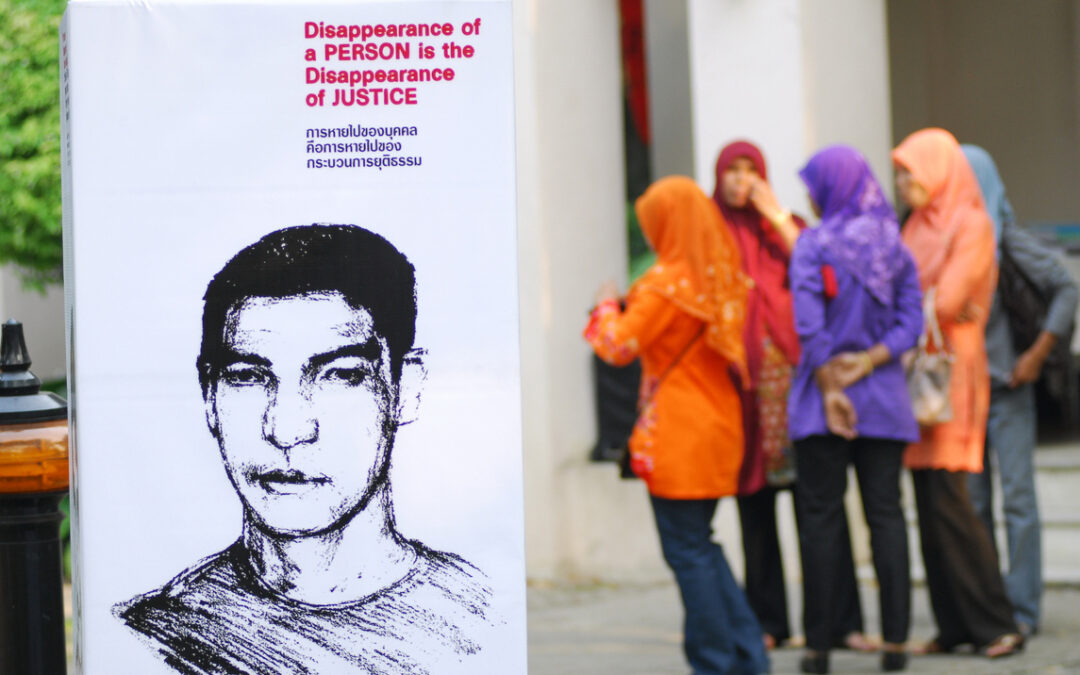
12 years have now passed since Somchai Neelapaijit (photo) was abducted in plain sight in the middle of Bangkok.
As the only open channel to justice, the ICJ’s letter underscored the significance of the DSI’s continuing investigation.
At a time when the Royal Thai Government is debating draft legislation that would ‘guarantee prompt, thorough, impartial investigation of any cases of torture and enforced disappearance’, now is the opportune moment to complement these efforts to comply with the International Convention for the Protection of All Persons from Enforced Disappearance.
Thailand’s obligations also include the International Covenant on Civil and Political Rights and the Convention against Torture and Other Cruel Inhuman or Degrading Treatment or Punishment, to which Thailand is a state party.
Enforced disappearance also amount a violation under both of these treaties, which also require that acts constituting enforced disappearance be criminalized and that persons responsibility be brought to justice.
Thailand-DSI Somchai-Advocacy-Open letters-2016-ENG (full text in PDF, English)
Thailand-DSI Somchai-Advocacy-Open letters-2016-THAI (full text in PDF, Thai)
Read also:
Somchai Neelapaijit verdict important test of Thailand’s treatment of cases of enforced disappearance

Jan 27, 2016
On 8 and 9 October 2015, the ICJ held a consultation meeting in Tunis on the topic of judicial accountability. The ICJ today is publishing a summary report of the discussions.
The focus of the meeting was on mechanisms and procedures for holding judges to account for involvement in violations of human rights, judicial corruption or similar judicial misconduct, in developing countries.
The Tunis meeting offered the opportunity for judges, researchers and other professionals with expertise in justice systems in a range of developing countries from Africa, South America and the MENA region, to exchange views and experiences on the topic.
Drawing from their professional experience,knowledge and personal opinion, the participants discussed types of accountability mechanisms, their efficiency, and the main challenges faced in pursuing judicial accountability and potential ways to overcome them in developing countries.
The Tunis consultation forms part of a larger ongoing project on judicial accountability.
The ICJ intends to publish in the coming months a report of further reflections on the particular challenges for judicial accountability in developing countries, as well as a more global Practitioners’ Guide on Judicial Accountability in June 2016.
These publications will draw on the Tunis consultation, the 2015 Geneva Forum of Judges and Lawyers (14-15 December 2015), as well as further research.
This report of the Tunis consultation offers a thematic summary of the discussions held over the course of the two days meeting, and also includes annexes with the list of participants, and questions for reflection, provided to the participants in advance of the meeting.
The ICJ is grateful for funding from the Ministry of Foreign Affairs of Finland, without which the Tunis consultation and additional ICJ consultations, research and analysis on judicial accountability in developing countries would not have been possible.”
Universal-Tunis Consultation-Publications-Seminar and Conference Report-2016-ENG (full report in PDF)

Jan 2, 2016
Initially published in Spanish on 29 November 2015, the tenth book of the ICJ series of Practitioners Guides has now been translated into English.
It can be downloaded below:
Universal-PG Enforced Disappearance N10-Publications-Practitioners’ Guide-2016-ENG (English version in PDF)
Universal-PG Desaparizion forzada N10-Publications-Practitioners’ Guide-2015-SPA (Spanish version in PDF)
Feb 27, 2015 | News
The Nepali government must fully implement yesterday’s decision of the Supreme Court rejecting the possibility of amnesties for perpetrators of serious human rights abuses during the country’s civil war, said today the ICJ.
The decision, by a three-person special constitutional bench, composed of Justice Kalyan Shrestha, Justice Baidhya Nath Upadhyay and Justice Cholendra Shumsher JB Rana, struck down the amnesty provision of the Commission on Investigation of Disappeared Persons, Truth and Reconciliation Act 2014 (TRC Act) promulgated last May 2014.
The Court also ruled that only the judiciary, and not the Commissions established by the TRC Act, can determine the criminality of any violations committed in the context of the country’s decade-long conflict.
“Nepal’s Supreme Court has once again firmly reasserted the right of the victims of human rights violations to seek justice,” said Sam Zarifi, ICJ’s Asia Director. “This bold and principled decision should finally end the cynical attempts by politicians from all Nepal’s major parties, as well as the military, to legislate impunity and shield themselves from accountability.”
The decision distinguished between the jurisdiction of the courts and the criminal justice system, and the non-judicial reconciliation and truth-seeking mechanisms established by the TRC Act.
In the months before the decision, the government had essentially frozen the prosecution of claims already before various courts, and had blocked the filing of First Information Reports (FIRs) by victims trying to lodge new complaints.
“Now, the government must not only remove obstacles to these cases, it must commit itself to prosecuting such claims,” Zarifi added. “The Government must immediately take all necessary steps to implement the court ruling including to ensure criminal investigation of FIRs, and address the concerns raised by the victims on the formation of the Truth and Reconciliation Commission and Commission of Inquiry on Enforced Disappearance.”
This is the second time that the Nepali Supreme Court has rejected the amnesty scheme introduced by the Nepali government.
On 2 January 2014, the Supreme Court had declared unconstitutional the Ordinance on the Truth and Reconciliation Commission (TRC Ordinance).
However, the Government effectively ignored the Court order and introduced a slightly modified version of the 2013 Ordinance replicating almost all of the provisions of the TRC Ordinance, including many of its problematic aspects, such as the ‘amnesty’ provision.
“The Government, with the help of the international community, must now dedicate itself to meeting the promise of the political parties to provide justice, truth and reparations to the victims and survivors of the conflict,” said Zarifi. “Only doing so will help end the country’s cycle of impunity.”
Contact:
Sam Zarifi, ICJ Asia Pacific Regional Director (Bangkok), t: +66 807819002; email: sam.zarifi(a)icj.org

Dec 19, 2014 | News
The Nepal government should ensure more victim participation and improve transparency when selecting candidates for two independent commissions on the country’s decade-long conflict, the ICJ and other groups said today.
The ICJ, Amnesty International, Human Rights Watch and five local human rights and conflict-era victims groups sent an open letter to Prime Minister Sushil Koirala.
The groups, reiterating concerns about the act, said Koirala should narrow the scope of the amnesty powers vested in the commissions and bring them in line with international standards.
The Truth and Reconciliation Commission and the Commission on Enforced Disappearances are being established under a 2014 law, the Commission on Investigation of Disappeared Persons, Truth and Reconciliation Act, 2071 (TRC Act).
“A consultative and transparent process for selecting commissioners is critical if the commissions are going to win the trust of conflict-era survivors as well as local and international observers,” the rights groups said in their letter. “The TRC Act is fundamentally flawed, and the government should take these steps to ensure that this important exercise in transitional justice remedies the flaws.”
Contact:
Sam Zarifi, ICJ Asia Pacific Regional Director (Bangkok), t: +66 807819002; email: sam.zarifi(a)icj.org
Nepal-TRCCommission-Advocay-Open Letter-2014-ENG (full text in PDF)