Mar 21, 2016 | News
Thailand’s National Council for Peace and Order (NCPO) must end its interference in the elections of the president and committee members of the Lawyers Council of Thailand (LCT), the ICJ and Thai Lawyers for Human Rights (TLHR), said today.
The LCT in turn must ensure the elections are conducted in a fair and impartial manner.
“International standards explicitly prohibit external interference in the elections of the executive body of a lawyers’ professional association by its members, and the association’s leadership must ensure that such elections are conducted in a fair and impartial manner” said Matt Pollard, the Head of the ICJ’s Centre for the Independence of Judges and Lawyers. “Ensuring the independence and democratic representation of the legal profession is essential to safeguarding human rights and the rule of law, especially in the current circumstances of military rule in Thailand.”
On 29 February 2016, Mr Wichien Choobtaisong, a representative of the electoral group of the current LCT President, Mr. Dej-udom Krairit, wrote to the NCPO “seeking permission” to hold meetings and campaigns for the LCT’s regularly-scheduled elections, referring to the NCPO’s ban on political gatherings of more than five persons.
On 16 March 2016, the NCPO replied, stating that the elections “contradict” the ban on political gatherings, which “must apply equally to all groups and sectors in the interest of maintaining national security during the transition period,” and taking the position that that the elections must accordingly be postponed with the current committee continuing its term until elections are held. The NCPO’s reply also notes it received a letter from the LCT on 14 December 2015, which the ICJ and TLHR have not seen.
In its letter, the NCPO referred to NCPO Announcement 7/2014, which bans the political gathering of more than five persons (Announcement 7/2014 was later replaced by Order 3/2015). The ICJ reiterates that these arbitrary and unjustified orders and announcements should be repealed, and calls on the NCPO, in any event, to immediately withdraw its letter of 16 March, replacing it with written confirmation that the LCT elections will be able to proceed as scheduled, without external interference.
The LCT must then put in place procedures to ensure the elections proceed as scheduled and in a fair and impartial manner.
“Since the military took power, we have seen a marked increase in the number of individuals requiring legal aid for sensitive and political cases,” said Yaowalak Anuphan, the Head of TLHR and member of the LCT. “In this environment, it is even more essential that the Lawyers Council of Thailand is able to exercise its functions without external interference and that everyone has effective and equal access to the legal services of lawyers.”
Contacts
In Bangkok: Kingsley Abbott, International Legal Adviser for Southeast Asia, t +66 94 470 1345 ; e: kingsley.abbott(a)icj.org
In Geneva: Matt Pollard, ICJ Senior Legal Adviser, t: +41 22 979 38 12 ; e: matt.pollard(a)icj.org
Background
The Lawyers Council of Thailand was established in 1957. Its mandate and responsibilities are set out in the Lawyers Council Act 1985.
The objectives of the Council include maintaining the ethics of lawyers, promoting legal education and providing legal assistance.
It also registers lawyers and issues them with licenses to practice law in Thailand. Members of the Council elect the president and committee members every three years.
Article 24 of the Basic Principles on the Role of Lawyers, adopted by the UN in 1990, sets out that: “Lawyers shall be entitled to form and join self-governing professional associations to represent their interests, promote their continuing education and training and protect their professional integrity.
The executive body of the professional associations shall be elected by its members and shall exercise its functions without external interference.”
Among other things, the UN Basic Principles also affirm that ensuring all persons have effective access to legal services provided by an independent legal profession is essential for adequate protection of human rights and fundamental freedoms.
They note the vital role of professional associations of lawyers including in protecting their members from persecution and improper restrictions and infringements. The Basic Principles specify that governments should respect and reflect the provisions of the Basic Principles in their national legislation and practice.
The UN Human Rights Committee has applied the Basic Principles as a necessary component of the right to a fair trial guaranteed in Article 14 of the International Covenant on Civil and Political Rights (ICCPR), to which Thailand is a State Party.
The UN Committee will review Thailand’s compliance with the ICCPR at an upcoming meeting.
Thailand-ICJ and TLHR statment on LCT-News-press releasess-2016-THA (full text in Thai, PDF)
Mar 18, 2016 | Advocacy, Non-legal submissions
The ICJ today joined an oral statement on the role of judges, lawyers, and prosecutors, as well as the threats they face, and the Universal Periodic Review of the UN Human Rights Council.
The statement, delivered by the Director of the International Bar Association’s Human Rights Institute, Dr Phillip Tahmindjis, read as follows:
“The International Bar Association’s Human Rights Institute (IBAHRI) released this week its report on the ‘Role of the UPR in advancing human rights in the administration of justice’. The report assesses more than 38,000 recommendations made between 2008 and 2014 for references to the legal profession.
The report’s key findings include:
UPR recommendations still insufficiently address the role of judges, lawyers and prosecutors, or the threats they face, as extensively documented by the Special Rapporteur on the Independence of Judges and Lawyers. Significantly, these recommendations often make no reference to relevant UN standards.
Recommendations relating to the independence of judges are often too vague to be an effective response to the shortcomings of any given jurisdiction. Serious issues in the appointment and removal of judges are mostly ignored.
The independence of lawyers was considered in fewer than 100 of the 38,000 UPR recommendations.
Prosecutorial independence is addressed in less than 10 per cent of the recommendations calling upon States to effectively investigate or prosecute rights violations.
Guarantees for legal professionals’ rights to freedom of expression, assembly and association are barely addressed. This fails to reflect the key role that self-governing organisations of legal professionals should play in upholding human rights and the rule of law, the independence of the legal profession and law reform processes.
As international organisations of legal professionals, we foster the engagement of the legal profession in UN human rights mechanisms and in monitoring the implementation of UPR recommendations.
We call upon the Human Rights Council, as well as States, to ensure that in the third cycle of the UPR, the role of judges, lawyers, and prosecutors receives the heightened attention that it is due, as recognised by the UN Basic Principles on the independence of the judiciary, the UN Basic Principles on the role of lawyers and the UN Guidelines on the role of prosecutors.”
The following organisations endorsed the statement:
- Commonwealth Magistrates’ and Judges’ Association
- Commonwealth Lawyers Association
- International Bar Association’s Human Rights Institute
- International Commission of Jurists
- Judges for Judges
- Lawyers for Lawyers
- Southern Africa Litigation Centre
The statement can be downloaded in PDF format here: HRC31-JointOralStatement-UPRLegalProfessions-2016
The IBAHRI report on ‘The role of the UPR in advancing human rights in the administration of justice’ is available at : http://tinyurl.com/gr525sq
Mar 17, 2016 | Advocacy, Non-legal submissions
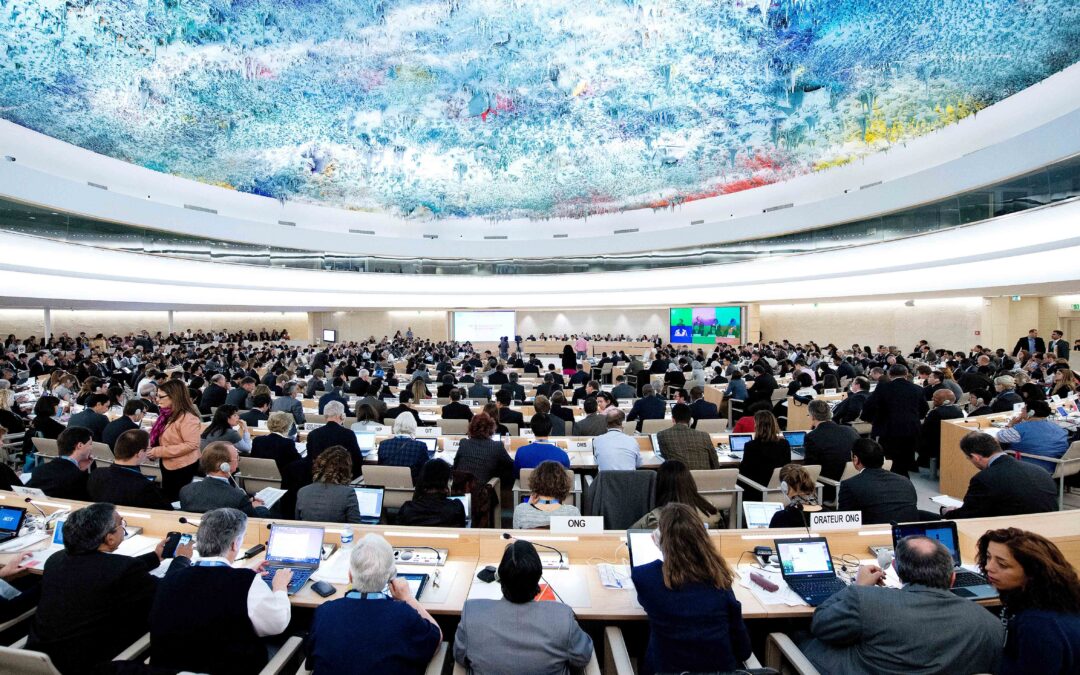
The ICJ today joined with the International Bar Association’s Human Rights Institute to make an oral statement on judges & lawyers in Myanmar, during the consideration of its Universal Periodic Review outcome by the UN Human Rights Council.
The statement:
“The International Bar Association’s Human Rights Institute (IBAHRI) and the International Commission of Jurists welcome Myanmar’s decision to accept recommendations made at the Universal Periodic Review relating to the administration of justice and the independence of the legal profession and call on the Government of Myanmar to implement the recommendations which it has accepted ‘in principle’ to reform the Bar Council Act to allow for the Bar Council to become a truly independent and self-governing association.
In order to ‘guarantee in law and practice that lawyers and judges can perform their professional functions without improper interference and legally form and join self-governing associations’, we call for the right to join such associations to be enshrined in law, and that the right of the first Independent Lawyers’ Association of Myanmar (ILAM) to register as an association be respected;
In order to ‘define professional legal standards and disciplinary procedures in conformity with the Basic Principles on the Role of Lawyers’, we call upon the government of Myanmar to engage in a consultation process with the legal profession and other stakeholders in relation to the revision of the Bar Council Act. The government should also commit sufficient funds to allow for the funding of the system created by the new Legal Aid Law.
We are encouraged by and support efforts by the Office of the Supreme Court of the Union to draft and implement a Code of Judicial Ethics.
Finally, we urge the Government to improve legal education and continue legal professional development including with regard to international human rights law and the UN human rights mechanisms.
We are glad to provide support in the realisation of these recommendations and will look for collaboration with the Government to that end.”

Mar 14, 2016 | Advocacy, Non-legal submissions
The ICJ today joined the International Bar Association’s Human Rights Institute in an oral statement during the interactive dialogue with the UN Special Rapporteur on the situation for human rights in Myanmar.The statement focussed on the situation of the legal profession and judiciary.
It is available to download in PDF format here: HRC31-Advocacy-OralStatement-SRMyanmar-2016

Feb 24, 2016
The ICJ published today a briefing paper providing a first assessment of the process of transition of the judicial system in Northern Kosovo from the Serbian to the Kosovo legal system.
The briefing paper, which follows a visit of a delegation of the ICJ in Kosovo from 1 to 4 November 2015, preliminarily identifies key issues for access to justice and the protection of human rights through the justice system, which need to be addressed and monitored during the transition process.
The paper documents an ongoing process of transition of the judicial system in Kosovo.
It concludes that a key determinant of the success of this transition must be the effective protection of access to justice for all in Kosovo that must be provided by an independent, impartial and effective judicial system, assisted by independent, impartial and effective legal profession and prosecution service.
In its conclusion, the ICJ found that the Kosovo legal system does not yet meet the requirements of the Kosovo Constitution to respect international human rights law and standards and, in particular, the right of minorities, including under the Council of Europe’s Framework Convention. Its shortcomings include:
- the reported lack of security for Kosovo Serb and Kosovo Albanians to access courts in areas dominated by the other ethnicity, with a clear obstructive effect on access to justice;
- the dramatic incapacity of the Kosovo legal and education system to ensure generational continuity for the Serb community in the legal profession with future stark consequences for the ethnic composition and competence of the judiciary, prosecution service and legal profession;
- the lack of equality in practice between Albanian and Serbian languages in judicial proceedings and unreliable quality of the drafting and translation of its legislation; and
- the existence of a deep divide between the laws as written, which often recall or refer to international standards, and the implementation of the laws on the ground.
Finally, the ICJ stressed that the respect, protection and fulfillment of all conditions of access to justice of the non-Albanian minorities is therefore a key benchmark against which the success of this transition or “integration” must be assessed.
The ICJ mission team was composed of Ketil Lund (ICJ Commissioner and former Supreme Court Justice of Norway), Róisín Pillay (Director of the ICJ Europe Programme), and Massimo Frigo (Legal Adviser of the ICJ Europe Programme).
Kosovo-Integration of the justice system-Publications-Reports-Fact Finding mission reports-2016-ENG (full paper, in PDF)

![Smoke rises after an Israeli air strike on the village of Taybeh in southern Lebanon [Source: Al Jazeera]](https://www.icj.org/wp-content/uploads/2026/03/Screenshot-2026-03-20-at-15.56.24-300x200.png)