Jun 9, 2015 | News
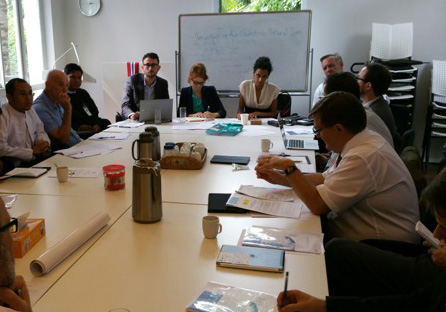
The ICJ today organized a diplomatic dialogue, in advance of the Universal Periodic Review (UPR), with ambassadors and high-level diplomatic representatives, to share the state of human rights in Myanmar.
Jun 5, 2015
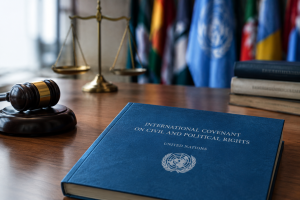
On 4 June 2015, the ICJ and other groups made a submission to UN Human Rights Committee in advance of the Committee’s examination of Venezuela’s compliance with its obligations under the International Covenant on Civil and Political Rights.
The submission by the ICJ, the International Bar Association’s Human Rights Institute and the International Association of Judges, ahead of the Committee’s 114th session from 29 June to 24 July 2015, highlights serious concerns regarding violations of the right to life, freedom from torture, freedom of association and the independence of the judiciary and legal profession in the country.
Venezuela-ICJ-IBAHRI-IAJ Informe Alternativo-Advocacy-legal submission-2015-SPA (full text in PDF, Spanish)
May 18, 2015
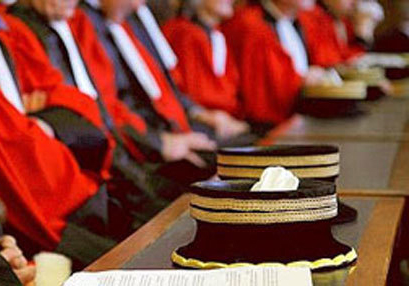
The ICJ today called on the Tunisian President to refrain from promulgating Organic Law No. 16/2015 on the High Judicial Council (HJC), and urged the Tunisian authorities to act to reform the deeply flawed articles of the law in full compliance with international standards on judicial independence.
The ICJ is deeply concerned that the law, which was approved by the Assembly of People’s Representatives on Friday 15 May, falls far short of international standards on judicial independence, in particular the provisions relating to the composition, independence and competencies of the HJC.
Of particular concern is the fact that the law does not provide for the HJC to consist of a majority of judges who are elected by their peers; does not provide for the HJC to be meaningfully involved in determining and ensuring sufficient budgeting for the judiciary; and does not adequately guarantee the security of tenure of judges, including by allowing for judges to be transferred without their consent for a maximum of three years.
The law also grants the Minister of Justice sweeping powers over the Judicial Inspection Service and over the commencement of disciplinary proceedings.
The ICJ is concerned that the drafting process of the law has failed to meet basic principles of inclusive participation and transparency.
Stakeholders, including professional associations of judges and civil society organizations, were not given the opportunity to provide their inputs or to meaningfully comment on the drafts.
“If promulgated, Law No. 16/2015 would perpetuate some of the provisions and practices that undermined judicial independence in Tunisia for decades, including by allowing for the Minister of Justice to initiate disciplinary proceedings against judges,” said Said Benarbia, Director of the ICJ MENA Programme.
“The Tunisian President must refrain from promulgating this law and initiate an inclusive process to draft a new law that unequivocally ends executive interference in judicial matters and empowers the HJC to oversee all issues relating to the judiciary, including judicial administration and the career of judges,” he added.
Contact:
Theo Boutruche, Legal Adviser, ICJ Middle East and North Africa Programme, t: +96 170 888 961, e: theo.boutruche(a)icj.org
Tunisia-Tunisian Law on HJC-News-Press Release-2015-ARA (press release in Arabic, PDF)
Tunisia-Tunisian Law on HJC-Advocacy-Position Paper-2015-ENG (position paper in English, PDF)
Tunisia-Tunisian Law on HJC-Advocacy-Position Paper-2015-ARA (position paper in Arabic, PDF)

May 18, 2015 | News
From 18 to 22 May, the ICJ will carry out a mission to the Russian Federation to examine questions related to the independence and integrity of the legal profession, access to an independent lawyer and the right to an effective defence.
The mission will address the role of Bar Associations in protecting the independence of lawyers, as well as obstacles faced by individual lawyers in protecting the rights of their clients.
The ICJ mission, led by Wilder Tyler, the ICJ Secretary General, will hold meetings with leading Russian experts in the field.
The mission will also meet with the representatives of the Federal Chamber of Lawyers, government officials, and independent lawyers and will take part in two round table discussion with legal scholars and practicing lawyers.
A comprehensive report analyzing the main findings will follow the mission and will present recommendations for reform of law and practice in light of international law and standards on the role of lawyers.
Contact:
Róisín Pillay, Director, Europe Programme, roisin.pillay(a)icj.org
Temur Shakirov, Legal Adviser, Europe Programme, temur.shakirov(a)icj.org
May 15, 2015 | News
Concluding a five-day mission today, an International Fact-Finding team of the ICJ observed that there are serious structural deficiencies in Swaziland’s justice system that need to be addressed systematically and in a structured way to ensure the country meet core rule of law principles.
The mission was conducted in collaboration with the Africa Judges and Jurists Forum, Judges for Judges (the Netherlands) and the Commonwealth Magistrates’ and Judges’ Association, with the aim to assess the state of independence of the judiciary and administration of justice in the country.
“Current developments are merely the symptoms of a systemic crisis,” said Mission leader retired Judge Chinhengo of Zimbabwe.
“There is a need for officials from all branches of government to adhere to the rule of law. The effect of denied justice and in Swaziland has made many victims. Its effect on the community has been devastating, as it has served to undermine respect for human rights and trust in the judiciary to act as a check on the other branches of the State,” he added.
The decision to convene the International Fact-Finding Mission coincided with highly troubling recent events, including the arrest of Judges Simelane and Annandale, Registrar Nhlabatsi and former Minister of Justice Shongwe, and the continuing stand-off between suspended Chief Justice Ramodibedi and governmental authorities.
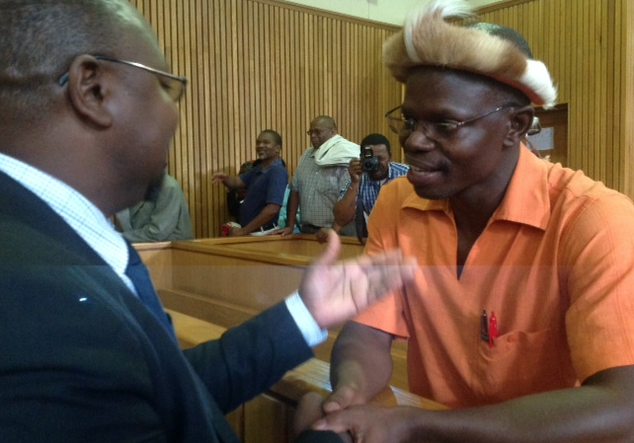
The Mission was also deeply concerned by the emblematic cases of the unfair dismissal of Judge Thomas Masuku in 2011 as well as the unfair trial and subsequent arbitrary detention of journalist Bheki Makhubu and lawyer Thulani Maseko (photo, on the right) in 2014.
The mission noted these developments were the culmination of a longstanding and deep-rooted systemic challenge that has to be adressed.
During its visit, from 11 to 15 May, the Mission met with key stakeholders in the administration of justice in Swaziland, including the Prime Minister and the acting Attorney General, the acting Chief Justice, the suspended Chief Justice and other members of the judiciary, and representatives of the Law Society and leading civil society actors.
The International Fact-Finding Mission will release a report with its observations and recommendations to the Swaziland authorities and the international community, providing concrete advice on strengthening the rule of law in the Kingdom.
Contact:
Arnold Tsunga, Director, ICJ Africa Regional Programme, t: +27 11 024 8268 or +27 73 131 8411: e: arnold.tsunga(a)icj.org,