Feb 13, 2014 | News
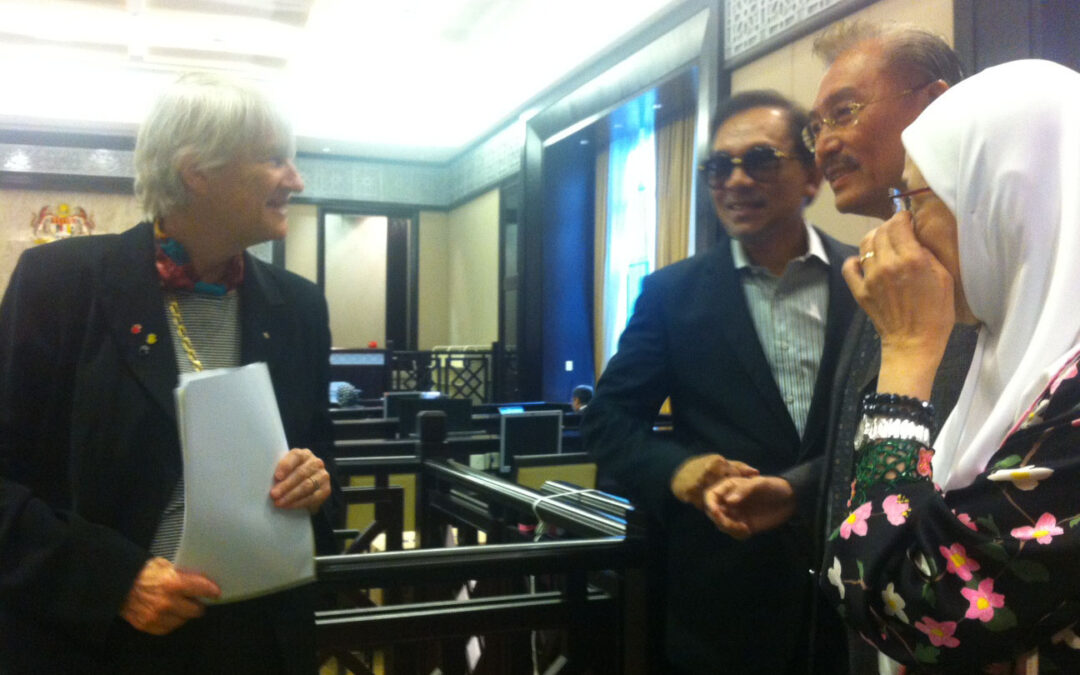
The ICJ continued its observation of the trial of Malaysian opposition leader Anwar Ibrahim on sodomy charges under the colonial-era Section 377B of the Penal Code, which criminalizes consensual same-sex sexual relations.
ICJ Commissioner Justice Elizabeth Evatt AC, the first woman judge to be appointed to an Australian Federal Court and a former member of the United Nations Human Rights Committee, observed a hearing on the appeal of Anwar Ibrahim at the Court of Appeal in Putrajaya yesterday.
“The ICJ will continue to monitor this case and evaluate the fairness of the proceedings in light of relevant international standards,” said Emerlynne Gil, ICJ international legal advisor for Southeast Asia. “The ICJ will also assess whether the prosecution under Section 377 is being used in this case to suppress political dissent, contrary to the right to freedom of expression.”
The hearing is an appeal against the High Court’s decision on 9 January 2012, which acquitted Anwar Ibrahim of sodomy.
“The ICJ has previously condemned Malaysia’s continuing use of colonial-era criminal charges of ‘sodomy’ to cover even consensual sexual relations between adults,” Gil said. “The ICJ believes that Article 377B of the Malaysian Penal Code is inconsistent with respect for the right to privacy under international standards.”
The Court of Appeal heard and eventually dismissed an interlocutory application filed by the lawyers of Anwar Ibrahim seeking to recall for testimony Jude Blacious s/o Pereira, the investigating officer and key witness in the sodomy case.
Pereira was recently found unfit to be a practicing lawyer in another case in a High Court decision of 10 January 2014.
In that decision, the High Court relied on a 2009 Human Rights Commission of Malaysia’s (SUHAKAM) report, which determined Pereira to be an unreliable witness in a public inquiry established to investigate the arrest and detention of 5 legal aid lawyers.
The Court of Appeal dismissed the application on the grounds that Anwar Ibrahim had failed to satisfy the court that additional evidence in the appellate stage was necessary in dispensing justice and that it fell in the category of “most exceptional” cases, particularly as the SUHAKAM report had already been available since 2009.
The Court of Appeal postponed the hearing on the appeal itself to allow Anwar Ibrahim’s lawyers to file a notice of appeal with the Federal Court on the dismissal of the interlocutory order.
Anwar Ibrahim’s counsel immediately filed a notice of appeal to the Federal Court on the dismissed interlocutory application.
The case management for the sodomy appeal has been fixed on 28 February 2014.
The appeal proper was initially scheduled on 17 and 18 September 2013 but has faced continuous delays due to a series of interlocutory matters.

Feb 11, 2014
An ICJ report published today raises concerns at the effect that the recent reform is having on the organization and effective functioning of the legal profession in the country.
The report casts light on a conflict in the legal profession, which has led to apparently arbitrary disciplinary action against a significant number of lawyers.
The report, Ukraine: conflict, disbarments and suspensions in the legal profession, reveals the escalating dispute in the legal profession following the implementation of a new law, signed by the President on 5 July 2012, which significantly changed the organization of the profession and provides for the establishment of a new bar association.
The law, which provided an opportunity to strengthen the independence of the profession, in practice has led to a serious split between rival groups of lawyers and to the abuse of the disciplinary process.
The conflict in the profession came to a head when a number of lawyers were prevented from taking part in the founding Constituent Congress for the establishment of the new bar association, in November 2012.
This led to those lawyers forming a parallel Congress and to the establishment of two rival National Associations of Lawyers.
“The fact that approximately half of the delegates were unable to take part in the main founding Congress of the National Association of Lawyers points to a worrying fracturing and weakness in the institutions and procedures of the profession,” Temur Shakirov, Legal Adviser of the Europe Programme, said today. “More generally, the way in which the reform was implemented has led to instances of abuse of powers within the legal profession, through for example imposing disciplinary sanctions.”
After the conclusion of the Congress, seemingly unwarranted disciplinary action was taken against lawyers who were active in one of the two rival National Bar Associations.
The report finds a consistent pattern in the decisions to initiate such disciplinary proceedings, suggesting reasons other than those related the lawyers’ professional conduct.
These disciplinary proceedings raise serious concerns in regard to possible violations of rights to freedom of association and the right to participate in the governance of the legal profession.
The ICJ noted that the UN Basic Principles on the Role of Lawyers, require the State to ensure that disciplinary sanctions are not unfairly or arbitrarily imposed on lawyers for action taken in accordance with the legitimate exercise of their professional duties, and in accordance with accepted standards of professional conduct.
“We call on the authorities to investigate the conflict in the profession and subsequent disciplinary action,” said Temur Shakirov. “They must ensure that lawyers are able to carry out their duties in an atmosphere free of intimidation, hindrance, harassment or improper interference.”
Contact:
Róisín Pillay, Director, ICJ Europe Programme, roisin.pillay(a)icj.org
Temur Shakirov, Legal Adviser, ICJ Europe Programme, temur.shakirov(a)icj.org
Ukraine – Conflict, Disbarments And Suspensions In The Legal Profession – publications-report-2014-eng (full text in pdf)
Ukraine – Conflict, Disbarments And Suspensions In The Legal Profession – publications-report-2014-ukr (full text in pdf)
Feb 11, 2014 | News
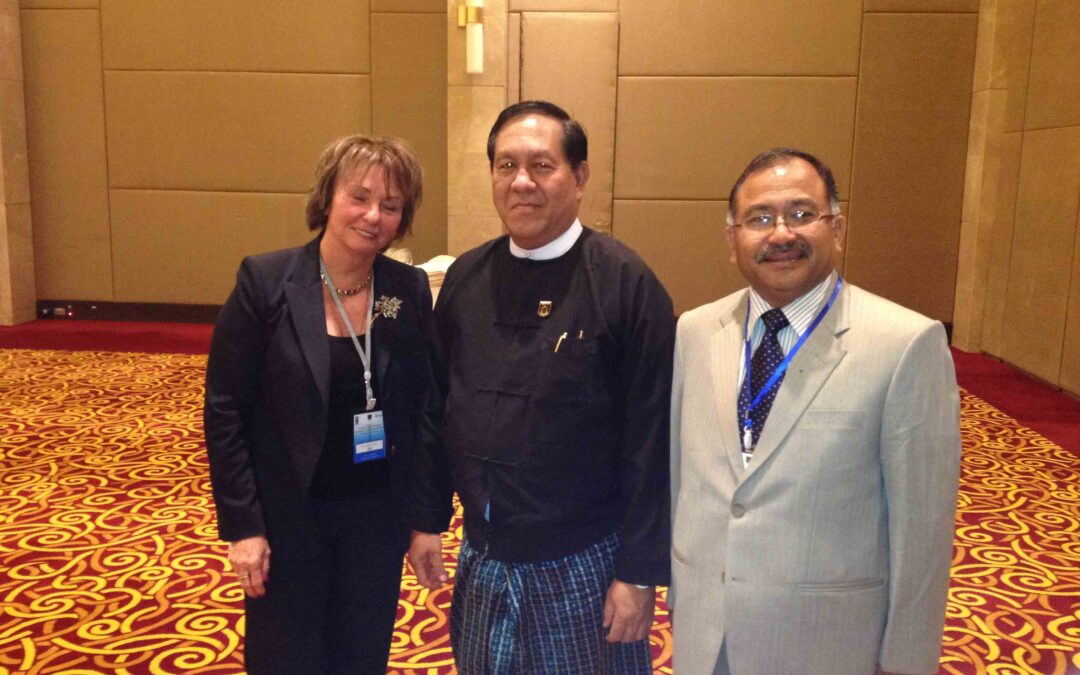
The seminar was on “The Role of Judicial Independence and Integrity in Improving the Effectiveness of the Rule of Law”, with the participation of the ICJ.
The event, hosted by the Office of the Supreme Court of the Union (OSCU) in collaboration with the United Nations Development Programme (UNDP) and the ICJ, took place in Nay Pyi Taw on February 10th and 11th 2014.
It was attended by more than 40 judges and senior court administrators from all states and regions in Myanmar.
Discussions at the seminar focused on the ways in which Myanmar’s judicial system can continue to develop its functional independence and deliver justice for all.
In opening the seminar, the Honourable Chief Justice of the Union, U Htun Htun Oo, remarked that judicial independence and integrity are essential to building a reliable judicial system in which the people of Myanmar can trust, and which can uphold the rule of law.
During the seminar, Justice Kalyan Shrestha of Nepal, and ICJ Vice President Justice Michèle Rivet of Canada shared their experiences of the challenges of preserving judicial independence as a key pillar of a democratic society.
In her opening remarks, Ms. Renata Lok-Dessallien, UN Resident Coordinator, also noted that in addition to the importance of a fair legal framework, a trained judiciary and well-functioning court system, “the other half of the equation is from the bottom up: it is people’s perceptions of the professionalism, integrity and fairness of the system.”
Sam Zarifi, ICJ’s regional director for Asia and the Pacific added that “access to an independent and impartial tribunal is a human right”.
Both UNDP and ICJ expressed their willingness to continue working with Myanmar’s judiciary on the issues of judicial independence, and justice for all for the long-term.
Photo: ICJ Vice President Justice Michèle Rivet, Justice Kalyan Shrestha and Chief Justice U Htun Htun Oo

Feb 11, 2014 | News
The personal decision of Khil Raj Regmi to resign and not return to his post as Chief Justice safeguards the independence of the judiciary and maintains the rule of law in Nepal, the ICJ says.
Caretaker Council of Minister Chairman Khil Raj Regmi announced this afternoon that he would not return to his former post of Chief Justice after acting as the Chairman of the Council of Ministers since March 2013.
“Khil Raj Regmi’s decision is one that will help to preserve the Supreme Court’s hard-earned reputation as an independent institution,” said Ben Schonveld, ICJ’s South Asia Regional Director.
International standards, including the International Covenant on Civil and Political Rights (ICCPR) and the UN Basic Principles on the Independence of the Judiciary, clarify that all governmental officials and institutions as well as judges must respect and preserve the independence and integrity of the judiciary.
The 2007 Interim Constitution of Nepal enshrines guarantees for the independence of the judiciary and contains safeguards for the separation of executive, legislative and judicial powers.
Article 106 of the 2007 Interim Constitution explicitly bans sitting and retired judges from assuming any appointment in government service apart from a role in the national human rights commission.
To enable former Chief Justice Regmi to act as caretaker Prime Minister, the President amended several provisions of the Interim Constitution, including Article 106.
These amendments were made in contravention of the Constitution, which required a two-thirds majority of a sitting Parliament.
“The return of Khil Raj Regmi to the post of Chief Justice would have significantly undermined the appearance of independence of the Supreme Court and the judiciary as a whole,” Schonveld added.
The Bangalore Principles of Judicial Conduct clarify that judges must not only be free from any inappropriate connections with the executive and legislative branches of government but also must appear to a reasonable observer to be free therefrom.
The ICJ applauds the personal decision of Chairman Khil Raj Regmi to resign as Chief Justice.
The ICJ calls on the new Government under the leadership of the Nepali Congress Chairperson, Sushil Koirala as well as the other elected political parties of the Constituent Assembly to honour the commitments made during the election and work to end impunity for gross violations of human rights.
Contact:
Ben Schonveld, ICJ South Asia Director, (Kathmandu); t: 977 9804596661; email: ben.schonveld(a)icj.org
Govinda Bandi Sharma, ICJ Senior Legal Adviser, Nepal (Kathmandu), t: +977 9851061167; email: govinda.sharma(a)icj.org
Sheila Varadan, ICJ Legal Adviser, South Asia Programme (Bangkok), t: +66 857200723; email: sheila.varadan(a)icj.org
Feb 7, 2014 | Artículos, Noticias
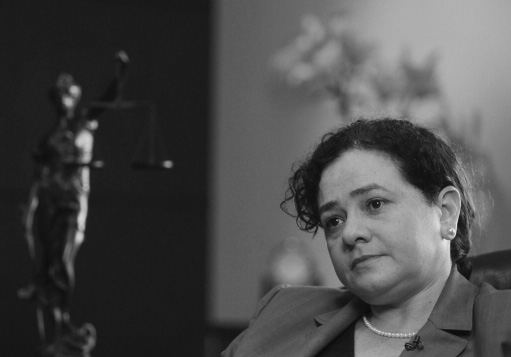
La actual Fiscal General y Jefa del Ministerio Público, Claudia Paz y Paz, fue nombrada el 10 de diciembre de 2010 para dirigir la institución por un período de 4 años, que legalmente vence el 9 de diciembre de 2014.
Su nombramiento ocurrió, hasta dicha fecha, como resultado de la repetición del proceso de selección debido a acusaciones que cuestionaban la honorabilidad e idoneidad de la persona previamente electa.
La actual Fiscal General y Jefa del Ministerio Público se ha constituido por sus resultados de gestión ante el Ministerio Público, como una figura democrática e independiente que ha realizado una importante labor en la protección y defensa de derechos humanos y en el desmantelamiento de estructuras criminales importantes. Esta figura contraviene los intereses de oscuros grupos que buscan interrumpir la continuidad del trabajo de la Fiscal.
Por ello, un abogado, ha puesto en marcha acciones jurídicas promoviendo que la Corte de Constitucionalidad acceda a reducir el período de gestión de la actual Fiscal.
El 05 de febrero del presente año, la Corte de Constitucionalidad emitió una resolución en que concede un amparo provisional y ordena al Congreso de la República convocar a la conformación de un nuevo proceso de elección para cambio de Fiscal General.
De confirmarse este amparo provisional por parte de la Corte de Constitucionalidad, se tendría como resultado que la fiscal sea removida de su cargo y se estaría violentando el Estado de Derecho.
Guatemala-Commuicado en defensa del estado de derecho-news-web story-2014-spa (full text in pdf)
Foto: ICTJ


![Smoke rises after an Israeli air strike on the village of Taybeh in southern Lebanon [Source: Al Jazeera]](https://www.icj.org/wp-content/uploads/2026/03/Screenshot-2026-03-20-at-15.56.24-300x200.png)