Mar 7, 2014 | News
The ICJ expressed concern at today’s arrest of Fakhriddin Zokirov, a prominent defence lawyer who had represented the former Minister of Industry, Zaid Sayidov.
The former Minister was recently convicted for a number of crimes including polygamy, receiving a bribe, rape, fraud, illegal confinement and sentenced to 26 years of imprisonment.
The ICJ is concerned at reports that the arrest of the lawyer may be related to his active and robust defence of the former Minister in court.
Lawyer Zokirov was arrested by the State Finance Control and Anti-Corruption Agency on charges of fraud in banking transactions, which allegedly took place several years ago.
Two other lawyers who defended the former Minister, Shukhrat Kudratov and Iskhok Tabarov, announced at a press conference that they had recently faced various threats and intimidation in connection with the case.
The lawyers reported that the pressure on them had significantly increased in relation to a lawsuit which they brought against the head of the State Finance Control and Anti-Corruption Agency, Fattokh Sayidov.
They alleged that the head of the Agency threatened that if they did not drop the case, they would “share the dock” with their client, the former Minister.
“Abusive prosecutions of lawyers and threats against them in connection with their work are contrary to international standards on the independence of lawyers and undermine the integrity of the justice system”, Róisín Pillay, Director of the Europe Programme, said today. “In the exercise of their profession, lawyers must remain free from intimidation, harassment, fear and arbitrary prosecution and arrest. The ICJ calls on the authorities of Tajikistan to ensure that lawyers’ integrity is protected, and that the criminal justice system is not misused to intimidate them.”
Under the UN Basic Principles on the Role of Lawyers, lawyers must not be identified with their clients’ causes, and must be protected against attacks and intimidation, including prosecutions or administrative or other sanctions for action taken in accordance with their recognized professional duties.
Contacts:
Róisin Pillay, Director, Europe Programme, t + 32 273 48 46, roisin.pillay(a)icj.org
Temur Shakirov, Legal Adviser, Europe Programme, t + 41 22 979 38 32, temur.shakirov(a)icj.org
Tajikistan-arrest of lawyer-news-web story-2014-rus (full text in pdf)
Mar 3, 2014 | News
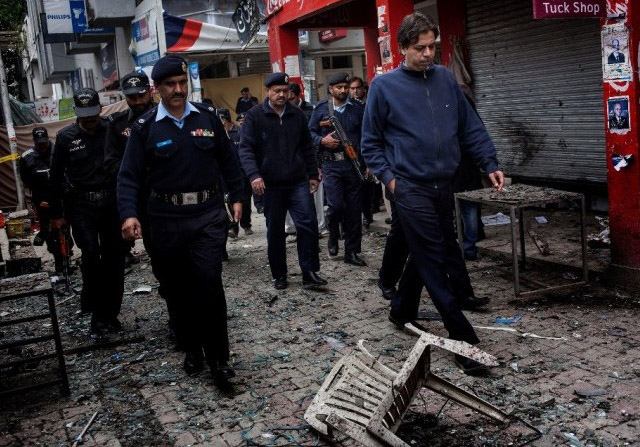
The shooting and bombing at an Islamabad Court today should be condemned as a presumed attack against the judicial officials and the independence of the judiciary in Pakistan, says the ICJ.
The attack resulted in the killing of Additional Sessions Judge Rafaqat Ahmad Khan Awan and at least ten other persons, including several lawyers.
According to reports, armed gunmen forced their way into a court complex in Islamabad, openly firing on judges and lawyers before at least two of the men blew themselves up inside the court complex.
One of the attackers detonated himself outside the door of a judge’s office, while the other targeted the office of the Lawyers’ Union President.
Another gunmen entered Judge Rafaqat Awan’s courtroom, where he shot and killed him.
“An intentional killing of a member of the judiciary can be seen as nothing other than an attack against the independence and impartiality of the judiciary as a whole,” said Sam Zarifi, ICJ Asia Pacific Regional Director.
“In addition to personal tragedy that has befallen the slain victims and their families, this attack and those like it are devastating for the people of Pakistan,” he added. “Courthouses, which should be places where justice is administered, are instead becoming slaughterhouses.”
This is the third armed attack against members of the judiciary in Pakistan in under a year. In March 2013, a judicial compound was attacked in Peshawar, killing four people.
In June 2013, a Sindh High Court judge’s convoy was attacked in Karachi, killing nine people.
As set out in the UN Principles on the Independence of the Judiciary, Pakistan must take steps to protect and ensure the safety of members of the judiciary from threats and violence from any quarter for any reason.
The Beijing Statement of Principles on the Independence of the Judiciary in the LAWASIA region further elaborates that the executive branch must at all times ensure the security and physical protection of judges and their families.
As a State party to the International Covenant on Civil and Political Rights, Pakistan is under a general obligation to ensure the safety of all persons within its territory at all times.
“If judges are under constant fear of violence from insurgent groups, they cannot function as an independent and impartial judiciary – an indispensible requirement for preserving rule of law and democracy,” Zarifi said.
The ICJ calls on the Government of Pakistan to take steps to immediately investigate and bring to justice those persons responsible for the armed attack on the Courthouse.
Contact:
Sam Zarifi, ICJ Asia-Pacific Regional Director, (Bangkok), t:+66(0) 807819002; email: sam.zarifi(a)icj.org
Reema Omer, ICJ Legal Advisor, Pakistan (London), t: +447889565691; email: reema.omer(a)icj.org
Photo credit: MYRA IQBAL

Mar 3, 2014 | Artículos, Noticias
La CIJ lamenta la muerte del Sr. Magistrado de la Corte Suprema de Justicia César Ricardo Crisóstomo Barrientos Pellecer, ocurrida el día de ayer domingo 2 de marzo.
Así mismo, expresa sus más sinceras condolencias a su familia, a sus colegas del Organismo Judicial, gremio de abogados y abogadas y al pueblo de Guatemala en general.
La muerte del magistrado César Barrientos deja un vacío muy grande en el ámbito de la justicia y lucha contra la impunidad en Guatemala, ya que siempre se distinguió como un defensor de la independencia judicial y del Estado de Derecho.

Mar 3, 2014 | News
La CIJ lamenta la muerte del Sr. Magistrado de la Corte Suprema de Justicia César Ricardo Crisóstomo Barrientos Pellecer, ocurrida el día de ayer domingo 2 de marzo.
Así mismo, expresa sus más sinceras condolencias a su familia, a sus colegas del Organismo Judicial, gremio de abogados y abogadas y al pueblo de Guatemala en general.
La muerte del magistrado César Barrientos deja un vacío muy grande en el ámbito de la justicia y lucha contra la impunidad en Guatemala, ya que siempre se distinguió como un defensor de la independencia judicial y del Estado de Derecho.

Feb 21, 2014 | News
The Kuala Lumpur High Court’s decision today to convict prominent Malaysian lawyer Karpal Singh on charges of sedition is inconsistent with international law and standards regarding free expression of opinion by lawyers, the ICJ said.
“This conviction sends a message that lawyers in Malaysia are not free to express their opinions about legal issues,” said Emerlynne Gil, ICJ’s International Legal Adviser on Southeast Asia.
Karpal Singh’s conviction was based on the fact that during a press conference held at his law firm in early 2009 he had spoken allegedly “seditious words” when questioned about whether Sultan Azlan Shah had the legal authority to remove the province’s Chief Minister, Datuk Seri Mohammad Nizar Jamaluddin, from office.
“This case is another sign of the lack of respect of the Malaysian government for the principle of free expression,” said Gil. “Karpal Singh was expressing an opinion in his capacity as a lawyer over a matter of law. He has every right to do that, as a lawyer, and of course as someone exercising his right to free expression of his views. He also has acted in fulfilment of a core function of the legal profession, which is to contribute to the public discourse on matters of law.”
The UN Basic Principles on the Role of Lawyers specifically provide that lawyers, like ordinary citizens, are entitled to freedom of opinion and expression. They have the right “to take part in public discussion of matters concerning the law, the administration of justice and the promotion and protection of human rights” without fear of suffering professional restrictions or repercussions due to their lawful action.
The High Court has fixed 7 March 2014 to hear Karpal’s mitigating circumstances, and for sentencing.
Under section 4(1) of the 1948 Sedition Act, Karpal Singh now faces a fine of up to RM 5,000 (approximately US$1,5010) and/or imprisonment of up to three years.
The conviction may force Karpal Singh to give up his seat as a member of the Malaysian parliament. Under the Federal Constitution, an elected representative is disqualified from office if fined more than RM 2,000 or jailed for a term exceeding one year.
Karpal Singh has provided legal defense in several high profile cases, including that of opposition leader Anwar Ibrahim, whose trial on charges of ‘sodomy’ has drawn heavy criticism in Malaysia and internationally.
Contact:
Emerlynne Gil, ICJ International Legal Adviser for Southeast Asia, t +66 2 619 8477; email: emerlynne.gil(a)icj.org
Craig Knowles, ICJ Media Consultant, t +66 81 9077653; email:craig.knowles(a)icj.org