Dec 15, 2020 | Agendas, Events
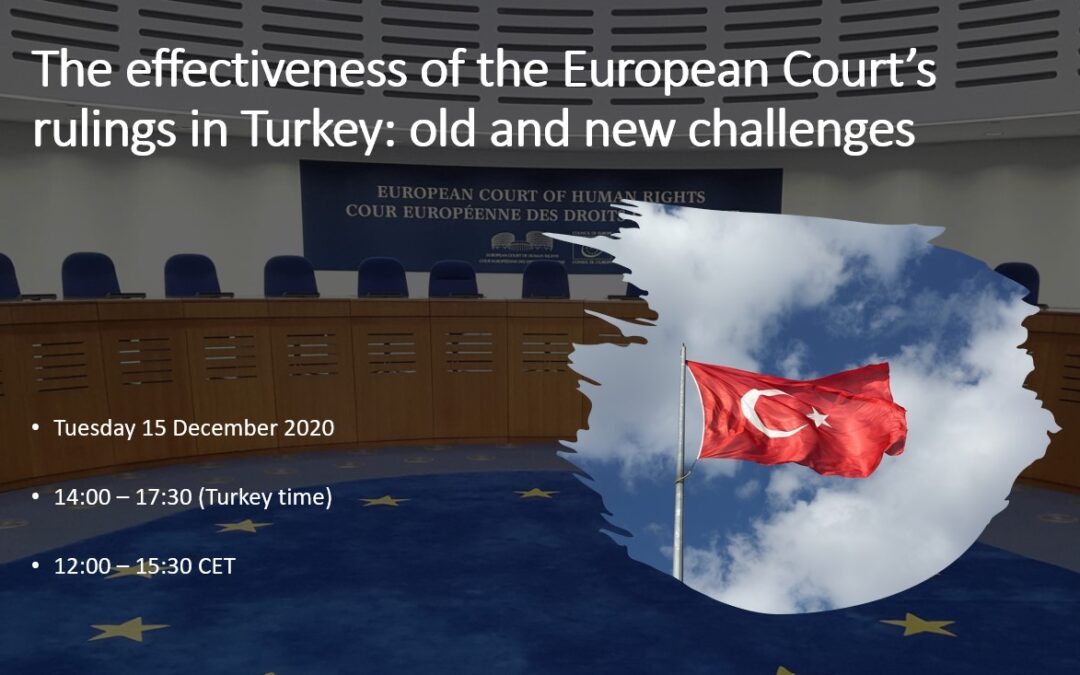
Join ICJ and IHOP in this online conference in which Turkish and international experts will discuss the current challenges in Turkey to promptly and fully implement the judgments of the Court and how to improve the execution of judgments in the Turkish national system.
Turkey is the Council of Europe member state with the third highest number of European Court of Human Rights judgments awaiting execution, after the Russian Federation and Ukraine. As a Party to the European Convention on Human Rights and founding member of the Council of Europe, Turkey has committed to implement all rulings of the Strasbourg Court, yet the results of this commitment are far from clear.
Implementation of the European Court judgments is a key indicator in Europe of a country’s commitment to human rights and the rule of law, and failure to implement judgments fundamentally undermines access to justice for victims of human rights violations by watering down the impact of their litigation before the Court.
Failure to implement judgments through general implementation measures reforming laws, policies and practices, also leads to persistent, repeated violations of the States’ obligations under the European Convention on Human Rights. This problem has existed for many years in Turkey, leaving long-standing systemic human rights problems unsolved. Recently civil society has denounced the Turkish authorities’ attempts to circumvent the general application of certain new key rulings of the European Court.
In this conference, Turkish and international experts will discuss the current challenges in Turkey to promptly and fully implement the judgments of the Court and how to improve the execution of judgments in the Turkish national system:
– Justice Egbert Myjer, Former Judge at the European Court of Human Rights and Commissioner of the ICJ,
– Prof. Philip Leach, Professor of Human Rights Law at Middlesex University
– George Stafford, Director at European Implementation Network
– Emma Sinclair-Webb, Turkey Director, Human Rights Watch
– Kerem Altıparmak, ICJ Legal Consultant
– Ayşe Bingöl Demir, Turkey Human Rights Litigation Support Project Co-Director, Lawyer
– Prof. Başak Çalı, Professor of International Law, Co-Director of the Centre for Fundamental Rights at the Hertie School
The event will be introduced and moderated by Feray Salman, General Coordinator of the Human Rights Joint Platform (IHOP), Roisin Pillay, Director of the ICJ Europe and Central Asia Programme, and Massimo Frigo, Senior Legal Adviser of the ICJ Europe and Central Asia Programme.<
TO REGISTER WRITE TO: ihop@ihop.org.tr
IHOPICJ-ZoomConference-ExecutionECtHRTurkey-Agenda-2020-ENG (download the agenda in English)
IHOPICJ-ZoomConference-ExecutionECtHRTurkey-Agenda-2020-TUR (download the agenda in Turkish)
The event is part of the REACT project: implemented jointly by ICJ and IHOP, this project seeks to support the role of civil society actors in turkey in ensuring effective access to justice for the protection of human rights. This project is funded by the European Union. The views expressed in the event do not necessarily reflect the opinion of the EU.

Dec 14, 2020
The ICJ today joined the Association des Magistrats Tunisiens (AMT), Avocats Sans Frontières (ASF), and the World Organisation Against Torture (OMCT) in publishing a paper entitled No Reconciliation Without Justice: Current Situation and Prospects of the Specialized Criminal Chambers in Tunisia.
The paper analyses the challenges that the Specialized Criminal Chambers are facing since the opening of trials in May 2018 and formulates recommendations to Tunisian authorities to address these obstacles.
The paper was endorsed by members of the Transitional Justice Coalition.
It is available in Arabic and French:
Tunisia-SCC assess-Advocacy-Analysis brief-2020-ARA
Tunisia-SCC assess-Advocacy-Analysis brief-2020-FRA
Dec 11, 2020
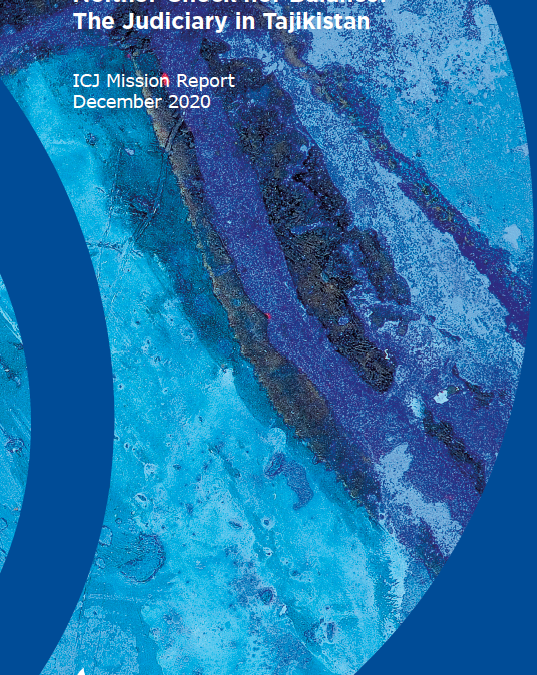
Today, as it publishes its mission report on the country’s judiciary, the ICJ calls on the Government of Tajikistan to adopt comprehensive measures to reform the judiciary, in order to ensure its independence and enable it to effectively protect human rights.
The ICJ report Neither Check nor Balance: the Judiciary in Tajikistan provides a detailed overview of the organization and functioning of the judiciary in administering justice in Tajikistan. Through an analysis of laws and information obtained during a mission to the country the ICJ has identified the weaknesses in the judiciary and made recommendations concerning the institutions and procedures of judicial governance.
“There have been many attempts to reform the justice system in Tajikistan, as we demonstrate in the report, but they have so far failed to result in a judiciary with strong self-governance institutions which are capable of protecting and supporting judges in independently applying the law,” said Temur Shakirov, Senior Legal Adviser of the ICJ Europe and Central Asia Programme.
“Among many other issues, the report points to the problem of an almost complete absence of acquittals in Tajikistan, which can be seen as a litmus paper of the judiciary’s ability to fulfil their role independently.”
The report provides a set of recommendations, in particular, in regard to the governing bodies of the judiciary, the system of appointment of judge, judicial security of tenure, and the disciplinary system for judges, with a view to strengthening the independence and effectiveness of the judiciary.
“There is a conspicuous need for a significant institutional reform to re-design a system of self-regulation that would allow for the independent administration of justice, without a formal or informal check or approval from superiors,” Shakirov added.
Background:
In April and May 2019, ICJ conducted a research mission on the independence of the judiciary in Tajikistan. Following the mission, the ICJ expressed concerns about the independence of individual judges as well as the functioning of judicial institutions and procedures in law and in practice.
Download
Tajikistan-Judiciary-Publications-Reports-Mission report-2020-ENG (full report in English, PDF)
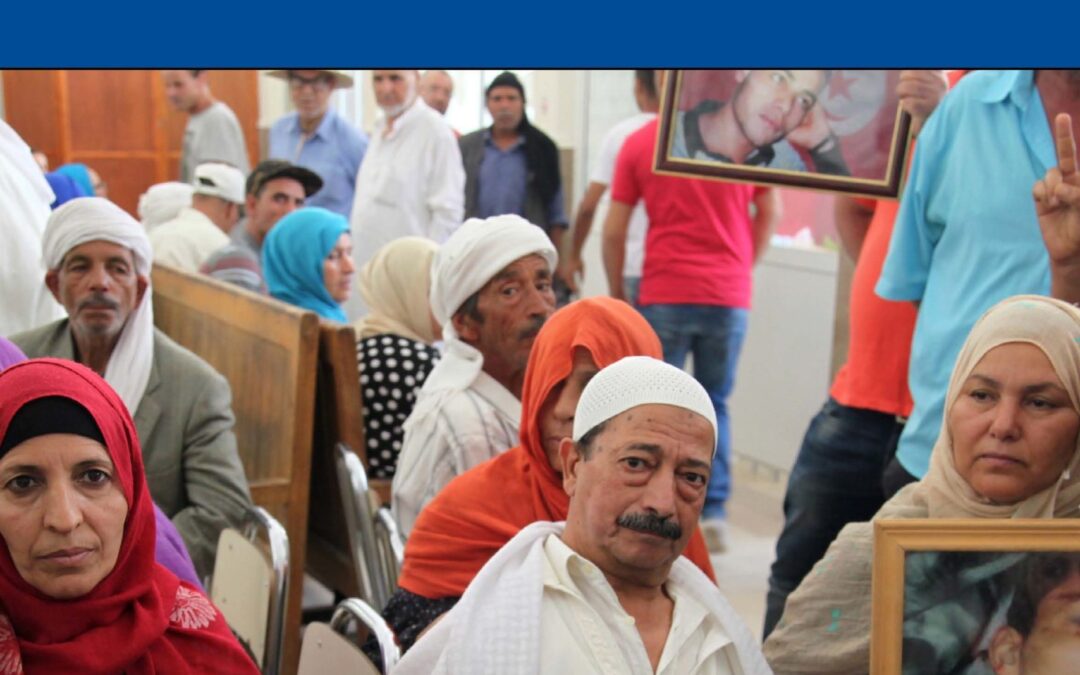
Dec 9, 2020
The ICJ today released two practical guides aimed to assist practitioners to advance accountability and justice through the Specialized Criminal Chambers (SCC) in Tunisia.
Practical Guide 2 addresses the investigation and prosecution of gross human rights violations under Tunisian and international law, while Practical Guide 3 covers the principles and best practices on evidence in the administration of justice. Practical Guide 1, which was released in December 2019, considered the role of international law and standards in proceedings before the SCC.
Trials before the SCC started in May 2018. Since the opening of the first hearing, it has been evident that gaps in the rules and procedures governing the investigation, prosecution and evidence in the SCC cases have served to endanger efforts to hold perpetrators to account and bring justice to victims for past violations of human rights.
“The credibility of SCC trials largely depends on their capacity to ensure effective and fair investigations and prosecutions based on strong, compelling and untainted evidence,” said Said Benarbia, the ICJ’s MENA Programme Director.
“These practical guides should serve to assist those working in the Tunisian justice sector to make the most of this opportunity to end impunity and enable victims to obtain redress, all while ensuring the highest possible fair trial standards.”
Practical Guide 2 sets out the international law and standards governing the obligation to investigate and prosecute gross human rights violations, the accused’s right to a fair trial, and the rights of victims and their families to participate in proceedings and to an effective remedy.
Practical Guide 3 describes the principles and best practices under international law that apply to the collection, admissibility and evaluation of evidence in the investigation and prosecution of gross human rights violations.
Both guides aim to provide options for applying Tunisia’s law and procedures on investigation, prosecution, and evidence in SCC cases in compliance with international law and standards.
“Tunisians have waited so long to see justice for the many human rights abuses that were committed in the past,” said Kate Vigneswaran, the ICJ’s MENA Programme Senior Legal Adviser.
“The SCC holds out the promise that this wait might end, but only if the trials are grounded on solid proceedings that put accountability, human rights and fairness at the forefront.”
Contact
Said Benarbia, Director, ICJ Middle East and North Africa Programme, t: +41-22-979-3817; e: said.benarbia(a)icj.org
Kate Vigneswaran, Senior Legal Adviser, ICJ Middle East and North Africa Programme, t: +31-62-489-4664; e: kate.vigneswaran(a)icj.org
Background information
The SCC were established in 2014 to adjudicate cases involving alleged “gross human rights violations” between 1955 and 2013 referred by the Truth and Dignity Commission (Instance Verité et Dignité, IVD).
At the end of its mandate in December 2018, the IVD’s referred to the SCC 200 cases of arbitrary deprivations of life, arbitrary deprivations of liberty, torture and other ill-treatment, enforced disappearance, rape and sexual assault and crimes against humanity committed by the past regime.
Practical Guides 2 and 3 are preceded by Practical Guide 1 on The Adjudication of Crimes Under Tunisian and International Law, which examines the principles of legality and non-retroactivity under international law and their application in the domestic system, and conducts an analysis of the definition of crimes under Tunisian law vis-à-vis international law for arbitrary deprivations of life, arbitrary deprivations of liberty, torture and other ill-treatment, enforced disappearance, rape and sexual assault and crimes against humanity. The three Guides will also be followed by Practical Guide 4 on modes of liability under Tunisian and international law.
In a briefing paper published in October 2020, the ICJ also called on the Tunisian authorities to undertake substantial legal and policy reforms with a view to strengthening accountability and removing the obstacles that impede the SCC work.
Download
Tunisia-SSC guide series no2-Publications-Reports-Thematic reports-2020-ENG (Guide 2 in English, PDF)
Tunisia-SSC guide series no3-Publications-Reports-Thematic reports-2020-ENG (Guide 3 in English, PDF)
Tunisia-Launch Guides-News-2020-ARA (story in Arabic, PDF)
Tunisia-SSC guide series no2-Publications-Reports-Thematic reports-2020-ARA (Guide 2 in Arabic, PDF)
Tunisia-SSC guide series no3-Publications-Reports-Thematic reports-2020-ARA (Guide 3 in Arabic, PDF)

Nov 20, 2020 | News
The ICJ expressed today its deep concern at the arrest of some 26 lawyers and the investigation of around 100, including lawyers active in the defence of human rights, in South East Turkey.
The arrests and investigations are on charges of “establishing organizations in favour of an illegal organisation”, an offence often used to arrest human rights defenders in Turkey.
Around 26 lawyers were arrested this morning, 20 November, at around 5 a.m. and taken to the Anti-Terror Branch of the Police in Diyarbakır in South East Turkey as part of an investigation against the Democratic Society Congress. The ICJ understands that around 100 lawyers are concerned by this investigation that also concerns the Lawyers Association for Freedom (ÖHD).
“We are concerned that these lawyers have been arrested under vague charges that are often used in Turkey to target human rights defenders ,” said Roisin Pillay, Director of the ICJ Europe and Central Asia Programme,
“Unless law enforcement officers and prosecutors promptly substantiate such charges with adequate evidence, as well as demonstrating valid grounds for their detention, the lawyers must be released immediately.”
The ICJ will follow the case closely to ascertain whether international law and standards are respected in any action against the lawyers concerned.
“Lawyers are often subject to bogus charges in Turkey to curb their work, including in defence of human rights, and the exercise of their freedom of expression,” added Roisin Pillay.
The ICJ stressed that lawyers should never be subject to arrest for the legitimate exercise or defence of human rights or for the exercise of their professional functions. In the event that any of the lawyers arrested on 20 November are subject to charges for cognizable crimes consistent with Turkish and international law, they must be brought promptly before a court to further consider whether specific grounds exist to justify their continued detention. If charged, they must be ensured the right of fair trial by an independent and impartial court.
Background
It is understood from documents shared by unofficial sources that lawyers’ houses in Diyarbakır have been raided as a part of an ongoing investigation conducted against the Democratic Society Congress (“DSC”). DSC was established in 2007 and continued its work at the premises of Diyarbakır municipality in between 2011-2014. Its members included deputies, mayors, and councillors. The Speaker of the Parliament of the time, officially invited the DSC to the meetings of the Constitutional Reconciliation Commission in 2012. However, following the state of emergency declared in July 2016 a criminal investigation against the DSC was initiated. In 2018, the building of the DSC was raided under this investigation and information about the Congress was gathered during that operation. It is understood that the arrests were made based on information obtained in that search. In the search warrant issued by the public prosecutor today, security forces were asked to look for “organisational documents” such as books, journals, articles, newspapers etc. as evidence. From this warrant, it is clear that the operation conducted against lawyers are not related to acts of violence.
The detained lawyers and human rights defenders are: Lawyers Association for Freedom co-chair Av. Bünyamin Şeker, İHD Adıyaman branch head av. Bülent Temel, ÖHD and İHD member lawyers Abdulkadir Güleç, Eshat Aktaç, Serdar Talay, İmran Gökdere, Diyar Çetedir, Serdar Özer, Feride Laçin, Gamze Yalçın, Gevriye Atlı, Resul Tamur, Cemile Turhallı Balsak, Ahmet Kalpak, Devrim Barış Baran, Neşet Girasun, Sedat Aydın, Mahsum Batı, Şivan Cemil Özen and Haknas Sadak, former TTB Central Council Member and still Honorary Board member Dr. Şehmus Gökalp, HRFT Diyarbakır Representation Office employee, Social Service Expert Serkan Delidere, MED Prisoner and Convict Families Association of Legal and Solidarity Associations Federation (TUHAD-FED) executive Diyar Dilek Özer and federation member Leyla Ayaz, DİVES member Süleyman Okur, Bağlar Municipality Council member Panayır Çelik,
Contact:
Roisin Pillay, e: roisin.pillay(a)icj.org
Massimo Frigo, e: massimo.frigo(a)icj.org