Jun 24, 2019 | Advocacy, Non-legal submissions
At the UN, the ICJ today highlighted the rights and duties of judges and prosecutors to exercise their freedoms of expression, assembly and association to defend the rule of law and human rights.
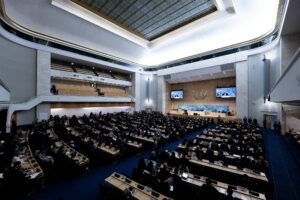
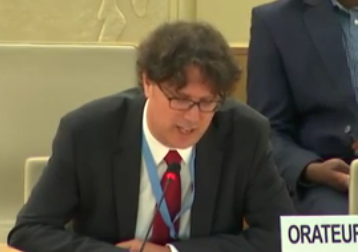
The oral statement was delivered in a Clustered Interactive Dialogue with the Independent Expert on Sexual Orientation and Gender Identity and the Special Rapporteur on the Independence of Judges and Lawyers, at the UN Human Rights Council in Geneva.
It read as follows:
“The International Commission of Jurists (ICJ) welcomes the report of the Special Rapporteur on the Independence of Judges and Lawyers on freedom of expression, association and peaceful assembly of judges and prosecutors.[1]
As the report acknowledges, exercise of these rights can be subject to restrictions arising from the fundamental need for judges and prosecutors to be perceived as independent and impartial. At the same time, as the report also emphasizes, any such restrictions must be provided by law and be demonstrably necessary to such legitimate aims, which in turn crucially requires proportionality.[2] These standards have been recognized both globally and in all regions of the world.[3] Any such restrictions on judges should be adopted and enforced by the judiciary itself.
We particularly welcome the recognition in the report that in situations where democracy and the rule of law are under threat, judges and prosecutors have not only the right, but potentially a duty, to speak out and organize in defence of democracy, the rule of law, and human rights, and that this can include participating in peaceful public demonstrations.[4]
Far too often in the ICJ’s work around the world, we see Executive and Legislative bodies, as well as compromised judicial hierarchies, arbitrarily or selectively targeting judges and prosecutors for removal, demotion or other disciplinary measures, precisely for exercising these rights to defend against threats to the rule of law. Examples highlighted in our submission to your study included Egypt, Morocco, Honduras, Hungary and Bulgaria.[5]
Mr. Rapporteur, how can judiciaries, governments, and civil society organisations (including international or regional legal professional associations) act internationally to support judges and prosecutors who are facing such abuse in another country?
The ICJ also welcomes the reports of the Independent Expert on protection against violence and discrimination based on sexual orientation and gender identity. We urge all States to strongly support the renewal of this essential mandate at the current session.
Thank you.”
[1] ICJ’s detailed submission to the Special Rapporteur’s consultation is available at: https://www.icj.org/judgesexpression2019/
[2] Paragraphs 39, 45, 46, 89.
[3] In addition to the global and European, Asian, and American standards cited in the report, see the African Commission on Human and Peoples’ Rights, Principles and Guidelines on the Right to a Fair Trial and Legal Assistance in Africa (2005), paras A(4)(s) and (t), and F(d) and (e).
[4] Paragraphs 61, 69, 90, 102.
[5] See for further information: https://www.icj.org/judgesexpression2019/
Jun 13, 2019 | News
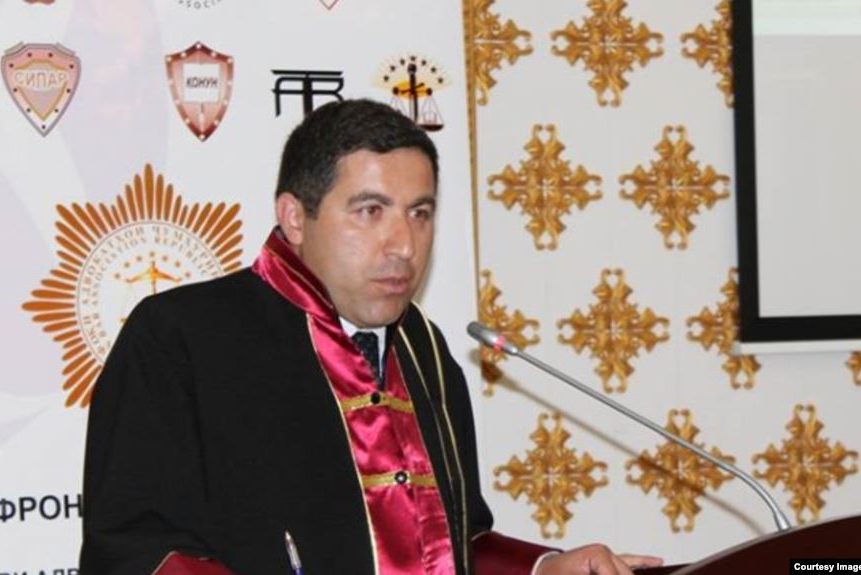
Today, the ICJ called on the authorities in Tajikistan to immediately release a prominent lawyer who is currently serving a sentence of imprisonment of 28 years on dubious charges.
The UN Working Group on Arbitrary Detention (WGAD) published a decision in Mr Yorov’s case on (date), finding that “the trials of Mr. Yorov were carried out in total disregard for the guarantees encapsulated in article 14 of the Covenant, being of such gravity as to give the deprivation of liberty of Mr Yorov an arbitrary character […].”
The Working Group recommended that the government remedy the situation of Yorov without delay and to this end “release Mr. Yorov immediately and accord him an enforceable right to compensation and other reparations, in accordance with international law”.
The ICJ has previously expressed concern that Buzurgmehr Yorov’s conviction may constitute a reprisal for his defense work in high-profile political trials in connection with his representation of thirteen leaders of the Islamic Renaissance Party of Tajikistan (IRPT).
The ICJ earlier expressed concerns at the conviction of the lawyer to a 28 year sentence in prison, which is based on clearly improper charges related to the defense of his clients.
The ICJ welcomes the decision of the WGAD and calls on the Tajikistan authorities to fully implement the decision and to take all necessary measures to protect lawyer Yorov, his family and his lawyers against any threats to their security, or any intimidation, hindrance, harassment or improper interference with their performance of their professional functions as lawyers.
In this regard, the ICJ notes recent protests by dozens of individuals who took part in a rally against Yorov in front of the representative offices of the United Nations and the European Union in Tajikistan, soon after the decision of the WGAD.
Posters of the demonstrators called on the UN High Commissioner of Human Rights to “take her hands off Tajikistan” and named organisations that had defended Mr Yorov or brought the petition on behalf of Yorov to the UN WGAD.
In this context, it is imperative that the Tajikistan government immediately publicly affirm the legitimacy of the decision of the WGAD and make clear its commitment to complying with it, the ICJ underlined.
Background
Buzurgmekhr Yorov was arrested two years ago on 28 September 2015, on charges of “fraud” and “forgery of documents.” Later, he was accused of violating three more articles of the Criminal Code, including in relation to alleged “public calls for extremist activity.”
On 6 October 2016, The Dushanbe City Court sentenced Yorov to 23 years imprisonment in a strict regime prison.
In March 2017, Yorov was sentenced to an additional two years’ deprivation of liberty for “contempt of court and insulting the representative of power.” In August 2017, he received a further three years sentence on charges of “insulting the president.”
The ICJ has, on a number of occasions, expressed its serious concerns over the arrest and conviction of Buzurgmehr Yorov and other lawyers in Tajikistan.
On 24 May 2019, the UN Working Group on Arbitrary Detention, a group of independent experts established in 1991 whose members are appointed by the UN Human Rights Council, published an Opinion finding a number of violations of human rights of Yorov protected under the International Covenant on Civil and Political Rights and recommended as a remedy his immediate release, payment of compensation or other reparation and conducting an investigation into the violation of Yorov’s rights.
The UN Basic Principles on the Role of Lawyers require that the Governments ensure that lawyers “are able to perform all of their professional functions without intimidation, hindrance, harassment or improper interference ”. Under these Principles “where the security of lawyers is threatened as a result of discharging their functions, they shall be adequately safeguarded by the authorities.” The right to “offer and provide professionally qualified legal assistance or other relevant advice and assistance in defending human rights and fundamental freedoms” is guaranteed by the Declaration on the Right and Responsibility of Individuals, Groups and Organs of Society to Promote and Protect Universally Recognized Human Rights and Fundamental Freedoms (Article 9.3(c)).
Jun 3, 2019
Today, the ICJ and IBAHRI filed their submission to the UN Human Rights Committee on the compliance by Tajikistan with its obligations under the International Covenant on Civil and Political Rights.
During its 126th session, from 1 to 26 July 2019, the Human Rights Committee will examine the Republic of Tajikistan’s implementation of the provisions of the International Covenant on Civil and Political Rights, including in light of the State Party’s third periodic report.
In the context of this review, the International Bar Association Human Rights Institute (IBAHRI) and the International Commission of Jurists (ICJ) bring to the Committee’s attention some issues of concern pertaining to Tajikistan’s implementation of the ICCPR. Their submission highlights a number of concerns relating to the lack of independence of the legal profession in Tajikistan, and its consequences for the protection of certain Covenant rights. In particular, the submission addresses:
(a) the legal profession’ lack of independence;
(b) the authorities’ interference with lawyers’ legitimate activities;
(c) restrictions placed on lawyers’ access to their clients and the rights of the defence; as well as
(d) specific cases of concern.
These concerns are relevant for the Committee’s evaluation of the Republic of Tajikistan’s implementation of the right to a fair trial under article 14 ICCPR, as well as other Covenant rights, including for example the State’s obligations under articles 2, 7, 9, and 10 of the ICCPR.
See the submission here: ICCPR report_Tajikistan_IBAHRI_ICJ_2019_eng.

Jun 3, 2019 | Artículos, Noticias
La CIJ rechaza nuevo acto gubernamental, que atenta en contra de la búsqueda de justicia en casos de graves violaciones a los derechos humanos cometidas durante el conflicto armado interno.
En esta ocasión, se trata de afectar el Archivo Histórico de la Policía Nacional (AHPN), que desde el año 2005 se encarga del resguardo, conservación y custodia de los archivos de la extinta Policía Nacional, que fuera una de las instituciones nacionales causantes de graves violaciones a los derechos humanos, durante el conflicto armado interno.
Después de más de una década de contar con el apoyo de la Comunidad Internacional, este archivo se considera una fuente importantísima para conocer la verdad de lo sucedido durante el conflicto armado interno y para lograr aclarar investigaciones y entablar acciones de persecución penal por parte del Ministerio Público y para lograr que los documentos del AHPN estén protegidos; para ello, el Ministerio de Gobernación, firmó con el Ministerio de Cultura de Deportes, el convenio interinstitucional 24-2009, con validez hasta el 30 de junio de 2019.
Sin embargo, el Ministro de Gobernación expresó recientemente, que no renovará el convenio interinstitucional 24-2009, en el cual acordaron conjuntamente con el Ministerio de Cultura de Deportes, la permanencia de los documentos del AHPN en el edificio en el que fueron encontrados, propiedad del MINGOB, por el plazo de 10 años, plazo que vence el 30 de junio de 2019; de esta forma, podría afectar no solo el acceso a la información contenida en el AHPN, argumentando que dicho archivo, contiene información de seguridad nacional, sino que también el resguardo y utilización como prueba importante, de dichos documentos en los juicios respectivos.
Nuevamente, esta posición del Ministro de Gobernación se puede considerar un “fraude de ley”, ya que el acto de no renovar el convenio interinstitucional 24-2009 persigue como resultado un acto prohibido por el ordenamiento jurídico nacional e internacional, como lo es debilitar la lucha contra la impunidad.
La CIJ lamenta que esta nueva posición del Ministro de Gobernación, se una a la de no renovar el mandato de la Comisión Internacional contra la Impunidad (CICIG) y al debilitamiento de la actual Policía Nacional Civil y a la llamada implementación de una “agenda regresiva”, que ha venido impulsando el Congreso de la República.
Ramón Cadena, Director de la CIJ para Centroamérica expresó: “Las decisiones del Ministro de Gobernación en torno al AHPN puede llegar a representar un grave retroceso y denegación de justicia a las víctimas de graves violaciones a los derechos humanos, cometidas durante el conflicto armado interno.
De llegar a implementarse pueden considerarse como un incumplimiento de las obligaciones del Estado de Guatemala en materia de verdad, justicia y medidas de no repetición.”
Cabe recordar que los estándares internacionales resaltan la necesidad de preservar los archivos que contengan información sobre las graves violaciones a los derechos humanos, así como la obligación de poner a disposición del público, dicho archivos.
Así, el Conjunto de Principios actualizado para la protección y la promoción de los derechos humanos mediante la lucha contra la impunidad, establece en su principio 14 que “El derecho a saber implica la necesidad de preservar los archivos.
Se deberán adoptar medidas técnicas y sanciones penales para impedir la sustracción, la destrucción, la disimulación y la falsificación de los archivos, entre otras cosas, con el fin de que queden impunes los autores de violaciones de derechos humanos y/o del derecho humanitario”.
May 29, 2019 | Communiqués de presse, Nouvelles
Un an après le début des travaux des chambres criminelles spécialisées en justice transitionnelle en Tunisie, les organisations de la Coalition pour la justice transitionnelle, dont la CIJ, déplorent aujourd’hui les nombreuses difficultés et contraintes subies par ces chambres, entravant ainsi leur fonctionnement normal et menaçant l’issue des affaires qu’elles traitent.
Les travaux des chambres criminelles spécialisées en justice transitionnelle ont démarré avec l’examen du dossier de M. Kamel Matmati le 29 Mai 2018 au Tribunal de 1ère Instance de Gabès.
Les organisations de la Coalition pour la justice transitionnelle organisent une série d’activités en commémoration de cette importante date dans l’histoire de la Tunisie tant elle est cruciale pour la révélation de la vérité, de la mémoire et de la lutte contre l’impunité.
Elles appellent ainsi les autorités tunisiennes à s’engager pour le suivi et l’application du processus de justice transitionnelle, le renforcement des chambres spécialisées et à leur protection institutionnelle.
Le communiqué a été signé par la CIJ avec d’autres organisations membres de la Coalition pour la justice transitionnelle.
Il peut être téléchargé ici:
Tunisia-CP Chambres Spécialisées-News-Press releases-2019-FRE (version française, PDF)
Tunisia-CP Chambres Spécialisées-News-Press releases-2019-ARA (version arabe, PDF)

![Smoke rises after an Israeli air strike on the village of Taybeh in southern Lebanon [Source: Al Jazeera]](https://www.icj.org/wp-content/uploads/2026/03/Screenshot-2026-03-20-at-15.56.24-300x200.png)