Apr 12, 2019 | News
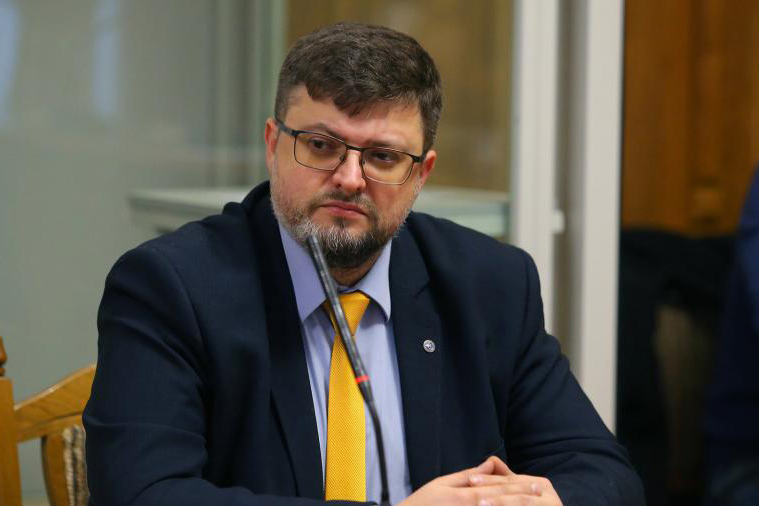
Today, the ICJ expressed concern at the criminal proceedings against Andriy Domanskyi, a lawyer practicing in Ukraine, known for representing individuals facing political prosecution and defending journalists.
The ICJ has called on the Ukrainian authorities to drop any criminal proceedings which may result from the identification of the lawyer with his clients and to ensure that the lawyer’s rights are protected and that he can continue to carry out his professional activity without improper interference, intimidation or threat.
On 5 April Domanskyi was issued a note of suspicion in a criminal proceeding reportedly initiated in 2013 concerning the “privatization of municipal premises”.
Criminal proceedings were initiated one day after the commencement on 4 April of a trial of his client Kirill Vyshynskyi, Chief Editor of RIA Novosti Ukraine recently changed with high treason and a number of other crimes.
Domanskyi considers these criminal proceedings against him are linked with his professional activity and are a means of putting pressure on him as a result of work on this high-profile case.
Earlier this year, on 17 January, while Domanskyi represented Vyshynskyi in a court hearing on the lawfulness of his arrest in Kherson, the lawyer’s home, office premises and his assistant’s relatives’ premises in Kyiv were searched by the officers of the General Prosecutor’s Office.
This took place only a few days after the Security Service of Ukraine (SBU) publicly announced that the investigation regarding Vyshynskyi had been terminated.
While these searches were sanctioned by the court, another search was conducted on the same day and was sanctioned by an investigator rather than the Prosecutor General or his Deputy or the Prosecutor of Kyiv City, as provided by the Law of Ukraine “On advokatura and advocates’ activity”.
The lawyer connected these searches to the fact that at that time he repeatedly filed motions to release Vyshynskyi on bail, with himself acting as a guarantor on the bail.
Any criminal proceedings against the lawyer amounting to harassment or reprisals for his professional activities would be highly problematic.
In recent years, the ICJ has witnessed an alarming increase in the number of cases of interference with the work of lawyers, including use of legal proceedings, threats or physical attacks on lawyers in Ukraine.
As was confirmed during an ICJ mission carried out only last month, searches of lawyers’ premises are often performed without due respect to procedures prescribed by law and result in undermining the independent work of lawyers and respect of procedural rights guarantees under national and international law.
Principle 18 of the UN Basic Principles on the Role of Lawyers states that, “lawyers shall not be identified with their clients or their clients’ causes as a result of discharging their functions.”
As affirmed by the Basic Principles, governments must ensure that lawyers “are able to perform all of their professional functions without intimidation, hindrance, harassment or improper interference” and “shall not suffer, or be threatened with, prosecution or administrative, economic or other sanctions for any action taken in accordance with recognized professional duties, standards and ethics.”
“Investigative and other law enforcement authorities in Ukraine must stop harassment of lawyers, including by improperly associating them with their clients or their clients’ causes, and carrying out searches of lawyers’ offices and documents in violation of national law and procedure as well as international human rights standards,” said Temur Shakirov, ICJ Senior Legal Adviser.
“In this regard, the ICJ stresses that this troubling pattern of attacks affects not only individual lawyers but also the legal professional as a whole. The Ukrainian authorities should take prompt and effective measures to ensure that lawyers are not identified with their clients or their client’s causes and that the safety and independence of lawyers is guaranteed in law and in practice,” he added.
Additional information:
On 4-8 March, the ICJ carried out a research mission to Ukraine on the independence and security of lawyers. Following the mission, the ICJ called on the Ukrainian authorities to take urgent steps to ensure the physical safety of lawyers and to bring to justice those responsible for a series of violent attacks against them.
Ukraine-Domansky statement-Advocacy-2019-UKR (story in Ukrainian, PDF)
Apr 12, 2019 | News
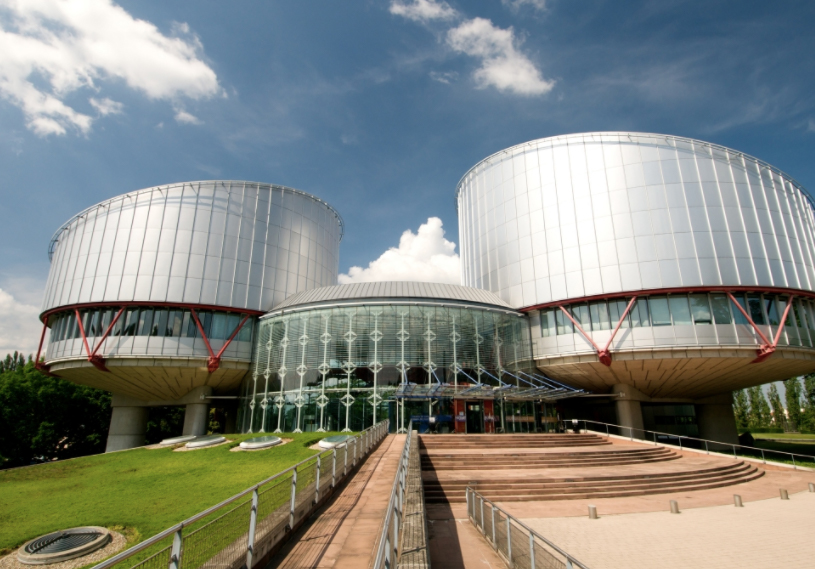
Today in Ankara the ICJ convened a workshop for lawyers and civil society practitioners on the implementation of judgments of the European Court of Human rights.
The 29 participants in the workshop will examine methods and tools available to guarantee the effective execution of the European Court of Human Rights judgments in Turkey.
The participants in the workshop will discuss the use of the Committee of Ministers’ judgment execution process and the potential of “rule 9“submissions, as well as ways to advance the implementation of the judgments oft he European Court of Human Rights in Turkey.
The workshop will share good practices with a view to promoting solutions and opportunities for cooperation in the matter.
This one-day event is organized by ICJ, in cooperation with its partners Kapasite Geliştirme Derneği, Human Rights Joint Platform and European Implementation Network, as part of the EU co-financed project Rebuilding and Ensuring Access to justice with civil society in Turkey.
The project is funded by the European Instrument for Democracy and Human Rights (EIDHR) of the European Union.
Apr 1, 2019 | News
As military courts in Pakistan once again cease to have jurisdiction over civilians for terrorism-related offences, the Government must bring reforms to strengthen the country’s criminal justice system, the ICJ said today.
Perpetrators of terrorist attacks and other serious crime must be brought to justice fair trials before competent, independent and impartial courts as required under international law, the ICJ added.
“The lapse of the jurisdiction of military courts over civilians is a step in the right direction, but unsurprisingly – even four years after military courts were empowered to try civilians – there is no sign of the promised reforms to strengthen the ordinary criminal justice system to effectively and fairly handle terrorism-related cases,” said Frederick Rawski, ICJ’s Asia Director.
The 23rd Amendment and corresponding amendments to the Army Act, 1952, lapsed on 30 March 2019, as their respective two-year sunset clauses expired. So far, the Government has failed to get support from opposition parties for a constitutional amendment to once again extend the jurisdiction of military courts to conduct trials of civilians.
“The Government must not re-enact legislation to continue secret military trials of civilians, nor resort to more short-term, short-sighted security measures that are contrary to Pakistan’s obligations to protect human rights,” Rawski said.
“Instead, the Government should urgently invest in enhancing the capacity and security of judges, investigators and prosecutors to make the regular criminal justice system more effective in conducting fair, credible terrorism trials, and bringing perpetrators to account without imposing the death penalty.”
According to military sources and ICJ’s monitoring of military trials in Pakistan since January 2015, military courts have convicted 617 people for terrorism-related offences, out of which 346 people have been sentenced to death and 271 people have been given prison sentences. At least 56 people have been hanged. Only four people have been acquitted.
The ICJ has documented serious fair trials violations in the operation of military courts, including: denial of the right to counsel of choice; failure to disclose the charges against the accused; denial of a public hearing; failure to give convicts copies of a judgment with evidence and reasons for the verdict; and a very high number of convictions based on “confessions” without adequate safeguards against torture and ill treatment.
Contact
Frederick Rawski, ICJ Asia Pacific Regional Director (Bangkok), e: frederick.rawski(a)icj.org
Reema Omer, ICJ International Legal Adviser for Pakistan (London), t: +447889565691; e: reema.omer(a)icj.org
Additional information
Military courts were first empowered to try civilians for certain terrorism-related offences in January 2015 through the 21st Amendment to the Constitution and amendments to the Pakistan Army Act, 1952, which were in operation for a period of two years.
The expansion of the jurisdiction of military tribunals was a key part of the Government’s 20-point National Action Plan, adopted following the attack on the Army Public School in Peshawar in December 2014. NAP envisioned military courts to be a short-term “solution” to try “terrorists”, to be operational only for a two-year period during which the government would bring about necessary “reforms in criminal courts system to strengthen the anti-terrorism institutions”.
Despite promises that military courts were only temporary, after the expiration of the 21st Amendment, on 31 March 2017, Parliament enacted the 23rd Amendment and amendments to the Army Act to renew military courts’ jurisdiction over civilians. The amendments were given retrospective effect from 7 January 2017, and were due to lapse two years after their date of “commencement”. The expanded jurisdiction of military courts lapsed on 30 March 2019 (even though earlier reports suggested the amendments would expire on 6 January 2019) — two years after the date of “operation” of the 23rd Amendment).
The ICJ opposes the death penalty in all circumstances as a form cruel, inhuman and degrading punishment and an arbitrary denial of the right to life. The ICJ recalls that the UN General Assembly has by overwhelming majorities repeatedly called on all states the retain the death penalty to place a moratorium on the practice with a view to abolition. Pakistan previously had such a moratorium from 2008 to 2014.
Apr 1, 2019 | News
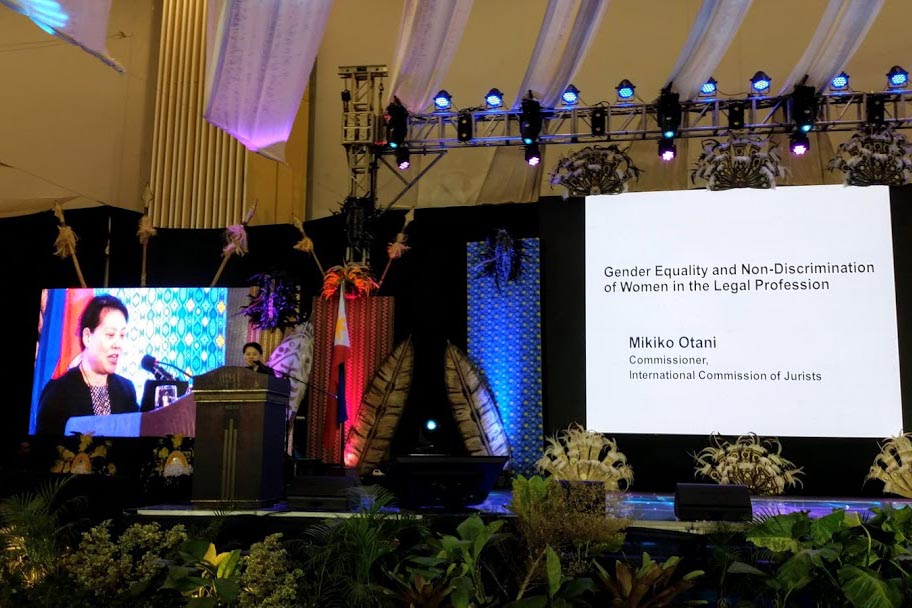
On 31 March, Mikiko Otani, ICJ’s Commissioner and a member of the UN Committee on the Rights of the Child, spoke to Filipino lawyers at the bi-annual National Lawyers’ Conference of the Integrated Bar of the Philippines (IBP), which took place at the Iloilo Convention Center, Iloilo City.
Mikiko Otani, who had been Chair of the Committee on International Human Rights of the Japan Federation of Bar Associations (JFBA) remains active in the JFBA, talked about the importance of advancing gender equality in the legal profession and the important initiatives of the JFBA on eliminating gender discrimination.
She noted that “female lawyers experience many forms of discrimination in the workplaces, practices, court rooms and bar associations.”
In countries all over the world, many formal barriers women used to face in entering the legal profession, including admission to law schools, the bar, have been eliminated.
However, women continue to face barriers, some of which are specific to the legal profession, but others common to women who work more generally.
Mikiko Otani noted that when she started practice as a lawyer in 1990, women applicants for jobs at law firms would often be asked during the interview whether they planned on getting married or having children.
Law firms preferred to hire male lawyers as they were thought to be unencumbered with looking after household matters, such as housekeeping and child care.
She recalled, “My colleagues questioned my decision to get married and have children almost immediately after becoming a lawyer while also continuing my practice as this was an unusual for women lawyers in Japan to do at that time. They felt that my decision to start a family at that point would be a hindrance to my career.”
She also talked about the bias observed in case assignment, where only male lawyers would be assigned to cases that required extensive traveling, while female lawyers would be often assigned to family cases, which are considered to be easy, unpopular or low-profile cases.
There was also frequent bias against female lawyers in promotion or offering partnership in law firms, contributing to a major gender gap in income between male and female lawyers.
In 2008, the JFBA formulated a Basic Plan which included the study of inequalities between male and female lawyers in Japan, finding ways to ensure a work-life balance for women, creating complaint handling bodies, and hosting trainings and educational activities in order to promote gender equality.
Mikiko Otani’s remarks resonated among many female lawyers in the Philippines, who shared in the discussion that followed that they face the same challenges.
“As lawyers, it is our responsibility to assist everyone, including women, in accessing justice,” said Marienne Ibadlit, a member of the Board of Governors of the IBP.
“We cannot be faithful to this responsibility if within our profession, we perpetuate gendered relationships and social inequalities that discriminate against women. A bar association that is committed to gender equality is a prerequisite to a justice system that does not discriminate against women and ensures the full enjoyment of women of their human rights.”
Contact:
Emerlynne Gil, Senior International Legal Adviser for Southeast Asia, t: +662 619 8477 (ext. 206) ; e: emerlynne.gil(a)icj.org

Mar 26, 2019 | News
The ICJ condemns the sentencing of Venezuelan Judge Maria Lourdes Afiuni to a further five years of imprisonment.
On 21 March, a court in Caracas sentenced Judge Afiuni on unfounded charges of “corruption”.
“This further five-year sentence against Judge Afiuni is both the latest in a long series of severe violations of her human rights, and also illustrates the grave extent to which independence of the judiciary in Venezuela has been more broadly undermined,” said Matt Pollard, ICJ Senior Legal Adviser and UN Representative.
Judge Afiuni was arbitrarily arrested and detained in 2009 after then-President Hugo Chavez publicly demanded she be imprisoned for 30 years, as she had released an accused person citing a decision by the UN Working Group on Arbitrary Detention that his detention was unlawful.
While in detention, she was subjected to torture and other ill-treatment.
In 2010, the UN Working Group on Arbitrary Detention issued an opinion declaring Judge Afiuni Mora’s detention arbitrary.
She was held in prison for 14 months before being transferred to house arrest for health reasons in 2011.
In 2013 she was granted parole but ordered not to leave the country or to use social media.
The UN Special Rapporteur on the Independence of Judges and Lawyers reacted earlier today to the latest sentencing by reaffirming the arbitrariness of her deprivation of liberty and the fact that her treatment amounts to reprisals for having implemented the UN Working Group’s decision.
The Rapporteur also said that the ruling “underscored his serious concerns about the independence of the judiciary in Venezuela, the impartiality of judges and prosecutors and the pressures they faced in handling politically sensitive cases.”
Further background on the situation for the judiciary in Venezuela, and Judge Afiuni’s case, is available here.

![Smoke rises after an Israeli air strike on the village of Taybeh in southern Lebanon [Source: Al Jazeera]](https://www.icj.org/wp-content/uploads/2026/03/Screenshot-2026-03-20-at-15.56.24-300x200.png)