Aug 28, 2017 | Comunicados de prensa, Noticias
La CIJ dice que la declaración de Iván Velásquez como persona no grata es un fraude de ley y sin efecto legal.
La CIJ a la comunidad nacional e internacional expresa:
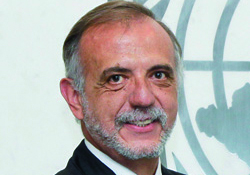
- Que la decisión del Presidente Morales de declarar “non grato” y de expulsar del país a Comisionado Iván Velásquez (foto), es nula “de pleno derecho” y no nació a la vida jurídica por las siguientes razones:
- Fue emitida de “mala fe” por el Presidente Morales, ya que el verdadero objetivo de la misma es obstruir a la justicia y proteger a él y a su familia; en tal sentido viola la Convención de Viena sobre el Derecho de los Tratados (artículo 26), ratificada por el Estado de Guatemala;
- Por tal razón, se trata de un acto contrario al Derecho internacional de los Derechos Humanos, que también viola el artículo 149 de la Constitución Política de la República de Guatemala;
- Nuevamente se configura el “fraude de ley“, de conformidad con el artículo 4. segundo párrafo, de la Ley del Organismo Judicial (Dto. 2-89 del Congreso de la República), ya que de conformidad con dicho artículo “los actos realizados al amparo del texto de una norma, que persigan un resultado prohibido por el ordenamiento jurídico, o contrario a él, se consideran ejecutadas en fraude de ley y no impedirán la debida aplicación de la norma que se hubiere tratado de eludir”;
- El Presidente Morales resolvió declarar non grato al Comisionado Velásquez para obstruir la justicia y provocar más impunidad; es importante recordar que la lucha contra la impunidad constituye una norma imperativa delDerecho internacional, de carácter obligatorio y que no admite derogación alguna;
- El acto unilateral del Presidente Morales atenta contra la Independencia Judicial. En menos de dos meses, es la segunda vez que el Presidente Morales comete este tipo de hecho antijurídico, ya que con anterioridad, trató de influir ilegalmente en los magistrados de la Corte Suprema de Justicia;
- Según el artículo 4. primer párrafo de la Ley del Organismo Judicial citada, “los actos contrarios a las normas imperativas y a las prohibitivas expresas, son nulos de pleno derecho”.
- Por todo ello, la CIJ pide al Ministerio Público abrir un expediente en contra del Presidente Morales y hacer todo lo que esté a su alcance, para que se deduzcan las responsabilidades penales y civiles a que da lugar, la conducta ilegal del Presidente de la República.
- La CIJ apoya y valora altamente la gestión del Comisionado de la CICIG Iván Velásquez
Ramón Cadena, Director de la CIJ para Centroamérica expresó:
“La decisión del Presidente Jimmy Morales es inaceptable y su actitud de no cumplir con la resolución que otorga amparo provisional de la Corte de Constitucionalidad debe ser acatada por él en forma inmediata. De lo contrario, estará incurriendo en otro delito.”
Aug 22, 2017 | News, Publications, Reports, Thematic reports, Video clips
The institutional political crisis in Venezuela has brought the rule of law to near collapse and severely obstructed accountability for those responsible for gross human rights violations, the ICJ concluded in a report released today.
The ICJ’s report Achieving Justice for Gross Human Rights Violations in Venezuela found that the authorities led by President Nicolás Maduro have undertaken a sustained campaign to take control of the Supreme Court of Justice and, with the Supreme Court’s support, suspend the constitutional powers of the former National Assembly and subvert efforts to hold the executive to account within a rule of law framework.
“Rule of law in Venezuela has been replaced by rule of arbitrary executive power,” said Alex Conte, ICJ’s Global Accountability coordinator.
“The Constitution is disregarded, the judiciary cannot exercise its independent function, and the separation of powers is non-existent,” he added.
The ICJ’s report concludes that the human rights situation in Venezuela has deteriorated rapidly in recent years, particularly since 2014.
Extrajudicial and arbitrary executions, the practices of torture and ill-treatment, arbitrary detention, the trial of civilians by military courts and the criminalization and prosecution of political and social dissent have only increased.
“The political context of extreme polarization and the breakdown of the rule of law, along with the judiciary’s lack of independence, have severely obstructed accountability for those responsible for gross human rights violations,” said Conte.
“Victims and their families are left without justice.”
This situation has been further exacerbated by the recent dismissal of Venezuela’s Attorney General, described by the ICJ as a politically motivated act that violates international standards and removes one of the last institutional checks on executive authority and destroys one of the few glimmers of hope for an end to impunity for human rights violations.
Also troubling is the establishment by the new Consituent National Assembly of a ‘Truth Commission’, which the ICJ fears will be a politically manipulated instrument aimed at entrenching impunity for the executive and, when combined with President Maduro’s declaration that legal immunity will be stripped from National Assembly members that have opposed him, a tool to silence Government opposition, rather than to help discharge Venezuela’s duty to promptly, independently and effectively investigate allegations of gross human rights violations.
“Venezuela’s situation of entrenched impunity cannot be resolved without the establishment of an independent judicial authority that can address human rights violations, deter further violations and help bring back the rule of law,” Conte added.
Contact:
Alex Conte, ICJ Global Redress and Accountability Initiative, t: +41 79 957 27 33; e: alex.conte(a)icj.org
Federico Andreu Guzman, ICJ Senior Legal Adviser, Americas, e: Federico.andreu(a)icj.org
Venezuela-GRA Baseline Study-Publications-Reports-Thematic reports-2017-ENG (full report, PDF)
Read also:
ICJ Position Paper on the Dismissal of the Attorney General of Venezuela (August 2017)
ICJ Report, Venezuela: The Sunset of the Rule of Law (October 2015)
ICJ Report, Strengthening the Rule of Law in Venezuela (November 2014)
Aug 22, 2017
La crisis política institucional en Venezuela ha llevado al colapso Estado de Derecho y ha obstaculizado gravemente la rendición de cuenta de los responsables de graves violaciones a los derechos humanos, concluyó la CIJ en un informe publicado hoy.
El informe de la CIJ Lograr justicia por graves violaciones a los derechos humanos en Venezuela constató que el gobierno de Presidente Nicolás Maduro han emprendido una sostenida campaña para tomar el control del Tribunal Supremo de Justicia, suspender, con el apoyo del máximo órgano de justicia, los poderes constitucionales de la anterior Asamblea Nacional, arrogarse amplísimos poderes y subvertir el Estado de Derecho.
“El Estado de Derecho en Venezuela ha sido reemplazado por el ejercicio arbitrario del poder por el Ejecutivo,” dijo Alex Conte, coordinador de la Iniciativa Global de la CIJ sobre Reparación y Rendición de Cuentas.
“La Constitución no es respetada, el Poder Judicial no es independiente y la separación de poderes es inexistente,” agregó Conte.
El informe del CIJ concluye que la situación de los derechos humanos en Venezuela se ha deteriorado rápidamente en los últimos años, especialmente desde 2014.
Las ejecuciones extrajudiciales y arbitrarias, la práctica de la tortura y malos tratos, las detenciones arbitrarias y el juzgamiento de civiles por tribunales militares, así como la criminalización y persecución de toda forma de disidencia política y social se han incrementado vertiginosamente.
“El contexto político de extrema polarización y la ruptura del Estado de Derecho, así como la falta de independencia del Poder Judicial, han obstaculizado gravemente la rendición de cuenta de los responsables de graves violaciones a los derechos humanos. Las víctimas y sus familias han visto denegado su derecho a la justicia,” dijo Conte.
Esta situación ha sido exacerbada por la reciente destitución de la Fiscal General de la República, calificada por la CIJ como un acto políticamente motivado, violatoria de los estándares internacionales, y que elimina uno de los últimos controles institucionales del Poder Ejecutivo y destruye uno de los pocos destellos de esperanza para una poner fin a la impunidad por las violaciones a los derechos humanos.
La CIJ considera que la creación de una “Comisión de la Verdad” por la Asamblea Nacional Constituyente es preocupante, toda vez que existen grandes temores de que sea un instrumento manipulado políticamente para afianzar la impunidad del Ejecutivo y para silenciar a la oposición, en lugar de cumplir con el deber del Estado de investigar pronta y efectivamente las denuncias de graves violaciones a los derechos humanos.
“La arraigada situación de impunidad en Venezuela no puede ser superada sin el establecimiento de un Poder Judicial independiente que pueda abordar las violaciones a los derechos humanos, disuadir de futuras violaciones y ayudar restablecer el Estado de Derecho,” agregó Conte.
Contacto:
Alex Conte, Coordinador de la Iniciativa Global de la CIJ sobre Reparación y Rendición de Cuentas, t: +41 79 957 27 33, C.E.:alex.conte(a)icj.org
Federico Andreu Guzmán, Representante de la CIJ para Suramérica, C.E.: federico.andreu(a)icj.org
Venezuela-GRABaseline Study-Publications-Reports-Thematic reports-2017-SPA (informe en PDF)
Aug 16, 2017
The dismissal of Luisa Ortega was a politically motivated act that violates international standards, removes one of the last remaining institutional checks on executive authority and further entrenches impunity for gross human rights violations in the country, the ICJ says in a Briefing Paper.
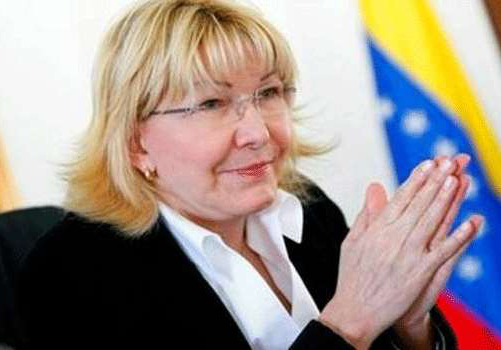
The dismissal of the Attorney General Dr Luisa Ortega Díaz (photo) was undertaken by a body not competent or empowered by Venezuelan law to do so, nor in observance of the established procedure and grounds defined in the law, the ICJ concluded in the Briefing Paper.
The dismissal also violated international standards regarding the independence of prosecutors.
“The dismissal of Attorney General Ortega Díaz appears to have been a measure taken in retaliation to her increasing challenges to Government initiatives and its expanded control over the legislature and judiciary, as well as her demands for accountability for gross human rights violations in the country,” said Alex Conte, ICJ’s Global Accountability coordinator.
“Her dismissal removes one of the last institutional checks on executive authority and destroys one of the few glimmers of hope for an end to impunity for gross human rights violations in the country,” Conte addedd.
“She must be reinstated and the independence of the Office of Public Prosecutions respected.”
Under Venezuela’s Organic Law of the Office of Public Prosecutions, which remains in force, removal of the Attorney General can only be on account of ‘serious misconduct’ (as defined by the law) and as a result of an absolute majority vote in the National Assembly, after confirmation by the Supreme Court of Justice.
“The purported grounds of misconduct by the Attorney General fall well short of the prescribed definition of serious misconduct under the Organic Law,” Conte said.
Ortega Díaz has at least in recent times been an outspoken critic of the Government led by President Nicolás Maduro.
She has been replaced by Tareck William Saab, a close political ally of President Maduro.
She has initiated several investigations and brought charges against State officials for the death of persons killed during public demonstrations; challenged decisions of the Supreme Court of Justice suspending the constitutional powers of the former National Assembly; challenged the appointment and conduct of Supreme Court judges; and challenged the convening of elections for the new Constituent National Assembly.
Since she began to criticize Government initiatives and take legal action to re-establish the rule of law, the Attorney General and her family have been the targets of multiple attacks, threats, harassment and campaigns of denigration and stigmatization by Government officials.
“This is not a question of the Attorney General’s politics but, rather, a significant assault on the effective administration of justice in Venezuela at a time when the rule of law is near collapse,” Conte added.
Contact:
Alex Conte, ICJ Global Redress and Accountability Initiative, t: +41 79 957 2733; email: alex.conte(a)icj.org
Federico Andreu Guzman, ICJ Senior Legal Adviser, Americas, email: Federico.andreu(a)icj.org
Venezuela-AG dismissal-Advocacy-Analysis Brief-2017-ENG (briefing paper in PDF)
Jul 25, 2017 | News
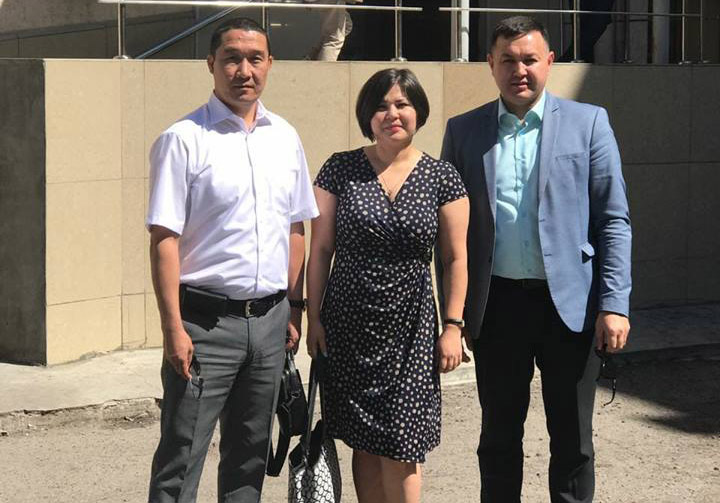
Today the ICJ expressed concern about the real threat of criminal prosecution against lawyers Yerlan Gazimzhanov, Amanzhol Mukhamedyarov and Assel Tokayeva (photo) in Kazakhstan.
The ICJ said the action against lawyers was aimed at their discharging of their professional functions on behalf of clients, and not for any genuine criminal misconduct.
The ICJ called on the responsible authorities of Kazakhstan to discontinue the proceedings against the lawyers, which are contrary to international law and standards on the role of lawyers and the rule of law in the administration of justice.
On 22 June, in a court hearing in the criminal case, judge Ubasheva issued interim rulings against the lawyers seeking their prosecution for a number of acts, which on their face do not consist of criminal misconduct. The conduct for which prosecution is sought includes lodging a complaint alleging unethical conduct by the judge with the Commission on Judicial Ethics and Judicial Jury of the Supreme Court of the Republic; filing a motion for recusal of the judge; stating that the crime for which their clients had been accused had in fact been committed by another defendant; and participating in an international conference, rather than attending a court hearing to defend clients.
The various legal procedures used by the lawyers, including their complaint against the judge and the request for the judge’s recusal, are not prohibited by law. On the contrary, acts such as filing motions for recusal, lodging ethics complaints through officially prescribed channels, and performing standard criminal defence functions they constitute regular procedures prescribed in legislation Kazakhstan. They are also fundamental pursuant to the proper administration of justice under the rule of law.
The interim rulings of the court did not provide an analysis of the legal provisions allegedly violated by the lawyers. Certain of the lawyers were said by the court to have “demonstrated superiority over other actors in criminal proceedings.” It was also alleged that the information posted on a Facebook page about the proceedings in which one of the lawyers took part was false. However, the ruling failed to cite any specific details or conduct of the lawyers which would support these conclusions.
Regarding the charge that two of the lawyers had chosen to participate in an international conference rather than appear at the court hearing, this at most would fall under disciplinary procedures governing the conduct of members of the bar, and not the criminal law. The ICJ notes these charges should normally be made to competent disciplinary body, the Collegium of Lawyers, and not the Ministry of Justice through the request of the judge.
In addition to the criminal prosecution, judge Ubasheva asked the Ministry of Justice to take measures against the lawyers for a breach of professional ethics, causing unjustified delays in criminal trial, and contempt of court, and asked the Ministry of Interior to undertake an inquiry to determine whether the conduct of the lawyers constituted an offence punishable under Article 407 of the Criminal Code of Kazakhstan (obstruction of justice).
On 20-21 July 2017, the Criminal Chamber of Appeals examined the lawyers’ appeals against the conviction and interim appeals against the interim rulings.
The appeal proceedings before the Astana City Court were attended by Gulnora Ishankhanova, ICJ Commissioner acting as an ICJ observer.
Kazhakstan-Trial observation 3 lawyers-News-web story-2017-RUS (story in Russian, PDF)

![Smoke rises after an Israeli air strike on the village of Taybeh in southern Lebanon [Source: Al Jazeera]](https://www.icj.org/wp-content/uploads/2026/03/Screenshot-2026-03-20-at-15.56.24-300x200.png)