Oct 3, 2019 | News
Today, ICJ and the Defender Center for Human Rights (DCHR) filed a submission to the Human Rights Council’s Working Group on the Universal Periodic Review in advance of its review of Libya’s human rights record in May 2020.
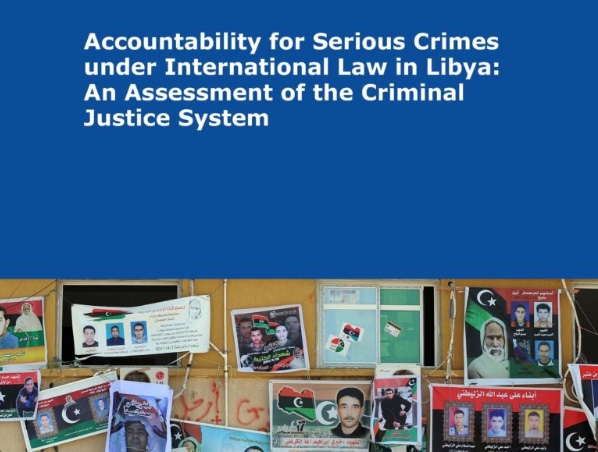
Information provided in the submission was based on the ICJ report titled Accountability for Serious Crimes under International Law in Libya: an Assessment of the Criminal Justice System, published in July 2019.
In the submission, the ICJ and DCHR drew the attention of the Working Group on the UPR to the following concerns with respect to Libya:
- Impunity for crimes under international law committed by State and non-State actors;
- The insufficient penalization of crimes under international law;
- The lack or inadequacy of investigations and prosecutions of crimes under international law;
- The systemic failure to guarantee the right to liberty and fair trial rights at pre-trial and trial stages.
The ICJ and DCHR called on the Working Group and the Human Rights Council to urge the Libyan authorities to take the following actions:
With regard to insufficient penalization of crimes under international law:
- Enact laws criminalizing war crimes, crimes against humanity and arbitrary deprivations of life (in particular arbitrary and summary executions) in line with international law;
- Amend Law No. 10 of 2013 to bring the definition of torture in line with the Convention Against Torture and the definition of enforced disappearance in line with the International Convention for the Protection of All Persons from Enforced Disappearance, and criminalize other acts of cruel, inhuman or degrading treatment or punishment consistent with international law;
- Amend article 425 of the Penal Code to include a definition of the crime of slavery consistent with international law;
- Amend articles 407 and 408 of the Penal Code to criminalize rape in line with international law and standards; enact laws criminalizing all forms of sexual and gender-based violence; and repeal article 424 of the Penal Code which extinguishes a conviction for rape or indecent assault and grants a stay of execution of the penalty imposed against the perpetrator if they marry the victim; and
- Amend (or repeal) Law No. 35 of 2012, Law No. 38 of 2012 and Law No. 6 of 2015 to exclude all crimes under international law from the scope of amnesties.
With regard to the obligation to independently and impartially investigate crimes:
- Amend article 3 of the Code of Criminal Procedure (CCP) to remove the requirement that an investigation can only be commenced upon the receipt of a criminal complaint, extend the three-month deadline for victims to file a complaint and remove the deadline entirely for crimes under international law and for other serious crimes under domestic law;
- Amend article 7 of the CCP to grant victims’ family members the right to file a complaint with a view to ensuring the commencement of an investigation;
- Repeal article 224 of the Penal Code to remove the power of the Minister of Justice to control and direct investigations and prosecutions by the Prosecutor’s Office; and
- Repeal Decree 388 of 2011 granting the “Supreme Security Committee” investigative powers and article 2 of Law No. 38 of 2012 permitting the use of information and evidence collected by “revolutionaries” during investigations and at trial.
With regard to the systemic failure to guarantee the right to liberty and fair trial rights at pre-trial and trial stages, amend the CCP in order to:
- Exclude the possibility of detaining an accused on the sole ground that she or he does not have a fixed place of residence;
- Set a maximum duration of pre-trial detention, and specify that any such detention should be employed as last resort only when necessary, proportionate and reasonable according to the circumstances of the case;
- Ensure that detainees are brought before an independent and impartial judicial authority promptly following arrest, and no later than 48 hours in any event;
- Include a provision recognizing the right to habeas corpus, and the right to compensation and other reparations for unlawful detention;
- Provide for the right to legal counsel from the moment of arrest in all circumstances, and repeal the provision requiring a lawyer to seek authorization from the investigating judge to speak during the interrogation of the accused;
- Require the disclosure of all evidence to the accused and allow them to make copies of the case file before a case is referred to court for prosecution; and
- Grant individuals the right to appeal any conviction and sentence on alleged errors of law and fact and to reconsideration of a conviction upon discovery of a new fact.
Download
Libya-UNHCR submission final-advocay-non legal submission-2019-ENG (submission in PDF)
Oct 2, 2019 | News
This support comes as the ICJ documents failure of criminal justice system on human rights accountability with its report Accountability for Serious Crimes under International Law in Libya: An Assessment of the Criminal Justice System.
At today’s launch of the publication, the UN Support Mission in Libya (UNSMIL), the Delegation of the European Union to Libya (EUDEL) and the European Union Border Assistance Mission (EUBAM) supported calls for the establishment of a UN Commission of Inquiry for Libya.
The ICJ’s report examines the criminal justice framework in Libya and finds that investigations and prosecutions of crimes under international law have been limited to a handful of cases, and that future cases are unlikely meet international standards necessary to ensure fair and effective justice, in particular the rights to liberty and a fair trial and the prohibition on torture and ill-treatment.
The support by international actors echoes the ICJ’s call for the establishment of a Commission of Inquiry or similar mechanism to monitor, document and report on human rights violations in order to identify perpetrators, and gather and preserve evidence for future prosecutions, either national or international.
UNSMIL, the EU and a number of States expressed their support for the establishment of a Commission of Inquiry or similar mechanism at the 42nd session of the Human Rights Council.
The ICJ also advocated for such a mechanism in its statement to the Council on 25 September.
At the launch, ICJ Senior Legal Adviser Kate Vigneswaran said that “it’s time for States to stop working on the premise that the Libyan criminal justice system can effectively ensure accountability for crimes committed by State and non-State Actors and instead look at options for ensuring they don’t go unpunished.”
The ICJ’s report also calls on States and UN actors to ensure they adopt human rights-compliant terms in their engagement with Libya and to refrain from entering into or implementing agreements with Libyan authorities that could give rise to support for or complicity in violations of international law.
Kate Vigneswaran stated: “Human rights and accountability should underpin any agreements and engagement with Libyan actors entered into by States, rather than being sidelined in the interests of a political solution. Time has shown that the absence of human rights at the forefront of dialogue and engagement with stakeholders has failed to ensure the cessation of egregious human rights violations and abuses being perpetrated throughout the country.”
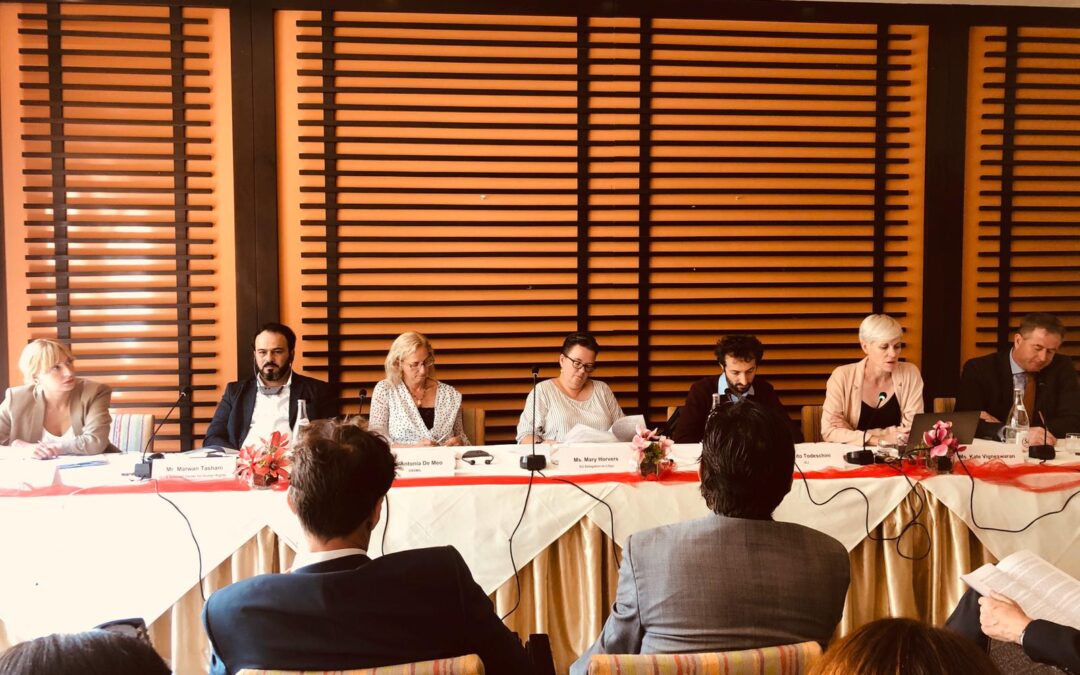
The launch, which was held in partnership with the Embassy of the Netherlands in Libya, was opened by the Netherlands’ Ambassador, H. E. Mr. Lars Tummers.
Kate Vigneswaran discussed the key findings and recommendations contained in the report. A panel comprised of ICJ Commissioner Marwan Tashani and representatives of EUDEL, EUBAM and UNSMIL responded to the report and provided insights into their work in Libya.
Sep 30, 2019 | Advocacy, Non-legal submissions
The ICJ has made a submission to the UN Human Rights Committee in advance of its forthcoming examination of Pakistan’s follow-up report under International Covenant on Civil and Political Rights (ICCPR).
In its submission, the ICJ has brought to the Committee’s attention concerns in relation to the following issues:
- Shortcomings in the legal framework relevant to enforced disappearances;
- The continuing practice of enforced disappearances and, in this context, the ongoing impunity of law enforcement and security agencies;
- The promulgation of the Actions (in aid of civil power) Ordinance, 2019; and
- The ineffectiveness of the Commission of Inquiry on Enforced Disappearances.
The Human Rights Committee will examine Pakistan’s follow-up report during its 127th session, which will be held in Geneva from 14 October to 9 November 2019.
The UN Human Rights Committee issued its Concluding Observations in August 2017, following its review in July 2017 of Pakistan’s first periodic report. Among its many recommendations, for follow-up the Committee prioritized recommendations related to the death penalty; enforced disappearances and extrajudicial killings; and freedom of religion, conscience and belief.
The Committee requested Pakistan to provide information on the implementation on these recommendations within one year of the adoption of the Concluding Observations, which was due on in August 2018.
Pakistan submitted its follow up report to the Committee in May 2019.
Download
Pakistan-UNHCR submission-advocacy-non legal submission-2019-ENG(submission in PDF)
Sep 26, 2019 | Advocacy, Non-legal submissions
The ICJ today highlighted challenges and urged strengthening and support for the Special Jurisdiction for Peace in Colombia, at the UN Human Rights Council in Geneva.
The statement was delivered during a general debate on technical assistance and capacity-building. It read as follows:
“The International Commission of Jurists (ICJ) appreciates the contribution of UN technical assistance and capacity-building to implementation of the Peace Agreement in Colombia.
Full implementation of the Peace Agreement is important to the fulfilment of Colombia’s international human rights obligations, including rights of victims. In particular, the Special Jurisdiction for Peace (JEP by its Spanish acronym) is playing a key role in addressing accountability for gross human rights violations committed during the internal conflict in Colombia.
The JEP faces several challenges.[1] First, the JEP must do more to strengthen effective participation of victims in its procedures. Second, the Special Jurisdiction from the outset should ensure that the sanctions it imposes and reparation measures it orders are sufficient and appropriate to meet international standards. Third, national authorities, including the President and the Parliament, must respect the judicial independence of the Special Jurisdiction.
The ICJ also highlights the need for effective measures to address security threats faced by victims and witnesses appearing before the JEP.
We urge the UN, States and other stakeholders to provide technical assistance and capacity building towards strengthening guarantees for victim’s rights in the JEP’s procedures, and we urge the Human Rights Council to follow closely the work of the Special Jurisdiction for Peace to ensure it makes an effective contribution to fulfilling Colombia’s obligations under international law.”
[1] See also ICJ, Colombia: The Special Jurisdiction for Peace, Analysis One Year and a Half After its Entry into Operation (executive summary in English and full report in Spanish available at: https://www.icj.org/colombia-the-special-jurisdiction-for-peace-one-year-after-icj-analysis/).
Sep 25, 2019 | Advocacy, Non-legal submissions
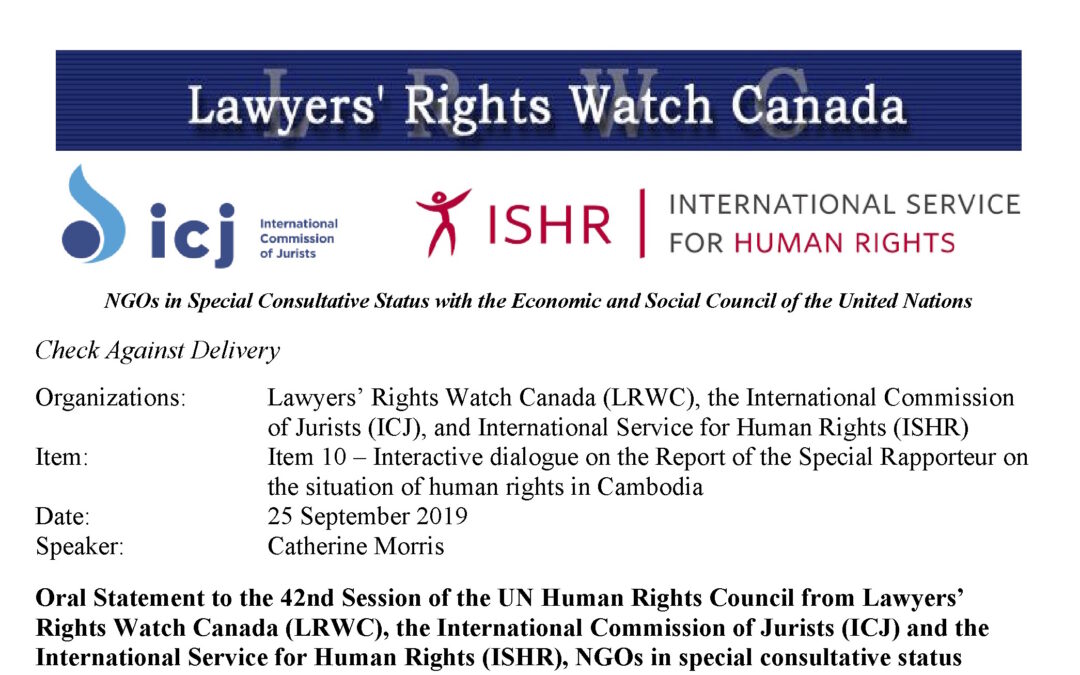
The ICJ today joined other NGOs in drawing the UN Human Rights Council’s attention to the role of the Government of Cambodia in widespread human rights violations and abuses in the country, and called for renewal of the mandate of the UN Special Rapporteur.
The joint NGO statement was delivered by Lawyers’ Rights Watch Canada in a dialogue on the situation in Libya. The statement read as follows:
“Lawyers’ Rights Watch Canada (LRWC), the International Commission of Jurists (ICJ), and the International Service for Human Rights (ISHR) thank the Special Rapporteur for her reports. Implementation of the Sustainable Development Goals, ensuring that no one is “left behind,” necessitates equal access to remedies for rights violations within a trustworthy and independent legal system.
Cambodia has not fulfilled its treaty obligations to establish judicial independence and integrity. Civil society’s rights advocacy is continually resisted. Lawyers, defenders, journalists, politicians, or activists reporting on corruption, election irregularities, labour rights violations, illegitimate land acquisition, environmental degradation, or other rights abuses, often by businesses, are routinely subjected to official vilification; intimidation; interference with rights to expression, association, and assembly; criminalization; arbitrary detention; and even unlawful killings with impunity.
Since 2017, political opposition has been systematically suppressed, including through misuse of the judiciary. Despite the Special Rapporteur’s repeated calls for release of opposition leader Kem Sokha, he remains under court-imposed restrictions tantamount to house arrest. The Special Rapporteur has been denied visits with him contrary to Special Procedures terms of reference for country visits. In May, 25 former opposition members were summoned to court for questioning over two weeks. In September, the government threatened to arrest anyone supporting opposition politician Sam Rainsy’s return to Cambodia.
Cambodia’s responses to Special Procedures’ recommendations for the past twenty-five years have been characterized by disregard, delay, resistance, or hostility. Continued support for the Special Rapporteur’s mandate is critical to ensure that Cambodia fulfils its international human rights obligations. We request that the Council extend the mandate.”
The full written statement, including references, can be downloaded in PDF format here: UN-HRC42-Cambodia-2019