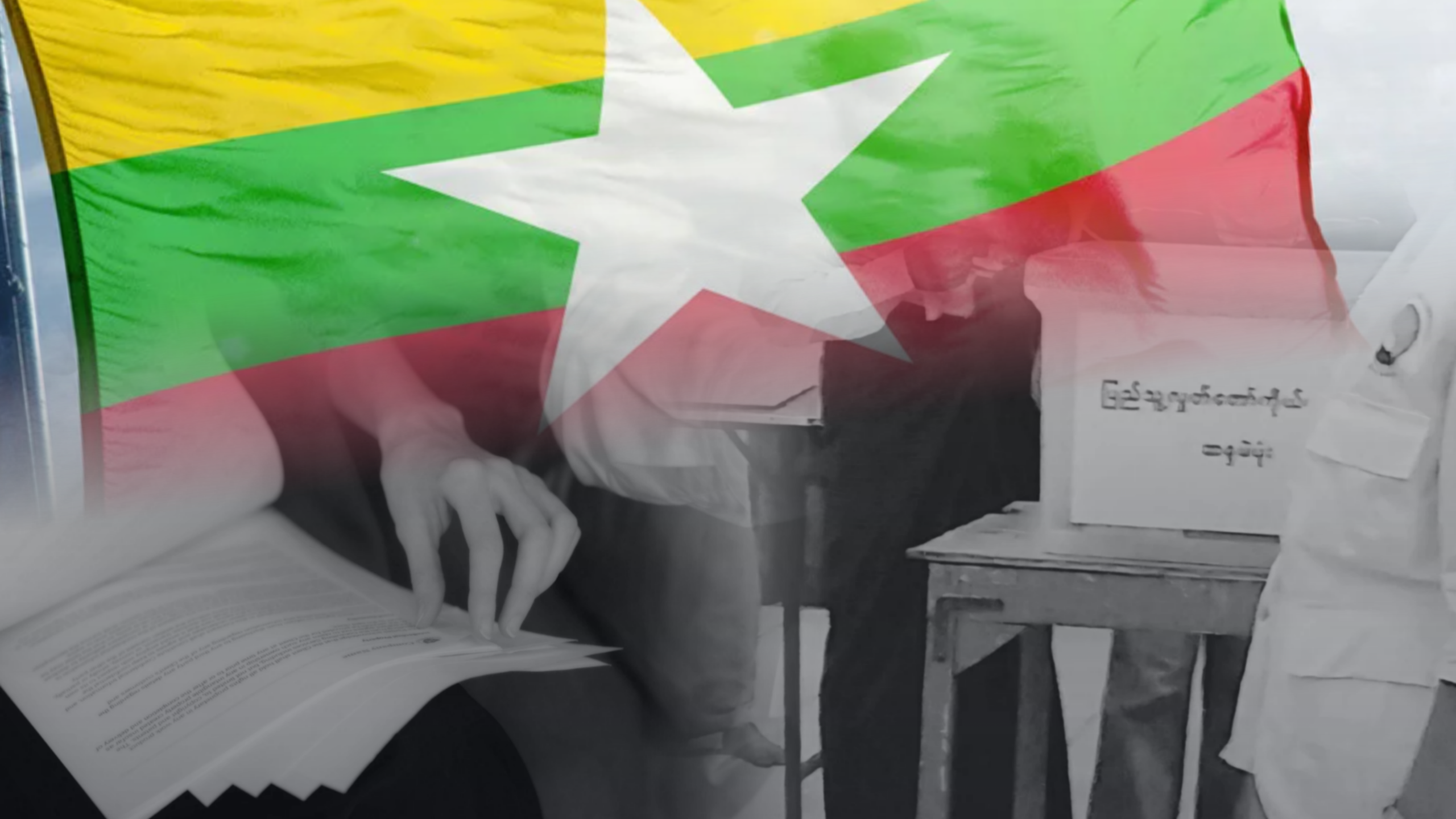
The Myanmar military authorities have scheduled general elections to take place in two phases, one later this month and the second one in January 2026. There are compelling reasons to consider that the process will not be free, fair or inclusive. In early 2023, the military regime amended the Political Parties Registration Law, imposing onerous membership and financial requirements that effectively block long-established political parties and ethnic organizations from registering. Other provisions deny political rights to individuals accused—often without due process—of involvement in “unlawful activities,” a sweeping term used to target critics, activists, and members of opposition movements. As a result, major political parties, including the National League for Democracy, have been effectively excluded from participating in the electoral process.
In light of the above, on 8 December 2025, the International Commission of Jurists (ICJ) convened a webinar on “Election-related Domestic Laws in Myanmar and International and Regional Responses.” The discussions examined laws enacted or amended since 2023 by the country’s military junta responsible for the coup in 2021, assessing their compatibility with international human rights law and standards, and considering their implications for political participation and the rule of law. The participants also reviewed regional and international reactions to the planned elections.
Participants expressed deep concern that Myanmar remains engulfed in widespread armed conflict, with large areas controlled by armed opposition groups or rendered inaccessible due to ongoing military operations. Even the military authorities have admitted that elections cannot be held in many regions as a result of the prevailing circumstances. Major opposition parties have urged a nationwide boycott, warning that conditions are far too dangerous and not conducive for a genuine democratic process.
The humanitarian and human rights situation has deteriorated sharply. UN reporting indicates that more than 3.3 million people have been internally displaced since the 2021 coup, over 5,350 civilians have been killed, and nearly 27,400 people have been arrested. Many detainees have reported torture and other ill-treatment, and at least 1,853 individuals have died in military custody, including women and children. Tens of thousands of homes and civilian structures have been destroyed, intensifying displacement and insecurity. Against this background, participants stressed that holding an election would only deepen marginalization, exclude millions who cannot safely participate, and further entrench authoritarian rule.
Participants also highlighted the pattern of disproportionate and politically motivated sentencing used to silence criticism of the electoral process. Individuals who question the legitimacy of the planned elections have faced severe punishment under security-related laws. In one prominent case cited during the webinar’s discussions, a local organizer reportedly received a 49-year prison sentence after publicly raising concern about unfair electoral conditions. Such cases illustrate how the legal and judicial system is being weaponized to suppress dissent and eliminate democratic political participation in the elections. Under the 2025 Law on the Protection of Multi-Party Democratic Elections, anyone “encouraging election boycotts, criticizing the election, commenting on fraud, or undermining stability” can face prison sentences ranging from three years to life imprisonment, or even the death penalty in certain cases.
The environment of fear was evident even within the webinar itself. A significant number of participants joined using pseudonyms rather than their real names, reflecting widespread concern about surveillance, monitoring, and potential reprisals for engaging in discussions related to the elections, democracy, or constitutional reform. Participants emphasized that the current context leaves no space for free political expression or meaningful public participation.
Participants expressed concern that, overall, granting any degree of legitimacy to the planned elections would mean endorsing a deeply flawed and coercive system, ultimately undermining efforts to restore democratic governance in Myanmar. Genuine elections cannot take place amid armed conflict, mass displacement, pervasive repression, and laws designed to exclude opposition parties and silence critics.
A total of 54 participants joined the webinar, during which three speakers highlighted various aspects of the electoral laws and regional responses. They also noted that the international community has broadly rejected the planned election. The UN Office of the High Commissioner for Human Rights (OHCHR) has warned that the December 2025 elections will take place in “an atmosphere of fear, violence and deep political repression,” and that the vote risks entrenching instability rather than restoring democracy. The Association of Southeast Asian Nations (ASEAN) has publicly stated that, under current circumstances, peace and cessation of violence, not elections, must be the priority. At a recent ministerial gathering, the bloc emphasized that an election cannot succeed without inclusive political dialogue and an end to violence. ASEAN has also declined to send an official observer mission, indicating it does not recognize the planned vote as credible under current conditions.
Contact
Mandira Sharma, Acting Regional Director, Asia and the Pacific Programme, e: mandira.sharma@icj.org