Jun 24, 2018 | News
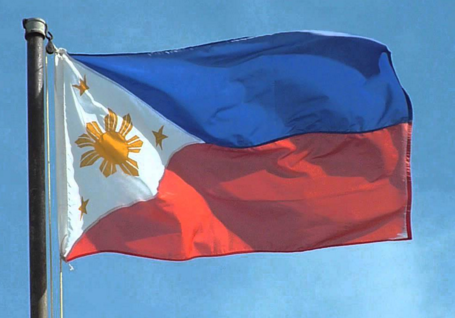
The proposed amendments to the Philippines’ Human Security Act of 2007 (HSA) would, if adopted, give government authorities a license to commit human rights violations, said the ICJ in its submission today to the House of Representatives.
The ICJ strongly urged the House of Representatives to reconsider these proposed amendments and in the interim to allow more time for full consultation and debate on revisions of the law.
In its submission to the House of Representatives’ joint Technical Working Group (TWG) of the Committees of Public Order and Safety and National Defense and Security, the ICJ stressed that certain proposed amendments to the HSA are clearly incompatible with international human rights.
It is also incompatible with laws and standards that prohibit unfettered surveillance power and arbitrary deprivation of the right to liberty and protect the rights to privacy, information, redress, and freedom of opinion and expression.
The ICJ also expressed deep concern that the law also gives military personnel responsibility in countering terrorism, specifically to conduct surveillance on, arrest, and detain persons who are suspected of acts of terrorism.
“The proposed amendments do not address the existing flaws of the HSA. For instance, the definition of acts of terrorism under the HSA is vague and ambiguous and the proposed changes do not in any way remedy that,” said Emerlynne Gil, Senior International Legal Adviser with the ICJ.
The ICJ also pointed out that the proposed amendments are likely to lead to violations of the right to freedom of opinion and expression.
The proposed amendments would also impermissibly lengthen to thirty (30) days the period within which an individual may be detained without judicial warrant.
“This is clearly incompatible with the Philippines international legal obligations and constitutes arbitrary deprivation of liberty,” said Gil.
The ICJ proposes to reduce the detention period to forty-eight (48) hours or less, in compliance with international human rights laws and standards.
“The Philippine government has the undeniable duty to protect people from acts of terrorism committed by non-State actors, but it cannot use as a pretext the serious nature of terrorist acts to avoid its obligations under international human rights law,” Gil added.
Contact:
Emerlynne Gil, Senior International Legal Adviser, t: +662 619 8477 (ext. 206) e: emerlynne.gil(a)icj.org.
Cover Letter ENG (PDF): Philippines-Amendments-to-HSA-Advocacy-Cover Letter-June-2018-ENG
Full Submission ENG (PDF): Philippines-Proposed-Amendments-to-HSA-Advocacy-non-legal-Submission-June-2018-ENG
Jun 22, 2018 | Events, News
This side event at the Human Rights Council takes place on Tuesday, 26 June, 14:00-15:00, room XXVII of the Palais des Nations. It is organized by the ICJ and the International Bar Association’s Human Rights Institute (IBAHRI).
In recent years, lawyers have increasingly been targeted across the world including Eastern Europe and Central Asia. Attempts to impede the work of lawyers through arbitrary disbarments and other disciplinary procedures, criminal or administrative proceedings, physical attacks or intimidation have become an unfortunate new normality in many lawyers’ work.
Lawyers are too often identified with their clients’ cause or specifically targeted in violation of their right to freedom of expression. This side event will discuss challenges faced by lawyers in defending human rights in Azerbaijan, Kazakhstan and Ukraine.
Moderator: Róisín Pillay, ICJ Europe and CIS Programme Director
Speakers:
- Helene Santos, Senior Fellow–UN Liaison Officer in Geneva for the IBAHRI
- Fariz Namazov, Lawyer, Member of the Azerbaijan Bar Association
- Hanna Boryak, Lawyer, Chair of the Committee for the Protection of Advocates’ Rights and advocacy at the Ukrainian National Bar Association
- Iurii Grygorenko, Lawyer, member of the Committee for the Protection of Advocates’ Rights and Advocacy at the Ukrainian National Bar Association
- Temur Shakirov, ICJ Senior Legal Adviser Europe and CIS Programme
Jun 22, 2018 | News
Conclusions of the Conference on Judicial Independence, Guatemala City, 18-19 June 2018
The ICJ is deeply concerned about the increase in the abuse of disciplinary measures against independent and impartial judges and about crimes committed against human rights defenders. These attacks are putting the rule of law at risk in Guatemala.
The ICJ therefore urges the Inter-American Commission on Human Rights, the Subcommittee on Human Rights of the European Parliament and the UN Special Rapporteur on the Independence of Judges and Lawyers to carry out visits to the country so as to verify the situation.
Judges facing malicious disciplinary proceedings
From 18-19 June 2018, the ICJ hosted a conference on the independence of judges with participants from different Central American judges’ associations.
The conference was able to verify that impartial and honourable judges face on-going disciplinary actions that seek to have then recused from trials or have them removed from office on account of their judicial decisions.
Judges are facing the malicious use of the judicial disciplinary system by groups or persons who disapprove of judicial rulings in high-impact cases.
The meeting was an opportunity for different justice sector institutions and judges, victims of attacks, to analyse fundamental concepts and international standards on the judiciary.
The conference concluded, the judicial career system must guarantee that a higher judicial authority can only sanction judges for legally established reasons as set down by international standards.
There was a full agenda of discussions with the participation of the Association of Guatemala Judges for Integrity (AGJI), the President of the Supreme Electoral Tribunal, the Supervisor General of Courts, judges from the Penal Chamber of the Supreme Court, the Commissioner of the International Commission against Impunity in Guatemala (CICIG) and the plenary of the Council of the Judicial Career.
The conference examined attacks against judges and their impact, case by case, in the light of international standards. The conference concluded that judges including Ericka Aifán, Yassmín Barrios, Miguel Ángel Gálvez, Carlos Ruano and Pablo Xitumul are facing disciplinary measures because they have acted independently and impartially.
The spurious complaints presented against them before the judicial disciplinary system or other State institutions should be excluded “in limine”.
Read the full Article in English (PDF): Guatemala-Conference-of-Judges-News-Web-stories-June-2018-ENG
Jun 22, 2018 | Новости, Событие
Это параллельное мероприятие в Совете по правам человека состоится во вторник, 26 июня, 14: 00-15: 00, в помещении XXVII Дворца Наций. Онo организованo МКЮ и Международным институтом по правам человека Международной ассоциации адвокатов (IBAHRI).
В последние годы юристы все чаще становятся объектами преследования во всем мире, включая Восточную Европу и Центральную Азию. Попытки препятствовать работе адвокатов посредством произвольных отстранений и других дисциплинарных процедур, уголовного или административного судопроизводства, физических нападений или запугивания стали тревожной норме во многих работах адвокатов.
Адвокаты слишком часто отождествляются со мотивом своих клиентов или лично подвергаютця лишением их права на свободу выражения. На этом параллельном мероприятии будут обсуждаться проблемы, с которыми сталкиваются юристы в защите прав человека в Азербайджане, Казахстане и Украине.
Председатель: Роушин Пиллэй, директор программы МКЮ Европы и СНГ
Учасники:
- Элен Сантос, старший сотрудник IBAHRI по связям с ООН в Женеве
- Фариз Намазов, юрист, член Ассоциации юристов Азербайджана
- Ханна Боряк, юрист, председатель Комитета по защите прав адвокатов и адвокации в Национальной ассоциации юристов Украины
- Юрий Григоренко, юрист, член Комитета по защите прав адвокатов и адвокатов при Национальной ассоциации юристов Украины
- Темур Шакиров, старшый юрисконсульт МКЮ Европы и СНГ
Листовка на английском (PDF):Geneva-Side-event-Attacks-on-lawyers-in-Azerbaijan-Kazakhstan-and-Ukraine-June-2018-ENG
Jun 22, 2018 | Events, News
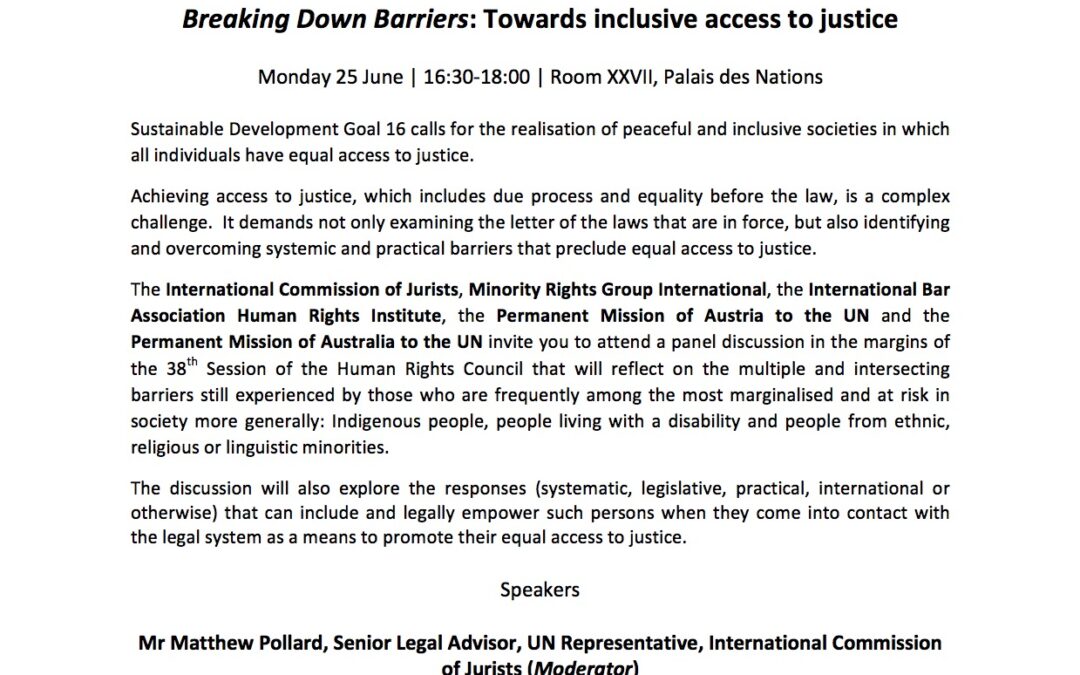
This side event to the UN Human Rights Council session addresses equal and effective access to justice for indigenous people, people living with a disability and people from ethnic, religious or linguistic minorities.
Monday 25 June | 16:30-18:00 | Room XXVII, Palais des Nations
Sustainable Development Goal 16 calls for the realisation of peaceful and inclusive societies in which all individuals have equal access to justice.
Achieving access to justice, which includes due process and equality before the law, is a complex challenge. It demands not only examining the letter of the laws that are in force, but also identifying and overcoming systemic and practical barriers that preclude equal access to justice.
The International Commission of Jurists, Minority Rights Group International, the International Bar Association Human Rights Institute, the Permanent Mission of Austria to the UN and the Permanent Mission of Australia to the UN invite you to attend a panel discussion in the margins of the 38th Session of the Human Rights Council that will reflect on the multiple and intersecting barriers still experienced by those who are frequently among the most marginalised and at risk in society more generally: Indigenous people, people living with a disability and people from ethnic, religious or linguistic minorities.
The discussion will also explore the responses (systematic, legislative, practical, international or otherwise) that can include and legally empower such persons when they come into contact with the legal system as a means to promote their equal access to justice.
Speakers:
Mr Matthew Pollard, Senior Legal Advisor, UN Representative, International Commission of Jurists (Moderator)
Dr June Oscar AO, Australia’s Aboriginal and Torres Strait Islander Social Justice Commissioner, Australian Human Rights Commission
Mr Glenn Payot, UN Representative, Minority Rights Group International
Ms Victoria Lee, Programme Manager, Human Rights and Disability Team, Office of the High Commissioner for Human Rights
For more information contact un(a)icj.org