May 4, 2018
Aujourd’hui, la CIJ publie son rapport sur la juridiction militaire et le droit international: les civils face aux tribunaux militaires. Pour l’heure, ce rapport n’est disponible qu’en espagnol.
Le rapport analyse la question des procès des civils par les tribunaux militaires, à la lumière des principes de l’État de droit et des normes et standards internationaux relatifs à l’administration de la justice et du droit à être jugé par un tribunal indépendant, impartial et compétent.
De même, le rapport aborde le développement historique et normatif, au double niveau international et national, du principe du juge naturel ou du tribunal compétent, ainsi que de l’interdiction des juridictions spéciales.
Le rapport présente la jurisprudence et la doctrine sur les procès de civils par les tribunaux militaires, développés par les organes conventionnels et les procédures spéciales des droits de l’Homme des Nations Unies, la Cour européenne des droits de l’Homme, la Commission africaine des droits de l’Homme et des peuples et la Cour et la Commission interaméricaine des droits de l’Homme.
Le rapport présente les principales tendances dans le domaine du champ de compétence des tribunaux militaires, à la lumière des développements nationaux. En outre, le rapport analyse la situation actuelle des tribunaux militaires au Brésil, en Guinée, au Mexique, au Portugal, en Tunisie et au Venezuela.
Enfin, le rapport reproduit les principales normes internationales relatives au droit à être jugé par un tribunal indépendant, impartial et compétent, ainsi que celles relatives aux procès de civils par des tribunaux militaires, adoptées par les systèmes intergouvernementaux, des associations de juges et des conférences internationales d’experts.
Ce rapport constitue le deuxième volume d’une première étude de la CIJ, intitulée Juridiction militaire et droit international – Volume I: Tribunaux militaires et graves violations des droits de l’homme, publiée en 2003 en anglais, en espagnol et en arabe. Ce premier volume traitait de la question du jugement de militaires pour des graves violations des droits de l’homme par des tribunaux militaires, à la lumière des normes et standards internationaux, ainsi que du droit comparé.
Universal-Tribunales Militares Vol II-Publications-Reports-Thematic reports-2018-SPA (rapport complet en espanol, PDF)

May 4, 2018
Hoy la CIJ lanza su informe Fuero militar y Derecho internacional: Los civiles ante los tribunales militares.
El informe analiza la cuestión del juzgamiento de civiles por tribunales militares, a la luz de los principios del Estado de Derechos y de las normas y estándares internacionales relativos a la administración de justicia y al derecho a ser juzgado por un tribunal independiente, imparcial y competente.
Asimismo, el informe aborda el desarrollo histórico y normativo, tanto a nivel internacional como nacional, del principio del juez natural o tribunal competente así como la prohibición de jurisdicciones especiales.
El informe presenta la jurisprudencia y doctrina sobre el juzgamiento de civiles por tribunales militares, desarrollados por los órganos de tratados y procedimientos especiales de derechos humanos de las Naciones Unidas, el Tribunal Europeo de Derechos Humanos, la Comisión Africana de los Derechos del Hombre y de los Pueblos y la Corte y la Comisión Interamericanas de Derechos Humanos.
El informe presenta las principales tendencias en materia del ámbito de competencia de los tribunales militares, a la luz de los desarrollos nacionales. Asimismo, el informe analiza la situación actual de los tribunales militares en Brasil, Guinea, México, Portugal, Túnez y Venezuela.
Finalmente, el informe reproduce las principales normas y estándares internacionales relativos al derecho a ser juzgado por un tribunal independiente, imparcial y competente, así como, al juzgamiento de civiles por tribunales militares, adoptados por sistemas intergubernamentales, asociaciones de jueces y conferencias internacionales de expertos.
Este informe constituye el segundo volumen de un primer estudio de la CIJ, intitulado Fuero militar y derecho internacional – Volumen I: Los tribunales militares y las graves violaciones a los derechos humanos, publicado en 2003. Ese primer volumen abordó la cuestión del juzgamiento de militares por graves violaciones a los derechos humanos por tribunales militares, a la luz de las normas y estándares internacionales, así como del derecho comparado.
Universal-Tribunales Militares Vol II-Publications-Reports-Thematic reports-2018-SPA (informe completo, en PDF)

May 4, 2018
Today the ICJ launched its report Military jurisdiction and international law: The civilians before military courts, available only in Spanish for the time being.
The report analyzes the question of the trial of civilians by military courts in light of the principles of the rule of law and international standards on the administration of justice and the right to a fair trial by an independent, impartial and competent tribunal.
Likewise, the report addresses the historical and normative development, both internationally and nationally, of the principle of the natural judge or competent tribunal, as well as the prohibition of special jurisdictions.
The report presents jurisprudence and doctrine on the trial of civilians by military tribunals, developed by treaty bodies and special human rights procedures of the United Nations, the European Court of Human Rights, the African Commission of Human Rights and the Peoples and the Court and the Inter-American Commission on Human Rights.
The report also presents the main trends in the field of competence of military tribunals, in light of national developments. In addition, the report analyzes the current situation of military tribunals in Brazil, Guinea, Mexico, Portugal, Tunisia and Venezuela.
Finally, the report reproduces the main international law and standards related to the right to be judged by an independent, impartial and competent tribunal, as well as to the trial of civilians by military tribunals, adopted by intergovernmental systems, associations of judges and international conferences of experts.
This report constitutes the second volume of a first ICJ study entitled Military Jurisdiction and International Law – Volume I: Military Tribunal and Gross Human Rights, published in 2003.
That first volume addressed the issue of the trial of military personnel for gross violations of human rights by military tribunals, in light of international law and standards, as well as comparative law.
Universal-Tribunales Militares Vol II-Publications-Reports-Thematic reports-2018-SPA (full report in Spanish, PDF)
May 3, 2018 | Feature articles, News
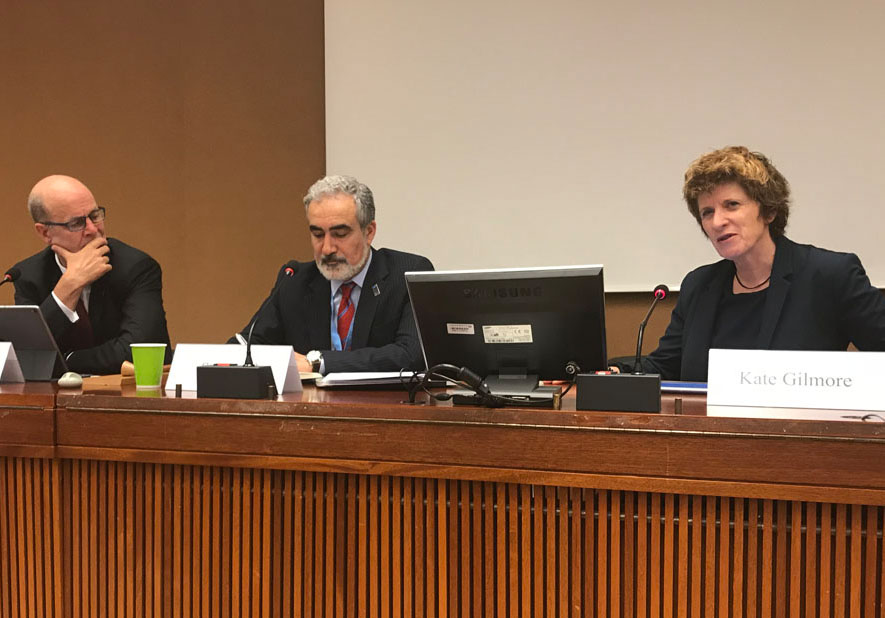
On 3 and 4 May 2018, the ICJ supported by UNAIDS and OHCHR convened an expert meeting on global principles addressing criminalization’s detrimental impact in the areas of sexuality, reproduction, drug use and HIV.
The expert meeting of leading jurists from around the globe aimed at laying the foundations for a set of principles to address the misuse and abuse of the criminal law and its detrimental impact on health, equality and human rights.
The expert group focused on the criminalization of conduct relating to four principal areas: sexuality, reproduction, personal drug use, and the overly broad criminalization of HIV exposure, transmission and non-disclosure.
In these areas, international human rights authorities, as well as domestic courts, have regularly found criminal law provisions to be contrary to international law and standards, and to have a deleterious effect on public health.
“We need to understand why the blunt instrument of the criminal law is used against and affects real people, and why the criminal law ought not to apply in our four areas of concern. Where the criminal law is misused, that is a betrayal of the rule of law. The rule of law must be our guiding compass,” said Justice Cameron, Constitutional Court of South Africa.
“The principles we hope to develop must facilitate the availability of tools which can impact key populations where they are in conflict with the law. They are often at risk of blackmail, stigma and discrimination. It falls on courts to make the difficult decisions. Judges can then consider legality, legitimate purpose and questions of necessity and proportionality in light of a broader understanding of the human rights principles at stake and the relevant scientific evidence,” said Judge Mbaru, Industrial Court of Kenya.
“The law is required to guarantee rights but at same time it can impose arbitrary restrictions. Often those restrictions in the form of the criminal law purport to be necessary in order to ‘protect’ people. That purported purpose ought to be closely scrutinised,” said Justice Ortiz, Constitutional Court of Columbia.
Sam Zarifi, Secretary General of the ICJ, stated: “The misuse of the criminal law affects the most marginalized groups of people and, in particular, the dispossessed and disenfranchised.”
“The centrality of the rule of law at a time when it is under threat globally, and our crucial obligation to stand against laws that are arbitrary, unequal and discriminatory,” he added.
Tim Martineau, Acting Deputy Executive Director of UNAIDS said: “The application of human rights principles to criminal law is key in order to address the detrimental impact of such laws in the areas of sexuality, reproduction, drug use and HIV.”
“While there was significant progress in HIV prevention, treatment and care, there was a big discrepancy in HIV prevention in relation to key populations who are more vulnerable to HIV infection in many respects because of a lack of legal protection, and the unjust criminalization of their behaviour,” he added.
Kate Gilmore, Deputy High Commissioner for Human Rights, stated that the criminal law can readily become a tool of repression or oppression. She said: “Wrongful deployment of criminal law betrays universal human rights standards. By eroding rather than protecting physical and mental integrity specifically in the contexts of sexuality, reproduction and gender identity, misuse of criminal law seeks a wrongful “regulation” of the body of women in particular, with devastating consequences for women’s and girls’ autonomy, health and well being.”
She emphasized that “the criminal law plays an essential role in the recognition, protection and enforcement of rights including by tackling impunity for violations for those rights.”
ICJ, UNAIDS and OHCHR consider that the envisaged principles will help legislators, judges and advocates in the development and review of criminal laws that have adverse consequences on health, equality and human rights particularly where they relate to key populations.
May 3, 2018
On 2 and 3 May 2018, the ICJ is holding a conference on the role of Tunisia’s Specialized Criminal Chambers (SCC) in addressing the legacy of gross human rights violations. The ICJ’s report, Achieving justice for gross human rights violations in Tunisia, was launched during the event.
The conference, held in cooperation with the International Center for Transitional Justice (ICTJ) and The National Independent Coordination for Transitional Justice (NICTJ), and organized in coordination with the Tunisia’s Ministry of Justice, High Judicial Council and Bar Association, aims to:
- Discuss the legal and factual requirements on the referral of cases by the Truth and Dignity Commission (IVD) to the SCC;
- Analyze and discuss the legal and practical obstacles that might impede the SCC’s work;
- Discuss the role of victims in criminal proceedings before the SCC;
- Identify recommendations to relevant authorities (including the High Judicial Council, the Ministry of Justice and the Bar Association) with a view to ensuring the effective administration of justice by the SCC in accordance with Tunisian domestic law and relevant international law and standards.
Four years after its establishment, the IVD transferred a first case on 2 March 2018, concerning 14 suspects and the crime of enforced disappearance, to the SCC. Three other cases were transferred since then.
While such referrals are a first step towards redress and accountability, numerous legal and practical obstacles may hinder the SCC’s capacity to deliver meaningful justice. In two memos addressing the jurisdiction and the procedures to be applied by the SCC, the ICJ identified such obstacles and formulated recommendations for amendments and reform.
Download the ICJ’s reports
Tunisia-GRA Baseline Study-Publications-Reports-Thematic reports-2018-ENG (full report in English, PDF)
Tunisia-GRA Baseline Study-Publications-Reports-Thematic reports-2018-ARA (full report in Arabic, PDF)
Further readings
Tunisia-Memo-on-SCC-Procedures-Advocacy-Analysis-Brief-2017-ENG-1 (Briefing Paper in English, July 2017)
Tunisia-Memo-on-SCC-Advocacy-Analysis-Brief-2016-ENG (Briefing Paper in English, November 2016)
Tunisia-Memo-on-SCC-Advocacy-Analysis-Brief-2016-ARA (Briefing paper in Arabic, November 2016)
Further references
Tunisia: appointment of constitutional court members must meet international standards (ICJ press release, 12 March 2018)
Tunisia: Specialized Criminal Chambers to hear enforced disappearance case, a first step towards accountability (ICJ press release, 6 March 2018)