Mar 20, 2018 | Advocacy
The ICJ today submitted a briefing note to the Senate of Swaziland calling for its urgent adoption of the Sexual Offences and Domestic Violence Bill 2015.
The ICJ’s briefing note concludes that enactment of the Bill is a matter required of the Kingdom of of Swaziland pursuant to its regional and universal human rights law obligations to criminalize and sanction the perpetrators of sexual and gender-based violence. Compliance with those obligations is reinforced by the ‘Vision 2022’ of His Majesty King Mswati III, the aims and targets of the Deputy Prime Minister’s Office and Swaziland’s consensus in the adoption of the 2030 Agenda for Sustainable Development.
The ICJ’s briefing note also concludes that, ten years after initial drafting of the Bill, its enactment during the current session of the Parliament of Swaziland is an essential step in complying with recommendations of the UN Human Rights Committee and CEDAW Committee and as a means of discharging the commitments made by His Majesty’s Government during the 2016 Universal Periodic Review.
Swaziland-SOADVBill-Advocacy-ParliamentaryBriefingNote-2018-ENG (Parliamentary Briefing Note, in PDF)
Mar 19, 2018 | Advocacy, Non-legal submissions
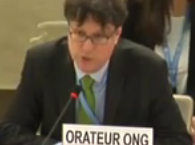
The ICJ spoke at the UN today on concerns about a resurgence of communal violence, and a failure to implement reconciliation and justice mechanisms, in Sri Lanka.
The statement, made during the adoption of the outcome of the Universal Periodic Review for Sri Lanka by the Human Rights Council, read as follows:
“The International Commission of Jurists (ICJ) welcomes the report of the Working Group on the Universal Periodic Review (UPR) on Sri Lanka.
Sri Lanka has stated that it maintains zero tolerance for hate speech and religious violence, and that the National Human Rights Action Plan 2017–2021 contains a firm commitment to enforce section 3(1) of the ICCPR Act. The ICJ further notes that a circular was issued requiring all police officers to take immediate action in this regard. Despite these commitments, recent events demonstrate renewed conflict owing to communal violence directed at the Muslim minority. A state of emergency was proclaimed on 6 March following inaction from law enforcement, and its inability to contain the violence, and emergency regulations were in operation until yesterday.
The ICJ urges the government to demonstrate through action, its willingness bring to account those who have incited communal violence, in line with the ICCPR Act and the commitments conveyed by His Excellency the Ambassador here today. Pervading impunity has emboldened perpetrators to incite violent hatred publicly. Justice must follow recent arrests, ensuring impartial and effective investigations and trials, in line with human rights.
The ICJ also notes the limited progress made on implementing HRC resolution 30/1. Of the reconciliation mechanisms promised, only the Office on Missing Persons is operational. There is little transparency with regards to the other proposed mechanisms (including the mechanism on accountability with involvement of international judges, prosecutors and investigators), or in relation to repeal and replacement of the Prevention of Terrorism Act. Any new counterterrorism law must comply with international human rights standards, and we welcome the Ambassador’s affirmation of the Government’s commitment to this today.
The ICJ urges Sri Lanka to accept and implement all relevant UPR recommendations without delay, before the opportunity for reform may be lost.”
Video of the ICJ statement is available here:
Video of the opening presentation by H.E. the Ambassador of Sri Lanka is available here:
Mar 19, 2018 | Advocacy, Non-legal submissions
The ICJ today delivered an oral statement at the UN calling on Pakistan to amend or repeal blasphemy laws, end military trials of civilians, and take effective measures against impunity.
The statement was delivered during the adoption of the Universal Period Review Outcome for Pakistan, at the UN Human Rights Council. It read as follows:
“The International Commission of Jurists (ICJ) regrets that Pakistan has not supported recommendations related to amending its blasphemy laws, ensuring its counter-terrorism measures are compatible with human rights, and combatting impunity for serious human rights violations.
Pakistan’s blasphemy laws are frequently misused; blatantly discriminate against minority religions and sects; infringe upon the rights to freedom of expression and religion; and give rise to serious fair trial concerns. The Government has failed to amend them in accordance with its international law obligations.
In January 2015, Pakistan empowered military courts to try people accused of terrorism-related offences. The ICJ has documented serious fair trials violations in the operation of military courts including: denial of the right to counsel of choice; failure to disclose the charges against the accused; denial of a public hearing; and a very high number of convictions based on ‘confessions’ without adequate safeguards against torture and other ill-treatment.
The Government has also failed to take steps to combat impunity for serious human rights violations such as extrajudicial killings, enforced disappearances, and torture and other ill-treatment, which are facilitated by laws such as the Actions (in aid of civil power) Regulation and other national security legislation.
Despite repeated commitments to do so, Pakistan has also not enacted legislation to recognize torture or enforced disappearance as a distinct, autonomous offence in its penal code.
The ICJ therefore urges the Government to reconsider, accept and implement UPR recommendations to:
- Ensure that military courts have no jurisdiction over civilians, including for terrorism-related offences;
- Repeal or amend all blasphemy laws, in line with international standards; and
- Ensure all perpetrators of serious human rights violations – including enforced disappearance and extrajudicial killings –are brought to justice.”
Video of the ICJ statement is available here:
Mar 19, 2018
The Government of the Philippines should reconsider and reverse its hasty and ill-conceived decision to withdraw as a State Party to the Rome Statute to the International Criminal Court, the ICJ said today.
In a letter transmitted to Philippine President Rodrigo Duterte, the ICJ questioned the stated basis for the decision to withdraw from the Rome statute, to which it has been party since 2011, and to commit itself to effectively investigate the numerous allegations of widespread and systematic extrajudicial killings and bring to justice those responsible.
The ICC has jurisdiction over certain serious crimes under international law including genocide, crimes against humanity, and war crimes.
“The Philippine government’s submitted justifications for withdrawing from the ICC are a litany of poorly thought out pseudo-legal arguments and self-serving statements that focus on President Duterte’s fear and resentment at facing questions for the horrific campaign of extrajudicial executions that his government has explicitly condoned,” said Sam Zarifi, ICJ’s Secretary General.
“At any rate, despite what the Philippine president may wish, withdrawal from the ICC will not prevent the Prosecutor from conducting a preliminary examination because the acts complained of were committed prior to the date when the withdrawal becomes effective,” he added.
Under the Rome Statute, withdrawal as a State Party takes effect only after one year from notification of the UN Secretary General, unless a later date is specified.
The ICJ’s letter to President Duterte highlights some of the legal and factual errors contained in the Philippine government’s official submission of the justifications for the withdrawal.
The letter points out that the launch of a preliminary examination does not violate the principle of presumption of innocence or due process.
In order to proceed with a full investigation, if the Prosecutor determines it is warranted, a pre-trial chamber of judges would still have to give approval.
The letter notes the Philippine government will have the opportunity to argue that it is willing to investigate and prosecute, and that its domestic processes are sufficient to address the crimes alleged.
Since President Rodrigo Duterte assumed office in June 2016, there has been a notable increase in the number of killings of persons allegedly involved in the trade and sale of illegal drugs.
It has been alleged that the number of persons killed has reached to the thousands, and that many of these killings were unlawful, amounting to extrajudicial executions.
“President Duterte has very publicly stated that he will block investigations into the conduct of his government and its role in the killings of thousands of people; he has insulted and threatened United Nations officials; he has bullied and belittled domestic critics and civil society. He’s now trying to avoid accountability under international law, too,” Zarifi said.
“There is no indication so far of a genuine, thorough, prompt, impartial, and independent investigations of these crimes in the Philippines, and the apparent unwillingness of the authorities to do so is one of the grounds on which the ICC can and should assert jurisdiction to undertake its own investigation,” he further said.
“Instead of engaging in legal maneuvers to facilitate impunity, President Duterte must unequivocally denounce extrajudicial killings, whether of alleged criminals or of any person in the Philippines, and allow a proper investigation of these crimes,” he added.
The ICJ calls on the Government to take immediate and effective measures to address the thousands of cases of extrajudicial killings in observance of its domestic laws and to respect its obligations under human rights law, including the International Covenant on Civil and Political Rights (ICCPR).
Investigations of extrajudicial, summary or arbitrary killings should be geared towards establishing the crime and bringing perpetrators to justice.
Contact
Emerlynne Gil, Senior International Legal Adviser for Southeast Asia, t +662 619 8499 (ext. 206) ; e: emerlynne.gil(a)icj.org
Philippines-ICJ Letter ICC Withdrawal-Advocacy-Open letters-2018-ENG (full letter, in PDF)
Mar 16, 2018 | News
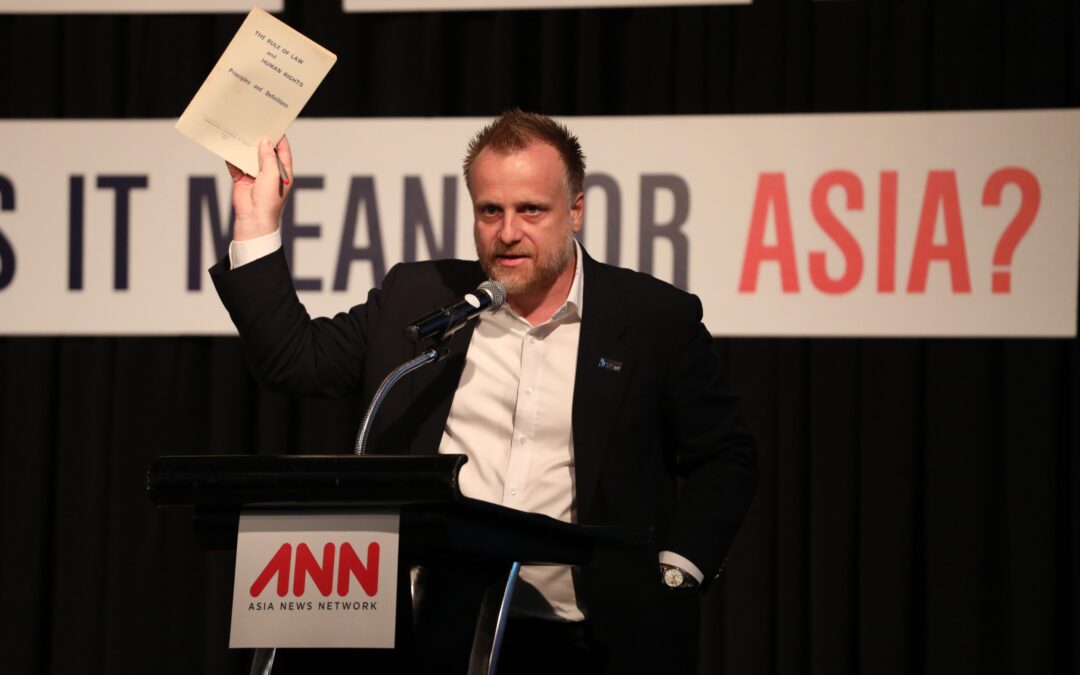
Today, Kingsley Abbott, ICJ’s Senior International Legal Adviser, gave the keynote address on the human rights and rule of law situation in Asia at the Asia News Network’s (ANN) international symposium on upcoming elections in Asia.
The event, held at a hotel in Bangkok, Thailand, was attended by nearly 300 diplomats, business leaders, academics and members of civil society.
ANN is an alliance of 24 leading media in 20 Asian countries.
The full speech can be downloaded here:
Asia-ANN Speech-News-web story-2018-ENG