Mar 13, 2018 | Uncategorized
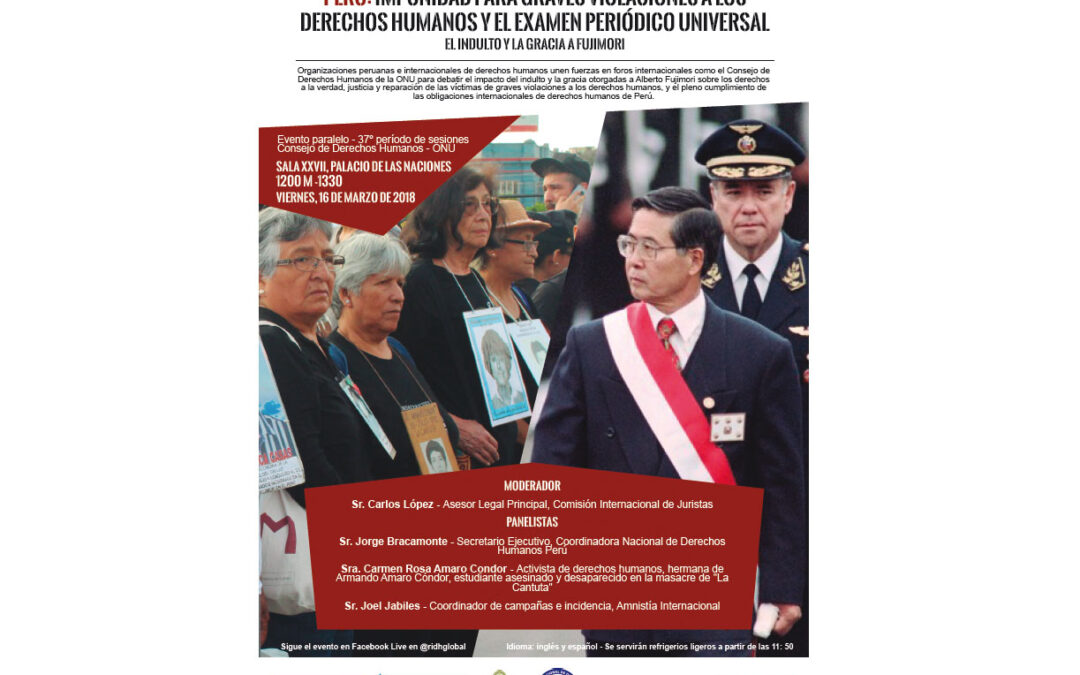
Este evento paralelo – 37º período de sesiones, Consejo de Derechos Humanos, ONU – tendrá lugar el Viernes, 16 de marzo de 2018, 1200 m-1330, Sala XXVII, Palacio de las Naciones, Ginebra, con el apoyo de la CIJ.
Organizaciones peruanas e internacionales de derechos humanos unen fuerzas en foros internacionales como el Consejo de Derechos Humanos de la ONU para debatir el impacto del indulto y la gracia otorgadas a Alberto Fujimori sobre los derechos a la verdad, justicia y reparación de las víctimas de graves violaciones a los derechos humanos, y el pleno cumplimiento de las obligaciones internacionales de derechos humanos de Perú.
Moderador
- Sr. Carlos López – Asesor Legal Principal, Comisión Internacional de Juristas
Panelistas
- Sr. Jorge Bracamonte – Secretario Ejecutivo, Coordinadora Nacional de Derechos
Humanos Perú
- Sra. Carmen Rosa Amaro Condor – Activista de derechos humanos, hermana de
Armando Amaro Cóndor, estudiante asesinado y desaparecido en la masacre de “La
Cantuta”
- Sr. Joel Jabiles – Coordinador de campañas e incidencia, Amnistía Internacional
Sigue el evento en Facebook Live en @ridhglobal
Idioma: inglés y español – Se servirán refrigerios ligeros a partir de las 11:50
Mar 12, 2018 | Advocacy, Non-legal submissions
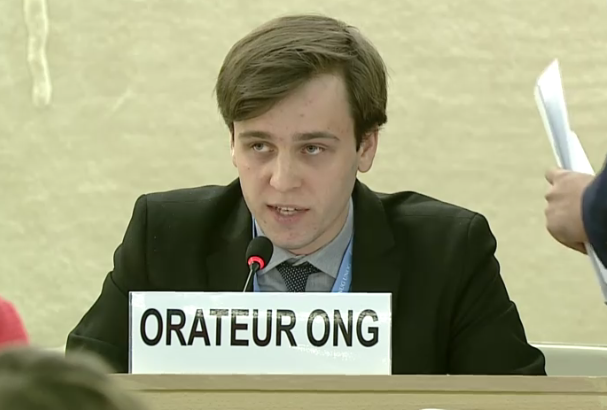
The ICJ today delivered a statement at the UN Human Rights Council calling on Myanmar to cooperate with UN mechanisms and for all UN agencies in the country to make human rights central to their approach.
The statement, made in the interactive dialogue with the international Fact Finding Mission on Myanmar, and the Special Rapporteur, read as follows:
“The International Commission of Jurists (ICJ) welcomes the update of the Independent International Fact Finding Mission. In relation to crimes under international law, the ICJ encourages the experts to continue to develop further specific recommendations for securing criminal accountability and providing redress.
The ICJ also welcomes the report of the Special Rapporteur, and strongly supports the renewal of her mandate and tenure.
As a UN Member State, the Government of Myanmar should fully cooperate with all the organs and mechanisms of the UN, in accordance with its obligations under the UN Charter.
At this session, the government asked for ‘concrete evidence’ of alleged human rights violations, and committed to taking action against perpetrators, but permission to enter the country is still refused to the Fact Finding Mission, to the Special Rapporteur and to the Office of the High Commissioner for Human Rights.
To demonstrate a genuine commitment to truth and accountability, the Government must allow them full access to areas of concern, particularly to Rakhine State and to conflict areas in Kachin State and Shan State.
Humanitarian actors and independent media must also be immediately allowed full and unimpeded access, particularly to Rakhine State, as recommended by the government’s own Advisory Commission.
The current situation in Rakhine State is incongruous to voluntary returns of Rohingya refugees. At the same time, the UN High Commissioner for Human Rights must be included in repatriation planning with a full mandate to protect refugees. This is contemplated in current repatriation arrangements with the Government of Bangladesh, and the Government of Myanmar must now formalize this relationship with UNHCR.
Experts, what can be done to ensure all UN agencies present in Myanmar actually put ‘human rights up front’ in the line with the mandate of every UN organ under the UN Charter?”
Mar 12, 2018 | News
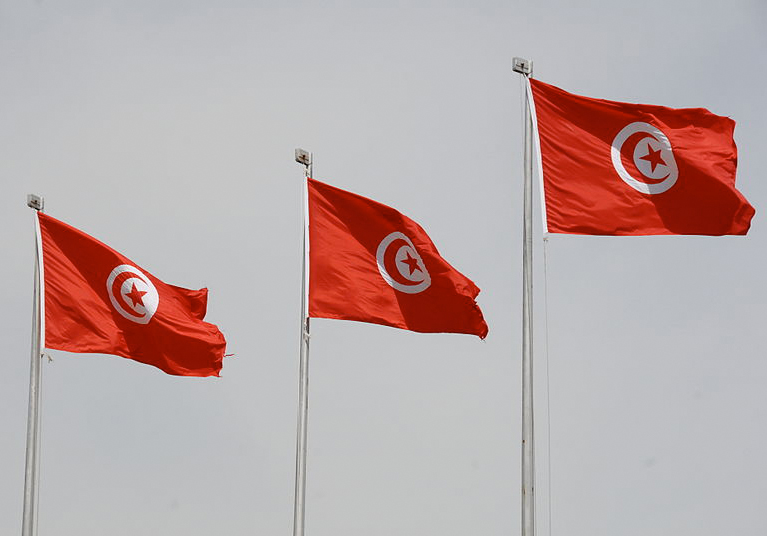
As they begin the appointment process, the Tunisian authorities must ensure that selection of members of the Constitutional Court are made in compliance with international standards on the independence of the judiciary, the ICJ said today.
This must happen through an open and transparent process and based on prescribed, objective criteria of merit, integrity, and equality before the law, the ICJ adds.
The 2014 Constitution and the Organic Law no. 50 of 2015 on the establishment of the Constitutional Court provide that three bodies are responsible for appointing the 12 members of the Constitutional Court.
These are the Assembly of People’s Representatives (ARP), the High Judicial Council, and the President of the Republic, which each body appointing four out of the 12 members successively.
The Constitution and the Organic Law also provide that members must have 20 years of professional experience and nine of them should have advanced legal expertise.
Over the past three weeks, the ARP has been reviewing the candidates for the Constitutional Court and the election of first four members is due to take place in a general plenary on Tuesday, 13 March 2018.
“Ensuring that the selection and appointment of all members of the Constitutional Court is made on the basis of their legal qualifications, competence and personal integrity is absolutely necessary to the strengthening of rule of law and the protection of human rights in Tunisia” said Said Benarbia, Director of the ICJ Middle East and North Africa Programme.
“In electing the four members, the ARP should ensure that these criteria are fully met, and that the process safeguards against appointments for improper motives, including political considerations and arrangements between political groups,” he added.
The Tunisian authorities should also ensure that the composition of the Constitutional Court reflects the diversity of the community it serves, including by ensuring the equal representation of women in the Court, as well as a significant representation of minority groups.
In a previous memorandum, the ICJ has also urged the authorities to ensure that the selection process guarantees the independence of the institution and of the individual judges in compliance with international standards.
Contact
Said Benarbia, Director of the ICJ Middle East and North Africa Programme, tel: +41798783546, email: said.benarbia(a)icj.org
Background
Article 11 and 12 of Law no. 50 of 2015 provides that the election of candidates by the Parliament and the High Judicial Council shall take place through a secret ballot with the vote of a majority of two-thirds of their members. Article 13 provides that the President of the Republic appoints the last four members of the Constitutional Court.
The 2014 Constitution requires the establishment of the Constitutional Court within a year after the legislative elections. Four years later, and despite the entry into force of Law no. 50 in 2015, the Constitutional Court has not yet been established.
Tunisia-PR-Constitutional-Court-2018-ARA (Full Text in Arabic, PDF)
Mar 9, 2018 | Advocacy, Non-legal submissions
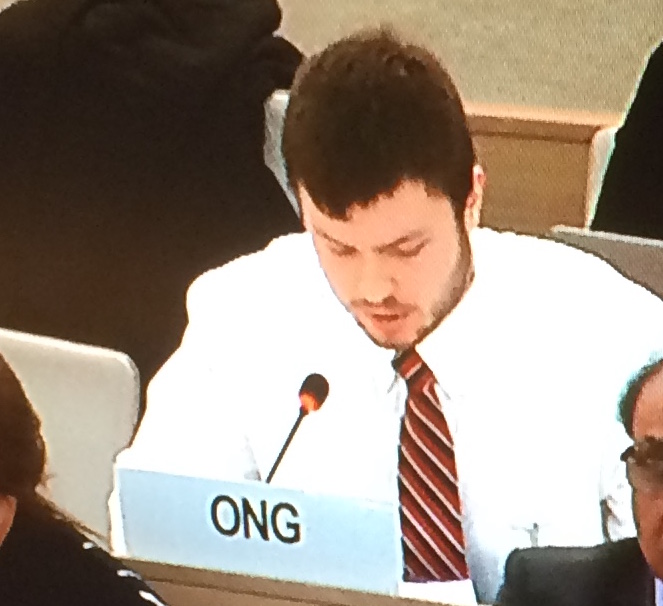
The ICJ today delivered an oral statement to the UN Human Rights Council, highlighting the need for substantive discussions towards a treaty on business and human rights to be transparent, broad-based with clear timelines.
The statement, which was made during the General Debate on item 3 with the Human Rights Council, read as follows:
Mr President,
Regarding the “Report on the third session of the open-ended intergovernmental working group on transnational corporations and other business enterprises with respect to human rights” (A/HRC/37/67), the ICJ notes with satisfaction the holding of the third session and congratulates the participants, especially the wide participation of civil society groups. The ICJ calls on States from all regions to engage meaningfully in the important work of the OEWG.
The discussions during the third session confirm the need for an international treaty in the area of business and human rights to fill the existing normative and legal protection gaps. Recent years have seen little improvement in this area despite the growing State and business discourse about policies and commitments. Harassment and attacks on human rights defenders that work in the area of corporate accountability have increased and the difficulties for victims of abuse to have access to an effective judicial remedy persist, especially at the transnational level.
The ICJ calls for a transparent and broad-based consultation process with clear timelines to move in the direction of a draft treaty on the basis of the document “Elements for a treaty” presented by the Chairperson –Rapporteur. The ICJ calls on all States and stakeholders to engage responsibly in this process to enable the fourth session of the Working Group to focus on substantive negotiations overcoming divisions on procedure and politics.
Thank you.
Mar 9, 2018 | Advocacy, Open letters
The ICJ and other organisations today express concern about China’s draft UN resolution, “Promoting the International Human Rights Cause through Win-Win Cooperation”.
In a letter addressed to the Member and Observer States of the UN Human Rights Council, the organizations wrote:
“The draft resolution entitled “Promoting the International Human Rights Cause through Win-Win Cooperation” lacks balance and undermines accepted international human rights law and principles. Its adoption could undermine the ability of the Council and its mechanisms to protect and promote human rights, and risks undermining the rights of victims of human rights violations.
No resolution that purports to promote human rights but ignores victims can be considered a “win” for anyone. The right of every victim to an effective remedy, regardless of the preferences of the responsible State, lies at the very heart of any meaningful understanding of human rights, as the General Assembly, the Council, as well as the Universal Declaration of Human Rights (UDHR) and human rights treaties, have repeatedly affirmed.
Cooperation between States, and between States and the Human Rights Council and its mechanisms, is an important component of the international human rights system. The version of cooperation envisioned by the draft resolution, however, finds no basis in the decades of practice of human rights at the UN or in the Institutional Building Package for the Council. “Win-win cooperation” and “a community of shared future for mankind” instead emanate specifically from the speech made by Chinese President Xi at the Palais des Nations in January 2017 and other national policy statements. Their implications have not been explained by the Chinese delegation, and reading these terms in their original context only raises greater concern about their import.
The language stating that “win-win cooperation is the only viable option” is perhaps the best example of our many concerns. Although the draft resolution does not specify in relation to what it is “the only viable option”, presumably the implication is with regard to human rights. This language of the draft resolution directly contradicts and undermines that part of the Council’s mandate, as articulated by the General Assembly in its resolution 60/251, that requires it to respond promptly and effectively to gross and systematic human rights violations.
Indeed, in all too many actual situations of gross and systematic violations faced by the Council, States responsible for human rights violations have shown no good faith to engage in any form of cooperation that could actually assist to end the violations or fulfil the rights of the victims. The draft resolution defies experience, and suggests no consequences for persistent non-cooperation.
Additionally, there is no mention in the draft concerning enforcement of States’ obligations under international human rights law by national, regional or international courts or other bodies, or even at a more general level, the need for accountability where abuses occur. As such, only impunity stands to “win” from such an approach.
Furthermore, the concept of “win-win cooperation” in the draft resolution as currently drafted clearly focuses predominantly, if not exclusively, on cooperation between States. The draft resolution does not call for States to cooperate with the Human Rights Council and its mechanisms. Neither does it call on States to refrain from committing reprisals against individuals or groups seeking to cooperate with UN human rights mechanisms to promote and protect human rights, including civil society actors and victims of human rights violations.
Our organisations call on States to reject the proposed resolution on “Promoting the International Human Rights Cause through Win-Win Cooperation” as drafted. Indeed, the problems with the text are so fundamental and far-reaching, it is difficult to see how consensus could possibly be reached without a substantial rethinking of the approach. If the proponents of the draft resolution sincerely believe that “win-win cooperation is the only viable option”, they surely cannot, at the same time, believe that it would be consistent with the draft resolution’s own terms for its adoption to be forced through on a divided vote, and should withdraw the draft resolution from consideration at the present Council session.
Signatories:
- Asian Legal Resource Center
- Amnesty International
- Cairo Institute for Human Rights Studies
- Conectas
- Defend Defenders
- FIDH
- Human Rights Watch
- International Commission of Jurists
- International Service for Human Rights
The letter can be downloaded in PDF format here: UN-HRC37-OpenLetter-ChinaResolution-2018