Jan 30, 2018
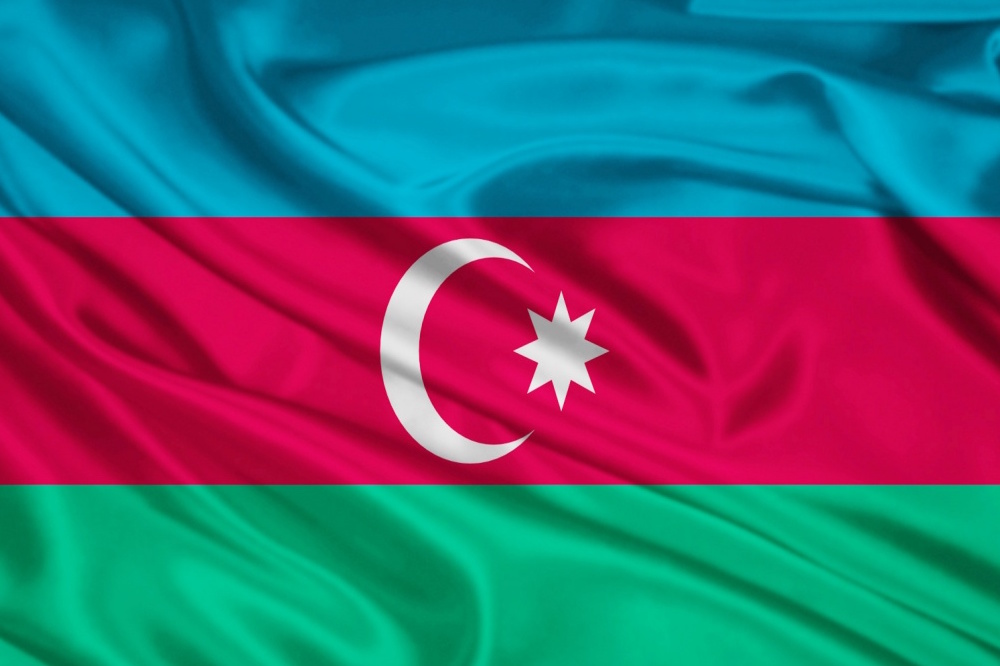
Today, the ICJ filed its submission to the UN Committee against Torture on the compliance by Azerbaijan with its obligations under the UN Convention against Torture.
The Committee will consider it during the adoption of a list of issues prior to reporting (LOIPR) for the examination of the Fifth Periodic Report of Azerbaijan under Article 19 of the Convention against Torture and Other Cruel, Inhuman or Degrading Treatment or Punishment (CAT).
During its 63rd session, from 23 April to 18 May 2018, the Committee will prepare and adopt a LOIPR on Azerbaijan.
Once adopted, the LOIPR will be transmitted to the State party. Azerbaijan’s formal response to the LOIPR will then constitute its Fifth Periodic Report under article 19 of the Convention.
Azerbaijan ratified the CAT in 1996. The last Concluding Observations on the compliance by Azerbaijan with its obligations under the Convention were adopted in 2015.
The ICJ submission to the Committee highlights a number of ongoing concerns with respect to the country’s implementation of and compliance with the provisions of the CAT:
- Azerbaijan’s legislation governing the legal profession;
- the situation of lawyers in practice;
- the lack independence of the legal profession;
- the role of the Bar Association with regard to attacks on lawyers.
The observations made in this submissions are based on the ICJ’s report “Defenceless defenders: Systemic problems in the legal profession of Azerbaijan”, published in September 2016 following a research mission to the country. The report analyses Azerbaijan’s legislation governing the legal profession; the situation of lawyers in practice, in particular, in relation to the lack independence of the legal profession; as well as the role that the Bar Association plays in attacks on lawyers.
ICJ-AzerbaijanCAT-ListofIssues-Jan18-final (download the submission)
Jan 30, 2018 | Agendas, Events
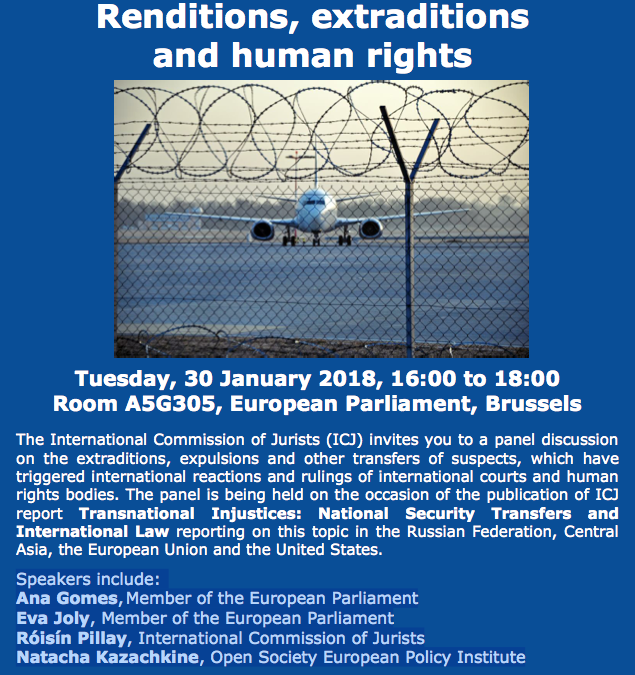
The ICJ invites you to an event to discuss challenges in prevention of, and accountability for, violations of human rights in renditions and other transfers of suspects, including through past European complicity in US-led renditions, and in ongoing transfers of suspects in the CIS region.
Join us for a discussion marking the EU launch of the International Commission of Jurists’ report, Transnational Injustices: National Security Transfers and International Law. The event is kindly hosted by Ana Gomez and Eva Joly, MEPs.
Panelists will discuss the ongoing practice of states unlawfully rendering people accused of terrorism, accountability for violations of human rights in past renditions, and how the EU institutions and EU Member States should address these.
When: Tuesday 30 January 16.00 – 18.00
Where: Room A5G305, European Parliament, Brussels
RSVP to: anamaria.gomes@europarl.europa.eu
Speakers include:
- Ana Gomes, Member of the European Parliament
- Eva Joly, Member of the European Parliament
- Róisín Pillay, International Commission of Jurists
- Natacha Kazachkine, Open Society European Policy Institute
A flyer for this event is available in PDF format by clicking here.
Jan 29, 2018 | Advocacy, Non-legal submissions
Today, the ICJ and Thai Lawyers for Human Rights (TLHR) filed their joint submission to the UN Committee against Torture (Committee).
The Committee will consider it during the adoption of a list of issues prior to reporting (LOIPR) for the examination of the Second Periodic Report of Thailand under Article 19 of the Convention against Torture and Other Cruel, Inhuman or Degrading Treatment or Punishment (CAT).
During its 63rd session, from 23 April to 18 May 2018, the Committee will prepare and adopt a LOIPR on Thailand.
Once adopted, the LOIPR will be transmitted to the State party. Thailand’s formal response to the LOIPR will then constitute its Second Periodic Report under article 19 of the Convention.
Thailand ratified the CAT in 2007. Following its review of Thailand’s initial report under CAT, the Committee adopted its Concluding Observations at its 52nd Session in May 2014.
The ICJ and TLHR’s joint submission to the Committee highlights a number of ongoing concerns with respect to the country’s implementation of and compliance with the provisions of the CAT.
In addition, the joint submissions formulates certain questions and recommends that the Committee should include them in its LOIPR and address them to the Government of Thailand, including on the following pressing issues:
- The fact that, since the coup d’ état of 22 May 2014, the constitutional and legal framework in force in Thailand has increased opportunities for legally-sanctioned impunity;
- The failure to criminalize through the adoption of bespoke domestic legislation the crimes of torture, cruel, inhuman or degrading treatment or punishment and enforced disappearance, consistent with the CAT and other relevant international law;
- The failure to conduct investigations of credible allegations of enforced disappearances, as well as into credible reports of the widespread use of torture and other ill-treatment in a prompt, effective, independent and impartial manner in numerous cases; and
- Threats and reprisals against persons working to bring to light cases of alleged torture, other ill-treatment and enforced disappearance.
Contact
Kingsley Abbott, Senior International Legal Adviser, ICJ Asia Pacific Programme, t: +66 94 470 1345, e: kingley.abbott@icj.org
Thailand-CAT Submission-Advocacy-non-legal submission-2017-ENG (Full submission in PDF)
THAILAND-CAT additional info-Advocacy-2018-ENG (additional information, updated in April 2018)
Jan 26, 2018
An opinion piece by Massimo Frigo, Senior Legal Adviser, ICJ Europe Programme.
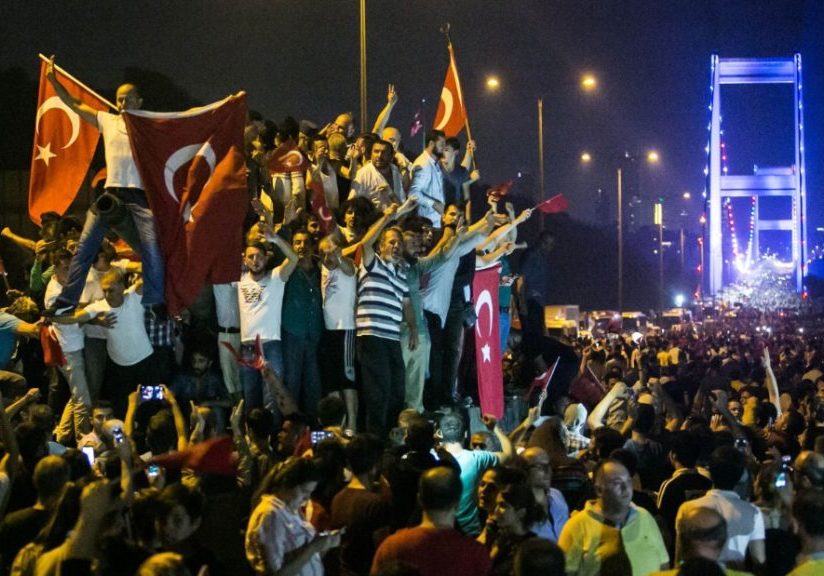
A legal dispute between first instance ordinary courts and the Constitutional Court in Turkey is leading the country into a major constitutional conflict and severely limiting the chance of people in Turkey to access effective remedies for human rights violations.
On 11 January, two criminal courts in Istanbul refused to apply the rulings of the Constitutional Court ordering a remedy for breaches of the right to liberty and freedom of expression of two journalists, Mehmet Altan and Şahin Alpay, detained on remand while under trial for terrorism offences and alleged links to the attempted coup of 15 July 2016.
The full piece and legal analysis can be read on the Opinio Juris blog.

Jan 25, 2018 | News
Myanmar’s publication in state media of lists with the names and accompanying photographs of more than 1,400 men, women and children under the heading “Members of ARSA Terrorist Group” constitutes an assault on human rights and contravenes key principles of the rule of law.
Authorities have not explained why or how listed persons were identified, if they are currently in detention, or if they are wanted for prosecution or for questioning pursuant to criminal investigations. Some or all persons listed appear to have been “accused” outside any formal judicial process.
Given the lack of publicly available information as to the basis of ascribing membership of a prescribed terrorist organization to the persons in the photos, and the manner in which their information has been publicized, the ICJ is concerned that the stated accusations may be arbitrary.
To the extent that there may be any credible basis for ascribing criminal conduct, the authorities have an obligation to administer justice through due process and fair trials, and not name calling and public shaming.
Authorities should cease publishing such material and take effective protective measures to ensure the safety and security of the people named in these publications and their families.
Serious crimes, including alleged acts of terrorism as well as human rights violations, necessitate investigations that are prompt, independent, impartial, effective and transparent in line with international standards.
As with other crimes, the investigation and prosecution of alleged acts of terrorism should conform to applicable national laws, including Myanmar’s Code of Criminal Procedure, to the extent these do not violate applicable international standards.
If any of the listed individuals have been detained, they must be brought promptly before a judge and charged with a cognizable offense or else released.
Accused persons must be afforded legal protections, and if properly charged, they must be brought to justice through fair trials.
State authorities have a duty to respect and ensure the presumption of innocence.
Authorities must refrain from making public statements that are defamatory in nature, that violate fair trial rights by affirming or implying the guilt of persons accused of crimes, and that violate the principle of judicial independence and the separation of powers, all of which are recognized in national and international law.
Particularly given the heightened tensions prevailing in northern Rakhine State, persons included in these lists and their families are at great risk of extra-judicial reprisals, which violates their right to security of the person.
In addition, the potentially defamatory publication of these photos by the government constitutes a violation of their right to privacy.
It also seriously undermines the government’s stated commitments to facilitating the safe return of refugees, and its responsibility to safeguard the physical security and integrity of all individuals from all communities in Myanmar.
Background
From 17 to 23 January 2018, Myanmar authorities published lists with the names, photos and identifying information of more than 1,400 men, women and children who they summarily accuse in the publications of involvement in or association with terrorism-related acts in Rakhine State.
These lists contain photos accompanied by captions with information variously including the name, age, village, alleged transgression, and other identifying information.
Most individuals are identified as “the terrorist” while others are characterized as a “family member of terrorists” or having “sympathized with the terrorist groups.”
The lists have run as supplements in the daily Burmese-language Myanmar Alinn newspaper and in the daily English-language Global New Light of Myanmar newspaper, published by the Ministry of Information.
Extracts have been published by the Office of the President of the Union, and by the Ministry of Foreign Affairs, which on 16 January requested Bangladesh authorities to extradite “accused” persons to Myanmar.
The ICJ has previously expressed concern that during and following security operations in Rakhine State, authorities have systematically failed to respect the rights of detainees in accordance with national and international law and standards.
Authorities have also so far failed to hold to account members of security forces, including soldiers and police, who appear to have perpetrated crimes against both Rohingya and Rakhine inhabitants of Rakhine State.
More than 650,000 inhabitants of northern Rakhine State, the vast majority of whom are Rohingya Muslims, have been displaced as a result of security operations commanded by Myanmar’s military, the Tatmadaw, following attacks on police posts by the Arakan Rohingya Salvation Army (ARSA) on 25 August 2017.
The government’s Counter-Terrorism Central Committee has declared ARSA as a ‘terrorist organization’ and stated that its supporters would be held responsible for acts of terrorism, pursuant to the 2014 Counter-Terrorism Law.
Myanmar-Terrorist Lists-News-web story-2018-BUR (story in Burmese, PDF)