Jul 14, 2017
The ICJ and the International Detention Coalition (IDC) have presented their observations on the draft European rules for the administrative detention of migrants.
In their submissions, the two human rights organizations noted that the current detention practices in most Council of Europe member States raise serious questions as to their compatibility with human rights law.
They stressed that, under international human rights law, immigration detention must always be an exceptional measure of last resort in full respect of the norms of necessity, proportionality and non-discrimination.
The ICJ and IDC expressed concern that the current draft document fails to adequately distinguish between criminal and administrative immigration detention regimes.
In doing so, the document risks normalizing unlawful detention practices and codifying prison standards that are wholly inappropriate in the context of migration.
The two organizations submitted that, as a general rule, persons in situations of particular vulnerability should never be detained merely for the purposes of enforcing immigration control.
Finally they called on the drafting Committee to prioritize alternative measures to detention.
Europe-ImmigrationDetentionRules-JointSubmission-ICJIDC-ENG-2017 (download the joint submission)
Background
The Council of Europe’s European Committee on Legal Co-Operation is currently drafting a set of European rules for the administrative detention of migrants.
This is a codifying exercise on a set of immigration detention rules based on existing international and regional human rights standards relating to the conditions of detention of migrants. The stated objective of the draft instrument is twofold:
- Protect migrants held in administrative detention by providing them with individual guarantees on the conditions of their administrative detention (i.e. detention not based on a criminal conviction);
- Provide guidance to both national authorities responsible for the closed centres and persons working closely with migrants.
The process to draft this codifying instrument started in May 2016.
The European Committee on Legal Co- Operation launched a written consultation procedure to involve civil society and key actors in the elaboration process of this codifying instrument.
This submission is the reply of the ICJ and the IDC to this written consultation.
Contact
Massimo Frigo, ICJ Legal Adviser, t: +41 22 979 3805 ; e: massimo.frigo(a)icj.org

Jul 13, 2017 | News
The ICJ today mourns the passing of Chinese human rights defender and Nobel Peace Prize winner, Liu Xiaobo. Liu Xiaobo was awarded the Nobel Peace Prize in 2010 and was described as the “foremost symbol of the struggle for human rights in China.”
He passed away today at the First Hospital of China Medical University, while still in the custody of Chinese authorities.
He has been imprisoned since 2009, after being found guilty for “subverting state power”, for calling for a new constitution in China. His wife, poet Liu Xia, remains under house arrest in Beijing.
In May 2017 authorities announced that he had been diagnosed with late-stage liver cancer.
Chinese authorities refused calls that he be allowed to travel to receive medical treatment abroad.
The ICJ honors Liu Xiaobo for his peaceful and unrelenting pursuit for human rights in China, and calls on the government to end the house arrest, and guarantee the freedom of movement, of Liu Xia.
Sam Zarifi, ICJ’s Secretary General said: “Liu Xiaobo will continue to serve as an inspiration not only for those fighting for human rights in China, but also for all human rights defenders working to promote and protect human rights all over the world.”
The ICJ believes that the death of Liu Xiaobo should serve as a wake up call to the Government of China that they cannot simply and brutally silence dissenting voices.
Liu Xiaobo’s death only serves to amplify his call for human rights and upholding the rule of law in China.
The ICJ has consistently called upon the Chinese government to end the harrassment and unlawful detention of lawyers and human rights defenders.

Jul 12, 2017 | News
The ICJ is alarmed at ongoing attacks on the rule of law in Poland.
On 12 July 2017, the Government tabled in Parliament draft bill no. 1727, that, if approved, would automatically dismiss all judges of the Supreme Court and let the Minister of Justice decide which judges are to be reinstated or newly appointed.
“This draft law is a direct blow to the principle of separation of powers, the bedrock of the rule of law,” said Massimo Frigo, Legal Adviser with the ICJ Europe Programme.
“The security of tenure and conditions of service of individual judges are essential to judicial independence,” he added.
Draft bill no. 1727 follows another piece of legislation, recently approved by Parliament, by which the Parliament empowered itself to appoint the majority of the members of the National Council of the Judiciary, the body which selects and governs the judiciary.
That law gives political powers in the Polish legislature and executive, which have increasingly demonstrated deep disregard for human rights and the rule of law, undue influence over the judiciary.
Such deficiencies were also highlighted by the Office for Democratic Institutions and Human Rights of the OSCE in May 2017.
“These series of legislative attacks to the independence of the judiciary in Poland must stop. These actions are inconsistent with the international obligations of Poland to ensure the independence of judges,” said Massimo Frigo.
“The European Union must intervene. A EU Member State that directly undermines the checks and balances of its own legal system threatens the founding values of the EU of the rule of law and respect for human rights,” he added.
Contact
Massimo Frigo, ICJ Legal Adviser, t: +41 22 979 3805 ; e: massimo.frigo(a)icj.org
International standards
Particularly in a context like present day Poland, mass removal of all judges from a court, by another branch of government, without a fair and evidence-based individual process for each judge, is incompatible with international standards such as the UN Basic Principles on the Independence of the Judiciary (See, ICJ Practitioners Guide no 13 on Judicial Accountability, pp. 99-104). The UN Basic Principles affirm, among other things, that:
1. The independence of the judiciary shall be guaranteed by the State and enshrined in the Constitution or the law of the country. It is the duty of all governmental and other institutions to respect and observe the independence of the judiciary.
2. The judiciary shall decide matters before them impartially, on the basis of facts and in accordance with the law, without any restrictions, improper influences, inducements, pressures, threats or interferences, direct or indirect, from any quarter or for any reason.
10. …Any method of judicial selection shall safeguard against judicial appointments for improper motives. …
12. Judges, whether appointed or elected, shall have guaranteed tenure until a mandatory retirement age or the expiry of their term of office, where such exists.
18. Judges shall be subject to suspension or removal only for reasons of incapacity or behaviour that renders them unfit to discharge their duties.
19. All disciplinary, suspension or removal proceedings shall be determined in accordance with established standards of judicial conduct.
20. Decisions in disciplinary, suspension or removal proceedings should be subject to an independent review. This principle may not apply to the decisions of the highest court and those of the legislature in impeachment or similar proceedings.
Similar mass removals with politicization of the procedure for reinstatement and new appointments have been condemned as violations of States’ international human rights obligations by, for instance, the UN Human Rights Committee acting under the International Covenant on Civil and Political Rights, to which Poland is also party (see Busyo, Wongodi, Matubaka et al v. Democratic Republic of the Congo, UN Doc CCPR/C/7878/D/933/2000 (2003), and the Inter-American Court of Human Rights (see e.g. Supreme Court of Justice (Quintana Coelle et al) v. Ecuador, Series C No. 266 (2013) and Constitutional Tribunal (Camba Campos et al) v. Ecuador, Series C No. 268 (2013).
Council of Europe standards, in the form of Recommendation CM/Rec(2010)12 of the Committee of Ministers to member states on judges: independence, efficiency and responsibilities, provide among other things as follows:
26. Councils for the judiciary are independent bodies, established by law or under the constitution, that seek to safeguard the independence of the judiciary and of individual judges and thereby to promote the efficient functioning of the judicial system.
27. Not less than half the members of such councils should be judges chosen by their peers from all levels of the judiciary and with respect for pluralism inside the judiciary.
44. Decisions concerning the selection and career of judges should be based on objective criteria pre-established by law or by the competent authorities. Such decisions should be based on merit, having regard to the qualifications, skills and capacity required to adjudicate cases by applying the law while respecting human dignity.
45. There should be no discrimination against judges or candidates for judicial office on any ground such as sex, race, colour, language, religion, political or other opinion, national or social origin, association with a national minority, property, disability, birth, sexual orientation or other status. A requirement that a judge or a candidate for judicial office must be a national of the state concerned should not be considered discriminatory.
46. The authority taking decisions on the selection and career of judges should be independent of the executive and legislative powers. With a view to guaranteeing its independence, at least half of the members of the authority should be judges chosen by their peers.
47. However, where the constitutional or other legal provisions prescribe that the head of state, the government or the legislative power take decisions concerning the selection and career of judges, an independent and competent authority drawn in substantial part from the judiciary (without prejudice to the rules applicable to councils for the judiciary contained in Chapter IV) should be authorised to make recommendations or express opinions which the relevant appointing authority follows in practice.
48. The membership of the independent authorities referred to in paragraphs 46 and 47 should ensure the widest possible representation. Their procedures should be transparent with reasons for decisions being made available to applicants on request. An unsuccessful candidate should have the right to challenge the decision, or at least the procedure under which the decision was made.
49. Security of tenure and irremovability are key elements of the independence of judges. Accordingly, judges should have guaranteed tenure until a mandatory retirement age, where such exists.
50. The terms of office of judges should be established by law. A permanent appointment should only be terminated in cases of serious breaches of disciplinary or criminal provisions established by law, or where the judge can no longer perform judicial functions. Early retirement should be possible only at the request of the judge concerned or on medical grounds.
69. Disciplinary proceedings may follow where judges fail to carry out their duties in an efficient and proper manner. Such proceedings should be conducted by an independent authority or a court with all the guarantees of a fair trial and provide the judge with the right to challenge the decision and sanction. Disciplinary sanctions should be proportionate.
Jul 12, 2017 | Incidencia
El abogado Carlos Ayala, miembro del comité ejecutivo de la CIJ analiza la constitucionalidad de esta asamblea y concluye que tanto la convocatoria como las Bases Comiciales de la ANC “configuran un fraude a la Constitución y una usurpación a la soberanía popular.
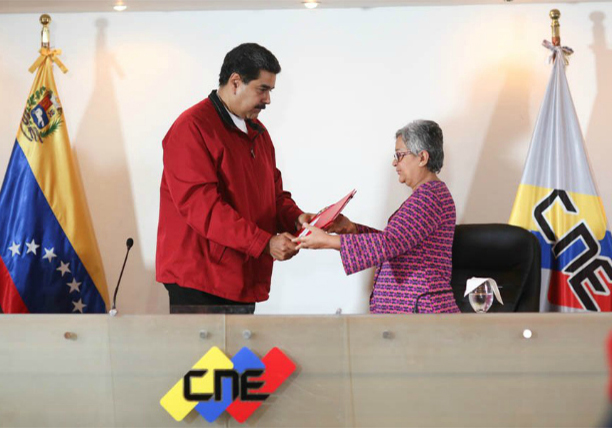
El 1 de mayo de 2017 el presidente Nicolás Maduro convocó una Asamblea Nacional Constituyente (ANC) mediante el Decreto No. 2.830.
Tibisay Lucena, presidenta del Consejo Nacional Electoral, aprobó la convocatoria e informó que el 30 de julio se realizarán los comicios para elegir a los constituyentistas.
Carlos Ayala concluye también que la ANC y la convocatoria violan los principios de la universalidad y la igualdad del sufragio”.
A continuación el texto completo:
Venezuela-ANC paper-Advocacy-Analysis brief-2017-SPA (en PDF)