
Jan 17, 2017 | News
Leading human rights organizations, including the ICJ, have hailed a landmark decision of the UK Supreme Court to hold the UK Government accountable for its role in human rights abuses overseas.
The country’s highest court issued today a long-awaited judgment in the two joined appeals in Belhaj and Others v. Jack Straw & Others and Rahmatullah v. Ministry of Defence and Another.
The Court ruled that the UK Government could not rely on the legal doctrines of sovereign immunity and foreign act of state to escape claims in the two cases alleging UK involvement in breaches of human rights by foreign governments.
The first case, brought by the former Libyan opposition leader Abdul-Hakim Belhaj (photo) and his wife, Fatima Boudchar, alleges that UK Government officials were complicit in the couple’s kidnap and rendition to Gaddafi’s Libya, where they were arbitrarily imprisoned and tortured.
The second case was brought by Yunus Rahmatullah, who was detained by UK forces in Iraq before being handed over to US forces and allegedly tortured and imprisoned without charge for over ten years.
The Government argued before the Supreme Court that the claimants’ cases should be dismissed because, under the doctrines of sovereign immunity and foreign act of state, the UK courts were not permitted to rule on the legality of acts by foreign governments.
The claimants argued in response that the doctrines only applied in certain limited situations, and that they did not extend to the circumstances in Belhaj and Rahmatullah.
The claimants’ position in Belhaj was supported by several prominent human rights organizations – the ICJ, Amnesty International, JUSTICE and REDRESS – who intervened in the case.
The intervening organizations submitted that dismissing the claims would effectively grant impunity for torture to UK officials, violating international human rights law and weakening international commitments to an effective remedy for torture and other ill-treatment, enforced disappearance, arbitrary detention and other human rights breaches.
The Supreme Court found unanimously in favour of the claimants and dismissed the Government’s appeal.
It ruled that the doctrine of sovereign immunity did not apply because the foreign governments were not parties to the cases and their legal interests were not affected by the claims put forward.
In respect of foreign act of state, while the judges differed in their reasoning, they agreed that the doctrine could not be invoked for such serious violations of law as torture, unlawful detention and enforced disappearance.
The Belhaj and Rahmatullah cases will now proceed to full trials, where the courts will examine the facts of the claims and determine whether the UK Government and its officials were complicit in the claimants’ torture and other human rights abuses.
“The UK Supreme Court has spoken forcefully in affirming that the public interest in ensuring access to justice for victims of serious human rights abuses is paramount,” said Ian Seiderman, ICJ Legal and Policy Director.
“Human rights are universal and their effective enforcement must not be blocked by misapplied juridical doctrine that contrives to deny victims a remedy,” he added.
Contact
Ian Seiderman, ICJ Legal and Policy Director, t: +41 22979 3800 ; e: ian.seiderman(a)icj.org
UK-Belhaj case-News-press releases-2017-ENG (full version of press release, in PDF)
Jan 17, 2017 | Адвокаси, Краткий анализ
В публикации представлен анализ применимого международного права и стандартов, актуальных с точки зрения вопросов, которые обсуждались на круглом столе, включая оценку работы судей и ее воздействие на судейскую независимость; распределение дел; качество судебных решений; а также исполнение решений.
В публикации рассматриваются нормы и стандарты международного и европейского регионального права, связанные с этими основными аспектами внутреннего функционирования судебных органов, которыми должен руководствоваться законодатель и практикующие юристы при анализе национального законодательства и практики в свете данных вопросов.
В документе также представлены рекомендации с точки зрения рассматриваемых норм международного права и стандартов, при этом учитываются актуальные вопросы российской судебной системы, которые поднимались на круглом столе.
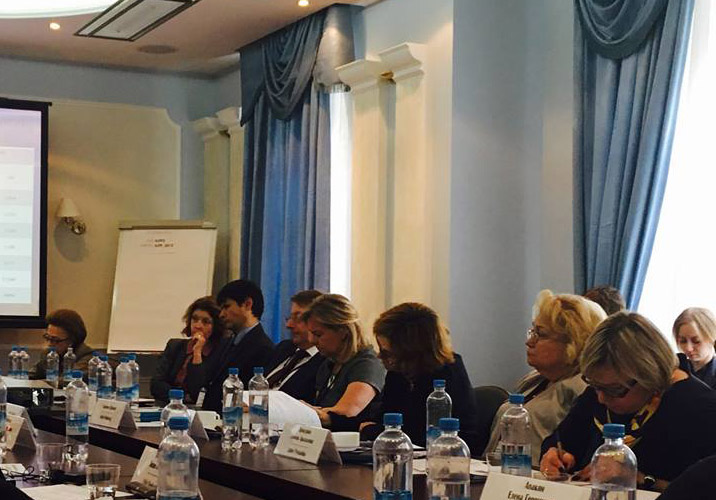
26 сентября 2016 года в Москве Международная комиссия юристов (МКЮ) совместно с Институтом права и публичной политики провела круглый стол на тему «Независимость, эффективность и качество правосудия».
Международные и российские эксперты МКЮ, в том числе судьи из России, Норвегии, Нидерландов и Италии, обсудили ряд вопросов, связанных с эффективностью судебных органов, распределением дел, качеством и исполнением судебных решений, а также иные сопряженные вопросы.
В ходе встречи российские и зарубежные судьи и юристы смогли обменяться опытом и обсудить основные аспекты организации судебных систем.
Участники семинара обсудили проблему сохранения низкого уровня доверия российского общества к судебным органам, а также необходимость дальнейших реформ, которые бы обеспечили, что судебные органы смогут эффективно выполнять свою роль истинного гаранта законности и прав человека.
Вызывает обеспокоенность не только соблюдение гарантий, напрямую связанных со справедливостью судопроизводства, но и сама организация судебных органов.
Несмотря на то, что институциональные аспекты судебной системы не так часто рассматриваются в индивидуальных делах, они крайне важны с точки зрения соблюдения права на справедливое судебное разбирательство по статье 6 ЕКПЧ и статье 14 Международного пакта о гражданских и политических правах (МПГПП), а также иных международных стандартов, касающихся независимости судебных органов и справедливого судопроизводства.
Russia-International standards_Moscow RT-Advocacy-Analysis brief-2017-RUS (брифинг на русском, PDF)
Jan 17, 2017
The paper aims to analyze relevant international law and standards applicable to the topics discussed at a recent round table, including assessment of the work of judges and its impact on judicial independence; assignment of cases; quality of judgments; and enforcement of judgments.
It sets out the international and European regional law and standards related to these key aspects of the internal functioning of the judiciary, which should serve as guidelines for policy makers and practitioners in the Russian Federation when assessing national legislation and practice in regard to these issues.
The paper also makes recommendations in light of the international law and standards analyzed, having particular regard to the challenges within the Russian judicial system, discussed at the round table.
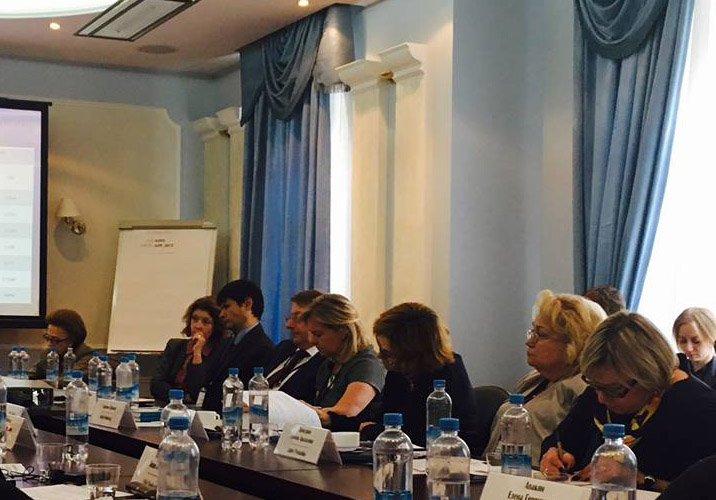
On 26 September 2016, the ICJ, in cooperation with the Institute of Law and Public Policy (ILPP), held a round table discussion in Moscow on Independence, Efficiency and Quality of Justice.
ICJ international and Russian national experts, including judges from Russia, Norway, the Netherlands and Italy, discussed a range of issues related to the efficiency of the judiciary, the allocation of cases, the quality and enforcement of court decisions and related topics.
The meeting allowed Russian and foreign judges and lawyers to share their experiences and discuss key aspects of organization of the judiciary.
Participants at the seminar discussed the continuing low levels of public trust in the judiciary in the Russian Federation and the need for further reforms to ensure that the judiciary can discharge its role as a true guarantor of the rule of law and human rights.
Concerns exist not only in regard to the guarantees that directly relate to the fairness of court hearings, but also as regards the organization of the judiciary.
While these institutional aspects are less often addressed in individual cases, they are essential to uphold the right to a fair trial under Article 6 of the ECHR and Article 14 of the International Covenant on Civil and Political Rights (ICCPR) as well as other international standards on the independence of the judiciary and fairness of court proceedings.
Russia-International standards_Moscow RT-Advocacy-Analysis brief-2017-ENG (Briefing paper in English, PDF)
Russia-International standards_Moscow RT-Advocacy-Analysis brief-2017-RUS (Briefing paper in Russian, PDF)

Jan 12, 2017
The ICJ today called on the Egyptian authorities to refrain from its attacks against independent judges and reinstate all those that have been removed from office following arbitrary and unfair disciplinary proceedings.
The call came as the ICJ released a legal briefing assessing the compliance of the mass disciplinary proceedings in the “the July 2013 Statement case” with international standards on judicial independence and due process.
Upholding a decision by the Disciplinary Board in the “July 2013 Statement case”, the Supreme Disciplinary Board found that 31 judges were “unfit” to hold judicial office for endorsing a public statement following the ousting of President Morsi and the seizure of power by the Military.
The Statement called for the 2012 Constitution to be restored, for a dialogue between all stakeholders to be established within the framework of constitutional legitimacy, and for the right to peaceful demonstration to be respected.
“The July 2013 Statement was a legitimate exercise, by the concerned judges, of their rights to freedom of expression, assembly and association,” said Saïd Benarbia, ICJ MENA Director.
“Removing these judges from office for exercising such rights and following mass, arbitrary, and unfair proceedings runs counter to Egypt’s obligations under international law to respect and observe the independence of the judiciary,” he added.
According to international standards, judges can only be removed for reasons of incapacity or behaviour that renders them unfit to discharge their duties after a fair hearing before an independent and impartial body.
The ICJ briefing analyses the numerous procedural and substantive flaws that marred the July 2013 Statement Case, including violations of the judges’ rights to freedom of expression and assembly, to a fair hearing before an independent and impartial body, and to equality of arms.
According to the study, the judges’ rights of defence were also undermined in a variety of ways, including by the failure to give judges prior and adequate notice of the hearings and access to the case file in advance of the hearings.
“Because of the litany of violations that marred the July 2013 Statement Case, the ICJ calls on the Egyptian authorities to reverse the decisions of the Supreme Disciplinary Board, to reinstate the judges that have been arbitrarily and unfairly removed from office, to refrain from attacks against the judiciary, and to put an immediate end to its campaign to silence independent judges,” Benarbia added.
Contact
Saïd Benarbia, ICJ Director of the ICJ Middle East and North Africa Programme, t: +41 22 979 38 17, e: said.benarbia(a)icj.org
Egypt-Attacks on judges-News-Press release-2017-ARA (Press release in Arabic, PDF)
Egypt-attacks-on-judges-Advocacy-Analysis brief-2017-ENG (Analysis brief in English, PDF)
Egypt-attacks-on-judges-Advocacy-Analysis brief-2017-ARA (Analysis brief in Arabic, PDF)

Jan 11, 2017 | News
It is with great sadness that the ICJ mourns the loss of Honorary Member Lord William Goodhart QC who passed away on 10 January at the age of 83.
Lord Goodhart, from the United Kingdom, was a long-serving friend of the ICJ, having served as a Commissioner from 1993-2007, on the Executive Committee and also as ICJ Vice-President. from 2007-2009 Lord Goodhart also served as the Chairman of JUSTICE, the ICJ’s independent UK Section.
Lord Goodhart was a Liberal Democrat peer of the UK House of Lords, a Member of the All Party Parliamentary Humanist Group and an eminent human rights barrister. He was knighted in 1989 and made a Life Peer in 1997 as Baron Goodhart of Youlbury.
Our thoughts and condolences are with his family and many friends.