Dec 23, 2016
The ICJ today called on the Moroccan authorities to develop and adopt, in close consultation with the associations of judges, a Code of Ethics and Judicial Conduct that is fully consistent with international standards on judicial independence and accountability.
The statement came following a high-level mission to Morocco from 19 to 21 December 2016, during which the ICJ engaged with members of the Conseil supérieur du pouvoir judiciaire (CSPJ) and the judiciary on the reforms needed with a view to developing standards of conduct that are in line with the Bangalore Principles of Judicial Conduct and the UN Basic Principles on the Independence of the Judiciary.
The ICJ submitted to the Moroccan authorities and published a memo analyzing and formulating recommendations on the content of the Judicial Code of Ethics, the procedure of its adoption, the composition and functions of the Judicial Ethics Board, and the flaws in in the laws on the CSPJ and on the Statute for Judges regarding the disciplinary system.
“The development of a Judicial Code of Ethics that is consistent with international standards is an important opportunity to reinforce judicial independence and to ensure that the judiciary remain accountable to the public it serves,” said Said Benarbia, ICJ Director of the Middle East and North Africa Programme.
The ICJ is calling for the development of a Code that contain ethical duties that do not undermine a judge’s human rights and fundamental freedoms, including the right to the freedom of expression and association.
It is important not only for the judges themselves, but for the public at large, that the voices of judges are heard regarding in particular questions concerning the administration of justice.
The ICJ considers that the obligations contained in the Code must be precisely defined in order to give judges notice of the types of conduct they should undertake or abstain from.
This is particularly important given the vague and imprecise definitions of disciplinary offences as provided for by the law on the Statute for Judges.
The ICJ calls on the Moroccan authorities to review the provisions on disciplinary offences, including by ensuring that they do not unnecessarily restrict the enjoyment of fundamental freedoms by the Moroccan judges, and that they also include judicial violations of human rights and international humanitarian law, as well as offences of serious judicial corruption.
In the interim, The ICJ recommends that the Judicial Code of Ethics fill that gap by clearly specifying the types of conduct that may render judges liable to disciplinary sanctions.
Furthermore, while the law on the CSPJ provides that a Judicial Ethics Board is to be established to ensure that judges respect the obligations contained within the Judicial Code of Ethics, the ICJ is concerned that neither the composition nor the mandate of the Judicial Ethics Board are clearly specified.
The Moroccan authorities should ensure that the composition of the Judicial Ethics Board is clarified and that its functions are clearly defined, including by entrusting the Board with an advisory role.
“Ensuring that judges are able to consult the Board whenever they have questions regarding the proper application of the Judicial Code of Ethics would contribute to preventing improper conduct and thus reinforce the public’s confidence in its judiciary,” Benarbia added.
Contact:
Said Benarbia, Director of the ICJ Middle East and North Africa Programme, t: +41.22.979.3817, e: said.benarbia(a)icj.org
Additional information:
The ICJ delegation met with Mr. Mustapha Farès, First President of the Cassation Court; Mr. Mustapha Meddah, Prosecutor General of the Cassation Court; Mr Driss El Yazami, President of the National Council of Human Rights; Mr. Yassin Mokhli and Mrs Aicha Nassiri, elected members of the CSPJ; Mr. Mohamed Khadraoui, vice-President of the Amicale Hassania; and Mr Abdellatif Chentouf, President of the Judges’ Club.
Morocco-Code of Ethics-News-Press releases-ARA-2016 (full text in Arabic, PDF)
Morocco-Code of Ethics-Advocacy-Analysis Brief-2016-ENG (Memo in English, PDF)
Morocco-Code of Ethics-Advocacy-Analysis Brief-2016-ARA (Memo in Arabic, PDF)

Dec 23, 2016 | Nouvelles, Plaidoyer
La CIJ a appelé aujourd’hui les autorités marocaines à élaborer et à adopter, en étroite consultation avec les associations de juges, un code de déontologie et de conduite judiciaire pleinement conforme aux normes internationales en matière d’indépendance et de responsabilité judiciaire.
Le droit à un système judiciaire indépendant et impartial est une pierre angulaire de l’État de droit et de la protection des droits de l’homme. Ce droit comme le droit à un procès équitable sont tous deux garantis par la Constitution du Maroc et par l’article 14 du Pacte international relatif aux droits civils et politiques (PIDCP), ratifié par le Maroc.
Les autorités marocaines sont donc tenues tant par la Constitution et par son droit national, que par le PIDCP, de respecter et protéger l’indépendance et l’impartialité du pouvoir judiciaire.
L’indépendance du pouvoir judiciaire exige non seulement une séparation claire des fonctions exécutive, législative et judiciaire, et des lois établissant des critères objectifs pour la nomination et assurant une rémunération adéquate et l’inamovibilité des magistrats ; mais également que la magistrature dans son ensemble, ainsi que les magistrats à titre individuel, maintiennent l’intégrité de la profession et qu’ils soient tenus responsables pour les fautes professionnelles commises dans l’exercice de leurs fonctions.
En effet, la confiance du public dans l’intégrité du système judiciaire est un élément essentiel de l’État de droit et cette confiance tient notamment au fait que les magistrats agissent de manière indépendante, sans influence ou pression indue, menaces ou autres ingérences, pour quelque raison que ce soit, et qu’ils seront tenus responsables s’ils agissent en violation de certaines normes de conduite judiciaire dans l’exercice de leurs fonctions judiciaires.
Morocco-Code of Ethics-Advocacy-Analysis Brief-2016-FRE (Texte complet en PDF)
Dec 20, 2016 | Multimedia items, News, Video clips
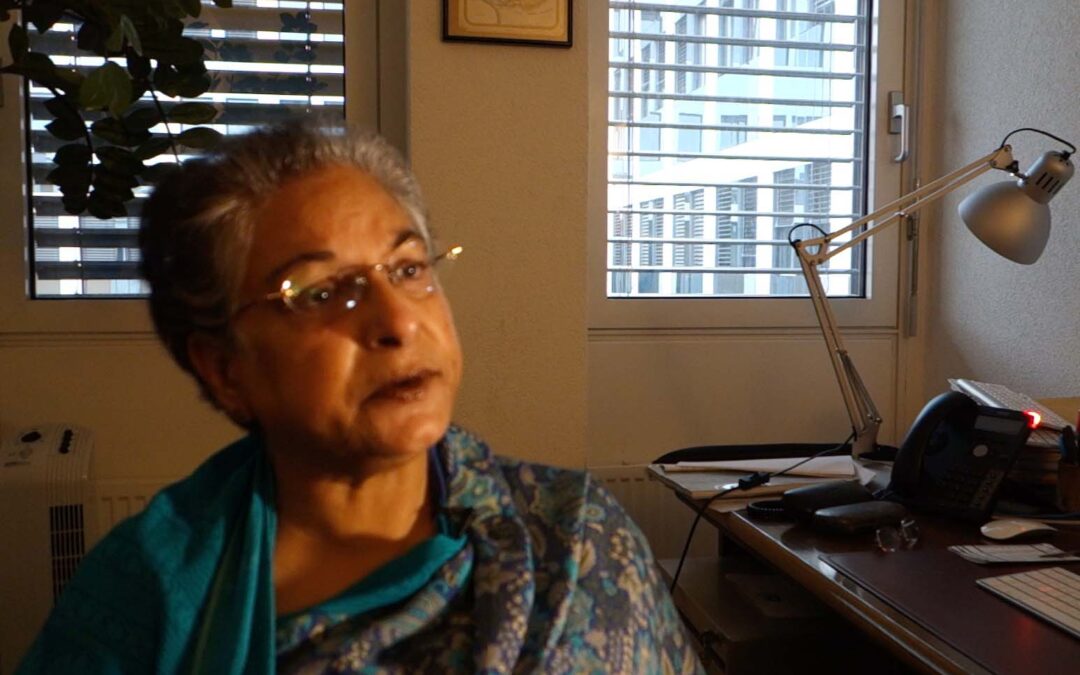
The ICJ continues its profile series of women’s rights defenders with ICJ Commissioner Hina Jilani.
Hina Jilani is a human rights activist and an advocate of the Supreme Court of Pakistan, she has served as the first UN Special Representative on Human Rights Defenders to the Secretary-General and has been an ICJ Commissioner since 2013. In 1980, Hina co-founded Pakistan’s first all-female legal aid practice, AGHS Legal Aid Cell (ALAC).
Hina started her legal career at a time of an oppressive military government takeover in Pakistan. The government sought to legitimize their authority on the basis of Islam, which they interpreted as meaning lesser rights for women who were reduced to second-class citizens and denied the same rights as men. This sparked Hina’s passionate commitment to women’s rights work.
The women’s rights movement in Pakistan has declared itself a secular movement, having decided that it is better to separate the question of religion and universal rights. Hina said that Islam doesn’t deny rights to anyone but that when it is used by those in positions of authority they can interpret religion in ways that suit their own political needs and this results in inequality.
Domestic violence is a major problem in Pakistan and Hina said that most women will have experienced this in one form or another at some point in their lives.
Hina identified a lack of social mobility and social prejudices as key challenges that women in Pakistan face in accessing justice.
In a society where women are encouraged to stay at home many women are unable to access the legal and other services they may need if their rights are being abused. Many women do not even have an awareness of what their rights are, nor do they have access to information about their rights or the kinds of people that could provide them with this information.
In addition, where women do seek justice through the legal system they often encounter social prejudices from those administering that system.
However, although the Pakistani judiciary has traditionally been very conservative there has been a lot of progress in this area. Ms Jilani thinks this is a results of women’s rights advocates taking cases to courts and presenting these in a way that makes the social inequalities and injustices apparent and makes it easier for judges to make better decision that challenge these prejudices.
Ms Jilani recommends three steps for eradicating violence against women:
Firstly, it is essential to have strong legislation; having something anchored in the law makes it incumbent for authorities and institutions to provide women with protection and justice.
Secondly, there must be mechanisms on the ground that make it possible for women to assert their rights under any such legislation; this goes beyond legal support and will include cross-sectoral services such as women’s shelters.
Thirdly, there must be independent judges administering the legislation; judges must be independent not only of the executive but also of their own social prejudices.
Defending women’s rights in the courts of law has seen some significant victories in terms of clarifying the whole meaning of equality and equal opportunity. However, Hina said that the most difficult rights protection work women can do is defending women’s rights.
Women’s rights defenders “are seen as change-makers who are not necessarily liked so they are targeted”. They are often vulnerable to exclusion, social isolation and being discredited, both within their wider communities and also, often, within their own families.
Hina Jilani recommends that women who engage in rights defence work develop strong support networks that also makes link with other rights movements. The more it is apparent they are not acting in isolation, the better protected they will be.
Watch the interview:
The series of profiles introducing the work of ICJ Commissioners and Honorary Members on women’s rights was launched on 25 November 2016 to coincide with the International Day to Eliminate Violence against Women and the first day of the 16 Days of Activism Against Gender-Based Violence Campaign.

Dec 17, 2016 | News
The ICJ jointly convened a two-and-a-half day training workshop with the Raoul Wallenberg Institute.
The meeting congregated lecturers from the four law schools from around the country to look into options for the development of clinical legal education programmes.
One of the objectives of the meeting was to acquaint and equip law schools with the various models and approaches to clinical legal education.
To that end the workshop covered issues including: an overview of clinical legal education programmes and models for law clinics; developing clinical legal education curricula; clinical/interactive teaching methods; and practical placement of students with local, regional and international organizations.
This initiative was a first step in a Clinical Legal Education Programme which is a response by the ICJ to concerns from judicial officers on the quality of legal graduates.
The clinical legal education programme is part of a broader ICJ intervention, which is looking to better equip and motivate lawyers to effectively contribute to the maintenance of the rule of law and preservation of human rights.
The process was jointly facilitated by Professor David Mcquoid-Mason (President, Commonwealth Legal Education Association) and Alex Conte of the ICJ and the University of Sussex.
The 17 participant academics (ten males and seven females) who attended the meeting where drawn from the four law schools in Zimbabwe: the Faculty of Law from the University of Zimbabwe; the Herbert Chitepo Law School at the Great Zimbabwe University; the Zimbabwe Ezekiel Guti University; and the Midlands State University.
Additional participants where drawn from the Institute for Peace, Leadership and Governance, at Africa University.
The workshop was held with the support of the European Union Delegation to Zimbabwe (EU).
Dec 15, 2016 | News
The Pakistani Government must not extend legal provisions that empower military courts to try civilians for terrorism-related offences, the ICJ said today.
The 21st Amendment and corresponding amendments to the Army Act, 1952, are scheduled to lapse on 6 January 2017, when their respective two-year sunset clauses expire.
“These military trials of civilians has been a disaster for human rights in Pakistan,” said Sam Zarifi, ICJ’s Asia Director.
“The conduct of these tribunals over the last two years has demonstrated that military trials are secret, opaque, violate even basic fair trials rights —and don’t do anything to protect people from acts of terrorism,” he added.
In a question-and-answer briefing paper released today, the ICJ provides answers to key questions regarding the conduct of military courts and the issues that have arisen in their operation.
The military has acknowledged the convictions of at least 144 people by military courts for their “involvement” in terrorism-related offences, 140 of whom have been sentenced to death.
Twelve out of the 140 people sentenced to death by military courts have been hanged.
The military has announced that least four people have been given life imprisonment sentences, but the actual number could be much higher.
Some 135 out of 144 people (94 per cent) convicted by military courts had allegedly “confessed” to the charges, raising serious questions about the possibility of torture or other coercive measures being used to secure these convictions.
The ICJ has documented how proceedings before Pakistani military courts fall short of national and international standards requiring fair trials before independent and impartial courts:
- Judges are part of the executive branch of the State and continue to be subjected to military command;
- The right to appeal to civilian courts is not available;
- The right to a public hearing is not guaranteed;
- A duly reasoned, written judgment, including the essential findings, evidence and legal reasoning, is denied;
- The procedures of military courts, the selection of cases to be referred to them, the location and timing of trial, and details about the alleged offences are kept secret; and
- The death penalty is implemented after unfair trials.
In addition to these concerns, the ICJ has also received reports that suspects tried by military courts have been subjected to torture and ill-treatment in detention and their family members have been harassed and intimidated by military authorities.
Allegations of torture and ill-treatment are not effectively investigated and information alleged to have been obtained by means of torture or other ill-treatment is not excluded as evidence in trial, the ICJ says.
In at least two cases, the petitioners have also alleged that the convicts were children under the age of 18 at the time they were arrested by law enforcement agencies.
Military courts were empowered to try civilians pursuant to the National Action Plan against terrorism, in contravention of international standards.
The National Action Plan envisioned military courts to be a short-term “solution” to try “terrorists”, to be operational only for a two-year period during which the Government would bring about necessary “reforms in criminal courts system to strengthen the anti-terrorism institutions”.
With less than one month left before military courts cease to be in effect, there is little sign of the promised reforms to strengthen the ordinary criminal justice system to effectively handle terrorism-related cases, the ICJ adds.
“Pakistan has not used the period of using military courts to reform and strengthen the criminal justice system,” said Zarifi.
“On the contrary, military courts have only further undermined the legitimacy of the ordinary courts and weakened the rule of law in Pakistan.”
The ICJ urges the Pakistan Government to not extend the 21st Amendment and ensure that all counter-terrorism laws and procedures are in accordance with Pakistan’s human rights obligations.
Contact
Sam Zarifi, ICJ Asia Pacific Regional Director (Bangkok), t: +66 807819002; e: sam.zarifi(a)icj.org
Reema Omer, ICJ International Legal Adviser for Pakistan (Lahore), t: +923214968434; e: reema.omer(a)icj.org
pakistan-military-courts-qa-advocacy-2016-eng (full Q& A on Military Courts, in PDF)
pakistan-list-of-convicted-advocacy-2016-eng (full list of convicted people, in PDF)