Aug 28, 2015 | News
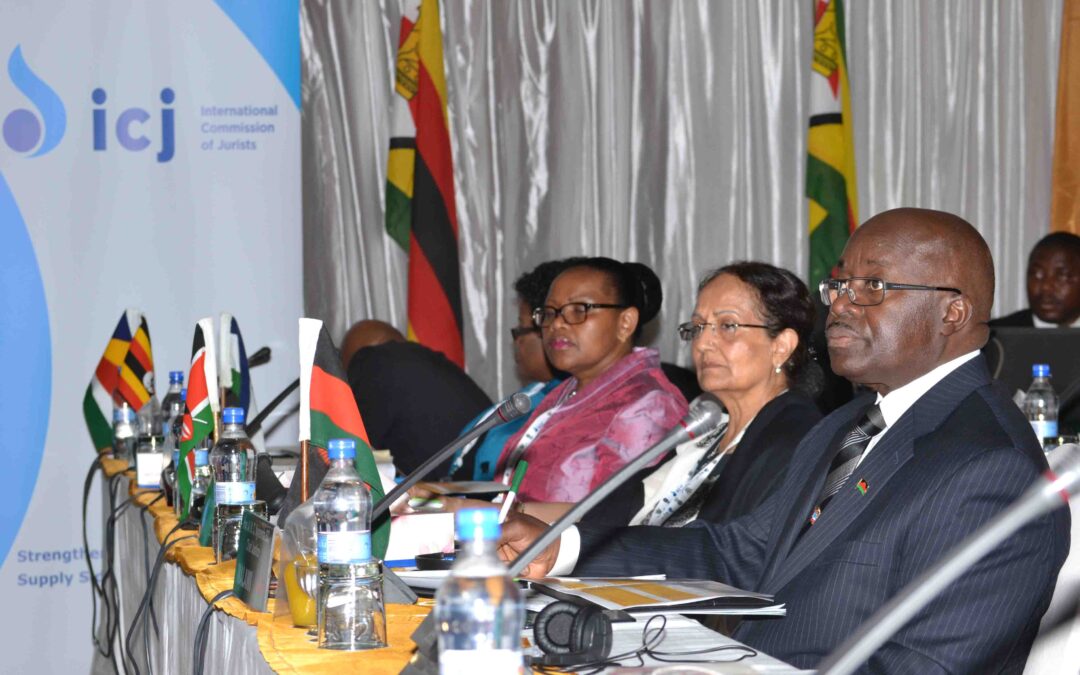
The Africa Regional Programme of the ICJ co-hosted the Southern African Chief Justices’ Forum Annual Conference in Zimbabwe, held on 27-28 August 2015 under the theme “Guaranteeing the Right to a Fair Trial in Africa; Show casing Best Practice”.
The meeting was organized in conjunction with the Southern Africa Chief Justices’ Forum (SACJF) and the Judicial Services Commission (JSC) of Zimbabwe.
This year it congregated 13 Chief Justices and 120 senior judges from East and Southern Africa.
The overall objective of the conference was to provide space for judiciaries in East and Southern Africa region to share achievements, best practices and innovations in justice delivery.
To this end, the conference sought to create a platform for judiciaries that had excelled in a variety of areas to showcase their achievements.
The programme was divided into three sub-themes, all of which had a direct relationship with the underlying theme of Fair Trial Rights in the Region.
The three sub thematic areas discussed were Appointment procedures, Judicial Training and Judicial Reform Each of the sessions was chaired by one of the Chief Justices, whose role it was to moderate the discussions and the speakers.
The panels had a presentation by a chief justice and experiences from another jurisdiction presented by a senior judge.
The presentations were then considered by discussants who were eminent academics.
Download the final declaration here:
Zimbabwe-SACJF ANNUAL CONFERENCE Declaration-Advocacy-2015-ENG (full text in PDF)
Aug 26, 2015
Hoy, la CIJ y la Organización Mundial Contra la Tortura (OMCT) presentaron a un Amicus Curiae ante la Corte Constitucional de Colombia, sobre una reforma constitucional (Acto Legislativo 01 de 25 de junio 2015, “Por el cual se reforma el artículo 221 de la Constitución Política de Colombia”).
Esta reforma constitucional pretende ampliar de forma exhorbitante el ámbito de competencia de la jurisdicción penal militar y niega los principios de complementariedad entre el Derecho internacional de los Derechos Humanos y el Derecho Internacional Humanitario y de la doble protección del ser humano bajo estas dos ramas del Derecho Internacional en las situaciones de conflicto armado.
La reforma constitucional fue demandada ante la Corte Constitucional por la Comisión Colombia de Juristas, varias Organizaciones No Gubernamentales de Derechos Humanos y asociaciones de víctimas de violaciones a los derechos humanos de Colombia.
Colombia-AmicusCuriaeCIJOMCT-Advocacy-Legal submission-2015-SPA (texto íntegro en PDF)
Aug 26, 2015 | Incidencia
Hoy, la CIJ y la Organización Mundial Contra la Tortura (OMCT) presentaron a un Amicus Curiae ante la Corte Constitucional de Colombia, sobre una reforma constitucional (Acto Legislativo 01 de 25 de junio 2015, “Por el cual se reforma el artículo 221 de la Constitución Política de Colombia”).
Esta reforma constitucional pretende ampliar de forma exhorbitante el ámbito de competencia de la jurisdicción penal militar y niega los principios de complementariedad entre el Derecho internacional de los Derechos Humanos y el Derecho Internacional Humanitario y de la doble protección del ser humano bajo estas dos ramas del Derecho Internacional en las situaciones de conflicto armado.
La reforma constitucional fue demandada ante la Corte Constitucional por la Comisión Colombia de Juristas, varias Organizaciones No Gubernamentales de Derechos Humanos y asociaciones de víctimas de violaciones a los derechos humanos de Colombia.
Colombia-AmicusCuriaeCIJOMCT-Advocacy-Legal submission-2015-SPA (texto íntegro en PDF)

Aug 25, 2015
The Maldives government must immediately reverse the politicisation of the country’s judiciary and the erosion of rule of law in the country, said the ICJ and South Asians for Human Rights (SAHR) in a joint fact-finding report released today.
The 35-page report, entitled Justice Adrift: Rule of Law and the Political Crisis in the Maldives highlights the breakdown of the rule of law and human rights protections in the Maldives, exemplified by the arrest and trial of former President Mohamed Nasheed.
Nasheed, who had been under house arrest, was unexpectedly imprisoned again on Monday without a clear legal basis.
The ICJ and SAHR called on the Maldives government to immediately release Nasheed from detention and to ensure he receives necessary medical care and access to his family and lawyers.
A joint delegation of the ICJ and SAHR conducted a fact-finding mission to the Maldives in May 2015 to assess the human rights situation since the current government assumed power in 2013.
“We documented a serious erosion of the independence, impartiality and integrity of the judiciary, which has resulted in the deterioration in the rule of law in the Maldives and the stalling of the country’s transition toward a more representative government,” said Hina Jilani, SAHR Chairperson and a Commissioner of the ICJ.
“This current crisis in the rule of law risks turning the country back to the authoritarian days of the past that it had so promisingly broken away from in 2008,” she added.
After decades of authoritarian rule, in 2008 the Maldives promulgated a new Constitution that established independent democratic institutions, the rule of law, human rights protections and the separation of powers.
The new report documents how the institutional and legal reforms needed to consolidate this democratic transition stalled and have endangered a backslide to the country’s authoritarian legacy.
“The political crisis in the Maldives has hurt the country’s human rights situation, and it can only be resolved with the establishment of credible and impartial institutions in the country, particularly the judiciary,” said Nikhil Narayan, ICJ Senior Legal Adviser for South Asia.
“The Maldives should take immediate steps to establish effective and independent government institutions in compliance with its international human rights obligations under Commonwealth and UN standards on judicial independence and separation of powers,” he added.
Among the specific problems identified in the report are: judicial proceedings against the national human rights commission and other independent institutions, as well as interference in other spheres, in a manner that raises serious concerns as to judicial independence and accountability; judicial conduct in high-profile criminal cases, including former President Mohamed Nasheed, which are grossly unfair and violate international fair trial standards; arbitrary and undue parliamentary interference in independent constitutional institutions; and, instances of serious violations and abuse of fundamental rights of civil society and human rights defenders, among other concerns raised.
“The Maldives must urgently implement the necessary reforms to strengthen judicial independence, the rule of law and human rights in accordance with international standards,” said Jilani.
The Maldives’ human rights record will be discussed at the UN Human Rights Council later next month as part of the Universal Periodic Review (UPR) process.
Member states of the UN have already made a range of recommendations to the Maldives, and can make further statements at the Council session.
The government will be expected formally to respond and indicate which of the recommendations it will commit to implement over the coming years.
The ICJ-SAHR report therefore comes at a timely moment, urging Maldives authorities to strengthen human rights protections, judicial independence and the rule of law, including by accepting and implementing key UPR recommendations as well as prior recommendations by UN Special Rapporteurs who have visited the country, and urging the international community to hold the Maldives to its obligations and commitments.
“The Maldivian government must make good on its assurances to the ICJ-SAHR delegation, the UN Human Rights Council, the UN Special Rapporteur on Independence of Judges and Lawyers and other outside observers of its commitment to the goal of strengthening judicial independence, the rule of law, fundamental rights and separation of powers, by demonstrating real steps to implement the recommendations set out by the delegation,” said Narayan.
Contact:
Nikhil Narayan, ICJ Senior Legal Adviser for South Asia, t: +977 9813187821 ; e: nikhil.narayan(a)icj.org
Deekshya Illangasinghe, Executive Director, SAHR, t: + 941 12695910 ; e: deekshya(a)southasianrights.org
Maldives-Justice-Adrift-Rule of Law-Publications-fact-finding report-2015-ENG (full report in pdf)
Aug 20, 2015
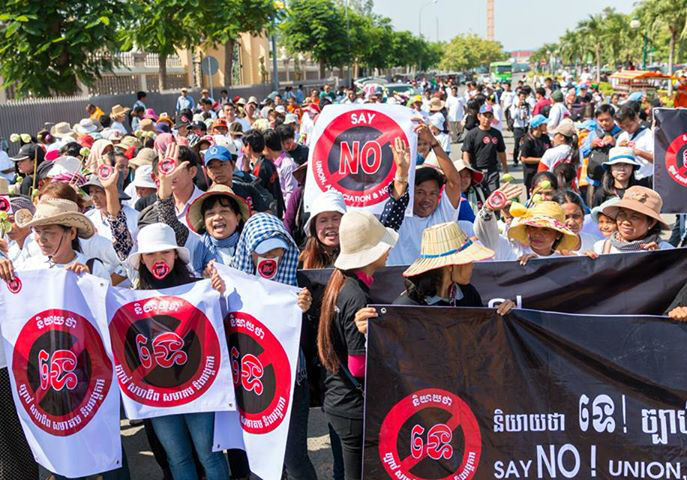
The UN Human Rights Council should pass a resolution that addresses the deteriorating human rights situation in Cambodia, the ICJ and 10 other international and Cambodian human rights groups said in a letter to the Permanent Representatives of Member and Observer States of the HRC.
The letter urges the Member States to support a resolution at the Human Rights Council’s 30th regular session (14 September to 2 October 2015), that:
- Raises substantial issues of concern, including violations of the rights to freedom of peaceful assembly, association and expression; threats to, and attacks against, human rights defenders; the lack of independence of the judiciary; violations of land and housing rights; the erosion of fundamental democratic principles and institutions; and ongoing impunity for perpetrators of human rights violations and abuses;
- Calls on the Cambodian Government to put an end to these serious violations, abide by its domestic and international human rights obligations, and implement key legal and institutional reforms that UN bodies and mechanisms have highlighted as priorities;
- Extends the mandate of the UN Special Rapporteur for a period of at least two years, with monitoring and reporting powers in addition to advisory services;
- Calls on the Cambodian Government to fully cooperate with the current Special Rapporteur, Ms. Rhona Smith, as well as with other UN human rights bodies and mechanisms; and
- Calls on the Cambodian Government to establish a time-bound action plan for the implementation of recommendations made by the Special Rapporteur and by previous mandate holders, as well as by UN bodies and mechanisms, including treaty monitoring bodies, thematic special procedures of the Human Rights Council, and the Universal Periodic Review (UPR).
The letter also requests Members States to express support for the renewal of the mandate of the OHCHR country office in Cambodia, and to underline the importance of the complementarities between the work of the Special Rapporteur and the OHCHR country office.
The letter was signed by the ICJ, International Federation for Human Rights (FIDH), Asian Forum for Human Rights and Development (Forum-Asia), Cambodian Center for Human Rights (CCHR), Cambodian Human Rights and Development Association (ADHOC), Cambodian League for the Promotion and Defense of Human Rights (LICADHO), CIVICUS: World Alliance for Citizen Participation, Civil Rights Defenders, International Service for Human Rights (ISHR), Human Rights Watch, and World Organization Against Torture (OMCT).
Cambodia-HRC-Human rights situation-Advocacy-open letters-2015-ENG (full text in PDF)