Jun 8, 2015
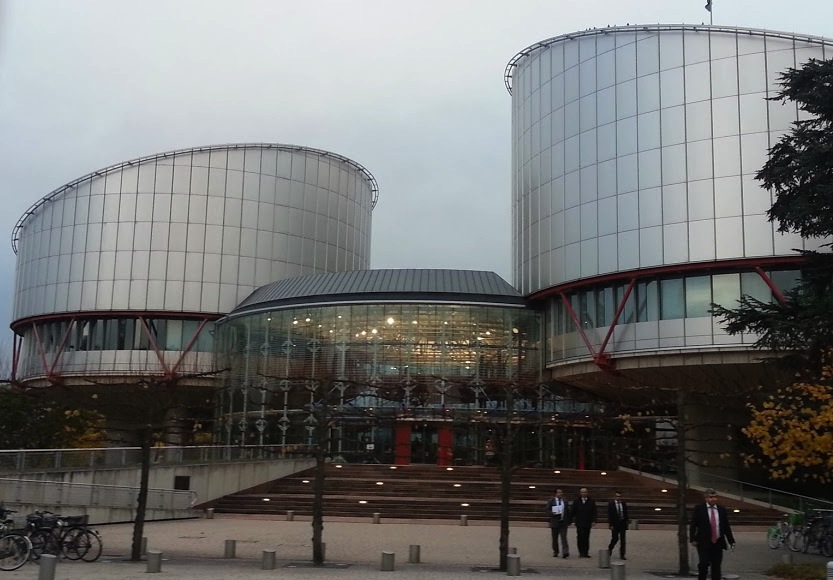
Today, the ICJ jointly with the AIRE Centre and ILGA-Europe submitted written submissions in the case of Klobučar v. Croatia (Application no. 28416/14) before the European Court of Human Rights.
The case, which concerns alleged ill-treatment at the hands of state officials motivated by homophobia, provides the Court with an important opportunity to identify the scope of the State Parties’ procedural obligations under the European Convention on Human Rights in such cases. These include the duty to take all reasonable steps to identify whether there has been any discriminatory motive behind the treatment said to be in violation of the Convention based on animus or prejudice against one’s real or imputed same-sex sexual orientation and/or gender identity or expression.
The submissions focus on:
- The nature and scope of the positive obligations of Contracting Parties under the Convention in respect of allegations disclosing credible evidence of treatment prohibited under Article 3;
- Same-sex sexual orientation and/or gender identity as a ground of discrimination; and
- The duty to take all reasonable steps to identify any discriminatory motive in connection with allegations of ill-treatment.
CROATIA-AMICUS in KLOBUCAR ECtHR-LEGAL SUBMISSION-2015-ENG
Jun 8, 2015 | News
While the constitution of Pakistan’s first National Commission for Human Rights is welcome, the Commission risks being toothless unless its powers are extended to investigate human rights violations allegedly committed by the security agencies, the ICJ warned today.
The ICJ was informed that members of the National Commission for Human Rights were notified on 20 May 2015, three years after the National Commission for Human Rights Act was passed in June 2012.
“The establishment of a national human rights commission is a much-needed step for the promotion and protection of human rights in Pakistan,” said Sam Zarifi, ICJ’s Asia Director. “But for the new Commission to be able to assist the people of Pakistan, who face tremendous violations of their rights in terms of civil, political, social, economic, and cultural rights, it must be able to address the conduct of the country’s powerful military and security agencies.”
Under the National Commission for Human Rights Act, the Commission’s powers include investigating human rights violations, suo motu or on petition; visiting detention centers to ascertain the legality of the detention of detainees and ensure detainees are treated according to law; reviewing and suggesting amendments to Pakistan’s constitutional and legal framework on human rights; making recommendations for the effective implementation of international human rights treaties; and developing a national plan of action for the promotion and protection of human rights.
The law provides that while inquiring into complaints under the Act, the Commission shall have all powers of a civil court, including summoning and ensuring attendance of witnesses, receiving evidence on affidavits; and discovery and production of documents.
However, the Commission’s mandate is very limited where the armed forces or security agencies are accused of committing human rights violations, the ICJ says.
The law specifically states that “the functions of the Commission do not include inquiring into the act or practice of the intelligence agencies”.
Where the armed forces are accused of human rights violations, the Commission is only authorized to seek a report from the Government and make recommendations.
“The Commission’s restricted mandate over the armed forces, and especially the intelligence agencies, is of grave concern given that Pakistan’s military and intelligence services are accused of perpetrating gross human rights violations, including enforced disappearances, extrajudicial killings, and torture and ill-treatment,” Zarifi said. “A human rights commission that does not have jurisdiction over abuses by these actors risks being toothless and ineffective – and worst, a cover for continuing government inaction in response to these violations.”
“With these exceptions in place, it seems questionable that the Commission will get accreditation by the International Coordinating Committee of NHRIs, which is a requirement for a National Human Rights Institution to be recognized internationally,” he added. “The Pakistani government should ensure that the Commission complies with international standards so it can help protect and promote the rights of all people in Pakistan.”
Additional Information:
Justice (r) Ali Nawaz Chohan was appointed as the Chairperson of the Commission. Other members include one representative from each province; one representative each from the Islamabad Capital Territory and the Federally Administered Tribal Areas; the Chairperson of the National Commission on the Status of Women; and a member belonging from a religious minority community.
The UN Principles relating to the Status of National Institutions (Paris Principles) provide the minimum standards required by national human rights institutions to be considered credible and effective, and get accreditation by the International Coordinating Committee of NHRIs. Section 3 (a) (ii) of the Paris Principles states that a NHRI should have the power to hear a matter without higher referral over “any situation of violation of human rights which it decides to take up”.
Section 4 of the National Commission on Human Rights Act, 2012, provides the following procedure for appointment of members of the Commission: the Federal Government invites nominations for commissioners through public notice; the Prime Minister and Leader of the Opposition scrutinize the nominations; and the Prime Minister and Leader of the Opposition forward three names for each member of the commission to a parliamentary committee for confirmation. The law provides that the parliamentary committee would comprise of two members of the National Assembly (lower house) and two members of the Senate (upper house) –with two members each from the government and two from the opposition.
Contact:
Sam Zarifi, ICJ Asia Pacific Regional Director (Bangkok), t: +66 807819002; e: sam.zarifi(a)icj.org
Reema Omer, ICJ International Legal Adviser for South Asia (London), t: +44 7889565691; e: reema.omer(a)icj.org
Jun 5, 2015 | News
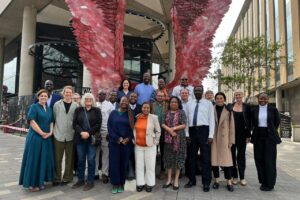
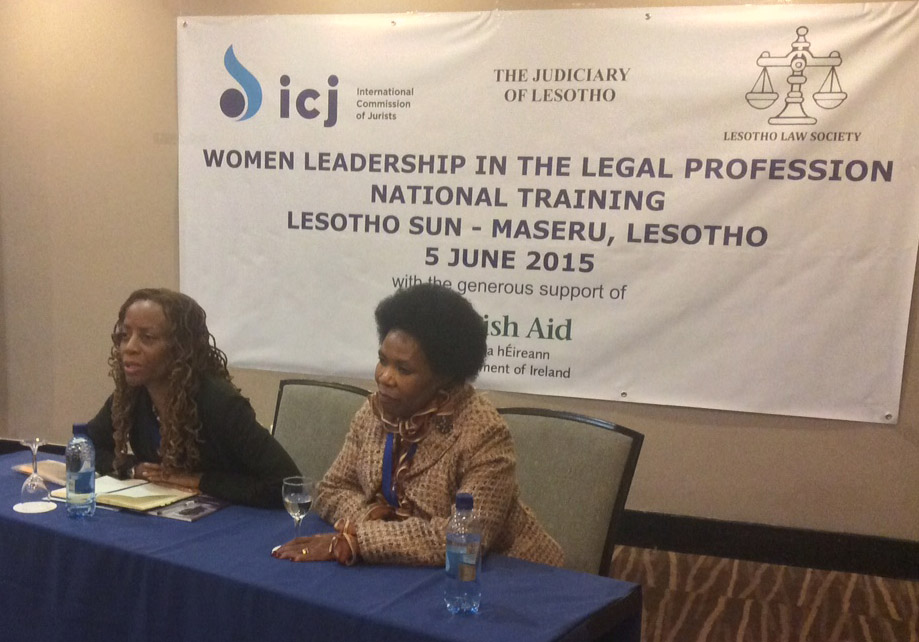
Today, the ICJ convened its training on “Women lawyers making a difference through the Legal Profession” in Maseru. Thirty-five women participated in the event.
In many jurisdictions, men invariably dominate the legal profession and there is a necessity to interrogate the reasons for this.
The advancement of women has not been significant despite the fact that there is equality in numbers in enrolment in law schools.
There have been cited challenges and obstacles that have been raised by women lawyers for this lack of advancement, and these needed to be fully explored in order to adopt concrete recommendations to inform an adequate and effective response to the apparent inequalities.
In order to address this issue within the legal profession in Lesotho, the ICJ collaborated with the Judicial Service Commission and the Lesotho Law Society.
The training brought together 35 women including Chief Justice Majara, Judges, Magistrates, Lawyers and Human Rights Activists from Non-Governmental Organisations.
The main objective of the training was to provide a platform for the participants to engage in robust discussions on the systemic obstacles that affect the ascendancy of women to leadership positions and provide them with an opportunity to introspect and come up with plausible innovative solutions and identify opportunities for change.
Further, the training would address the gender gap in the legal profession and also interrogate possible capacity building initiatives for the participants, which will enable them to effectively advance women’s rights through various advocacy techniques.
In addition, the training also sought to provide an opportunity for the Judicial Service Commission and the Lesotho Law Society for dialogue on improving the situation of women in the legal profession, as well as contributing to the promotion and protection of women’s rights and access to justice.
Jun 5, 2015
On 4 June 2015, the ICJ and other groups made a submission to UN Human Rights Committee in advance of the Committee’s examination of Venezuela’s compliance with its obligations under the International Covenant on Civil and Political Rights.
The submission by the ICJ, the International Bar Association’s Human Rights Institute and the International Association of Judges, ahead of the Committee’s 114th session from 29 June to 24 July 2015, highlights serious concerns regarding violations of the right to life, freedom from torture, freedom of association and the independence of the judiciary and legal profession in the country.
Venezuela-ICJ-IBAHRI-IAJ Informe Alternativo-Advocacy-legal submission-2015-SPA (full text in PDF, Spanish)